EUROPE
5255 articles
USA
0 articles
DIGITAL
22 articles (à imprimer)
Partitions Digitales
Partitions à imprimer
22 partitions trouvées


Piano,Tenor Saxophone - Level 2 - Digital Download SKU: A0.1303419 Composed by Gabriel Faure. Arranged by Harry Walker. 19th Century,Contest,Festival,Romantic Period. Score and part. 8 pages. SCORE EDITIONS #892993. Published by SCORE EDITIONS (A0.1303419). This mélodie is the first in a set of three songs, opus 7, which also comprises Hymne and Barcarolle respectively. All three were composed between 1870 and 1877, then collected and published in 1878 under the title Trois Mélodies. Not originally conceived as a song cycle, these three songs acquired this opus number much later, in the 1890s. The poem for Après un rêve was loosely adapted from an anonymous Italian text by Romain Bussine. It describes, in the form of a dream, the imaginary flight of two lovers who are head over heels in love, although the last verse brings the dreamer inexorably back to harsh reality as dawn is breaking. In this version, the composition was arranged for Tenor Saxophone and Piano by Harry Walker.
Après un rêve (Fauré) for Tenor Saxophone and Piano
Saxophone Tenor et Piano

$5.99 5.21 € Saxophone Tenor et Piano PDF SheetMusicPlus

Piano,Tenor Saxophone - Level 1 - Digital Download SKU: A0.548749 By Cat Stevens. By Cat Stevens. Arranged by James M. Guthrie, ASCAP. Rock. Score and part. 11 pages. Jmsgu3 #3415225. Published by jmsgu3 (A0.548749). Very strong arrangement for Easter. Duration: 2:48. 84 ms. Score: 7 pg. Solo part 1 pg. piano part 3 pg. Morning Has Broken is a popular and well-known Christian hymn first published in 1931. It has words by English author Eleanor Farjeon and was inspired by the village of Alfriston in East Sussex, then set to a traditional Scottish Gaelic tune known as Bunessan [1] (it shares this tune with the 19th century Christmas Carol Child in the Manger[2]). It is often sung in children's services and in Funeral services.[3] English pop musician and folk singer Cat Stevens included a version on his 1971 album Teaser and the Firecat. The song became identified with Stevens due to the popularity of this recording. It reached number six on the U.S. Billboard Hot 100, number one on the U.S. easy listening chartin 1972,[4] and number four on the Canadian RPM Magazine charts. The hymn originally appeared in the second edition of Songs of Praise (published in 1931), to the tune Bunessan, composed in the Scottish Islands. In Songs of Praise Discussed, the editor, Percy Dearmer, explains that as there was need for a hymn to give thanks for each day, English poet and children's author Eleanor Farjeon had been asked to make a poem to fit the lovely Scottish tune. A slight variation on the original hymn, also written by Eleanor Farjeon, can be found in the form of a poem contributed to the anthology Children's Bells, under Farjeon's new title, A Morning Song (For the First Day of Spring), published by Oxford University Press in 1957. The song is noted in 9/4 time but with a 3/4 feel. Bunessan had been found in L. McBean's Songs and Hymns of the Gael, published in 1900.[5] Before Farjeon's words, the tune was used as a Christmas carol, which began Child in the manger, Infant of Mary, translated from the Scottish Gaelic lyrics written by Mary MacDonald. The English-language Roman Catholic hymnal also uses the tune for the James Quinn hymns, Christ Be Beside Me and This Day God Gives Me, both of which were adapted from the traditional Irish hymn St. Patrick's Breastplate. Another Christian hymn, Baptized In Water, borrows the tune. -Wikipedia  
Morning Has Broken
Saxophone Tenor et Piano
Cat Stevens
$47.95 41.74 € Saxophone Tenor et Piano PDF SheetMusicPlus

Piano,Tenor Saxophone - Level 3 - Digital Download SKU: A0.549404 Composed by Carl Bohm. Arranged by James M. Guthrie, ASCAP. Romantic Period,Sacred,Standards,Wedding. Score and part. 12 pages. Jmsgu3 #3493501. Published by jmsgu3 (A0.549404). Duration: ca. 4:00, Score: 7 pages, solo part: 2 page, piano part: 3 pages. A very popular number for weddings, also effective for meditations and recital encores. Carl Bohm Carl Bohm, sometimes spelled with a K as in Karl Bohm, was born in 1844 and died in 1920. Bohm was a German composer, pianist, and songwriter. He was famous for writing songs with a light and optimistic atmosphere. Some of his most famous songs are Calm as the Night, Twilight, May Bells, Enfant Cheri, and The Fountain. In addition to his songs, he was a very popular composer of string quartets and string trios. His music was very popular and profitable. His publisher used some of the profits from sales of Bohm’s work to prepare the works of Johannes Brahms for publication. Output He certainly was prolific, not only with individual compositions but collections and albums of original music, such as the Bohm Album for the Pianoforte. The quality of his melodies is remarkable. They have a familiar quality similar to folk-songs. It’s no wonder they have become so popular.   His greatest masterpiece may well be the famous Calm as the Night as it is so well finished and refined. This song comes to us from a collection known simply as Lieder Op. 326. Calm as the Night (Still wie die Nacht) is listed as Number 27 in the collection. The song is scored for vocal duet and piano. The lyrics for Bohm’s Still wie die Nacht are anonymous. Lyrics: Still wie die Nacht Und tief wie das Meer, Soll deine Liebe sein! Wenn du mich liebst, So wie ich dich, Will ich dein eigen sein. Heiß wie der Stahl Und fest wie der Stein Soll deine Liebe sein! English: As quiet as the night And deep as the sea, Your love should be! If you love me The same as I love you, I want to be yours. As hot as steel And as firm as a rock, Your love should be!
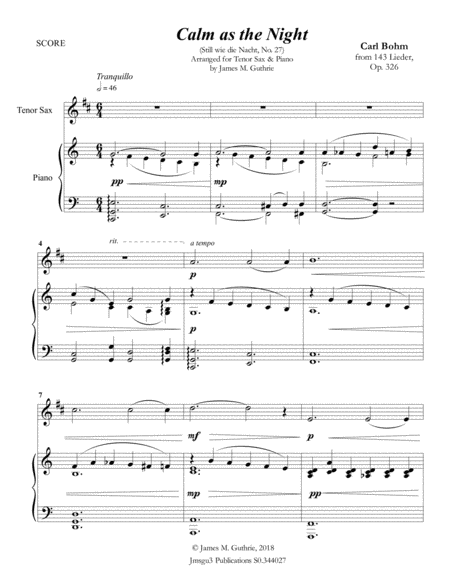
Bohm: Calm as the Night for Tenor Sax & Piano
Saxophone Tenor et Piano

$26.95 23.46 € Saxophone Tenor et Piano PDF SheetMusicPlus

Piano,Tenor Saxophone - Level 3 - Digital Download SKU: A0.550115 Composed by Claude Debussy. Arranged by James M. Guthrie. 20th Century,Holiday,Multicultural,Standards,World. Score and part. 15 pages. Jmsgu3 #4595969. Published by jmsgu3 (A0.550115). Moonlight * лунный Ñвет * 月光 * Σεληνόφωτο * MÄ›síÄní svit, Claude Debussy, 1890. Monumental impressionist masterpiece - perfect for Valentine's Day.Duration ca. 3:50 Score: 8 pages. Debussy was inspired by this poem by Paul Verlaine to compose this work:Your soul is a chosen landscapeWhere charming masquerades and dancers are promenading,Playing the lute and dancing, and almostSad beneath their fantastic disguises.While singing in a minor keyOf victorious love, and the pleasant lifeThey seem not to believe in their own happinessAnd their song blends with the moonlight,With the sad and beautiful moonlight,Which sets the birds in the trees dreaming,And makes the fountains sob with ecstasy,The tall slim water streams among the marble statues.Paul Verlaine, 1869
Debussy: Claire de Lune for Tenor Sax & Piano
Saxophone Tenor et Piano

$32.95 28.68 € Saxophone Tenor et Piano PDF SheetMusicPlus


Partitions Gratuites
Acheter des Partitions Musicales
Acheter des Partitions Digitales à Imprimer
Acheter des Instruments de Musique

© 2000 - 2026

Accueil - Version intégrale





