EUROPE
9 articles
USA
0 articles
DIGITAL
30 articles (à imprimer)
Partitions Digitales
Partitions à imprimer
30 partitions trouvées


Piano,Tenor Saxophone - Level 2 - Digital Download SKU: A0.550935 Composed by J. S. Bach - Gounod. Arranged by James M. Guthrie, ASCAP. Christmas,Concert,Contemporary,Easter,Wedding. Score and part. 12 pages. Jmsgu3 #4888767. Published by jmsgu3 (A0.550935). This arrangement features the controversial Schwencke measure (ms. 27) that was originally introduced in 1783 by Christian Friedrich Gottlieb Schwencke. The convenient 1st & 2nd endings provide an option for extended performance. Duration with repeat - 4:50. Score: 7 pages. Solo part: 1 page, piano part: 4 pages. Based on Prelude #1 in C Major from the Well-Tempered Clavier, Book 1. Well suited for church meditations or school programs or recital encores. Register for free lifetime updates and revisions at www.jamesguthrie.comAve MariaAve Maria is a Catholic prayer that consequently asks for the mother of Jesus (Mary) to intercede. Charles Gounod composed a famous version of the Ave Maria. He was a French Romantic composer who overlaid a new melody on an existing Bach chord progression. The progression is from Bach’s Prelude No. 1 from Well-Tempered Clavier I. This version, as well as Schubert’s version, have become essential items at weddings, masses, and funerals.Bach OverviewFirst of all, Johann Sebastian Bach is maybe the greatest composer in music history. Certainly, he was prolific. As a result, everyone has heard of his works. Furthermore, these works number well over a thousand. It seems like people are probably most familiar with the instrumental works such as the Brandenburg Concertos, and the Goldberg Variations. But, similarly famous are such noteworthy works as the Well-Tempered Clavier, the Musical Offering, and certainly the Art of Fugue. Seems like his most famous vocal works include the most noteworthy Mass in B Minor. Also, most noteworthy, though, are the St. John Passion, and certainly the Christmas Oratorio. HistoryBach came from a long line of musicians and above all, composers. Consequently, he, first of all, pursued a career as a church organist. So as a result, he gained employment in various Protestant churches in Germany. For a while, he worked as a court musician in Weimar and Köthen. Here he probably developed his organ style and likewise his chamber music style. Eventually, he, therefore, gained an appointment as Cantor of St. Thomas in Leipzig. Here he worked until difficulties with his employer ultimately drove him away. The King of Poland finally appointed him as a court composer. StyleIt seems like Bach created a fascinating new international style. He synthesized elements of the most noteworthy European music ideas into his new style. Even more, this new style was probably his synthesis of European musical rhythm and form. Furthermore, he demonstrated a complete mastery of counterpoint and motivic development. His sense of harmonic organization probably propelled him to the top.Revival              Mendelssohn conducted a Bach revival in the nineteenth century. His effort probably helped to re-familiarize the public with the magnitude of Bach’s works. During this period, scholars published many noteworthy Bach biographies. Moreover, Wolfgang Schmieder published the BWV (Bach Werke Verzeichnis). As a result, this is now the official catalog of his entire artistic output. The BWV number allows us to locate a work in the catalog. Sometimes scholars will simply use an S (Schmieder) as an abbreviation for BWV. VoyagerNASA launched two Voyager spacecraft in 1977. Onboard are phonograph records with sounds, music, and images of life on Earth. The purpose of the launch was to inform intelligent extraterrestrial life forms about conditions on Earth. The music on the disc is varied. There is Bach, Mozart, Beethoven and Stravinsky among others. However, because Bach is so important in our music history, it contains three times more Bach that all the others combined.
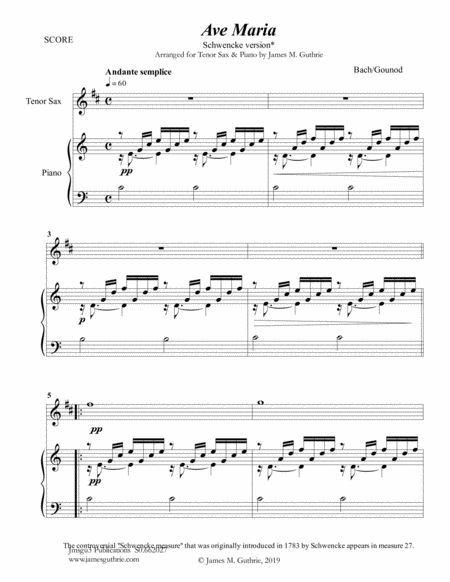
Bach-Gounod: Ave Maria, Schwencke version for Tenor Sax & Piano
Saxophone Tenor et Piano

$27.95 23.88 € Saxophone Tenor et Piano PDF SheetMusicPlus

Piano,Tenor Saxophone - Level 2 - Digital Download SKU: A0.549367 Composed by Bach-Gounod. Arranged by James M. Guthrie, ASCAP. Christmas,Contemporary,Easter,Wedding. Score and part. 12 pages. Jmsgu3 #3490159. Published by jmsgu3 (A0.549367). This arrangement follows the original Bach prelude and so excludes the extra measure that Schwencke introduced in 1783. If you prefer the extra measure, please see Bach-Gounod: Ave Maria, Schwencke version for Tenor Sax & Piano - S0.662027. The convenient 1st & 2nd endings provide an option for extended performance with minimal page turns for the accompanist. The duration with repeat is about 4:50. Score: 6 pages. Solo part: 1 page, piano part: 4 pages. Based on Prelude #1 in C Major from the Well-Tempered Clavier, Book 1. Well suited for church meditations or school programs or recital encores. Ave Maria Ave Maria is a Catholic prayer that consequently asks for the mother of Jesus (Mary) to intercede. Charles Gounod composed a famous version of the Ave Maria. He was a French Romantic composer who overlaid a new melody on an existing Bach chord progression. The progression is from Bach’s Prelude No. 1 from Well-Tempered Clavier I. This version, as well as Schubert’s version, have become essential items at weddings, masses, and funerals. Bach Overview First of all, Johann Sebastian Bach is maybe the greatest composer in music history. Certainly, he was prolific. As a result, everyone has heard of his works. Furthermore, these works number well over a thousand. It seems like people are probably most familiar with instrumental works such as the Brandenburg Concertos, and the Goldberg Variations. But, similarly famous are such noteworthy works as the Well-Tempered Clavier, the Musical Offering, and the Art of Fugue. Seems like his most famous vocal works include the most noteworthy Mass in B Minor. Also, most noteworthy, though, are the St. John Passion, and certainly the Christmas Oratorio.  History Bach came from a long line of musicians and above all, composers. Consequently, he, first of all, pursued a career as a church organist. So as a result, he gained employment in various Protestant churches in Germany. For a while, he worked as a court musician in Weimar and Köthen. Here he probably developed his organ style and likewise his chamber music style. Eventually, he gained an appointment as Cantor of St. Thomas in Leipzig. Here he worked until difficulties with his employer ultimately drove him away. The King of Poland finally appointed him as court composer.  Style It seems like Bach created an engaging new international style. He synthesized elements of the most noteworthy European music ideas into his new style. Even more, this new style was probably his synthesis of European musical rhythm and form. Furthermore, he demonstrated a complete mastery of counterpoint and motivic development. His sense of harmonic organization probably propelled him to the top. Revival               Mendelssohn conducted a Bach revival in the nineteenth century. His effort probably helped to re-familiarize the public with the magnitude of Bach’s works. During this period, scholars published many noteworthy Bach biographies. Moreover, Wolfgang Schmieder published the BWV (Bach Werke Verzeichnis). As a result, this is now the official catalog of his entire artistic output. The BWV number allows us to locate a work in the catalog. Sometimes scholars will simply use an S (Schmieder) as an abbreviation for BWV.  
Bach-Gounod: Ave Maria for Tenor Sax & Piano
Saxophone Tenor et Piano

$32.95 28.15 € Saxophone Tenor et Piano PDF SheetMusicPlus

Piano,Tenor Saxophone - Level 3 - Digital Download SKU: A0.549469 Composed by Alexander Scriabin. Arranged by James M. Guthrie, ASCAP. Concert,Instructional,Romantic Period,Sacred,Standards. Score and part. 12 pages. Jmsgu3 #3499759. Published by jmsgu3 (A0.549469). Score: 8 pages, solo part: 2 pages, piano part: 2 pages. Duration: 3:10. An introspective and meditative work with a lot of dynamic and phrasing nuance. Works well for church meditations or recital encores. Background Op.11/2 Alto Clarinet version. First of all, Scriabin composed mostly for the solo piano and also the orchestra. This is probably because he was a gifted pianist and therefore certainly appreciated the piano. Scriabin grew up in the late Romantic period, consequently, he was fond of the great piano masters of the time. As a result, he wrote his first noteworthy compositions in the manner of Chopin and Liszt. Forms Likewise, Scriabin used many of the same forms as Chopin. These certainly include the étude, prelude, nocturne, and even the mazurka. In contrast, as he developed his own sense of style his music became more and more unusual. So, the last five of his Piano Sonatas do not have a key signature and therefore lean towards atonality. Philosophy Scriabin also developed a keen interest in philosophy and likewise poetry. He was above all particularly fascinated by Nietzsche, Delville, and Blavatsky. Consequently, he finally established his own ideas about metaphysics and certainly mysticism. Scriabin consequently advanced theories about the relationship between color and musical keys. Synesthesia He also may have experienced a condition called synesthesia where he could probably sense a response created from a different stimulus. Therefore, it was almost as if he could see music and hear colors. Scriabin, therefore, arranged the colors in a circle similar to the circle-of-fifths and assigned each key area a color. Finally, he assigned the key of C to the color red, while the key of G was orange. Similarly, he assigned D to yellow, A to green, and so forth. Strangely, he did not differentiate between major and minor key colors.  Multimedia Hence, his ability to translate colors into music certainly gave Scriabin a most noteworthy interest in creating multimedia events. Furthermore, He designed his biggest work, the Mysterium, to last an entire week. Even more, Scriabin made plans not only for music, but also colored lights, incense, and dancing. He designed the performance to occur in the foothills of the Himalaya mountains. The Mysterium was never performed, and only sketches of the work remain. Modern Performances In modern times, we often experience performances of Scriabin’s most famous completed works accompanied by colored laser lights and incense. These are the Poem of Ecstasy (completed in 1908) and the Poem of Fire (completed in 1910). The lighting effects for these early performances were accomplished by the clavier à lumiéres. It was a keyboard instrument that projected colored light onto a screen.
Scriabin: Prelude Op. 11 No. 2 for Tenor Sax & Piano
Saxophone Tenor et Piano

$19.95 17.04 € Saxophone Tenor et Piano PDF SheetMusicPlus

Piano,Tenor Saxophone - Level 4 - Digital Download SKU: A0.551574 Composed by Johann Sebastian Bach. Arranged by James Guthrie, ASCAP. Baroque,Instructional,Standards,Wedding. Score and part. 22 pages. Jmsgu3 #5317607. Published by jmsgu3 (A0.551574). BACH: Sonata in C Major BWV 1033, Duration: 8:30, Score:13 pages.1. Andante - Presto2. Allegro3. Adagio4. Menuet I.5. Menuet II.Johann Sebastian Bach was a German composer, musician, organist, and harpsichordist in the Baroque period of music. He is considered one of the greatest and most influential composers of his time and of all time, and his works form an essential part of the standard concert repertoire. Bach is credited with being largely responsible for the development of the sonata form in the Baroque era. He created several new forms of writing, such as the sinfonia and the prelude, which became popular in the Baroque. Bach also regularly combined two or three voice parts in the form of canons or fugues. His forms were complex and innovative and helped to establish the sonata as a form of composition. He composed some of the most famous and beautiful sonatas in music history. Bach's influence on the sonata form was massive.
BACH: Sonata in C Major BWV 1033 for Tenor Sax & Piano
Saxophone Tenor et Piano

$32.95 28.15 € Saxophone Tenor et Piano PDF SheetMusicPlus

Small Ensemble Alto Saxophone,Piano,Tenor Saxophone - Level 3 - Digital Download SKU: A0.524289 Composed by C. Austin Miles. Arranged by John A. Dempsey. Christian,Easter,Praise & Worship,Sacred,Traditional. Score and parts. 16 pages. John A. Dempsey #5215731. Published by John A. Dempsey (A0.524289). A trio for alto sax, tenor sax and piano, this arrangement of In the Garden contains touches that give the hymn added sparkle, such as ornamentation, dynamic shading and a bit of variation.  And yet, this classic is still instantly recognizable, an unforgettable combination of serenity and joy that reflects our daily walk with God.  Recommended for traditional church services and other worship events, as a prelude, postlude, an offertory or special music.  Concert Key (Piano): F major.  Alto Sax Key: D major.  Tenor Sax Key: G major.  12 pages of music (that includes separate two-page parts for alto sax and tenor sax).
In the Garden (Trio for Alto Sax, Tenor Sax and Piano)
Saxophone Tenor et Piano

$11.99 10.24 € Saxophone Tenor et Piano PDF SheetMusicPlus

Piano,Tenor Saxophone - Level 3 - Digital Download SKU: A0.524390 Composed by C. Austin Miles. Arranged by John A. Dempsey. Christian,Easter,Praise & Worship,Sacred,Traditional. Score and part. 11 pages. John A. Dempsey #5376693. Published by John A. Dempsey (A0.524390). This duet arrangement for tenor sax and piano contains touches that give the traditional hymn added sparkle, such ornamentation, dynamic shading and a bit of variation in both parts.  And yet, this classic is still instantly recognizable, an unforgettable combination of serenity and joy that reflects our daily walk with God.  Recommended for traditional church services and other worship events, as a prelude, postlude, an offertory or special music.  7 pages of music (that includes a separate two-page tenor sax part).  Concert Key (Piano): F major.  Tenor Sax Key: G major. .
In the Garden (Tenor Sax and Piano)
Saxophone Tenor et Piano

$6.99 5.97 € Saxophone Tenor et Piano PDF SheetMusicPlus

Small Ensemble Flute,Piano,Tenor Saxophone - Level 3 - Digital Download SKU: A0.525084 Composed by Traditional French Christmas Carol. Arranged by John A. Dempsey. Christian,Christmas,Holiday,Sacred,Traditional. Score and parts. 20 pages. John A. Dempsey #6657147. Published by John A. Dempsey (A0.525084). Arranged as a lively trio for flute, tenor sax and piano, this exultant arrangement of a traditional French Christmas carol contains variation in all three parts as well as dynamic shading, embellishments and incidental music by Grieg, all adding to the joyful atmosphere of praise and thanksgiving.  Gloria in excelsis Deo is Latin for Glory to God in the Highest.  Recommended for Christmas plays, pageants and programs, holiday recitals and Christmas concerts as well as traditional Christmas church services and other seasonal worship events.  Suggested worship uses: prelude, postlude, offertory, interlude, Christmas play overture and special music.  Concert Key (Piano): C major.  Flute Key: C major.  Tenor Sax Key: D major.  16 pages of music (that includes separate two-page parts for flute and tenor sax).
Angels We Have Heard on High (Trio for Flute, Tenor Sax and Piano)
Saxophone Tenor et Piano

$11.99 10.24 € Saxophone Tenor et Piano PDF SheetMusicPlus

Small Ensemble Alto Saxophone,Piano,Tenor Saxophone - Level 3 - Digital Download SKU: A0.523544 Composed by C. Austin Miles, Scott Joplin. Arranged by John A. Dempsey. Easter,Praise & Worship,Sacred,Spiritual,Traditional. Score and parts. 18 pages. John A. Dempsey #3533901. Published by John A. Dempsey (A0.523544). In this uplifting trio for alto sax, tenor sax and piano, In the Garden emerges as a jazzy ragtime tune complete with splashes of Maple Leaf Rag, giving the classic hymn a buoyant, lively texture and tempo.  Recommended for traditional church services and other worship events as a prelude, postlude, an offertory or special music.  14 pages of music (that includes separate two-page pullout parts for alto sax and tenor sax).  Concert Key (Piano): C major.  Alto Sax Key: A major.  Tenor Sax Key: D major.  Alto and Tenor Sax Level: Intermediate.  Piano Level: Late Intermediate  .
In the Garden / Maple Leaf Rag (Trio for Alto Sax, Tenor Sax and Piano)
Saxophone Tenor et Piano

$11.99 10.24 € Saxophone Tenor et Piano PDF SheetMusicPlus

Instrumental Duet,Piano Alto Saxophone,Instrumental Duet,Piano,Tenor Saxophone - Level 2 - Digital Download SKU: A0.1169126 Composed by Various. Arranged by B. C. Dockery. Christian,Easter,Holiday,Religious,Sacred. 109 pages. Ben Dockery #769477. Published by Ben Dockery (A0.1169126). These twenty classic Easter hymns have been arranged for alto and tenor sax duet with optional piano accompaniment. Great for preludes, offertories, postludes, recitals, and lessons. Easy enough for early-intermediate students to learn and for more advanced players to sight-read. Includes scores and individual parts.Alleluia! Alleluia! (Ode to Joy) * Are You Washed in the Blood? * At the Cross * Christ Arose (Low in the Grave He Lay) * Christ the Lord is Risen Today * Crown Him With Many Crowns * Down at the Cross * He Lives (I know That My Redeemer Lives!) * I Stand Amazed in the Presence (How Marvelous) * Jesus Paid It All * Jesus Saves * Near the Cross * Nothing But the Blood * O Sacred Head, Now Wounded * O the Blood of Jesus * Tell Me the Story of Jesus * The Old Rugged Cross * There is a Fountain * Were You There * When I Survey the Wondrous Cross.
20 Easter Hymn Duets for Alto & Tenor Sax with Piano: Vols. 1-2
Saxophone Tenor et Piano

$17.99 15.37 € Saxophone Tenor et Piano PDF SheetMusicPlus


Partitions Gratuites
Acheter des Partitions Musicales
Acheter des Partitions Digitales à Imprimer
Acheter des Instruments de Musique

© 2000 - 2026

Accueil - Version intégrale





