EUROPE
0 articles
USA
0 articles
DIGITAL
7 articles (à imprimer)
Partitions Digitales
Partitions à imprimer
7 partitions trouvées


Piano,Tenor Saxophone - Level 2 - Digital Download SKU: A0.550935 Composed by J. S. Bach - Gounod. Arranged by James M. Guthrie, ASCAP. Christmas,Concert,Contemporary,Easter,Wedding. Score and part. 12 pages. Jmsgu3 #4888767. Published by jmsgu3 (A0.550935). This arrangement features the controversial Schwencke measure (ms. 27) that was originally introduced in 1783 by Christian Friedrich Gottlieb Schwencke. The convenient 1st & 2nd endings provide an option for extended performance. Duration with repeat - 4:50. Score: 7 pages. Solo part: 1 page, piano part: 4 pages. Based on Prelude #1 in C Major from the Well-Tempered Clavier, Book 1. Well suited for church meditations or school programs or recital encores. Register for free lifetime updates and revisions at www.jamesguthrie.comAve MariaAve Maria is a Catholic prayer that consequently asks for the mother of Jesus (Mary) to intercede. Charles Gounod composed a famous version of the Ave Maria. He was a French Romantic composer who overlaid a new melody on an existing Bach chord progression. The progression is from Bach’s Prelude No. 1 from Well-Tempered Clavier I. This version, as well as Schubert’s version, have become essential items at weddings, masses, and funerals.Bach OverviewFirst of all, Johann Sebastian Bach is maybe the greatest composer in music history. Certainly, he was prolific. As a result, everyone has heard of his works. Furthermore, these works number well over a thousand. It seems like people are probably most familiar with the instrumental works such as the Brandenburg Concertos, and the Goldberg Variations. But, similarly famous are such noteworthy works as the Well-Tempered Clavier, the Musical Offering, and certainly the Art of Fugue. Seems like his most famous vocal works include the most noteworthy Mass in B Minor. Also, most noteworthy, though, are the St. John Passion, and certainly the Christmas Oratorio. HistoryBach came from a long line of musicians and above all, composers. Consequently, he, first of all, pursued a career as a church organist. So as a result, he gained employment in various Protestant churches in Germany. For a while, he worked as a court musician in Weimar and Köthen. Here he probably developed his organ style and likewise his chamber music style. Eventually, he, therefore, gained an appointment as Cantor of St. Thomas in Leipzig. Here he worked until difficulties with his employer ultimately drove him away. The King of Poland finally appointed him as a court composer. StyleIt seems like Bach created a fascinating new international style. He synthesized elements of the most noteworthy European music ideas into his new style. Even more, this new style was probably his synthesis of European musical rhythm and form. Furthermore, he demonstrated a complete mastery of counterpoint and motivic development. His sense of harmonic organization probably propelled him to the top.Revival              Mendelssohn conducted a Bach revival in the nineteenth century. His effort probably helped to re-familiarize the public with the magnitude of Bach’s works. During this period, scholars published many noteworthy Bach biographies. Moreover, Wolfgang Schmieder published the BWV (Bach Werke Verzeichnis). As a result, this is now the official catalog of his entire artistic output. The BWV number allows us to locate a work in the catalog. Sometimes scholars will simply use an S (Schmieder) as an abbreviation for BWV. VoyagerNASA launched two Voyager spacecraft in 1977. Onboard are phonograph records with sounds, music, and images of life on Earth. The purpose of the launch was to inform intelligent extraterrestrial life forms about conditions on Earth. The music on the disc is varied. There is Bach, Mozart, Beethoven and Stravinsky among others. However, because Bach is so important in our music history, it contains three times more Bach that all the others combined.
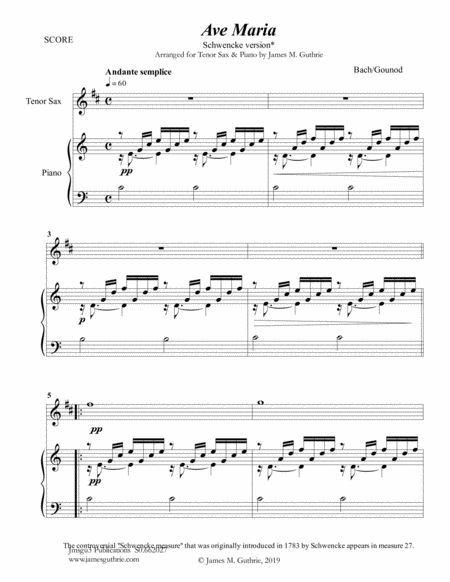
Bach-Gounod: Ave Maria, Schwencke version for Tenor Sax & Piano
Saxophone Tenor et Piano

$27.95 24.19 € Saxophone Tenor et Piano PDF SheetMusicPlus

Piano,Tenor Saxophone - Level 2 - Digital Download SKU: A0.549236 Composed by Johann Sebastian Bach. Arranged by James M. Guthrie, ASCAP. Baroque,Easter,Standards,Wedding. Score and part. 8 pages. Jmsgu3 #3468806. Published by jmsgu3 (A0.549236). J. S. Bach BWV 508. Bist du bei mir Bach adapted this aria from a lost Stölzel opera called Diomedes. He changed the original orchestral instrumentation to soprano, strings, and continuo.  He also modified the voice-leading making it sound more like a Bach composition. The work appears as BWV 508 No. 25 in the Anna Magdalena Notebook No. 2.   Source Only a few remnants of the original opera have survived. Historians speculate that Anna Magdalena got the song from the Leipzig Opera after the bankruptcy of 1720. Chances are good, though, that the tune was a favorite of everyone in Leipzig at the time.   Lyrics When thou art near, I go with joyTo death and to my rest.O how joyous would my end be,If your fair hands            Would close my faithful eyes. - Unknown Bach Overview First of all, Johann Sebastian Bach is maybe the greatest composer in music history. Certainly, he was prolific. As a result, everyone has heard of his works. Furthermore, these works number well over a thousand. It seems like people are probably most familiar with instrumental works such as the Brandenburg Concertos, and the Goldberg Variations. But, similarly famous are such noteworthy works as the Well-Tempered Clavier, the Musical Offering, and certainly the Art of Fugue. Seems like his most famous vocal works include the most noteworthy Mass in B Minor. Also, most noteworthy are the St. John Passion, and indeed the Christmas Oratorio.  History Bach came from a long line of musicians and above all, composers. Consequently, he, first of all, pursued a career as a church organist. So as a result, he gained employment in various Protestant churches in Germany. For a while, he worked as a court musician in Weimar and Köthen. Here he probably developed his organ style and likewise his chamber music style. Eventually, he therefore, gained an appointment as Cantor of St. Thomas in Leipzig. Here he worked until difficulties with his employer ultimately drove him away. The King of Poland finally appointed him as court composer.  Style It seems like Bach created a fascinating new international style. He synthesized elements of the most noteworthy European music ideas into his new style. Even more, this new style was probably his synthesis of European musical rhythm and form. Furthermore, he demonstrated a complete mastery of counterpoint and motivic development. His sense of harmonic organization probably propelled him to the top. Revival               Mendelssohn conducted a Bach revival in the nineteenth century. His effort probably helped to re-familiarize the public with the magnitude of Bach’s works. During this period, scholars published many noteworthy Bach biographies. Moreover, Wolfgang Schmieder published the BWV (Bach Werke Verzeichnis). As a result, this is now the official catalog of his entire artistic output. The BWV number allows us to locate a work in the catalog. Sometimes scholars will simply use an S (Schmieder) as an abbreviation for BWV.  Voyager NASA launched two Voyager spacecraft in 1977. Onboard are phonograph records with sounds, music, and images of life on Earth. The purpose of the launch was to inform intelligent extraterrestrial life forms about conditions on Earth. The music on the disc is varied. There is Bach, Mozart, Beethoven, and Stravinsky among others. However, because Bach is so important in our music history, it contains three times more Bach than all the others combined.  
Bach: Bist du bei mir BWV 508 for Tenor Sax & Piano
Saxophone Tenor et Piano

$32.95 28.52 € Saxophone Tenor et Piano PDF SheetMusicPlus

Piano,Tenor Saxophone - Level 3 - Digital Download SKU: A0.548470 Composed by Johann Pachelbel. Arranged by James M. Guthrie, ASCAP. Baroque,Instructional,Standards,Wedding. Score and part. 8 pages. Jmsgu3 #3386301. Published by jmsgu3 (A0.548470). The famous Pachelbel Canon arranged for Tenor Sax & Piano. Great choice for weddings & receptions! Pachelbel's Canon Pachelbel's Canon is, in fact, the traditional title for a composition by the German composer Johann Pachelbel. Other names for the work include namely: Canon and Gigue for 3 violins and basso continuo, Canon and Gigue in D, and of course Canon in D. We do not know when or why in particular it was written. The oldest copy is surprisingly from the 19th century. It is important to realize that it was a common routine for organists to practice improvisation on the chord progression underlying the canon. Pachelbel originally scored the Canon notably for three violins and continuo. He also in fact paired the Canon with a gigue. The movements are homotonal, to clarify, both are in the key of D major. History In due time, Pachelbel's Canon went out of style and remained in virtual oblivion for centuries. The Jean-François Paillard chamber orchestra, however, recorded an arrangement of it in 1968. As a result, it gained approval.  Many ensembles began likewise to record the piece in the 1970s and by the 1980s became ubiquitous as background music. From the 1970s to the early 2000s, pop songs correspondingly used elements of the piece. The chord progression, in particular, was used this way. Also, since the 1980s, it has been not only wildly popular for weddings, but also for funeral ceremonies in the USA and Europe. Pachelbel Background Johann Pachelbel (1653 –1706) was a German composer, as well as an organist. He was furthermore instrumental in bringing the south German organ school to its apex. He wrote a large body of music, both sacred and, equally important, secular. In particular, he uniquely helped develop the chorale prelude and fugue. For this, he has, in fact, earned a rightful place in the company of the most significant composers of the mid-Baroque period. Works Pachelbel's music was certainly popular. With this in mind, he also consequently had many pupils. His music expressly developed into a model for the south German composers. Nowadays, Pachelbel is most famous particularly for the Canon in D, as well as the F minor Chaconne, the Toccata in E minor, and of course the Hexachordum Apollinis, a set of variations for the keyboard. Influences Johann Jakob Froberger and Johann Caspar Kerll were south German composers who significantly influenced Pachelbel. Furthermore, he was especially influenced by Italians such as Frescobaldi and Poglietti. He frequently preferred an articulate, simple contrapuntal style that highlighted clarity. His music is markedly less extravagant and harmonically adventurous than that of Dieterich Buxtehude. However, as a point often overlooked, like Buxtehude, Pachelbel experimented with different instrumental combinations in his chamber music. Legacy All in all, Pachelbel was most famous as a composer for the keyboard. He composed over two hundred pieces specifically for the instrument. Pachelbel was also surprisingly a prolific composer of vocal music. All in all, about a hundred vocal works survive, including 40 or so large-scale works. 
Pachelbel: Canon for Tenor Sax & Piano
Saxophone Tenor et Piano

$32.95 28.52 € Saxophone Tenor et Piano PDF SheetMusicPlus

Piano,Tenor Saxophone - Level 2 - Digital Download SKU: A0.587902 Composed by G F Handel. Arranged by David McKeown. Baroque,Concert,Contemporary,Opera,Standards. Score and part. 5 pages. David McKeown #5042565. Published by David McKeown (A0.587902). Ombra Mai Fù is the beautiful opening aria from Handel’s Opera Serse, (Xerxes). The opera was not well received when it premiered in London in 1736 and sank into immediate obscurity, only to re-emerged as one of Handel’s best-loved works nearly two hundred years later. Ombra Mai Fù is often referred to as Handel’s Largo. In 1906 Ombra Mai Fù gained the distinction of being the first piece of music ever broadcast on radio. This full version of Ombra Mai Fù is arranged as a Solo for Tenor Saxophone and Piano and both parts are reasonably simple; the performance time is around three minutes. The pdf file contains both the piano score and a separate solo part. You can listen to a full performance of this arrangement on Alto Saxophone via the YouTube link above.Musicians at an early intermediate level and above will find Ombra Mai Fù ideal for formal and informal performances, with both the solo and accompaniment enjoying melodic interest. Teachers will enjoy using this arrangement as a fun way to help with developing tone, phrasing and expression. There are many more top quality arrangements and compositions by David McKeown for you to browse at http://www.sheetmusicplus.com/publishers/david-mckeown/6203
Handel's Largo from Xerxes, Ombra Mai Fù, for solo Tenor Saxophone and Piano
Saxophone Tenor et Piano

$4.60 3.98 € Saxophone Tenor et Piano PDF SheetMusicPlus

Piano,Tenor Saxophone - Level 3 - Digital Download SKU: A0.587681 Composed by Peter Ilyich Tchaikovsky. Arranged by David McKeown. Children,Concert,Instructional,Romantic Period,Standards. Score and part. 9 pages. David McKeown #4737749. Published by David McKeown (A0.587681). Swan Lake, is the first ballet of three composed by Pyotr Tchaikovsky. Here, the famous main theme is arranged for Solo Tenor Saxophone and Piano, directly from the orchestral score. The first performance of the ballet in Moscow in 1877 was not well received. The production was fraught with disagreements between choreographer and composer; the Russian audience were suspicious of the story’s Germanic origins and the music was regarded as too complex for ballet. Tchaikovsky did not live to see a triumphant revival production in 1895 that confirmed Swan Lake as one of the greatest ballet scores of all. Included in the single download are six pages of piano score and a separate two-page part for the solo instrument. The short sample here and the full length version on the youtube link are from the Clarinet version of this arrangement.Musicians at an intermediate level and above will find this ideal for formal and informal performances. The melody is expressive and legato; the accompaniment is challenging in parts, with tremolos and rich chords. Both parts require dramatic dynamic contrasts and the solo part explores a wide range of the instrument. The overall performance time is around two and a half minutes.There are many more top quality arrangements and compositions by David McKeown for you to browse at http://www.sheetmusicplus.com/publishers/david-mckeown/6203 
Swan Lake Theme, for Solo Tenor Saxophone and Piano
Saxophone Tenor et Piano

$4.60 3.98 € Saxophone Tenor et Piano PDF SheetMusicPlus

Piano,Tenor Saxophone - Level 2 - Digital Download SKU: A0.587927 Composed by G F Handel. Arranged by David McKeown. Baroque,Concert,Opera,Standards. Score and part. 4 pages. David McKeown #5044841. Published by David McKeown (A0.587927). Lascia ch’io Pianga is a beautiful aria from Handel’s Opera Rinaldo The opera premiered in London in 1711 and during his lifetime was the most successful of Handel’s operas. However, following his death there were no further productions until a school in London revived it in 1933. Handel used the melody of Lascia ch’io Pianga in two other works, but it is the version from Rinaldo that has achieved a deserved place in the concert hall, and a starring role in films like Farinelli.This version of Lascia ch’io Pianga is arranged as a Solo for Tenor Saxophone and Piano and both parts are reasonably simple; the performance time is around three and a half minutes. The pdf file contains both the piano score and a separate solo part. You can listen to a full performance of this arrangement on Alto Saxophone via the YouTube link above.Musicians at an early intermediate level and above will find Lascia ch’io Pianga ideal for formal and informal performances, with both the solo and accompaniment enjoying melodic interest. Teachers will enjoy using this arrangement as a fun way to help with developing tone, phrasing and expression. There are many more top quality arrangements and compositions by David McKeown for you to browse at http://www.sheetmusicplus.com/publishers/david-mckeown/6203 
Lascia Ch'io Pianga, Aria from Rinaldo, by G F Handel, for Tenor Saxophone and Piano
Saxophone Tenor et Piano

$4.60 3.98 € Saxophone Tenor et Piano PDF SheetMusicPlus

Piano,Tenor Saxophone - Level 1 - Digital Download SKU: A0.1203649 Composed by Anon. Arranged by Phil Beaman. Children,Classical,Folk,Instructional,Traditional. Score and part. 4 pages. Phil Beaman #802224. Published by Phil Beaman (A0.1203649). You have just learned how to finger and play the first three notes on your instrument.  Now it is time for your first easy piece for performance!  My booklet  First Three Notes contains my arrangements of two well known tunes, Three Blind Mice and Mary Had a Little Lamb.  Prepared for the earliest beginners, it uses only the first three notes you learned on your instrument, and also uses only crotchet notes (quarter notes) and crotchet rests (quarter rests).  The piano accompaniment fills it out with simple but richly updated harmony.  4 pages, with cover, scores, parts1:30 minutes, totalAlso available on this site, I have transposed this booklet for most of the traditional instruments that I know.
First Three Notes - Three Blind Mice - Mary Had a Little Lamb - tenor saxophone and piano
Saxophone Tenor et Piano

$2.99 2.59 € Saxophone Tenor et Piano PDF SheetMusicPlus


Partitions Gratuites
Acheter des Partitions Musicales
Acheter des Partitions Digitales à Imprimer
Acheter des Instruments de Musique

© 2000 - 2026

Accueil - Version intégrale





