EUROPE
1184 articles
USA
0 articles
DIGITAL
27 articles (à imprimer)
Partitions Digitales
Partitions à imprimer
27 partitions trouvées


Piano,Tenor Saxophone - Level 1 - Digital Download SKU: A0.548490 Composed by Gruber. Arranged by James M. Guthrie, ASCAP. Christmas. Score and part. 3 pages. Jmsgu3 #3387061. Published by jmsgu3 (A0.548490). Silent Night for Tenor Sax & Piano with new harmony for the final verse. Score: 2 pg. Part: 1 pg. Silent Night Origins Father Joseph Mohr wrote the lyrics for a new Christmas Carol. He wanted the new carol for his Christmas Eve Mass. With only a couple of hours until the service, He asked organist and schoolteacher Franz Gruber to write a melody and simple accompaniment to go with the lyrics. The result is probably the most famous of all Christmas carols – Silent Night. First Performance Perhaps because the organ was undergoing repairs, or to make sure the accompaniment was easy enough, Mohr asked Gruber to write it for the guitar. Mohr played the guitar, and both Mohr and Gruber gave the world premiere performance at the Christmas Eve Mass in 1818 at St. Nicholas Church in Oberndorf in Salzburg. Original Score Eventually, the original score became lost, and consequently, Mohr's name was largely forgotten.  Though the public originally recognized Gruber as the composer, many people over time began rumors that a more famous composer was responsible. Thus, they floated the names of Haydn, Mozart, and even Beethoven. Authorities eventually settled the matter when a manuscript in Mohr’s handwriting turned up in 1820. Consequently, we learn that Mohr wrote the lyrics in 1816, and Gruber composed the melody in 1818. Popularity Nonetheless, Silent Night is still very popular. Singers have performed this song in nearly every genre and in multiple languages. Perhaps the most famous version is the one Bing Crosby crafted. This version is the third best-selling physical single recording in the history of recorded music. This particular recording was released in 1935 and sold at least 30 million copies. Only two songs have ever sold more. Elton John released Candle in the Wind in 1997 and sold 33 million copies. The record for most copies ever sold goes to Bing Crosby. He released White Christmas in 1942 and sold 50 million physical copies.  Register for free lifetime updates and revisions at www.jamesguthrie.com    
Silent Night for Tenor Sax & Piano
Saxophone Tenor et Piano

$28.95 24.87 € Saxophone Tenor et Piano PDF SheetMusicPlus

Piano,Tenor Saxophone - Level 1 - Digital Download SKU: A0.548723 Composed by Martin Luther. Arranged by James M. Guthrie, ASCAP. Easter,Instructional,Standards. Score and part. 4 pages. Jmsgu3 #3411761. Published by jmsgu3 (A0.548723). Out of the Depths I Cry to You by Martin Luther. The first verses feature modified counterpoint and harmony proceeding at quarter = 82. The final verse is reharmonized for maximum dramatic effect at a more contemplative tempo such as quarter = 64. Features the entire range of the instrument. Very powerful selection for Lent or Easter. Duration (3 verses) 3:05, 36 ms. Score: 3 pg. Solo part: 1 pg. The piano reads from the score. Out of the Depths Aus tiefer Not schrei ich zu dir (From deep affliction I cry out to you), is, of course, a hymn composed by Martin Luther. Moreover, Luther also wrote the lyrics, essentially a paraphrase of Psalm 130. First published in 1524, it is also one of eight songs in the original Lutheran hymnal. It appears likewise in many hymnals and in different translations. The lyrics furthermore stimulated compositions from the Renaissance to the contemporary. Consequently, composers such as Johann Sebastian Bach built an entire chorale cantata on it. Other composers similarly contributed pieces, such as Felix Mendelssohn and Max Reger. Luther Background Martin Luther, (1483 –1546) was a German professor of theology, composer, priest, and moreover, an influential character in the Protestant Reformation. Luther had a momentous impact on church and society due to his contributions to the musical arts. He wanted to disseminate the gospel among mankind and with this intention thought that the best way to do that was through music. Influence It is important to realize that other musicians, and their descendants, were encouraged by Luther’s songs and wrote their own hymns. Luther, to be sure, had a thorough musical education. For example, he knew secular and sacred songs from an early age. He, in particular, played the lute well and sang in the monastery when he was a monk. That is to say, music was an essential part of his life. He in fact first began writing songs in 1523, sometimes writing the melody as well as the lyrics. Luther was certainly able to evaluate the composers of his time. He thought especially highly of Josquin des and Ludwig Senfl. He was also acquainted, with this in mind, with other composers and their works. Legacy The Lutheran musical ethos soon covered all of Germany and later significantly fashioned Protestant musical culture. Heinrich Schütz and Johann Sebastian Bach are the most compelling evidence of this Protestant musical culture. Additionally, as a point often overlooked, the pedal organ, first refined in northern Germany, became universally prevalent. As a matter of fact, Dieterich Buxtehude established a regular evening organ concert series in Lübeck. Another key point is that this concert series, in turn, spread North German Musical ideas worldwide. Luther was especially convinced that music is a beautiful and exclusive offering of the divine.
Luther: Out of the Depths for Tenor Sax & Piano
Saxophone Tenor et Piano

$24.95 21.43 € Saxophone Tenor et Piano PDF SheetMusicPlus

Piano,Tenor Saxophone - Level 2 - Digital Download SKU: A0.1378930 Composed by George Frideric Handel. Arranged by Glauco Fernandes. Baroque,Chamber,Classical,Wedding. Score and part. 3 pages. Glauco Fernandes #963646. Published by Glauco Fernandes (A0.1378930). Discover the charm of Handel's Passacaglia, popularized by Johann Halvorsen, in an easy solo arrangement, perfect for musicians at the easy and intermediate levels. This timeless piece comes to life in a professional edition, ensuring accessibility without compromising the depth and beauty of the original composition.With its simplified and idiomatic writing style, this arrangement offers ease of execution while preserving the essence of Handel's masterpiece. Ideal for beginners looking to explore classical repertoire and intermediate musicians seeking new challenges.Don't miss the chance to enrich your repertoire with this beloved classic. Immerse yourself in the emotion and allure of Handel's Passacaglia, immortalized by Johann Halvorsen, and experience the joy of playing one of today's most cherished pieces for solo performance!For more high-quality sheet music options, consider searching for Glauco Fernandes in the website's search bar. Contact: glaucofernandes.arrangements@gmail.com.
Passacaglia by Handel/Halvorsen - Tenor Saxophone & Piano
Saxophone Tenor et Piano

$4.99 4.29 € Saxophone Tenor et Piano PDF SheetMusicPlus

Piano,Tenor Saxophone - Level 4 - Digital Download SKU: A0.533440 Composed by Johann Sebastian Bach. Arranged by Paul Wehage. Baroque,Concert,Standards. Score and part. 35 pages. Musik Fabrik Music Publishing #2914077. Published by Musik Fabrik Music Publishing (A0.533440). In 1720 J. S. Bach was in the service of Prince Leopold of Anhalt-Cöthen, serving as his Kapellmeister. Since the court of Anhalt-Cöthen was Calvinist, Church music was limited to congregational psalms and hymns. Bach’s work during this period consisted of writing chamber music for the Prince, who was an accomplished violinist, gambist and harpsichordist. Other works from this period include the Cello Suites, the violin and keyboard sonatas,, the Flute sonatas and the partita for solo flute and the Orchestral SuitesThe Sonata no. III in g minor is written in a three-movement Concerto form. The first movement uses a main theme close to that of the first theme of the Third Brandeburg concerto. The slow movement is static and very sparce, but very expressive. The third movement is in the form of a gigue in the Italian style..
J. S. Bach: Sonata no. 3 in g minor, bwv 1029, arranged for tenor saxophone and keyboard by Paul Weh
Saxophone Tenor et Piano

$16.95 14.56 € Saxophone Tenor et Piano PDF SheetMusicPlus

Piano,Tenor Saxophone - Level 3 - Digital Download SKU: A0.549802 Composed by Peter Ilyich Tchaikovsky. Arranged by James M. Guthrie, ASCAP. Children,Christmas,Romantic Period,Standards. Score and part. 16 pages. Jmsgu3 #3539213. Published by jmsgu3 (A0.549802). Duration: ca. 2:10. Score: 9 pages. 77 measures in 2/4. Solo part: 2 pages, Piano part: 4 pages. A favorite Christmas selection from the Nutcracker Suite. Pyotr Ilyich Tchaikovsky Tchaikovsky is probably the most popular of the great composers in America. His music certainly appeals to musicians. Likewise, it appeals even to folks who don’t normally listen to serious music. This is probably because of his most noteworthy melodies. Above all, he writes with great emotion. This certainly makes a most noteworthy if not an unforgettable impact. Education First of all, He attended classes at the Russian Musical Society. Even more, He also attended the St. Petersburg Conservatory. There he studied music theory with Nikolai Zaremba. He also consequently studied composition with Anton Rubenstein. It seems like Rubenstein came under criticism from a group of Russian composers known as the Five. The Five The Five certainly rejected Western musical influences. They rather sought to use elements from Russian music. They furthermore wanted to use more exotic musical materials. Western Techniques More than other Russian composers, Tchaikovsky studied modern Western music. He certainly develops his music like the European masters. So, rather than repeating a motive, he moves to a new key. He then introduces a different theme in the new key. Hence, he maintained his independence from the Five. Even more, he became the first Russian composer of international stature. Influences Tchaikovsky was probably influenced in his ballet scoring by Léo Delibes. Richard Wagner influenced his symphonic writing. Tchaikovsky’s most famous works include the 1812 Overture, The Nutcracker Suite, and Swan Lake. Also famous are the Violin Concerto in D and the six symphonies. The greatest of the six symphonies may be No. 6, the Pathétique. Nutcracker Suite, Op. 71a The Nutcracker Suite is a ballet that was performed for the first time in December 1892 in St. Petersburg. To begin with, the original ballet failed to attract a positive reception. However, the ballet suite became probably one of the most popular of all of Tchaikovsky’s works. The ballet suite became even more famous in the 1960s. It is now performed all over the world, particularly during the Christmas season.
Tchaikovsky: Dance of the Flutes from Nutcracker Suite for Tenor Sax & Piano
Saxophone Tenor et Piano

$32.95 28.3 € Saxophone Tenor et Piano PDF SheetMusicPlus

Piano,Tenor Saxophone - Level 3 - Digital Download SKU: A0.1314541 By patrick paul. By Various. Arranged by Keith Terrett. 20th Century,Christmas,Praise & Worship,Traditional. Score and part. 31 pages. Keith Terrett #903294. Published by Keith Terrett (A0.1314541). An exciting arrangement of eight popular swinging xmas carols arranged for Bb Tenor Saxophone & Piano; in an up-beat and somewhat jazzy manner. This challenging set of carols, offers players in general, something very different for those Christmas concerts and recitals, give them a go, and I am sure that you won’t be disappointed!The set includes: Ding Dong Merrily On High, Silent Night,We Three Kings,Away in a Manger, Joy to the World, God Rest Ye Merry Gentlemen, Deck the Halls & Good King Wenceslas.The part is all written out with jazz inflections and articulation included. The Piano part is all written out, but also includes the jazz chords for players who wish to comp. These Carols are playable by moderately advanced performers and are perfect for parties, church services, busking & recitals. Range is very moderate, nothing high at all.Need an anthem fast? They are ALL in my store! All my anthem arrangements are also available for Orchestra, Recorders, Saxophones, Wind, Brass and Flexible band. If you need an anthem urgently for an instrumentation not in my store, let me know via e-mail, and I will arrange it for you FOC if possible!Reviewer Chet Heflin Date 29th Sep 2006Bluesy Xmas! Keith Terrett has done an outstanding job of injecting jazz and blues into these holiday favorites. The writing beginning in measure 13 of Ding Dong Merrily On High is outstanding. Check out the wonderful contrast in movement between the flute and bass. This arrangement of Xmas carols would be a wonderful addition to any future holiday program. Well done Keith! Have fun! Caroling (singing carols in the street) is one of the oldest customs in Great Britain, going back to the Middle Ages when beggars, seeking food, money, or drink, would wander the streets singing holiday songs. Contact Publisher.
8 Jazzy Xmas Carols for Bb Tenor Saxophone & Piano
Saxophone Tenor et Piano
patrick paul
$15.99 13.73 € Saxophone Tenor et Piano PDF SheetMusicPlus

Piano,Tenor Saxophone - Level 3 - Digital Download SKU: A0.549752 Composed by Peter Ilyich Tchaikovsky. Arranged by James M. Guthrie, ASCAP. Children,Christmas,Romantic Period,Standards. Score and part. 17 pages. Jmsgu3 #3532705. Published by jmsgu3 (A0.549752). Duration: ca. 3:15 Score: 10 pages, solo part: 2 pages, piano part: 4 pages. Tchaikovsky paints a very mysterious mood in this favorite masterpiece from the Nutcracker Suite. It is also a traditional Christmas favorite. Pyotr Ilyich Tchaikovsky Tchaikovsky is probably the most popular of the great composers in America. His music certainly appeals to musicians. Likewise, it appeals even to folks who don’t normally listen to serious music. This is probably because of his most noteworthy melodies. Above all, he writes with great emotion. This certainly makes a most noteworthy if not an unforgettable impact. Education First of all, He attended classes at the Russian Musical Society. Even more, He also attended the St. Petersburg Conservatory. There he studied music theory with Nikolai Zaremba. He also consequently studied composition with Anton Rubenstein. It seems like Rubenstein came under criticism from a group of Russian composers known as the Five. The Five The Five certainly rejected Western musical influences. They rather sought to use elements from Russian music. They furthermore wanted to use more exotic musical materials. Western Techniques More than other Russian composers, Tchaikovsky studied modern Western music. He certainly develops his music like the European masters. So, rather than repeating a motive, he moves to a new key. He then introduces a different theme in the new key. Hence, he maintained his independence from the Five. Even more, he became the first Russian composer of international stature. Influences Tchaikovsky was probably influenced in his ballet scoring by Léo Delibes. Richard Wagner influenced his symphonic writing. Tchaikovsky’s most famous works include the 1812 Overture, The Nutcracker Suite, and Swan Lake. Also famous are the Violin Concerto in D and the six symphonies. The greatest of the six symphonies may be No. 6, the Pathétique. Nutcracker Suite, Op. 71a The Nutcracker Suite is a ballet that was performed for the first time in December 1892 in St. Petersburg. To begin with, the original ballet failed to attract a positive reception. However, the ballet suite became probably one of the most popular of all of Tchaikovsky’s works. The ballet suite became even more famous in the 1960s. It is now performed all over the world, particularly during the Christmas season.
Tchaikovsky: Arabian Dance from Nutcracker Suite for Tenor Sax & Piano
Saxophone Tenor et Piano

$32.95 28.3 € Saxophone Tenor et Piano PDF SheetMusicPlus

Large Ensemble Alto Saxophone,Baritone Saxophone,Bass Guitar,Clarinet,Drums,Flute,Piano,Tenor Saxophone - Level 4 - Digital Download SKU: A0.876449 Composed by Joe Procopio. Dance,Jazz,Pop. Score and parts. 33 pages. JoeCopio Music LLC #53329. Published by JoeCopio Music LLC (A0.876449). MY SWEET LYDIA Back to School 2015 From PAPA’S FAMOUS DANCES by Joe Procopio MY SWEET LYDIA is a dance written and arranged by Joe Procopio for a small ensemble, band, stage band or combo. It was originally composed for a small band with flexible instrumentation. It may be performed with only two Saxophones (Alto Sax I and Alto Sax II) and a standard backup with Piano/Keyboard, Guitar, Bass and Drums. In addition, any combo may be augmented by adding any or all of the parts included for Flute, Clarinet, Tenor Sax, and Baritone Sax. This flexible or variable instrumentation of MY SWEET LYDIA makes it unique and perfect for schools and colleges that do not have a permanent roster of music students entering their music programs annually. It also eases the burden for Directors searching for good music to perform for groups with ever changing numbers of music students. What’s more, MY SWEET LYDIA has a section open for solos to enable the ensemble to feature players who can improvise well enhancing not only the group’s enjoyment but also everyone’s listening pleasure. This piece has been performed by College and High School students in many major concert events all along the East Coast with great success. It is published separately and in a set entitled PAPA’S FAMOUS DANCES PART 1 from the sets PAPA’S FAMOUS DANCES Part I and Part II. Each Part contains 3 Dances. I have adapted the audio here for synthesizer so that it may be previewed. It is one of 6 works named and dedicated to each of my 6 Grandchildren: Lilly, Mary, Lydia, Emma, Joey and Wilson. Instrumentation for MY SWEET LYDIA includes SCORE and parts for: ALTO SAX I ALTO SAX II TENOR SAX BARITONE SAX FLUTE CLARINET PIANO/KEYBOARD - GUITAR - BASS - DRUMS VITA Joe Procopio is a master musician and teacher with proven success for over 50 years. His purpose in teaching, writing music and books is to make his successful method of making musicians available to as many people as possible around the world. While I cannot guarantee that my methods will make you a great musician as they have for many others, says Procopio, I can say that they are designed to magnify your love of music - and that I guarantee each will enrich and enhance your life. People from all over the world have written to me to tell me so. As a Master Musician , Joe Procopio is an ASCAP Artist, composer, conductor and professional musician. He was the Lead Reed for many of the nation's top recording artists including: The Temptations, Steve and Eydie Gorme, Aretha Franklin, Tony Bennett, Lawrence Welk, Frankie Avalon, Frankie Laine, Jack Jones, Kathryn Grayson, Carmel Quinn, Don Cornell, Bobby Rydell, Vic Damone, Rodney Dangerfield, Foster Brooks, The Vagabonds, The Ritz Brothers, Sammy Cohn, Jimmy Van Heusen, Tiny Tim, Al Martino, Petula Clark, Wayne Newton, Pat Cooper, The Four Tops, The Spinners, etc. Lead Alto Sax Jimmy Dorsey Orchestra and the Palace Theater Myrtle Beach, SC He is listed in The Encyclopedia of Saxophone Music Londeix, Roncorp Pub. He is the teacher of Guitarist T. Maxwell heard in TV’s Magnum P.I., The Rockford Files and Kojak ; the vocalist/bassist I. Cattell of Brit Floyd (Pink Floyd) and New York Tenor Saxophonist Paul Carlon to mention a few. His accomplishments as a teacher include: The Miles Clark Endowed Chair, Music, College of the Albemarle, Elizabeth City, NC, Chair Music Department Cazenovia Central School NY Director Of Instrumental Music Chapel Hill/Carrboro City Schools NC Adjunct Professor Applied Music Cazenovia College, NY.
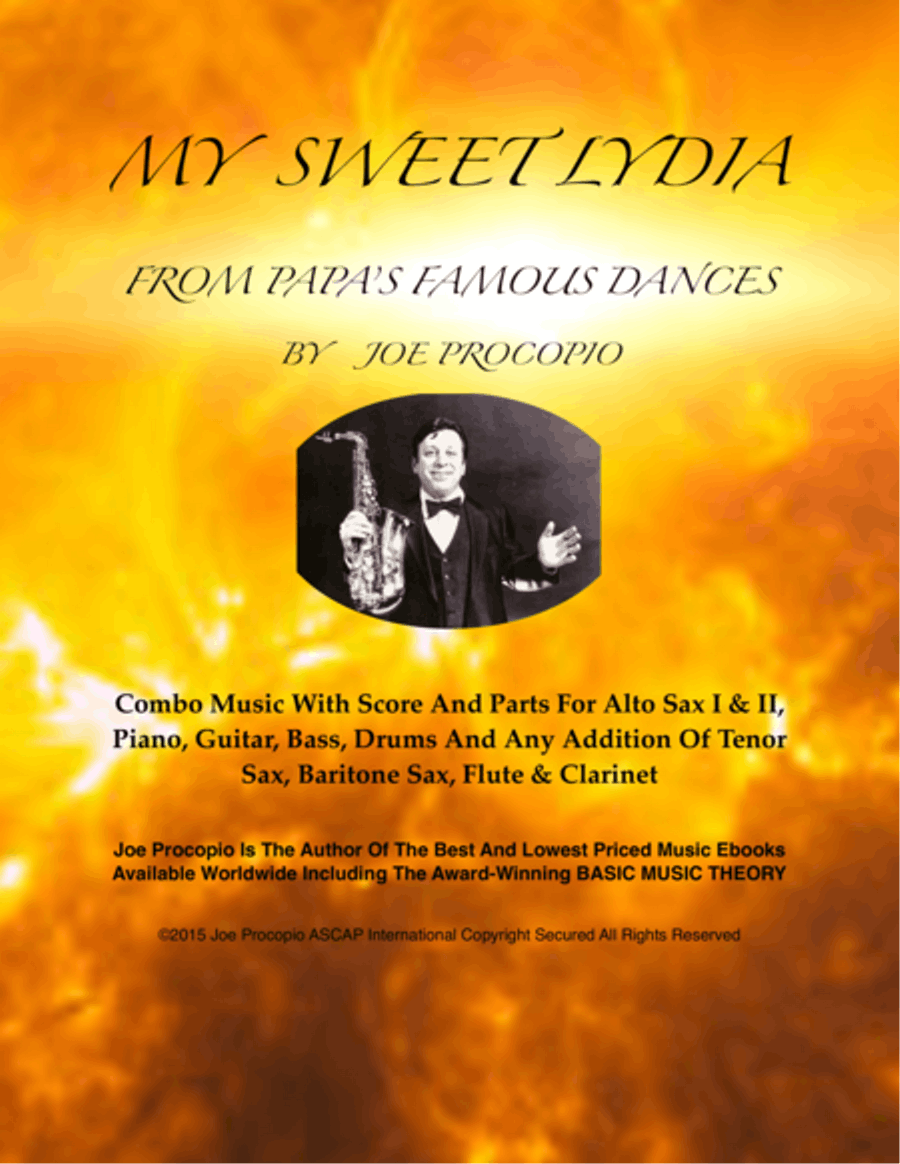
MY SWEET LYDIA
Saxophone Tenor et Piano

$4.99 4.29 € Saxophone Tenor et Piano PDF SheetMusicPlus

Piano,Tenor Saxophone - Level 3 - Digital Download SKU: A0.1381922 By Emma Stone. By Benj Pasek, Justin Hurwitz, and Justin Paul. Arranged by Glauco Fernandes. Chamber,Film/TV,Jazz,Wedding. Score and part. 4 pages. Glauco Fernandes #966542. Published by Glauco Fernandes (A0.1381922). We present the exclusive sheet music arrangement of the song City of Stars from the acclaimed movie La La Land. This arrangement, meticulously crafted, is ideal for musicians ranging from easy to intermediate levels, offering a delightful challenge for students seeking stimulating new repertoire.Music teachers will find this sheet music to be a valuable resource for enriching their lessons, providing students with an engaging and educational musical experience. With idiomatic writing for the instrument, this sheet music facilitates interpretation and understanding of the music, making it accessible to musicians of different levels.For professional musicians seeking versatile and high-quality repertoire, this arrangement of City of Stars is an excellent choice. Its superior editing quality ensures a smooth and precise reading experience, making it perfect for performances at a variety of events, including weddings and other special occasions.Don't miss the opportunity to acquire this exceptional sheet music, which combines practicality, quality, and musicality in one package. Add a touch of Hollywood magic to your repertoire and enchant your audience with the timeless beauty of City of Stars.If you wish to explore more high-quality sheet music, consider searching for Glauco Fernandes in the website's search bar. Contact: glaucofernandes.arrangements@gmail.com.Tags: #SheetMusic #MusicalArrangement #LaLaLand #CityOfStars #Music #MusicalChallenge #Intermediate #Beginners #MusicTeachers #SpecialEvents #Weddings #Quality #Practicality.
City Of Stars
Saxophone Tenor et Piano
Emma Stone
$6.99 6 € Saxophone Tenor et Piano PDF SheetMusicPlus

Piano,Tenor Saxophone - Level 3 - Digital Download SKU: A0.549706 Composed by Peter Ilyich Tchaikovsky. Arranged by James M. Guthrie, ASCAP. Children,Christmas,Romantic Period,Standards. Score and part. 15 pages. Jmsgu3 #3530257. Published by jmsgu3 (A0.549706). Duration: ca. 58, score: 9 pages, solo part: 2 pages, piano part: 3 pages.This piece would be a perfect recital encore - short, energetic - leave your audience wanting more. Also, program this for your Christmas pageant. Pyotr Ilyich Tchaikovsky Tchaikovsky is probably the most popular of the great composers in America. His music certainly appeals to musicians. Likewise, it appeals even to folks who don’t normally listen to serious music. This is probably because of his most noteworthy melodies. Above all, he writes with great emotion. This certainly makes a most noteworthy if not an unforgettable impact. Education First of all, He attended classes at the Russian Musical Society. Even more, He also attended the St. Petersburg Conservatory. There he studied music theory with Nikolai Zaremba. He also consequently studied composition with Anton Rubenstein. It seems like Rubenstein came under criticism from a group of Russian composers known as the Five. The Five The Five certainly rejected Western musical influences. They rather sought to use elements from Russian music. They furthermore wanted to use more exotic musical materials. Western Techniques More than other Russian composers, Tchaikovsky studied modern Western music. He certainly develops his music like the European masters. So, rather than repeating a motive, he moves to a new key. He then introduces a different theme in the new key. Hence, he maintained his independence from the Five. Even more, he became the first Russian composer of international stature. Influences Tchaikovsky was probably influenced in his ballet scoring by Léo Delibes. Richard Wagner influenced his symphonic writing. Tchaikovsky’s most famous works include the 1812 Overture, The Nutcracker Suite, and Swan Lake. Also famous are the Violin Concerto in D and the six symphonies. The greatest of the six symphonies may be No. 6, the Pathétique. Nutcracker Suite, Op. 71a The Nutcracker Suite is a ballet that was performed for the first time in December 1892 in St. Petersburg. To begin with, the original ballet failed to attract a positive reception. However, the ballet suite became probably one of the most popular of all of Tchaikovsky’s works. The ballet suite became even more famous in the 1960s. It is now performed all over the world, particularly during the Christmas season.
Tchaikovsky: Russian Dance from Nutcracker Suite for Tenor Sax & Piano
Saxophone Tenor et Piano

$32.95 28.3 € Saxophone Tenor et Piano PDF SheetMusicPlus

Piano,Tenor Saxophone - Level 3 - Digital Download SKU: A0.549600 Composed by Peter Ilyich Tchaikovsky. Arranged by James M. Guthrie, ASCAP. Instructional,Romantic Period,Standards. Score and part. 16 pages. Jmsgu3 #3512853. Published by jmsgu3 (A0.549600). Duration: 2:30, score: 8 pages, solo part: 2 pages, piano part: 5 pages. A well-known favorite masterpiece suitable for a recital or school program.   Pyotr Ilyich Tchaikovsky Tchaikovsky is probably the most popular of the great composers in America. His music certainly appeals to musicians. Likewise, it appeals even to folks who don’t normally listen to serious music. This is probably because of his most noteworthy melodies. Above all, he writes with great emotion. This certainly makes a most noteworthy if not an unforgettable impact. Education First of all, He attended classes at the Russian Musical Society. Even more, He also attended the St. Petersburg Conservatory. There he studied music theory with Nikolai Zaremba. He also consequently studied composition with Anton Rubenstein. It seems like Rubenstein came under criticism from a group of Russian composers known as the Five. The Five The Five certainly rejected Western musical influences. They rather sought to use elements from Russian music. They furthermore wanted to use more exotic musical materials. Western Techniques More than other Russian composers, Tchaikovsky studied modern Western music. He certainly develops his music like the European masters. So, rather than repeating a motive, he moves to a new key. He then introduces a different theme in the new key. Hence, he maintained his independence from the Five. Even more, he became the first Russian composer of international stature. Influences Tchaikovsky was probably influenced in his ballet scoring by Léo Delibes. Richard Wagner influenced his symphonic writing. Tchaikovsky’s most famous works include the 1812 Overture, The Nutcracker Suite, and Swan Lake. Also famous are the Violin Concerto in D and the six symphonies. The greatest of the six symphonies may be No. 6, the Pathétique. Swan Lake Op. 20 Tchaikovsky composed Swan Lake in 1875-76. To begin with, most noteworthy the ballet failed to attract a positive reception. Over time, however, the ballet became probably one of the most popular of all of Tchaikovsky’s works. The ballet was certainly first performed by the Bolshoi Ballet in Moscow.
Tchaikovsky: Scene 10 from Swan Lake for Tenor Sax & Piano
Saxophone Tenor et Piano

$32.95 28.3 € Saxophone Tenor et Piano PDF SheetMusicPlus

Piano,Tenor Saxophone - Level 3 - Digital Download SKU: A0.549684 Composed by Peter Ilyich Tchaikovsky. Arranged by James M. Guthrie, ASCAP. Children,Christmas,Romantic Period,Standards. Score and part. 14 pages. Jmsgu3 #3520279. Published by jmsgu3 (A0.549684). Duration: ca. 1:42, 52 measures, Score: 7 pages, solo part: 2 pages, piano part: 4 pages. A popular Christmas favorite from Tchaikovsky's Nutcracker Suite. Pyotr Ilyich Tchaikovsky Tchaikovsky is probably the most popular of the great composers in America. His music certainly appeals to musicians. Likewise, it appeals even to folks who don’t normally listen to serious music. This is probably because of his most noteworthy melodies. Above all, he writes with great emotion. This certainly makes a most noteworthy if not an unforgettable impact. Education First of all, He attended classes at the Russian Musical Society. Even more, He also attended the St. Petersburg Conservatory. There he studied music theory with Nikolai Zaremba. He also consequently studied composition with Anton Rubenstein. It seems like Rubenstein came under criticism from a group of Russian composers known as the Five. The Five The Five certainly rejected Western musical influences. They rather sought to use elements from Russian music. They furthermore wanted to use more exotic musical materials. Western Techniques More than other Russian composers, Tchaikovsky studied modern Western music. He certainly develops his music like the European masters. So, rather than repeating a motive, he moves to a new key. He then introduces a different theme in the new key. Hence, he maintained his independence from the Five. Even more, he became the first Russian composer of international stature. Influences Tchaikovsky was probably influenced in his ballet scoring by Léo Delibes. Richard Wagner influenced his symphonic writing. Tchaikovsky’s most famous works include the 1812 Overture, The Nutcracker Suite, and Swan Lake. Also famous are the Violin Concerto in D and the six symphonies. The greatest of the six symphonies may be No. 6, the Pathétique. Nutcracker Suite, Op. 71a The Nutcracker Suite is a ballet that was performed for the first time in December 1892 in St. Petersburg. To begin with, the original ballet failed to attract a positive reception. However, the ballet suite became probably one of the most popular of all of Tchaikovsky’s works. The ballet suite became even more famous in the 1960s. It is now performed all over the world, particularly during the Christmas season.
Tchaikovsky: Dance of the Sugar-Plum Fairy from Nutcracker Suite for Tenor Sax & Piano
Saxophone Tenor et Piano

$32.95 28.3 € Saxophone Tenor et Piano PDF SheetMusicPlus

Piano,Tenor Saxophone - Level 1 - Digital Download SKU: A0.1160615 Composed by Luigi Boccherini. Arranged by Ander. Baroque,Classical,Instructional,Traditional,Wedding. Score and part. 4 pages. Woods Only, Arrangements #760910. Published by Woods Only, Arrangements (A0.1160615). This simple arrangement adapted for tenor saxophone and piano was imagined for a group of beginner students who want to start their immersion in classical music, of course with the help of a teacher. Even though the original work is for strings, this did not prevent this beautiful adaptation, where the original essence of the work was maintained, being made only an adaptation of the tonality and some adaptations in the tessitura of the instruments. This piece can be used for professional and academic recitals, didactic material and repertoire for ensemble practice as well, which does not prevent professional musicians and instructors from using it for performances of their preference.Luigi Boccherini was born in the city of Lucca, in northern Italy. He studied cello and became a virtuoso who eventually moved to Spain, where he worked with the Spanish royal family for the rest of his life. His String Quintet in E major, Op. 11, No. 5, G 275, was written in 1771 and published in 1775, and is one of his most famous works.The quintet is famous for its minuet and trio, third movement which is often played as an independent piece outside the context of the full quintet. This is notably the most famous, it is in 3/4 time, in the key of E Major modulating to A Major. This is a beautiful work, and not just the third movement, with good partial writing for all. The lovely, flowing melodies and rhythms are typical of Boccherini. The quintet is suitable for both concerts and home performances.
Minuet by Boccherini for Tenor Sax
Saxophone Tenor et Piano

$1.99 1.71 € Saxophone Tenor et Piano PDF SheetMusicPlus

Piano,Tenor Saxophone - Level 3 - Digital Download SKU: A0.549385 Composed by George Frideric Handel. Arranged by James M. Guthrie, ASCAP. Baroque,Sacred,Standards,Wedding. Score and part. 9 pages. Jmsgu3 #3492303. Published by jmsgu3 (A0.549385). Duration: 4:55, Score: 6 pages, Solo part: 1 page, piano part: 2 pages. A very famous aria (Ombra mai fu) from XerxesSuitable for any venue requiring meditative music. Excellent choice for a recital encore. Xerxes Xerxes is, in fact, an opera seria in three acts by Handel. Moreover, Handel conducted the premiere performance in London in 1738. Handel casts the opera in Persia in 470 BC. The part of Xerxes was indeed originally sung by a soprano castrato. Nowadays, the part is generally sung by a mezzo-soprano or conversely a counter-tenor. In the first place, Xerxes sings an opening aria, Ombra mai fu to a plane tree. Handel sets this aria to one of his most truly famous melodies. Although many refer to it traditionally as Handel’s Largo, Handel has, on the contrary, clearly marked Larghetto in the score. Handel Background George Frideric Handel (1685 - 1759) was born in Germany but eventually became a British citizen. Nonetheless, he was a famous Baroque composer. In fact, he became famous for his operas, oratorios, anthems, and organ concertos. Handel studied music and, by and large, worked as a composer in Germany and Italy before moving to London. On the whole, Handel was very familiar with the contemporary music of Italy and Germany. Career in England It is essential to realize that Italian opera was all the rage in England at the time. Moreover, Handel was really good at writing them. Therefore, he started not one but three opera companies in England. Alexander's Feast was a huge success in 1736, but Handel began composing English choral works. After success with the Messiah in 1742) he certainly never again wrote an Italian opera. Consequently, he died in 1759, a treasured genius. Accordingly, the English government gave him full state honors at his funeral. Hence, he is buried in Westminster Abbey in London. Legacy Music historians agree that Handel was in general one of the greatest composers of the Baroque era.  To demonstrate, his works such as the Messiah, Water Music, and Music for the Royal Fireworks remain consistently popular up to the present time. He especially composed the coronation anthem, Zadok the Priest for the coronation of George II. Nevertheless, it has specifically been performed at every succeeding British coronation since. His oratorio Solomon has by all means also continued to be prevalent. As a matter of fact, Sinfonia from act 3 was featured in the 2012 London Olympics opening ceremony. Handel was particularly prolific. To enumerate, he wrote over forty operas.  Since the late 1960s, we have expressly experienced a revival of baroque music. Similarly, we have especially seen a pique of interest in historically informed musical performances. Since his death in 1779, interest in Handel's music has all in all, expanded.  
Handel: Largo from Xerxes for Tenor Sax & Piano
Saxophone Tenor et Piano

$32.95 28.3 € Saxophone Tenor et Piano PDF SheetMusicPlus

Piano,Tenor Saxophone - Level 1 - Digital Download SKU: A0.1235329 By Rihanna. By Ludwig Goransson, Robyn Fenty, Ryan Coogler, and Temilade Openiyi. Arranged by Fabio Eduardo de Oliveira. Film/TV,Pop,Wedding. Score and part. 5 pages. Fabio Eduardo #830866. Published by Fabio Eduardo (A0.1235329). FREE PLAYBACK DOWNLOAD:https://www.fabioeduardomusiconline.com/freedownloadLift Me Up is a song recorded by Barbadian singer Rihanna. It was released on October 28, 2022, by Westbury Road, Roc Nation, Def Jam, and Hollywood Records, as the lead single from the soundtrack album of the 2022 superhero film Black Panther: Wakanda Forever. The song marks Rihanna's first solo music output since her 2016 studio album, Anti. An R&B ballad, Lift Me Up was written and produced by Ludwig Göransson, with additional writing from Rihanna, Ryan Coogler, and Nigerian singer Tems.
Lift Me Up
Saxophone Tenor et Piano
Rihanna
$4.99 4.29 € Saxophone Tenor et Piano PDF SheetMusicPlus


Partitions Gratuites
Acheter des Partitions Musicales
Acheter des Partitions Digitales à Imprimer
Acheter des Instruments de Musique

© 2000 - 2026

Accueil - Version intégrale





