EUROPE
8896 articles
USA
0 articles
DIGITAL
20 articles (à imprimer)
Partitions Digitales
Partitions à imprimer
20 partitions trouvées


Piano,Soprano Saxophone - Level 4 - Digital Download SKU: A0.1463923 Composed by Johannes Brahms. Arranged by Glauco Fernandes. Chamber,Classical,Romantic Period,Wedding. Score and part. 7 pages. Glauco Fernandes #1042633. Published by Glauco Fernandes (A0.1463923). Hungarian Dance No. 5 by Johannes Brahms - Exclusive ArrangementAre you passionate about music? We have the perfect offer for you! Presenting the exclusive sheet music arrangement of Hungarian Dance No. 5 by Johannes Brahms.Why choose our arrangement?This arrangement has been carefully crafted to capture the essence and beauty of the original piece, making it accessible for musicians of different levels. Every note is thoughtfully placed to provide the best musical experience.The sheet music is easy to follow, making it ideal for students learning to play, teachers seeking quality educational material, and professionals performing at events, including weddings. With precise instructions, you'll be able to perform the music confidently and effortlessly.Moreover, Hungarian Dance No. 5 is a versatile piece suitable for various occasions, from intimate concerts to larger events. Its captivating melody is sure to enchant any audience.Add Hungarian Dance No. 5 to your repertoire and captivate everyone with this timeless melody. Get your sheet music now!Purchase Sheet MusicTags: Hungarian Dance No. 5, Johannes Brahms, Arrangement, Sheet Music, Music Students, Music Teachers, Wedding Music, Classical Music, Brahms Hungarian Dance, Hungarian Dance Piano Sheet, Hungarian Dance Piano Sheet Music, Hungarian Dance Sheet Music Piano, Hungarian Dance Piano Sheet Music PDF, Classical Dance Music, Hungarian Dance Tutorial, Hungarian Dance Piano, Brahms Dance, Hungarian Dance Piano Solo.
Hungarian Dance No. 5
Saxophone Soprano et Piano

$6.99 6.03 € Saxophone Soprano et Piano PDF SheetMusicPlus

Piano,Soprano Saxophone - Level 4 - Digital Download SKU: A0.1463922 Composed by Johannes Brahms. Arranged by Glauco Fernandes. Chamber,Classical,Romantic Period,Wedding. Score and part. 7 pages. Glauco Fernandes #1042632. Published by Glauco Fernandes (A0.1463922). Hungarian Dance No. 5 by Johannes Brahms - Exclusive ArrangementAre you passionate about music? We have the perfect offer for you! Presenting the exclusive sheet music arrangement of Hungarian Dance No. 5 by Johannes Brahms.Why choose our arrangement?This arrangement has been carefully crafted to capture the essence and beauty of the original piece, making it accessible for musicians of different levels. Every note is thoughtfully placed to provide the best musical experience.The sheet music is easy to follow, making it ideal for students learning to play, teachers seeking quality educational material, and professionals performing at events, including weddings. With precise instructions, you'll be able to perform the music confidently and effortlessly.Moreover, Hungarian Dance No. 5 is a versatile piece suitable for various occasions, from intimate concerts to larger events. Its captivating melody is sure to enchant any audience.Add Hungarian Dance No. 5 to your repertoire and captivate everyone with this timeless melody. Get your sheet music now!Purchase Sheet MusicTags: Hungarian Dance No. 5, Johannes Brahms, Arrangement, Sheet Music, Music Students, Music Teachers, Wedding Music, Classical Music, Brahms Hungarian Dance, Hungarian Dance Piano Sheet, Hungarian Dance Piano Sheet Music, Hungarian Dance Sheet Music Piano, Hungarian Dance Piano Sheet Music PDF, Classical Dance Music, Hungarian Dance Tutorial, Hungarian Dance Piano, Brahms Dance, Hungarian Dance Piano Solo.
Hungarian Dance No. 5
Saxophone Soprano et Piano

$6.99 6.03 € Saxophone Soprano et Piano PDF SheetMusicPlus

Piano,Soprano Saxophone - Level 3 - Digital Download SKU: A0.1401579 Composed by Alexander Scriabin. Arranged by James M. Guthrie. 20th Century,Chamber,Contemporary,Contest,Festival,Historic. Score and part. 7 pages. Jmsgu3 #984760. Published by jmsgu3 (A0.1401579). The historical context of Scriabin's Prelude, Op. 51 No. 2 is rooted in the broader tradition of preludes as improvisatory pieces that precede performances on keyboard instruments. Scriabin's composition, part of his Quatre Morceaux (Four Pieces) Op. 51, published in 1906, reflects his innovative approach to piano music within the musical landscape of the early 20th century. This piece, along with others by Scriabin, demonstrates a blend of traditional influences and his quest to develop a distinctive and original style in his compositions. The meaning behind Scriabin's Prelude, Op. 51 No. 2 is characterized by its emotional depth and expressive qualities, reflecting the composer's unique musical language and style. This piece, along with others by Scriabin, delves into themes of fatigue, exhaustion, eternity, and millions of years, as described by the composer. In this prelude, Scriabin's use of dissonance, tonal centers, and harmonic language conveys a sense of obsessively seeking out pain or grief. The composition captures a range of emotions, from fatigue to a cry in the night, showcasing Scriabin's ability to evoke intense feelings through his music.
Scriabin: Prelude, Op. 51, No. 2, for Soprano Saxophone & Piano
Saxophone Soprano et Piano

$32.95 28.41 € Saxophone Soprano et Piano PDF SheetMusicPlus

Instrumental Duet,Piano Piano,Soprano Saxophone - Level 3 - Digital Download SKU: A0.528916 Composed by Felix Mendelsshon. Arranged by Diego Marani. Classical,Instructional,Romantic Period,Standards. Score and part. 7 pages. Diego Marani #6664381. Published by Diego Marani (A0.528916). Songs Without Words (Lieder ohne Worte) is a series of short lyrical piano songs by the Romantic composer Felix Mendelssohn Bartholdy, written between 1829 and 1845.The works were part of the Romantic tradition of writing short lyrical pieces for the piano, although the specific concept of Songs Without Words was new.This arrangement for soprano sax (or tenor sax) with piano accompaniment faithfully reflects the original for piano solo.
Song Without Words Op. 19 No. 1 for Soprano Saxophone and Piano
Saxophone Soprano et Piano

$8.99 7.75 € Saxophone Soprano et Piano PDF SheetMusicPlus

Piano,Soprano Saxophone - Level 3 - Digital Download SKU: A0.549403 Composed by Carl Bohm. Arranged by James M. Guthrie, ASCAP. Romantic Period,Sacred,Standards,Wedding. Score and part. 7 pages. Jmsgu3 #3493321. Published by jmsgu3 (A0.549403). Duration: ca. 4:00, Score: 7 pages, solo part: 2 page, piano part: 3 pages. A very popular number for weddings, also effective for meditations and recital encores. Carl Bohm Carl Bohm, sometimes spelled with a K as in Karl Bohm, was born in 1844 and died in 1920. Bohm was a German composer, pianist, and songwriter. He was famous for writing songs with a light and optimistic atmosphere. Some of his most famous songs are Calm as the Night, Twilight, May Bells, Enfant Cheri, and The Fountain. In addition to his songs, he was a very popular composer of string quartets and string trios. His music was very popular and profitable. His publisher used some of the profits from sales of Bohm’s work to prepare the works of Johannes Brahms for publication. Output He certainly was prolific, not only with individual compositions but collections and albums of original music, such as the Bohm Album for the Pianoforte. The quality of his melodies is remarkable. They have a familiar quality similar to folk-songs. It’s no wonder they have become so popular.   His greatest masterpiece may well be the famous Calm as the Night as it is so well finished and refined. This song comes to us from a collection known simply as Lieder Op. 326. Calm as the Night (Still wie die Nacht) is listed as Number 27 in the collection. The song is scored for vocal duet and piano. The lyrics for Bohm’s Still wie die Nacht are anonymous. Lyrics: Still wie die Nacht Und tief wie das Meer, Soll deine Liebe sein! Wenn du mich liebst, So wie ich dich, Will ich dein eigen sein. Heiß wie der Stahl Und fest wie der Stein Soll deine Liebe sein! English: As quiet as the night And deep as the sea, Your love should be! If you love me The same as I love you, I want to be yours. As hot as steel And as firm as a rock, Your love should be!
Bohm: Calm as the Night for Soprano Sax & Piano
Saxophone Soprano et Piano

$26.95 23.24 € Saxophone Soprano et Piano PDF SheetMusicPlus

Small Ensemble Accordion,Bass Clarinet,Cello,Percussion,Piano,Soprano Saxophone - Digital Download SKU: A0.799434 Composed by Drake Mabry. 20th Century,Contemporary. Score and parts. 25 pages. Drake Mabry #518831. Published by Drake Mabry (A0.799434). Soleil Luisant was written for the French ensemble 'Aleph' and benefits from the diversity of their instrumentation. Included are the voice, contrabass clarinet, cello, accordion, percussion and piano. The text comes from the 15th century French prince and poet Charles d'Orleans. His life story reads like a soap opera. In three movements, the first line of each poem can be translated as: The weather has left its coat, There is no point in having an unhappy heart and In winter the fire, fire. The score includes written and spatial notation. The last movement is basically a tavern song. The duration is 7'30. This is a manuscript score, thus the reduced price.Soleil Luisant was premiered by the Ensemble Aleph at the Theatre Dunois, Paris, France on December 9, 1996.
Soleil Luisant (score)
Saxophone Soprano et Piano

$9.99 8.62 € Saxophone Soprano et Piano PDF SheetMusicPlus

Piano,Soprano Saxophone - Level 3 - Digital Download SKU: A0.549685 Composed by Tcahikovsky. Arranged by James M. Guthrie, ASCAP. Children,Christmas,Romantic Period,Standards. Score and part. 13 pages. Jmsgu3 #3520287. Published by jmsgu3 (A0.549685). Duration: ca. 1:42, 52 measures, Score: 7 pages, solo part: 2 pages, piano part: 4 pages. A popular Christmas favorite from Tchaikovsky's Nutcracker Suite. Pyotr Ilyich Tchaikovsky Tchaikovsky is probably the most popular of the great composers in America. His music certainly appeals to musicians. Likewise, it appeals even to folks who don’t normally listen to serious music. This is probably because of his most noteworthy melodies. Above all, he writes with great emotion. This certainly makes a most noteworthy if not an unforgettable impact. Education First of all, He attended classes at the Russian Musical Society. Even more, He also attended the St. Petersburg Conservatory. There he studied music theory with Nikolai Zaremba. He also consequently studied composition with Anton Rubenstein. It seems like Rubenstein came under criticism from a group of Russian composers known as the Five. The Five The Five certainly rejected Western musical influences. They rather sought to use elements from Russian music. They furthermore wanted to use more exotic musical materials. Western Techniques More than other Russian composers, Tchaikovsky studied modern Western music. He certainly develops his music like the European masters. So, rather than repeating a motive, he moves to a new key. He then introduces a different theme in the new key. Hence, he maintained his independence from the Five. Even more, he became the first Russian composer of international stature. Influences Tchaikovsky was probably influenced in his ballet scoring by Léo Delibes. Richard Wagner influenced his symphonic writing. Tchaikovsky’s most famous works include the 1812 Overture, The Nutcracker Suite, and Swan Lake. Also famous are the Violin Concerto in D and the six symphonies. The greatest of the six symphonies may be No. 6, the Pathétique. Nutcracker Suite, Op. 71a The Nutcracker Suite is a ballet that was performed for the first time in December 1892 in St. Petersburg. To begin with, the original ballet failed to attract a positive reception. However, the ballet suite became probably one of the most popular of all of Tchaikovsky’s works. The ballet suite became even more famous in the 1960s. It is now performed all over the world, particularly during the Christmas season.
Tchaikovsky: Dance of the Sugar-Plum Fairy from Nutcracker Suite for Soprano Sax & Piano
Saxophone Soprano et Piano

$32.95 28.41 € Saxophone Soprano et Piano PDF SheetMusicPlus

Piano,Soprano Saxophone - Level 2 - Digital Download SKU: A0.549421 Composed by Antonin Dvorak. Arranged by James M. Guthrie, ASCAP. Instructional,Romantic Period,Sacred,Standards. Score and part. 12 pages. Jmsgu3 #3494001. Published by jmsgu3 (A0.549421). Score: 7 pages, solo part: 2 pages, piano part: 3 pages. Duration: 4:25 Not difficult, but requires sensitivity & dynamic control. Suitable for recitals, church meditations, or school programs. Dvořák Background Antonín Dvořák (1841 –1904) was, of course, a composer from Czechoslovakia. As a matter of fact, he was among the first Bohemian composers to attain universal recognition. It is important to realize that the late Romantic Nationalist period featured composers who used traditional and folk elements to portray the character of their nation. In particular, we see this in the music of Grieg (Norway), Finland (Sibelius), and Smetana (Bohemia).  Dvořák relied markedly on rhythms and other characteristics of Moravian and Bohemian folk music. Ascent to Fame Dvořák was truly a child musical prodigy on the violin. The premiere performances of his compositions notably occurred in 1872 and 1873. He submitted his First Symphony in particular to a German competition, but it failed to win. Consequently, in 1874 he presented two more symphonies to the Austrian State Prize for Composition. Johannes Brahms was the principal of the jury and was accordingly very impressed. They forthwith awarded the prize to Dvořák in 1874, 1876, and 1877. At this point, Brahms thereupon endorsed Dvořák to the publisher Simrock. Later, the publisher commissioned Dvořák to compose the Slavonic Dances, Op. 46. These became popular overnight and, as a result, Dvořák's worldwide status was launched. International Status Dvořák visited England upon invitation nine times. On each visit, he frequently conducted performances of his own compositions. He conducted concerts of his music, especially in Moscow and St. Petersburg. Eventually, the Prague Conservatory in fact appointed Dvořák as a professor. There, to be sure, he wrote his famous Dumky Trio. United States Consequently, the National Conservatory of Music of America appointed him as director in 1892. As a result, Dvořák composed his two most famous symphonic works: the Symphony No. 9 (From the New World), which spread his name universally, and his Concerto for Cello and Orchestra, one of the most famous of all cello works. Moreover, he wrote his most celebrated American String Quartet during this time. At the same time, because of his growing recognition in Europe and his homesickness for his own country, he left to return to Bohemia in 1895.
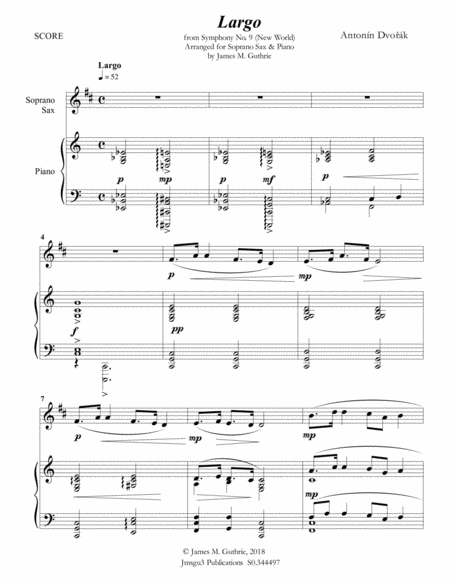
DvoÅ™ák: Largo from the New World Symphony for Soprano Sax & Piano
Saxophone Soprano et Piano

$32.95 28.41 € Saxophone Soprano et Piano PDF SheetMusicPlus

Piano,Soprano Saxophone - Level 3 - Digital Download SKU: A0.549620 Composed by Peter Ilyich Tchaikovsky. Arranged by James M. Guthrie, ASCAP. Children,Christmas,Romantic Period,Standards. Score and part. 24 pages. Jmsgu3 #3515113. Published by jmsgu3 (A0.549620). Duration: ca. 3:20 Score: 13 pages, solo part: 3 pages, piano part: 7 pages, 182 measures in 2/4. Overture in Miniature to Tchaikovsky's Nutcracker Suite. Program for a recital, church meditation, school plays, and Christmas presentations of all kinds. Pyotr Ilyich Tchaikovsky Tchaikovsky is probably the most popular of the great composers in America. His music certainly appeals to musicians. Likewise, it appeals even to folks who don’t normally listen to serious music. This is probably because of his most noteworthy melodies. Above all, he writes with great emotion. This certainly makes a most noteworthy if not an unforgettable impact. Education First of all, He attended classes at the Russian Musical Society. Even more, He also attended the St. Petersburg Conservatory. There he studied music theory with Nikolai Zaremba. He also consequently studied composition with Anton Rubenstein. It seems like Rubenstein came under criticism from a group of Russian composers known as the Five. The Five The Five certainly rejected Western musical influences. They rather sought to use elements from Russian music. They furthermore wanted to use more exotic musical materials. Western Techniques More than other Russian composers, Tchaikovsky studied modern Western music. He certainly develops his music like the European masters. So, rather than repeating a motive, he moves to a new key. He then introduces a different theme in the new key. Hence, he maintained his independence from the Five. Even more, he became the first Russian composer of international stature. Influences Tchaikovsky was probably influenced in his ballet scoring by Léo Delibes. Richard Wagner influenced his symphonic writing. Tchaikovsky’s most famous works include the 1812 Overture, The Nutcracker Suite, and Swan Lake. Also famous are the Violin Concerto in D and the six symphonies. The greatest of the six symphonies may be No. 6, the Pathétique. Nutcracker Suite, Op. 71a The Nutcracker Suite is a ballet that was performed for the first time in December 1892 in St. Petersburg. To begin with, the original ballet failed to attract a positive reception. However, the ballet suite became probably one of the most popular of all of Tchaikovsky’s works. The ballet suite became even more famous in the 1960s. It is now performed all over the world, particularly during the Christmas season.
Tchaikovsky: Overture from Nutcracker Suite for Soprano Sax & Piano
Saxophone Soprano et Piano

$32.95 28.41 € Saxophone Soprano et Piano PDF SheetMusicPlus


Partitions Gratuites
Acheter des Partitions Musicales
Acheter des Partitions Digitales à Imprimer
Acheter des Instruments de Musique

© 2000 - 2026

Accueil - Version intégrale





