EUROPE
25062 articles
USA
0 articles
DIGITAL
200 articles (à imprimer)
Partitions Digitales
Partitions à imprimer
200 partitions trouvées

1 16 31 ....196

Piano,Soprano Saxophone - Level 4 - Digital Download SKU: A0.533351 Composed by Ali Ben Sou Alle. Arranged by Paul Wehage. Concert,Romantic Period,Standards. Score and part. 33 pages. Musik Fabrik Music Publishing #2363197. Published by Musik Fabrik Music Publishing (A0.533351). One of the most enigmatic figures in the history of the Saxophone, Ali Ben Sou Alle (Charles-Valentin Soualle) was born in1820 in Arras, France. After receiving his first prize in Clarinet at the Paris Conservatory in 1844. he served as the director ofmusic of The French Marine Band in Senegal, and then was named first clarinet solo at the Opéra-Comique in Paris. However, after the Revolution of 1848, Soualle was forced to flee France to England where he settled in London, playing in the Orchestra of the Queen's Theatre. His songs and piano pieces were published in London.While in London, Soualle met another exiled French musician, Louis Antoine Jullien, who conducted a light music series inLondon. Jullien encouraged Soualle to take up the saxophone, and after modifying the instrument by adding a single octavemechanism (the modern system used today) and keys for the lower register, Soualle became known as a virtuoso and begantouring performing solo recitals (or mono-concerts, as they were called at the time) calling his modified saxophone the«turcophone ». He performed in all the European capitals and then traveled to Australia, New Zealand, Manilla, Java, throughChina and then to India where he finally settled in Mysore, becoming the director of the Royal Music for the Maharadjah. It wasduring this period that he converted to Islam and changed his nmae to Ali ben Sou Alle (or Ali, son of Soualle). Hesubsequently travaled to Ile Maurice, to French Polynesia, the Cap of Natal and the Cap of Good Hope. All of these voyageswere subjects of musical works which Soualle entitled Souvenirs de... and may perhaps have been part of a collection knownas The Royal Album which was presented to the Prince of Wales after a royal concert. Soualle returned to Mysore in 1858 and was almost killed in the Indian Revolution.Around 1860, Soualle returned to France for health reasons and began publishing his own music. On March 27 1865, heperformed a command performance for the Emperor Napoleon III at the Tuileries Palace in the presence of the entire ImperialFamily. After 1865, nothing more is known about him.Souvenirs du Cap Bonne Espérence (Souvenirs of the Cap of Good Hope) begins with a dramatic aria, perhaps evoking the trip to the Cap which was, in the 19th century, still very dangerous. The Irish folksong « the Irish Emigrant » is presented as a them and in two variations. Finally an extended polka in rondo form finishes the work brilliantly.
Ali Ben Sou Alle: Souvenirs du Cap Bonne Espérence Largo, Variations sur “The Irish Emigrant" et Pol
Saxophone Soprano et Piano

$19.95 17.32 € Saxophone Soprano et Piano PDF SheetMusicPlus

Piano,Soprano Saxophone - Level 3 - Digital Download SKU: A0.549403 Composed by Carl Bohm. Arranged by James M. Guthrie, ASCAP. Romantic Period,Sacred,Standards,Wedding. Score and part. 7 pages. Jmsgu3 #3493321. Published by jmsgu3 (A0.549403). Duration: ca. 4:00, Score: 7 pages, solo part: 2 page, piano part: 3 pages. A very popular number for weddings, also effective for meditations and recital encores. Carl Bohm Carl Bohm, sometimes spelled with a K as in Karl Bohm, was born in 1844 and died in 1920. Bohm was a German composer, pianist, and songwriter. He was famous for writing songs with a light and optimistic atmosphere. Some of his most famous songs are Calm as the Night, Twilight, May Bells, Enfant Cheri, and The Fountain. In addition to his songs, he was a very popular composer of string quartets and string trios. His music was very popular and profitable. His publisher used some of the profits from sales of Bohm’s work to prepare the works of Johannes Brahms for publication. Output He certainly was prolific, not only with individual compositions but collections and albums of original music, such as the Bohm Album for the Pianoforte. The quality of his melodies is remarkable. They have a familiar quality similar to folk-songs. It’s no wonder they have become so popular.   His greatest masterpiece may well be the famous Calm as the Night as it is so well finished and refined. This song comes to us from a collection known simply as Lieder Op. 326. Calm as the Night (Still wie die Nacht) is listed as Number 27 in the collection. The song is scored for vocal duet and piano. The lyrics for Bohm’s Still wie die Nacht are anonymous. Lyrics: Still wie die Nacht Und tief wie das Meer, Soll deine Liebe sein! Wenn du mich liebst, So wie ich dich, Will ich dein eigen sein. Heiß wie der Stahl Und fest wie der Stein Soll deine Liebe sein! English: As quiet as the night And deep as the sea, Your love should be! If you love me The same as I love you, I want to be yours. As hot as steel And as firm as a rock, Your love should be!
Bohm: Calm as the Night for Soprano Sax & Piano
Saxophone Soprano et Piano

$26.95 23.4 € Saxophone Soprano et Piano PDF SheetMusicPlus

Piano,Soprano Saxophone - Level 4 - Digital Download SKU: A0.533501 Composed by Ali Ben Sou Alle. Concert,Romantic Period,Standards. Score and part. 30 pages. Musik Fabrik Music Publishing #3001077. Published by Musik Fabrik Music Publishing (A0.533501). The work is divided into three large sections. An initial introduction and aria leads an Irish ballade The Last Rose of Summer which is then varied. The Valse Brillante which follows is interrupted by a reprise of the ballade before finishing with a brillant coda.One of the most enigmatic figures in the history of Wind Music, Ali Ben Sou Alle (Charles-Valentin Soualle) was born in 1820 in Arras, France. After receiving his first prize in Clarinet at the Paris Conservatory in 1844. he served as the director of music of The French Marine Band in Senegal, and then was named first clarinet solo at the Opéra-Comique in Paris. However, after the Revolution of 1848, Soualle was forced to flee France to England where he settled in London, playing in the Orchestra of the Queen's Theatre. His songs and piano pieces were published in London.While in London, Soualle met another exiled French musician, Louis Antoine Jullien, who conducted a light music series in London. Jullien encouraged Soualle to take up the saxophone, and after modifying the instrument by adding a single octave mechanism (the modern system used today) and keys for the lower register, Soualle became known as a virtuoso and began touring performing solo recitals (or mono-concerts, as they were called at the time) calling his modified saxophone the «turcophone ». He performed in all the European capitals and then traveled to Australia, New Zealand, Manilla, Java, through China and then to India where he finally settled in Mysore, becoming the director of the Royal Music for the Maharadjah. It was during this period that he converted to Islam and changed his nmae to Ali ben Sou Alle (or Ali, son of Soualle). He subsequently travaled to Ile Maurice, to French Polynesia, the Cap of Natal and the Cap of Good Hope. All of these voyages were subjects of musical works which Soualle entitled Souvenirs de... and may perhaps have been part of a collectionknown as The Royal Album which was presented to the Prince of Wales after a royal concert. Soualle returned to Mysore in 1858 and was almost killed in the Indian Revolution.Around 1860, Soualle returned to France for health reasons and began publishing his own music. On March 27 1865, he performed a command performance for the Emperor Napoleon III at the Tuileries Palace in the presence of the entire Imperial Family. After 1865, nothing more is known about him.
Ali Ben Sou Alle: Souvenirs d'Irelande for soprano saxophone and piano
Saxophone Soprano et Piano

$19.95 17.32 € Saxophone Soprano et Piano PDF SheetMusicPlus

Piano,Soprano Saxophone - Level 1 - Digital Download SKU: A0.548720 Composed by Martin Luther. Arranged by James M. Guthrie, ASCAP. Easter,Instructional,Standards. Score and part. 4 pages. Jmsgu3 #3411755. Published by jmsgu3 (A0.548720). Out of the Depths I Cry to You by Martin Luther. The first verses feature modified counterpoint and harmony proceeding at quarter = 82. The final verse is reharmonized for maximum dramatic effect at a more contemplative tempo such as quarter = 64. Features the entire range of the instrument. Very powerful selection for Lent or Easter. Duration (3 verses) 3:05, 36 ms. Score: 3 pg. Solo part: 1 pg. The piano reads from the score. Out of the Depths Aus tiefer Not schrei ich zu dir (From deep affliction I cry out to you), is, of course, a hymn composed by Martin Luther. Moreover, Luther also wrote the lyrics, essentially a paraphrase of Psalm 130. First published in 1524, it is also one of eight songs in the original Lutheran hymnal. It appears likewise in many hymnals and in different translations. The lyrics furthermore stimulated compositions from the Renaissance to the contemporary. Consequently, composers such as Johann Sebastian Bach built an entire chorale cantata on it. Other composers similarly contributed pieces, such as Felix Mendelssohn and Max Reger. Luther Background Martin Luther, (1483 –1546) was a German professor of theology, composer, priest, and moreover, an influential character in the Protestant Reformation. Luther had a momentous impact on church and society due to his contributions to the musical arts. He wanted to disseminate the gospel among mankind and with this intention thought that the best way to do that was through music. Influence It is important to realize that other musicians, and their descendants, were encouraged by Luther’s songs and wrote their own hymns. Luther, to be sure, had a thorough musical education. For example, he knew secular and sacred songs from an early age. He, in particular, played the lute well and sang in the monastery when he was a monk. That is to say, music was an essential part of his life. He in fact first began writing songs in 1523, sometimes writing the melody as well as the lyrics. Luther was certainly able to evaluate the composers of his time. He thought especially highly of Josquin des and Ludwig Senfl. He was also acquainted, with this in mind, with other composers and their works. Legacy The Lutheran musical ethos soon covered all of Germany and later significantly fashioned Protestant musical culture. Heinrich Schütz and Johann Sebastian Bach are the most compelling evidence of this Protestant musical culture. Additionally, as a point often overlooked, the pedal organ, first refined in northern Germany, became universally prevalent. As a matter of fact, Dieterich Buxtehude established a regular evening organ concert series in Lübeck. Another key point is that this concert series, in turn, spread North German Musical ideas worldwide. Luther was especially convinced that music is a beautiful and exclusive offering of the divine.
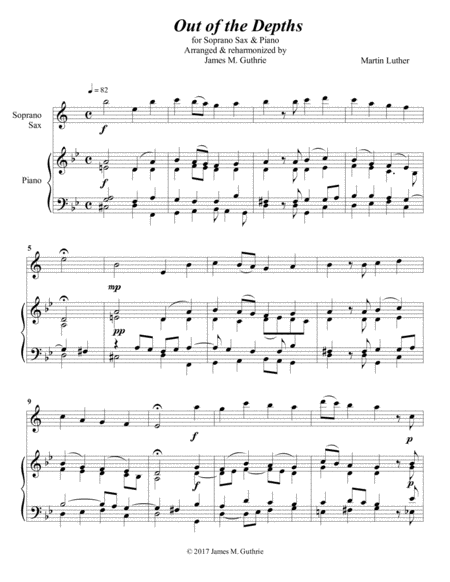
Luther: Out of the Depths for Soprano Sax & Piano
Saxophone Soprano et Piano

$24.95 21.66 € Saxophone Soprano et Piano PDF SheetMusicPlus

Piano,Soprano Saxophone - Level 3 - Digital Download SKU: A0.523887 Composed by Giacomo Puccini. Arranged by John A. Dempsey. Classical,Multicultural,Opera,Romantic Period,Wedding,World. Score and part. 15 pages. John A. Dempsey #4296779. Published by John A. Dempsey (A0.523887). Two Italian masterpieces combined, this duet medley for soprano sax and piano includes melody augmentation, mood shifts, tempo fluctuations, rich dynamic shading and a lavish finale, all built on two of the most beautiful melodies Puccini ever composed.  Included: Un Bel Di (One Fine Day) from Madame Butterfly and Quando M'en Vo (Musetta's Waltz) from La Boheme. Recommended for weddings, as a prelude, unity candle music, or a bridesmaid processional.  Also popular as a soaring, romantic selection for recitals, concerts and more.  11 pages of music (that includes a separate two-page soprano sax part).  Concert Key (Piano): Eb major.  Soprano Sax Part: F major.  Soprano Sax Level: Intermediate.  Piano Level: Late Intermediate.
Puccini Medley: Un Bel Di (Madame Butterfly) and Musetta's Waltz (La Boheme): Soprano Sax and Piano
Saxophone Soprano et Piano

$6.99 6.07 € Saxophone Soprano et Piano PDF SheetMusicPlus

Piano,Soprano Saxophone - Level 4 - Digital Download SKU: A0.1106202 Composed by Scott Joplin. Arranged by David McKeown. 20th Century,Jazz,Ragtime. Score and part. 8 pages. David McKeown #709317. Published by David McKeown (A0.1106202). The Easy Winners was one of many solo piano rags written by Scott Joplin. Published in 1901, It is considered to be one of Joplin’s finest and most adventurous works. Indeed the complex harmony made the first publisher so nervous that he only released a simplified version. The Easy Winners refers to elite athletes who featured on the original title page.  This arrangement of The Easy Winners is arranged as a solo for one Soprano Saxophone with Piano accompaniment. Both the piano and the separate solo part are included in the one downloadable pdf file. Musicians at an intermediate level and above will find this ideal for formal and informal performances. The overall performance time, with repeats, is between four and five minutes. Teachers will enjoy using this arrangement as a fun way to help with phrasing, syncopated rhythms and light articulation.  Click the YouTube link to hear a full performance of the clarinet version of this arrangement. There are many more top quality arrangements and compositions by David McKeown for you to browse at http://www.sheetmusicplus.com/publishers/david-mckeown/6203
The Easy Winners, for Soprano Saxophone and Piano
Saxophone Soprano et Piano

$3.99 3.46 € Saxophone Soprano et Piano PDF SheetMusicPlus

Piano,Soprano Saxophone - Level 4 - Digital Download SKU: A0.533350 Composed by Ali Ben Sou Alle. Arranged by Paul Wehage. Concert,Romantic Period,Standards. Score and part. 39 pages. Musik Fabrik Music Publishing #2348229. Published by Musik Fabrik Music Publishing (A0.533350). One of the most enigmatic figures in the history of the Saxophone, Ali Ben Sou Alle (Charles-Valentin Soualle) was born in1820 in Arras, France. After receiving his first prize in Clarinet at the Paris Conservatory in 1844. he served as the director ofmusic of The French Marine Band in Senegal, and then was named first clarinet solo at the Opéra-Comique in Paris. However, after the Revolution of 1848, Soualle was forced to flee France to England where he settled in London, playing in the Orchestra of the Queen's Theatre. His songs and piano pieces were published in London.While in London, Soualle met another exiled French musician, Louis Antoine Jullien, who conducted a light music series inLondon. Jullien encouraged Soualle to take up the saxophone, and after modifying the instrument by adding a single octavemechanism (the modern system used today) and keys for the lower register, Soualle became known as a virtuoso and begantouring performing solo recitals (or mono-concerts, as they were called at the time) calling his modified saxophone the«turcophone ». He performed in all the European capitals and then traveled to Australia, New Zealand, Manilla, Java, throughChina and then to India where he finally settled in Mysore, becoming the director of the Royal Music for the Maharadjah. It wasduring this period that he converted to Islam and changed his nmae to Ali ben Sou Alle (or Ali, son of Soualle). Hesubsequently travaled to Ile Maurice, to French Polynesia, the Cap of Natal and the Cap of Good Hope. All of these voyageswere subjects of musical works which Soualle entitled Souvenirs de... and may perhaps have been part of a collection knownas The Royal Album which was presented to the Prince of Wales after a royal concert. Soualle returned to Mysore in 1858 and was almost killed in the Indian Revolution.Around 1860, Soualle returned to France for health reasons and began publishing his own music. On March 27 1865, heperformed a command performance for the Emperor Napoleon III at the Tuileries Palace in the presence of the entire ImperialFamily. After 1865, nothing more is known about him.Souvenirs de l'Inde (Souvenirs of India) starts with an expressive andante. A folksong from the region of Malabar is presented in an evocation of drums, bells and pipes and is then varied. The final polonaise is in rondo form and ends with a brilliant coda.
Ali Ben Sou Alle :Souvenirs de l'Inde Andante, Air Malabar varié et Polonnaise for soprano saxophone
Saxophone Soprano et Piano

$16.95 14.72 € Saxophone Soprano et Piano PDF SheetMusicPlus

Piano,Soprano Saxophone - Level 1 - Digital Download SKU: A0.964378 Composed by Johann Sebastian Bach. Arranged by Leyandder Trustworthy. Baroque,Instructional,Sacred,Standards,World. Score and part. 2 pages. Leyandder Trustworthy #6321029. Published by Leyandder Trustworthy (A0.964378). Cantata 156 was written for the third Sunday after Epiphany in 1729, and was first performed on January 23 of that year. The text is by Picander, one of Bach's favorite librettists. of the four cantatas written by Bach for the feast (72, 73, 111 and 156), it was the last, and the only one scored for solo voice. Like Cantatas 73 and 111, it is a choral cantata, employing a choral melody in several movements. Cantata 156, in fact, employs two different melodies and choral texts in the second and sixth (final) movements, respectively; the second uses Machs mit mir, Gott, nach deiner Güt (Schein, 1628), which Herr, wie du willt, so schicks mit mir (Binemann, 1582) is reserved for the finale. This version of the piece was adapted for Soprano Saxophone along with a piano accompaniment that comes with the product.
ARIOSO, by J. S. Bach (sinfonia) - for Soprano Saxophone and accompaniment
Saxophone Soprano et Piano

$1.99 1.73 € Saxophone Soprano et Piano PDF SheetMusicPlus

Piano,Soprano Saxophone - Level 3 - Digital Download SKU: A0.592559 Composed by Jule Styne. Arranged by David McKeown. Contemporary. Score and part. 6 pages. David McKeown #6366379. Published by David McKeown (A0.592559). It’s Been a Long Long Time is arranged as a solo for one Soprano Saxophone with Piano accompaniment. It’s Been a Long Long Time is best known to modern audiences as the song at the end of The Avengers, Endgame, where Steve Rogers, after seventy years, finally gets his dance with Peggy Carter. The song of course, is much older. Two versions of It’s Been a Long Long Time topped the charts in late 1945, and as US servicemen returned from Europe and the Pacific, it perfectly caught the mood of the times. One version was by Bing Crosby, and the other by the Harry James Orchestra featuring Kitty Kallen on vocals. It is the latter version that is heard in Endgame and the one that forms the basis of this arrangement.Musicians at an intermediate standard will find It’s Been a Long Long Time ideal for formal and informal concert performances. with both solo instrument and piano enjoying plenty of melodic interest. The separate solo part is included with the piano score in the same pdf file. The overall performance time is just over two and a half minutes. Click the link above to listen to a full performance of the clarinet version on YouTube.To keep up with new titles, search for Dave McKeown Sheet Music Downloads on Facebook.There are many more top quality arrangements and compositions by David McKeown for you to browse at http://www.sheetmusicplus.com/publishers/david-mckeown/6203
It's Been A Long, Long Time
Saxophone Soprano et Piano

$5.99 5.2 € Saxophone Soprano et Piano PDF SheetMusicPlus

Piano,Soprano Saxophone - Level 3 - Digital Download SKU: A0.1464368 By Billie Eilish. By Billie Eilish O'Connell and Finneas O'Connell. Arranged by Glauco Fernandes. Pop,Wedding. Score and part. 10 pages. Glauco Fernandes #1043090. Published by Glauco Fernandes (A0.1464368). Introducing the exclusive arrangement of Billie Eilish's song Birds Of A Feather, now available for purchase on major online sheet music platforms. This arrangement has been carefully crafted to provide a rich and engaging musical experience, ideal for musicians of various levels and purposes.If you are an instrument student, this arrangement is perfect for enhancing your technical and interpretive skills with a modern and relevant piece. Music teachers will find this material an excellent option to motivate and engage their students with a contemporary and popular song. Additionally, professional or amateur musicians who perform at events, such as weddings, will discover that Birds Of A Feather is a charming and emotional addition to their repertoire, capable of captivating any audience.The sheet music has been created with attention to detail, ensuring a faithful and accessible transcription of the original work. This arrangement offers an authentic and exciting performance, preserving the essence of Billie Eilish's music and providing a unique experience for both players and listeners.Don't miss the opportunity to acquire this unique piece and enrich your musical collection with one of Billie Eilish's most remarkable songs. Take advantage of this high-quality sheet music to create unforgettable moments in your performances and lessons.Tags: sheet music, arrangement, modern music, Billie Eilish, Birds Of A Feather, sheet music for students, teaching material, music lessons, professional musicians, amateur musicians, events, weddings, musical transcription, online sheet music, sheet music purchase, contemporary sheet music, popular sheet music.
Birds Of A Feather
Saxophone Soprano et Piano
Billie Eilish
$7.99 6.94 € Saxophone Soprano et Piano PDF SheetMusicPlus

Piano,Soprano Saxophone - Level 3 - Digital Download SKU: A0.1046462 By Keith Terrett. By Giacomo Puccini. Arranged by Keith Terrett. Classical,Patriotic,Romantic Period. Score and part. 5 pages. Keith Terrett #650984. Published by Keith Terrett (A0.1046462). An arrangement of one of Puccini’s greatest arias for Bb Soprano Saxophone & Piano. Great piece to improve trumpeter’s player’s bell canto style of playing. Take a listen to Conrad Gozzo’s playing on the Tutti Trumpet CD for a fine example! Quando me'n vo', also known as Musetta's Waltz, is a soprano aria, a waltz in act two of Puccini's 1896 opera La bohème. It is sung by Musetta, in the presence of her bohemian friends, hoping to reclaim the attention of her occasional boyfriend Marcello. This scene takes place at the Café Momus [fr]. Shortly after Mimì, Rodolfo, and their friends have taken seats for a drink, Marcello's former girlfriend, Musetta, shows up with her current patron, the elderly Alcindoro. They quarrel for a bit, then the episode begins as Musetta initiates her move on Marcello. She grabs the spotlight, musically speaking, for a short self-promoting aria (Quando me'n vo'). It is a song directed at the people in the café as much as at the audience in the theater. Popular renditions of the melody were produced during the 1950s, including an American Top 40 hit by Sammy Kaye (You) and a version by Della Reese (Don't You Know?), which reached number two on the U.S. Billboard Hot 100. You will find more Italian arias and Neapolitan songs in my Sibelius & ArrangeMe stores.
Quando Me'n Vo for Bb Soprano Saxophone & Piano
Saxophone Soprano et Piano
Keith Terrett
$4.99 4.33 € Saxophone Soprano et Piano PDF SheetMusicPlus


1 16 31 ....196


Partitions Gratuites
Acheter des Partitions Musicales
Acheter des Partitions Digitales à Imprimer
Acheter des Instruments de Musique

© 2000 - 2026

Accueil - Version intégrale





