EUROPE
1662 articles
USA
0 articles
DIGITAL
21 articles (à imprimer)
Partitions Digitales
Partitions à imprimer
21 partitions trouvées


Piano,Soprano Saxophone - Level 2 - Digital Download SKU: A0.1303417 Composed by Gabriel Faure. Arranged by Harry Walker. 19th Century,Contest,Festival,Romantic Period. Score and part. 8 pages. SCORE EDITIONS #892991. Published by SCORE EDITIONS (A0.1303417). This mélodie is the first in a set of three songs, opus 7, which also comprises Hymne and Barcarolle respectively. All three were composed between 1870 and 1877, then collected and published in 1878 under the title Trois Mélodies. Not originally conceived as a song cycle, these three songs acquired this opus number much later, in the 1890s. The poem for Après un rêve was loosely adapted from an anonymous Italian text by Romain Bussine. It describes, in the form of a dream, the imaginary flight of two lovers who are head over heels in love, although the last verse brings the dreamer inexorably back to harsh reality as dawn is breaking. In this version, the composition was arranged for Soprano Saxophone and Piano by Harry Walker.
Après un rêve (Fauré) for Soprano Saxophone and Piano
Saxophone Soprano et Piano

$5.99 5.19 € Saxophone Soprano et Piano PDF SheetMusicPlus

Piano,Soprano Saxophone - Level 3 - Digital Download SKU: A0.549382 Composed by George Frideric Handel. Arranged by James M. Guthrie, ASCAP. Baroque,Sacred,Standards,Wedding. Score and part. 9 pages. Jmsgu3 #3492289. Published by jmsgu3 (A0.549382). Duration: 4:55, Score: 6 pages, Solo part: 1 page, piano part: 2 pages. A very famous aria (Ombra mai fu) from XerxesSuitable for any venue requiring meditative music. Excellent choice for a recital encore. Xerxes Xerxes is, in fact, an opera seria in three acts by Handel. Moreover, Handel conducted the premiere performance in London in 1738. Handel casts the opera in Persia in 470 BC. The part of Xerxes was indeed originally sung by a soprano castrato. Nowadays, the part is generally sung by a mezzo-soprano or conversely a counter-tenor. In the first place, Xerxes sings an opening aria, Ombra mai fu to a plane tree. Handel sets this aria to one of his most truly famous melodies. Although many refer to it traditionally as Handel’s Largo, Handel has, on the contrary, clearly marked Larghetto in the score. Handel Background George Frideric Handel (1685 - 1759) was born in Germany but eventually became a British citizen. Nonetheless, he was a famous Baroque composer. In fact, he became famous for his operas, oratorios, anthems, and organ concertos. Handel studied music and, by and large, worked as a composer in Germany and Italy before moving to London. On the whole, Handel was very familiar with the contemporary music of Italy and Germany. Career in England It is essential to realize that Italian opera was all the rage in England at the time. Moreover, Handel was really good at writing them. Therefore, he started not one but three opera companies in England. Alexander's Feast was a huge success in 1736, but Handel began composing English choral works. After success with the Messiah in 1742) he certainly never again wrote an Italian opera. Consequently, he died in 1759, a treasured genius. Accordingly, the English government gave him full state honors at his funeral. Hence, he is buried in Westminster Abbey in London. Legacy Music historians agree that Handel was in general one of the greatest composers of the Baroque era.  To demonstrate, his works such as the Messiah, Water Music, and Music for the Royal Fireworks remain consistently popular up to the present time. He especially composed the coronation anthem, Zadok the Priest for the coronation of George II. Nevertheless, it has specifically been performed at every succeeding British coronation since. His oratorio Solomon has by all means also continued to be prevalent. As a matter of fact, Sinfonia from act 3 was featured in the 2012 London Olympics opening ceremony. Handel was particularly prolific. To enumerate, he wrote over forty operas.  Since the late 1960s, we have expressly experienced a revival of baroque music. Similarly, we have especially seen a pique of interest in historically informed musical performances. Since his death in 1779, interest in Handel's music has all in all, expanded.  
Handel: Largo from Xerxes for Soprano Sax & Piano
Saxophone Soprano et Piano

$32.95 28.58 € Saxophone Soprano et Piano PDF SheetMusicPlus

Piano,Soprano Saxophone - Level 3 - Digital Download SKU: A0.1411413 Composed by P. I. Tchaikovsky. Arranged by Diego Marani. Classical,Film/TV,Instructional,Romantic Period,Standards. Score and part. 15 pages. Diego Marani #993679. Published by Diego Marani (A0.1411413). The Sleeping Beauty is a ballet in a prologue and three acts, first performed in 1890. The music was composed by Pyotr Ilyich Tchaikovsky (his opus 66). The score was completed in 1889, and is the second of his three ballets.This arrangement for soprano sax with piano accompaniment of the marvelous Grande valse villageoise (a.k.a. The Garland Waltz) is maybe one of the most famous composition of Tchaikovsky used also in the Disney's film Sleeping Beauty.It suitable for any occasion: repertoire, recital, classroom or also for an outstanding and beautiful encore.
The Sleeping Beauty Waltz for Soprano Saxophone and Piano
Saxophone Soprano et Piano

$8.99 7.8 € Saxophone Soprano et Piano PDF SheetMusicPlus

Piano,Soprano Saxophone - Level 5 - Digital Download SKU: A0.1021992 Composed by Mark Engebretson. 20th Century,Contemporary. Score and part. 79 pages. Effiny Music #6273829. Published by Effiny Music (A0.1021992). The Concerto for Soprano Saxophone and Orchestra was composed in 2012 for saxophonist Susan Fancher. The project was supported by the North Carolina Arts Council, a division of the Department of Cultural Resources, with funding from the National Endowment for the Arts. Duration is 20:00 The work is in three movements, entitled Groove, Grace, and Burn.  The first movement takes inspiration from electronic, pop and hip-hop worlds, and features a cadenza played over the top of looped orchestral parts. The second is fashioned as a highly ornamented jazz ballad. The third movement is a flashy tour-de-force that fully displays the technical virtuosity of the soloist. Overall, the Concerto continues my interest in developing pieces in close collaboration with stellar performers, so that the composition is imbued with aspects of the musicality, performance abilities and personality of the dedicatee. Susan Fancher gave the first performance on April 15, 2012 with conductor Ligia Amadio and the Symphonic Orchestra of the University of Sao Paulo in Sala Sao Paulo, Brazil.
Concerto for Soprano Saxophone
Saxophone Soprano et Piano

$20.00 17.34 € Saxophone Soprano et Piano PDF SheetMusicPlus

Piano,Soprano Saxophone - Level 5 - Digital Download SKU: A0.1021994 Composed by Mark Engebretson. 20th Century,Contemporary. Score and part. 29 pages. Effiny Music #6273879. Published by Effiny Music (A0.1021994). Grace is a piano version of the second movement of a larger Concerto for soprano saxophone and orchestra.  It is a highly ornamented adagio that is harmonically and expressively rooted in the tradition of the jazz standard.  The entire Concerto for Soprano Saxophone and Orchestra was completed in 2012 for saxophonist Susan Fancher. The project was supported by the North Carolina Arts Council, a division of the Department of Cultural Resorces, with funding from the National Endowment for the Arts. The work is in three movements, entitled Groove, Grace, and Burn. The first movement takes inspiration from electronic, pop and hip-hop worlds, and features a cadenza played over the top of looped orchestral parts. The third movement is a flashy tour-de-force that fully displays the technical virtuosity of the soloist. Overall, the Concerto continues my interest in developing pieces in close collaboration with stellar performers, so that the composition is imbued with aspects of the musicality, performance abilities and personality of the dedicatee. Susan Fancher is set to give the first performance of the entire work on April 15, 2012 with conductor Ligia Amadio and the Symphonic Orchestra of the University of Sao Paulo in Sala Sao Paulo, Brazil.
Grace
Saxophone Soprano et Piano

$10.00 8.67 € Saxophone Soprano et Piano PDF SheetMusicPlus

Piano,Soprano Saxophone - Level 2 - Digital Download SKU: A0.550932 Composed by J. S. Bach - Gounod. Arranged by James M. Guthrie, ASCAP. Christmas,Easter,Wedding. Score and part. 12 pages. Jmsgu3 #4888739. Published by jmsgu3 (A0.550932). This arrangement features the controversial Schwencke measure (ms. 27) that was originally introduced in 1783 by Christian Friedrich Gottlieb Schwencke. The convenient 1st & 2nd endings provide an option for extended performance. Duration with repeat - 4:50. Score: 6 pages. Solo part: 1 page, piano part: 4 pages. Based on Prelude #1 in C Major from the Well-Tempered Clavier, Book 1. Well suited for church meditations or school programs or recital encores.  Ave Maria Ave Maria is a Catholic prayer that consequently asks for the mother of Jesus (Mary) to intercede. Charles Gounod composed a famous version of the Ave Maria. He was a French Romantic composer who overlaid a new melody on an existing Bach chord progression. The progression is from Bach’s Prelude No. 1 from Well-Tempered Clavier I. This version, as well as Schubert’s version, have become essential items at weddings, masses, and funerals. Bach Overview First of all, Johann Sebastian Bach is maybe the greatest composer in music history. Certainly, he was prolific. As a result, everyone has heard of his works. Furthermore, these works number well over a thousand. It seems like people are probably most familiar with instrumental works such as the Brandenburg Concertos, and the Goldberg Variations. But, similarly famous are such noteworthy works as the Well-Tempered Clavier, the Musical Offering, and the Art of Fugue. Seems like his most famous vocal works include the most noteworthy Mass in B Minor. Also, most noteworthy, though, are the St. John Passion, and certainly the Christmas Oratorio.  History Bach came from a long line of musicians and above all, composers. Consequently, he, first of all, pursued a career as a church organist. So as a result, he gained employment in various Protestant churches in Germany. For a while, he worked as a court musician in Weimar and Köthen. Here he probably developed his organ style and likewise his chamber music style. Eventually, he, therefore, gained an appointment as Cantor of St. Thomas in Leipzig. Here he worked until difficulties with his employer ultimately drove him away. The King of Poland finally appointed him as a court composer.  Style It seems like Bach created an engaging new international style. He synthesized elements of the most noteworthy European music ideas into his new style. Even more, this new style was probably his synthesis of European musical rhythm and form. Furthermore, he demonstrated a complete mastery of counterpoint and motivic development. His sense of harmonic organization probably propelled him to the top. Revival               Mendelssohn conducted a Bach revival in the nineteenth century. His effort probably helped to re-familiarize the public with the magnitude of Bach’s works. During this period, scholars published many noteworthy Bach biographies. Moreover, Wolfgang Schmieder published the BWV (Bach Werke Verzeichnis). As a result, this is now the official catalog of his entire artistic output. The BWV number allows us to locate a work in the catalog. Sometimes scholars will simply use an S (Schmieder) as an abbreviation for BWV.  Voyager NASA launched two Voyager spacecraft in 1977. Onboard are phonograph records with sounds, music, and images of life on Earth. The purpose of the launch was to inform intelligent extraterrestrial life forms about conditions on Earth. The music on the disc is varied. There is Bach, Mozart, Beethoven, and Stravinsky among others. However, because Bach is so important in our music history, it contains three times more Bach than all the others combined.
Bach-Gounod: Ave Maria, Schwencke version for Soprano Sax & Piano
Saxophone Soprano et Piano

$32.95 28.58 € Saxophone Soprano et Piano PDF SheetMusicPlus

Piano,Soprano Saxophone - Level 4 - Digital Download SKU: A0.533349 Composed by Ali Ben Sou Alle. Arranged by Paul Wehage. Concert,Romantic Period,Standards. Score and part. 42 pages. Musik Fabrik Music Publishing #2348225. Published by Musik Fabrik Music Publishing (A0.533349). One of the most enigmatic figures in the history of the Saxophone, Ali Ben Sou Alle (Charles-Valentin Soualle) was born in 1820 in Arras, France. After receiving his first prize in Clarinet at the Paris Conservatory in 1844. he served as the director ofmusic of The French Marine Band in Senegal, and then was named first clarinet solo at the Opéra-Comique in Paris. However, after the Revolution of 1848, Soualle was forced to flee France to England where he settled in London, playing in the Orchestra of the Queen's Theatre. His songs and piano pieces were published in London. While in London, Soualle met another exiled French musician, Louis Antoine Jullien, who conducted a light music series in London. Jullien encouraged Soualle to take up the saxophone, and after modifying the instrument by adding a single octave mechanism (the modern system used today) and keys for the lower register, Soualle became known as a virtuoso and began touring performing solo recitals (or mono-concerts, as they were called at the time) calling his modified saxophone the «turcophone ». He performed in all the European capitals and then traveled to Australia, New Zealand, Manilla, Java, through China and then to India where he finally settled in Mysore, becoming the director of the Royal Music for the Maharadjah. It was during this period that he converted to Islam and changed his nmae to Ali ben Sou Alle (or Ali, son of Soualle). He subsequently travaled to Ile Maurice, to French Polynesia, the Cap of Natal and the Cap of Good Hope. All of these voyages were subjects of musical works which Soualle entitled Souvenirs de... and may perhaps have been part of a collection known as The Royal Album which was presented to the Prince of Wales after a royal concert. Soualle returned to Mysore in 1858 and was almost killed in the Indian Revolution. Around 1860, Soualle returned to France for health reasons and began publishing his own music. On March 27 1865, he performed a command performance for the Emperor Napoleon III at the Tuileries Palace in the presence of the entire Imperial Family. After 1865, nothing more is known about him.Souvenirs d’Ecosse begins with a classical aria which leads to theme and three variations on the Scottish song « Charley is my Darling », a ballade by Charles Gray (1782-1851). The work ends with a brillant and decidedly non-Scottish bolero, which was probably a piece that Soualle wrote while he was in Scotland.
Ali Ben Sou Alle: Souvenirs d’Écosse Introduction, Variations sur "Charley is my darling" et Boléro
Saxophone Soprano et Piano

$19.95 17.3 € Saxophone Soprano et Piano PDF SheetMusicPlus

Piano,Soprano Saxophone - Level 2 - Digital Download SKU: A0.549234 Composed by Johann Sebastian Bach. Arranged by James M. Guthrie, ASCAP. Baroque,Easter,Standards,Wedding. Score and part. 9 pages. Jmsgu3 #3468788. Published by jmsgu3 (A0.549234). J. S. Bach BWV 508. Bist du bei mir Bach adapted this aria from a lost Stölzel opera called Diomedes. He changed the original orchestral instrumentation to soprano, strings, and continuo.  He also modified the voice-leading making it sound more like a Bach composition. The work appears as BWV 508 No. 25 in the Anna Magdalena Notebook No. 2.   Source Only a few remnants of the original opera have survived. Historians speculate that Anna Magdalena got the song from the Leipzig Opera after the bankruptcy of 1720. Chances are good, though, that the tune was a favorite of everyone in Leipzig at the time.   Lyrics When thou art near, I go with joyTo death and to my rest.O how joyous would my end be,If your fair hands            Would close my faithful eyes. - Unknown Bach Overview First of all, Johann Sebastian Bach is maybe the greatest composer in music history. Certainly, he was prolific. As a result, everyone has heard of his works. Furthermore, these works number well over a thousand. It seems like people are probably most familiar with instrumental works such as the Brandenburg Concertos, and the Goldberg Variations. But, similarly famous are such noteworthy works as the Well-Tempered Clavier, the Musical Offering, and certainly the Art of Fugue. Seems like his most famous vocal works include the most noteworthy Mass in B Minor. Also, most noteworthy are the St. John Passion, and indeed the Christmas Oratorio.  History Bach came from a long line of musicians and above all, composers. Consequently, he, first of all, pursued a career as a church organist. So as a result, he gained employment in various Protestant churches in Germany. For a while, he worked as a court musician in Weimar and Köthen. Here he probably developed his organ style and likewise his chamber music style. Eventually, he, therefore, gained an appointment as Cantor of St. Thomas in Leipzig. Here he worked until difficulties with his employer ultimately drove him away. The King of Poland finally appointed him as court composer.  Style It seems like Bach created a fascinating new international style. He synthesized elements of the most noteworthy European music ideas into his new style. Even more, this new style was probably his synthesis of European musical rhythm and form. Furthermore, he demonstrated a complete mastery of counterpoint and motivic development. His sense of harmonic organization probably propelled him to the top. Revival               Mendelssohn conducted a Bach revival in the nineteenth century. His effort probably helped to re-familiarize the public with the magnitude of Bach’s works. During this period, scholars published many noteworthy Bach biographies. Moreover, Wolfgang Schmieder published the BWV (Bach Werke Verzeichnis). As a result, this is now the official catalog of his entire artistic output. The BWV number allows us to locate a work in the catalog. Sometimes scholars will simply use an S (Schmieder) as an abbreviation for BWV.  Voyager NASA launched two Voyager spacecraft in 1977. Onboard are phonograph records with sounds, music, and images of life on Earth. The purpose of the launch was to inform intelligent extraterrestrial life forms about conditions on Earth. The music on the disc is varied. There is Bach, Mozart, Beethoven, and Stravinsky among others. However, because Bach is so important in our music history, it contains three times more Bach than all the others combined.  
Bach: Bist du bei mir BWV 508 for Soprano Sax & Piano
Saxophone Soprano et Piano

$32.95 28.58 € Saxophone Soprano et Piano PDF SheetMusicPlus

Piano,Soprano Saxophone - Level 3 - Digital Download SKU: A0.587687 Composed by Peter Ilyich Tchaikovsky. Arranged by David McKeown. Children,Concert,Instructional,Romantic Period,Standards. Score and part. 9 pages. David McKeown #4737761. Published by David McKeown (A0.587687). Swan Lake, is the first ballet of three composed by Pyotr Tchaikovsky. Here, the famous main theme is arranged for Solo Soprano Saxophone and Piano, directly from the orchestral score. The first performance of the ballet in Moscow in 1877 was not well received. The production was fraught with disagreements between choreographer and composer; the Russian audience were suspicious of the story’s Germanic origins and the music was regarded as too complex for ballet. Tchaikovsky did not live to see a triumphant revival production in 1895 that confirmed Swan Lake as one of the greatest ballet scores of all. Included in the single download are six pages of piano score and a separate two-page part for the solo instrument. The short sample here and the full length version on the youtube link are from the Clarinet version of this arrangement.Musicians at an intermediate level and above will find this ideal for formal and informal performances. The melody is expressive and legato; the accompaniment is challenging in parts, with tremolos and rich chords. Both parts require dramatic dynamic contrasts and the solo part explores a wide range of the instrument. The overall performance time is around two and a half minutes.There are many more top quality arrangements and compositions by David McKeown for you to browse at http://www.sheetmusicplus.com/publishers/david-mckeown/6203  
Swan Lake Theme, for Solo Soprano Saxophone and Piano
Saxophone Soprano et Piano

$4.60 3.99 € Saxophone Soprano et Piano PDF SheetMusicPlus

Instrumental Duet,Piano Piano,Soprano Saxophone - Level 3 - Digital Download SKU: A0.528883 Composed by Karl Jenkins. Arranged by Diego Marani. Baroque,Classical,Contemporary,Film/TV,Instructional. Score and part. 10 pages. Diego Marani #6626459. Published by Diego Marani (A0.528883). Palladio is a composition for string orchestra by Karl Jenkins, written in 1995, with the title referring to the Italian Renaissance architect Andrea Palladio (1508–1580). The work in three movements is in the form of a concerto grosso. Motifs of the first movement, Allegretto, were used for a TV commercial of De Beers, A Diamond Is Forever, from 1993.This arrangement for soprano sax with piano accompaniment of the first movement is suitable for classroom, repertoire and recital.
Annette
Saxophone Soprano et Piano

$12.99 11.27 € Saxophone Soprano et Piano PDF SheetMusicPlus

Piano,Soprano Saxophone - Level 4 - Digital Download SKU: A0.533501 Composed by Ali Ben Sou Alle. Concert,Romantic Period,Standards. Score and part. 30 pages. Musik Fabrik Music Publishing #3001077. Published by Musik Fabrik Music Publishing (A0.533501). The work is divided into three large sections. An initial introduction and aria leads an Irish ballade The Last Rose of Summer which is then varied. The Valse Brillante which follows is interrupted by a reprise of the ballade before finishing with a brillant coda.One of the most enigmatic figures in the history of Wind Music, Ali Ben Sou Alle (Charles-Valentin Soualle) was born in 1820 in Arras, France. After receiving his first prize in Clarinet at the Paris Conservatory in 1844. he served as the director of music of The French Marine Band in Senegal, and then was named first clarinet solo at the Opéra-Comique in Paris. However, after the Revolution of 1848, Soualle was forced to flee France to England where he settled in London, playing in the Orchestra of the Queen's Theatre. His songs and piano pieces were published in London.While in London, Soualle met another exiled French musician, Louis Antoine Jullien, who conducted a light music series in London. Jullien encouraged Soualle to take up the saxophone, and after modifying the instrument by adding a single octave mechanism (the modern system used today) and keys for the lower register, Soualle became known as a virtuoso and began touring performing solo recitals (or mono-concerts, as they were called at the time) calling his modified saxophone the «turcophone ». He performed in all the European capitals and then traveled to Australia, New Zealand, Manilla, Java, through China and then to India where he finally settled in Mysore, becoming the director of the Royal Music for the Maharadjah. It was during this period that he converted to Islam and changed his nmae to Ali ben Sou Alle (or Ali, son of Soualle). He subsequently travaled to Ile Maurice, to French Polynesia, the Cap of Natal and the Cap of Good Hope. All of these voyages were subjects of musical works which Soualle entitled Souvenirs de... and may perhaps have been part of a collectionknown as The Royal Album which was presented to the Prince of Wales after a royal concert. Soualle returned to Mysore in 1858 and was almost killed in the Indian Revolution.Around 1860, Soualle returned to France for health reasons and began publishing his own music. On March 27 1865, he performed a command performance for the Emperor Napoleon III at the Tuileries Palace in the presence of the entire Imperial Family. After 1865, nothing more is known about him.
Ali Ben Sou Alle: Souvenirs d'Irelande for soprano saxophone and piano
Saxophone Soprano et Piano

$19.95 17.3 € Saxophone Soprano et Piano PDF SheetMusicPlus

Piano,Soprano Saxophone - Level 4 - Digital Download SKU: A0.587749 Composed by Peter Ilyich Tchaikovsky. Arranged by David McKeown. Children,Concert,Film/TV,Romantic Period,Standards. Score and part. 14 pages. David McKeown #4839887. Published by David McKeown (A0.587749). Sleeping Beauty, is the second ballet of three composed by Pyotr Tchaikovsky. Here, the famous Waltz is arranged for Solo Soprano Saxophone and Piano, directly from the orchestral score. The first performance of the ballet was in St Petersburg in 1890. Like his other ballets, Sleeping Beauty was slow to gain popularity with the public and international recognition only came after Tchaikovsky’s death. Included in the single download are nine pages of piano score and an attached four-page part for the solo instrument. Musicians at an upper intermediate level and above will find this ideal for formal and informal performances. The melody is expressive and legato; the accompaniment is challenging in parts with a high tempo throughout. Both parts require dramatic dynamic contrasts and the solo part explores a wide range of the instrument. The overall performance time is around five minutes. The linked youtube performance is the clarinet version of this arrangement.There are many more top quality arrangements and compositions by David McKeown for you to browse at http://www.sheetmusicplus.com/publishers/david-mckeown/6203 
The Sleeping Beauty Waltz by Tchaikovsky, for Soprano Saxophone and Piano
Saxophone Soprano et Piano

$4.60 3.99 € Saxophone Soprano et Piano PDF SheetMusicPlus

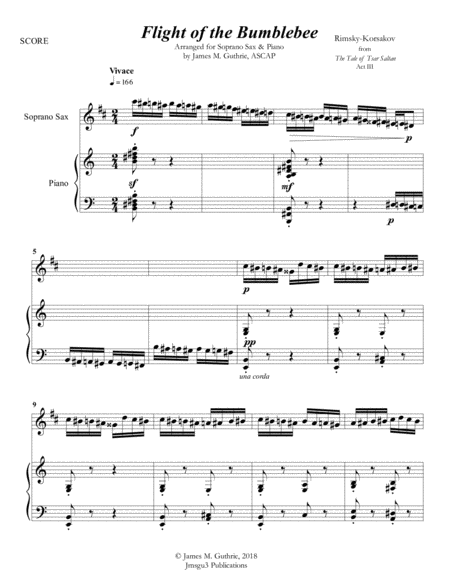
Piano,Soprano Saxophone - Level 5 - Digital Download SKU: A0.549256 Composed by Nikolay Andreyevich Rimsky-Korsakov. Arranged by James M. Guthrie, ASCAP. Instructional,Romantic Period,Standards. Score and part. 15 pages. Jmsgu3 #3473699. Published by jmsgu3 (A0.549256). Flight of the Bumblebee from Korsakov's Tale of Tsar Saltan Score: 9 pages, Solo part: 3 pages, Piano accompaniment part: 3 pages. Duration: ca. 1:15 Amaze your listeners with this short but stunning recital encore! Korsakov: Flight of the Bumblebee Flight of the Bumblebee is, to be sure, an orchestral interlude composed by Nikolai Rimsky-Korsakov for his opera The Tale of Tsar Saltan. Korsakov, of course, intended to musically portray the chaotic flying pattern of a bumblebee. Nowadays, this piece is one of the comparatively more famous classical works because it frequently appears from time to time in popular culture. In the opera, the piece appears notably at the close of Act III, Tableau 1. This is when the magic Swan-Bird, in fact, changes the Prince (the son of the Tsar) into a bee so he can fly away to visit his father. Interestingly, at this point in the drama, his father, in effect, does not know that he is alive.   Korsakov Background Nikolai Rimsky-Korsakov (1844 –1908) was a uniquely famous composer from Russia. He was likewise a member of an infamous assembly of composers called The Five. Korsakov was furthermore an expert in orchestration. His correspondingly most famous orchestral compositions-Capriccio Espagnol, the Russian Easter Festival Overture, and the Scheherazade suite-are important monuments of the standard music repertoire.  Also, comparatively very important are his suites and excerpts from his 15 operas. Korsakov was moreover fond of using Russian folklore and fairy tales in his music, such as Scheherazade.  Nationalistic Style Korsakov believed, similarly to fellow outspoken composer Balakirev, in creating a nationalistic, Russia-centric style of classical music. The new style was in fact called Orientalism. It similarly relied on native Russian materials, exotic scales, and experimental harmonic, melodic and rhythmic procedures. This practice, conversely, ran counter to the developments in Western musical culture. Musical Developments Nevertheless, Korsakov developed an appreciation of Western musical techniques after he became a professor of musical composition, harmony, and orchestration at the Saint Petersburg Conservatory in 1871. Moreover, he undertook a rigorous three-year program of self-education and mastered Western methods, incorporating them in conjunction with the influences of Mikhail Glinka and other members of The Five. His techniques of composition and orchestration were additionally enriched by his exposure to the works of Richard Wagner. Naval Service Korsakov combined his music career accordingly with a career in the Russian military. He was in the first place an officer in the Russian Navy. In due time, he was appointed as a civilian Inspector of Naval Bands. As a result, Korsakov expanded his knowledge of woodwind and brass playing, which in turn heightened his capabilities in orchestration. Legacy Korsakov in due time contributed a significant number of Russian nationalist works. He also prepared, from time to time, compositions by The Five for presentation. This brought their works straightaway into the active classical repertoire as well. He also shaped an entire generation of younger composers during his time as a music educator. Therefore, music historians consider Korsakov as the foremost engineer of what the public considers to be the Russian style of composition. He served, all in all, as a transitional figure between The Five and the classically trained composers who became the norm over time. In addition to the Russians, he forthwith influenced non-Russian composers such as Ravel, Debussy, Dukas, and Respighi.  
Korsakov: Flight of the Bumblebee for Soprano Sax & Piano
Saxophone Soprano et Piano

$32.95 28.58 € Saxophone Soprano et Piano PDF SheetMusicPlus

Piano,Soprano Saxophone - Level 4 - Digital Download SKU: A0.533436 Composed by Johann Sebastian Bach. Arranged by Paul Wehage. Baroque,Concert,Standards. Score and part. 43 pages. Musik Fabrik Music Publishing #2914069. Published by Musik Fabrik Music Publishing (A0.533436). In 1720 J. S. Bach was in the service of Prince Leopold of Anhalt-Cöthen, serving as his Kapellmeister. Since the court of Anhalt-Cöthen was Calvinist, Church music was limited to congregational psalms and hymns. Bach’s work during this period consisted of writing chamber music for the Prince, who was an accomplished violinist, gambist and harpsichordist. Other works from this period include the Cello Suites, the viola da gamba sonatas, the Flute sonatas and the partita for solo flute and the Orchestral Suites.  The Sonata presented here is in the four movement “Church Sonata†style. The first five sonatas all share the same principal of Slow-Fast-Slow-Fast with a generally unified three-voice “Trio Sonata†texture. Passages which include double stops have been arranged as grace notes, which should be performed rapidly, but with a sensitivity to creating the necessary resonance which suggest implied chords. 
J. S. Bach: Sonata no. 3 in E major, bwv 1016, arranged for soprano saxophone and keyboard by Paul W
Saxophone Soprano et Piano

$16.95 14.7 € Saxophone Soprano et Piano PDF SheetMusicPlus


Partitions Gratuites
Acheter des Partitions Musicales
Acheter des Partitions Digitales à Imprimer
Acheter des Instruments de Musique

© 2000 - 2026

Accueil - Version intégrale