EUROPE
7299 articles
USA
0 articles
DIGITAL
76 articles (à imprimer)
Partitions Digitales
Partitions à imprimer
76 partitions trouvées

1 16 31 ....76

Piano,Soprano Saxophone - Level 3 - Digital Download SKU: A0.1310939 Composed by Chiquinha Gonzaga. Arranged by César Madeira. 19th Century,Children,Classical,Latin,Romantic Period. Score and part. 9 pages. Sheet Music To Play Editions #899912. Published by Sheet Music To Play Editions (A0.1310939). Gaúcho (Corta-Jaca) - Brazilian Tango by Francisca Gonzaga. Arrangement for French Horn and Piano. With Full Score and Individual Parts. Enjoy it!Francisca Gonzaga, better known as Chiquinha Gonzaga (1847 – 1935) was a Brazilian composer, pianist and the first woman conductor in Brazil. Chiquinha Gonzaga was the first pianist of choro and author of the first carnival march, Ó Abre Alas (1899). Her plays and operettas, such as Forrobodó and Jurití, were a great success with the public because they used elements of Brazilian popular culture of the time.For Tutorials, Play Alongs or request New Arrangements, visit the YouTube Channel: Sheet Music To Play
Gaúcho (Corta-Jaca) - French Horn and Piano (Full Score and Parts)
Saxophone Soprano et Piano

$6.99 6.08 € Saxophone Soprano et Piano PDF SheetMusicPlus

Piano,Soprano Saxophone - Level 1 - Digital Download SKU: A0.548675 Composed by Adam. Arranged by James M. Guthrie, ASCAP. Christian,Christmas. Score and part. 10 pages. Jmsgu3 #3410437. Published by jmsgu3 (A0.548675). Duration: 4:56. Score 5 pg. 44 ms. Solo part: 2 pg. Piano part: 3 pg.Cantique de Noël The French composer Adolphe Adam was already famous as a composer of many successful ballets and operas. Then, in the 1840’s he wrote his most famous work - O Holy Night. The original song title was Minuit Chretiens or Cantique de Noël.  Placide Cappeau provided the original song lyrics. The song was first performed in Roquemaure by the opera singer Emily Laurey at midnight mass in 1847. It became very popular among the French, much the way that Silent Night was famous elsewhere. In the 1850’s John S. Dwight, a Unitarian minister and music teacher translated the song into English.   Adolphe Adam In his younger years, Adam studied organ and composition at the Paris Conservatoire. He also played the timpani in the Conservatoire orchestra. Adam used his savings and borrowed money to open a new opera house - the fourth opera house in Paris in 1847. Unfortunately, the Revolution of 1848 forced him to close. He taught composition at the Paris Conservatoire from 1849 until his death in 1856. Placide Cappeau The poet Cappeau was an advocate of the French Enlightenment philosopher Voltaire.  Voltaire was renowned for criticizing the Catholic church, religious intolerance, and dogma in general. Consequently, Cappeau made the Redeemer figure in his song a kind of reformer of injustices, in particular, the problem of original sin. To begin with, people recognized Cappeau’s theology as eccentric, probably even doubtful. Theology In the earlier form of Minuit, the Christ figure descends to intervene with His Father’s plan to punish mankind.  Traditional doctrine pronounces that Christ came from love, not to intervene. This version also declares that Christ appeared to expunge the original sin of Adam. Cappeau removed this part from his poem years later, because he just didn’t believe it.  He preferred to portray Christ as the reformer of disparity and unfairness. Before long, the writer/politician Alphonse de Lamartine referred to the Minuit as the the Marseillaise of religion. Most French churchmen agreed with this idea but certainly did not consider it a tribute.  Register for free lifetime updates and revisions at www.jamesguthrie.com
O Holy Night for Soprano Sax & Piano
Saxophone Soprano et Piano

$24.95 21.72 € Saxophone Soprano et Piano PDF SheetMusicPlus

Piano,Soprano Saxophone - Level 4 - Digital Download SKU: A0.533492 Composed by Ali Ben Sou Alle. Concert,Romantic Period,Standards. Score and part. 16 pages. Musik Fabrik Music Publishing #3000185. Published by Musik Fabrik Music Publishing (A0.533492). Souvenirs d’Angleterre is composed of an opening aria with a number of cadenzas followed by a Valse brillante with variations. Stylistically, the work seems to be more influenced by German Classical music (note especially the classical piano figurations in the opening aria, reminiscent of such composers as Beethoven and Weber). The Valse has an expressive variation in a minor key and the entire work ends, elegantly, pianissimo.One of the most enigmatic figures in the history of the Saxophone, Ali Ben Sou Alle (Charles-Valentin Soualle) was born in1820 in Arras, France. After receiving his first prize in Clarinet at the Paris Conservatory in 1844. he served as the director ofmusic of The French Marine Band in Senegal, and then was named first clarinet solo at the Opéra-Comique in Paris. However, after the Revolution of 1848, Soualle was forced to flee France to England where he settled in London, playing in the Orchestra of the Queen's Theatre. His songs and piano pieces were published in London.While in London, Soualle met another exiled French musician, Louis Antoine Jullien, who conducted a light music series inLondon. Jullien encouraged Soualle to take up the saxophone, and after modifying the instrument by adding a single octavemechanism (the modern system used today) and keys for the lower register, Soualle became known as a virtuoso and begantouring performing solo recitals (or mono-concerts, as they were called at the time) calling his modified saxophone the«turcophone ». He performed in all the European capitals and then traveled to Australia, New Zealand, Manilla, Java, throughChina and then to India where he finally settled in Mysore, becoming the director of the Royal Music for the Maharadjah. It wasduring this period that he converted to Islam and changed his nmae to Ali ben Sou Alle (or Ali, son of Soualle). Hesubsequently travaled to Ile Maurice, to French Polynesia, the Cap of Natal and the Cap of Good Hope. All of these voyageswere subjects of musical works which Soualle entitled Souvenirs de... and may perhaps have been part of a collection knownas The Royal Album which was presented to the Prince of Wales after a royal concert. Soualle returned to Mysore in 1858 and was almost killed in the Indian Revolution.Around 1860, Soualle returned to France for health reasons and began publishing his own music. On March 27 1865, heperformed a command performance for the Emperor Napoleon III at the Tuileries Palace in the presence of the entire ImperialFamily. After 1865, nothing more is known about him.
Ali Ben Sou Alle: Souvenirs d'Angleterre for soprano saxophone and piano
Saxophone Soprano et Piano

$11.95 10.4 € Saxophone Soprano et Piano PDF SheetMusicPlus

Piano,Soprano Saxophone - Level 4 - Digital Download SKU: A0.533350 Composed by Ali Ben Sou Alle. Arranged by Paul Wehage. Concert,Romantic Period,Standards. Score and part. 39 pages. Musik Fabrik Music Publishing #2348229. Published by Musik Fabrik Music Publishing (A0.533350). One of the most enigmatic figures in the history of the Saxophone, Ali Ben Sou Alle (Charles-Valentin Soualle) was born in1820 in Arras, France. After receiving his first prize in Clarinet at the Paris Conservatory in 1844. he served as the director ofmusic of The French Marine Band in Senegal, and then was named first clarinet solo at the Opéra-Comique in Paris. However, after the Revolution of 1848, Soualle was forced to flee France to England where he settled in London, playing in the Orchestra of the Queen's Theatre. His songs and piano pieces were published in London.While in London, Soualle met another exiled French musician, Louis Antoine Jullien, who conducted a light music series inLondon. Jullien encouraged Soualle to take up the saxophone, and after modifying the instrument by adding a single octavemechanism (the modern system used today) and keys for the lower register, Soualle became known as a virtuoso and begantouring performing solo recitals (or mono-concerts, as they were called at the time) calling his modified saxophone the«turcophone ». He performed in all the European capitals and then traveled to Australia, New Zealand, Manilla, Java, throughChina and then to India where he finally settled in Mysore, becoming the director of the Royal Music for the Maharadjah. It wasduring this period that he converted to Islam and changed his nmae to Ali ben Sou Alle (or Ali, son of Soualle). Hesubsequently travaled to Ile Maurice, to French Polynesia, the Cap of Natal and the Cap of Good Hope. All of these voyageswere subjects of musical works which Soualle entitled Souvenirs de... and may perhaps have been part of a collection knownas The Royal Album which was presented to the Prince of Wales after a royal concert. Soualle returned to Mysore in 1858 and was almost killed in the Indian Revolution.Around 1860, Soualle returned to France for health reasons and began publishing his own music. On March 27 1865, heperformed a command performance for the Emperor Napoleon III at the Tuileries Palace in the presence of the entire ImperialFamily. After 1865, nothing more is known about him.Souvenirs de l'Inde (Souvenirs of India) starts with an expressive andante. A folksong from the region of Malabar is presented in an evocation of drums, bells and pipes and is then varied. The final polonaise is in rondo form and ends with a brilliant coda.
Ali Ben Sou Alle :Souvenirs de l'Inde Andante, Air Malabar varié et Polonnaise for soprano saxophone
Saxophone Soprano et Piano

$16.95 14.75 € Saxophone Soprano et Piano PDF SheetMusicPlus

Piano,Soprano Saxophone - Level 4 - Digital Download SKU: A0.533349 Composed by Ali Ben Sou Alle. Arranged by Paul Wehage. Concert,Romantic Period,Standards. Score and part. 42 pages. Musik Fabrik Music Publishing #2348225. Published by Musik Fabrik Music Publishing (A0.533349). One of the most enigmatic figures in the history of the Saxophone, Ali Ben Sou Alle (Charles-Valentin Soualle) was born in 1820 in Arras, France. After receiving his first prize in Clarinet at the Paris Conservatory in 1844. he served as the director ofmusic of The French Marine Band in Senegal, and then was named first clarinet solo at the Opéra-Comique in Paris. However, after the Revolution of 1848, Soualle was forced to flee France to England where he settled in London, playing in the Orchestra of the Queen's Theatre. His songs and piano pieces were published in London. While in London, Soualle met another exiled French musician, Louis Antoine Jullien, who conducted a light music series in London. Jullien encouraged Soualle to take up the saxophone, and after modifying the instrument by adding a single octave mechanism (the modern system used today) and keys for the lower register, Soualle became known as a virtuoso and began touring performing solo recitals (or mono-concerts, as they were called at the time) calling his modified saxophone the «turcophone ». He performed in all the European capitals and then traveled to Australia, New Zealand, Manilla, Java, through China and then to India where he finally settled in Mysore, becoming the director of the Royal Music for the Maharadjah. It was during this period that he converted to Islam and changed his nmae to Ali ben Sou Alle (or Ali, son of Soualle). He subsequently travaled to Ile Maurice, to French Polynesia, the Cap of Natal and the Cap of Good Hope. All of these voyages were subjects of musical works which Soualle entitled Souvenirs de... and may perhaps have been part of a collection known as The Royal Album which was presented to the Prince of Wales after a royal concert. Soualle returned to Mysore in 1858 and was almost killed in the Indian Revolution. Around 1860, Soualle returned to France for health reasons and began publishing his own music. On March 27 1865, he performed a command performance for the Emperor Napoleon III at the Tuileries Palace in the presence of the entire Imperial Family. After 1865, nothing more is known about him.Souvenirs d’Ecosse begins with a classical aria which leads to theme and three variations on the Scottish song « Charley is my Darling », a ballade by Charles Gray (1782-1851). The work ends with a brillant and decidedly non-Scottish bolero, which was probably a piece that Soualle wrote while he was in Scotland.
Ali Ben Sou Alle: Souvenirs d’Écosse Introduction, Variations sur "Charley is my darling" et Boléro
Saxophone Soprano et Piano

$19.95 17.36 € Saxophone Soprano et Piano PDF SheetMusicPlus

Piano,Soprano Saxophone - Level 4 - Digital Download SKU: A0.533501 Composed by Ali Ben Sou Alle. Concert,Romantic Period,Standards. Score and part. 30 pages. Musik Fabrik Music Publishing #3001077. Published by Musik Fabrik Music Publishing (A0.533501). The work is divided into three large sections. An initial introduction and aria leads an Irish ballade The Last Rose of Summer which is then varied. The Valse Brillante which follows is interrupted by a reprise of the ballade before finishing with a brillant coda.One of the most enigmatic figures in the history of Wind Music, Ali Ben Sou Alle (Charles-Valentin Soualle) was born in 1820 in Arras, France. After receiving his first prize in Clarinet at the Paris Conservatory in 1844. he served as the director of music of The French Marine Band in Senegal, and then was named first clarinet solo at the Opéra-Comique in Paris. However, after the Revolution of 1848, Soualle was forced to flee France to England where he settled in London, playing in the Orchestra of the Queen's Theatre. His songs and piano pieces were published in London.While in London, Soualle met another exiled French musician, Louis Antoine Jullien, who conducted a light music series in London. Jullien encouraged Soualle to take up the saxophone, and after modifying the instrument by adding a single octave mechanism (the modern system used today) and keys for the lower register, Soualle became known as a virtuoso and began touring performing solo recitals (or mono-concerts, as they were called at the time) calling his modified saxophone the «turcophone ». He performed in all the European capitals and then traveled to Australia, New Zealand, Manilla, Java, through China and then to India where he finally settled in Mysore, becoming the director of the Royal Music for the Maharadjah. It was during this period that he converted to Islam and changed his nmae to Ali ben Sou Alle (or Ali, son of Soualle). He subsequently travaled to Ile Maurice, to French Polynesia, the Cap of Natal and the Cap of Good Hope. All of these voyages were subjects of musical works which Soualle entitled Souvenirs de... and may perhaps have been part of a collectionknown as The Royal Album which was presented to the Prince of Wales after a royal concert. Soualle returned to Mysore in 1858 and was almost killed in the Indian Revolution.Around 1860, Soualle returned to France for health reasons and began publishing his own music. On March 27 1865, he performed a command performance for the Emperor Napoleon III at the Tuileries Palace in the presence of the entire Imperial Family. After 1865, nothing more is known about him.
Ali Ben Sou Alle: Souvenirs d'Irelande for soprano saxophone and piano
Saxophone Soprano et Piano

$19.95 17.36 € Saxophone Soprano et Piano PDF SheetMusicPlus

Piano,Soprano Saxophone - Level 4 - Digital Download SKU: A0.533493 Composed by Ali Ben Sou Alle. Concert,Romantic Period,Standards. Score and part. 15 pages. Musik Fabrik Music Publishing #3000187. Published by Musik Fabrik Music Publishing (A0.533493). Souvenirs d’Île Maurice begins with a lyrical pastorale in 12/8 time which features chromatic harmonies in the piano. The Rondo section presents first a Waltz theme in minor mode and then reprises the pastorale theme which is then varied in several brilliant passages.One of the most enigmatic figures in the history of the Saxophone, Ali Ben Sou Alle (Charles-Valentin Soualle) was born in1820 in Arras, France. After receiving his first prize in Clarinet at the Paris Conservatory in 1844. he served as the director ofmusic of The French Marine Band in Senegal, and then was named first clarinet solo at the Opéra-Comique in Paris. However, after the Revolution of 1848, Soualle was forced to flee France to England where he settled in London, playing in the Orchestra of the Queen's Theatre. His songs and piano pieces were published in London.While in London, Soualle met another exiled French musician, Louis Antoine Jullien, who conducted a light music series inLondon. Jullien encouraged Soualle to take up the saxophone, and after modifying the instrument by adding a single octavemechanism (the modern system used today) and keys for the lower register, Soualle became known as a virtuoso and begantouring performing solo recitals (or mono-concerts, as they were called at the time) calling his modified saxophone the«turcophone ». He performed in all the European capitals and then traveled to Australia, New Zealand, Manilla, Java, throughChina and then to India where he finally settled in Mysore, becoming the director of the Royal Music for the Maharadjah. It wasduring this period that he converted to Islam and changed his nmae to Ali ben Sou Alle (or Ali, son of Soualle). Hesubsequently travaled to Ile Maurice, to French Polynesia, the Cap of Natal and the Cap of Good Hope. All of these voyageswere subjects of musical works which Soualle entitled Souvenirs de... and may perhaps have been part of a collection knownas The Royal Album which was presented to the Prince of Wales after a royal concert. Soualle returned to Mysore in 1858 and was almost killed in the Indian Revolution.Around 1860, Soualle returned to France for health reasons and began publishing his own music. On March 27 1865, heperformed a command performance for the Emperor Napoleon III at the Tuileries Palace in the presence of the entire ImperialFamily. After 1865, nothing more is known about him.
Ali Ben Sou Alle: Souvenirs d'Île Maurice for soprano saxophone and piano
Saxophone Soprano et Piano

$11.95 10.4 € Saxophone Soprano et Piano PDF SheetMusicPlus

Piano,Soprano Saxophone - Level 3 - Digital Download SKU: A0.533495 Composed by Ali Ben Sou Alle. Concert,Romantic Period,Standards. Score and part. 18 pages. Musik Fabrik Music Publishing #3000191. Published by Musik Fabrik Music Publishing (A0.533495). “Loc-tee-kun-tzin: air chinoise et Rondo. Souvenirs de la Chine starts with a setting of the Chinese folksong « Loc-tee-kun-tzin », one of eight used by Pucinni in his opera Turandot but set in a completely different harmonic context here. The Rondo which follows is in the form of a valse with several scherzando passages and an brillant code. The folksong is briefly reprised before the concise endingOne of the most enigmatic figures in the history of Wind Music, Ali Ben Sou Alle (Charles-Valentin Soualle) s born in 1820 in Arras, France. After receiving his first prize in Clarinet at the Paris Conservatory in 1844. he served as the director of music of The French Marine Band in Senegal, and then was named first clarinet solo at the Opéra-Comique in Paris. However, after the Revolution of 1848, Soualle was forced to flee France to England where he settled in London, playing in the Orchestra of the Queen's Theatre. His songs and piano pieces were published in London.While in London, Soualle met another exiled French musician, Louis Antoine Jullien, who conducted a light music series in London. Jullien encouraged Soualle to take up the saxophone, and after modifying the instrument by adding a single octave mechanism (the modern system used today) and keys for the lower register, Soualle became known as a virtuoso and began touring performing solo recitals (or mono-concerts, as they were called at the time) calling his modified saxophone the «turcophone ». He performed in all the European capitals and then traveled to Australia, New Zealand, Manilla, Java, through China and then to India where he finally settled in Mysore, becoming the director of the Royal Music for the Maharadjah. It was during this period that he converted to Islam and changed his nmae to Ali ben Sou Alle (or Ali, son of Soualle). He subsequently travaled to Ile Maurice, to French Polynesia, the Cap of Natal and the Cap of Good Hope. All of these voyages were subjects of musical works which Soualle entitled Souvenirs de... and may perhaps have been part of a collectionknown as The Royal Album which was presented to the Prince of Wales after a royal concert. Soualle returned to Mysore in 1858 and was almost killed in the Indian Revolution.Around 1860, Soualle returned to France for health reasons and began publishing his own music. On March 27 1865, he performed a command performance for the Emperor Napoleon III at the Tuileries Palace in the presence of the entire Imperial Family. After 1865, nothing more is known about him.
Ali Ben Sou Alle: Souvenirs de la Chine for soprano saxophone and piano
Saxophone Soprano et Piano

$11.95 10.4 € Saxophone Soprano et Piano PDF SheetMusicPlus

Piano,Soprano Saxophone - Level 4 - Digital Download SKU: A0.533351 Composed by Ali Ben Sou Alle. Arranged by Paul Wehage. Concert,Romantic Period,Standards. Score and part. 33 pages. Musik Fabrik Music Publishing #2363197. Published by Musik Fabrik Music Publishing (A0.533351). One of the most enigmatic figures in the history of the Saxophone, Ali Ben Sou Alle (Charles-Valentin Soualle) was born in1820 in Arras, France. After receiving his first prize in Clarinet at the Paris Conservatory in 1844. he served as the director ofmusic of The French Marine Band in Senegal, and then was named first clarinet solo at the Opéra-Comique in Paris. However, after the Revolution of 1848, Soualle was forced to flee France to England where he settled in London, playing in the Orchestra of the Queen's Theatre. His songs and piano pieces were published in London.While in London, Soualle met another exiled French musician, Louis Antoine Jullien, who conducted a light music series inLondon. Jullien encouraged Soualle to take up the saxophone, and after modifying the instrument by adding a single octavemechanism (the modern system used today) and keys for the lower register, Soualle became known as a virtuoso and begantouring performing solo recitals (or mono-concerts, as they were called at the time) calling his modified saxophone the«turcophone ». He performed in all the European capitals and then traveled to Australia, New Zealand, Manilla, Java, throughChina and then to India where he finally settled in Mysore, becoming the director of the Royal Music for the Maharadjah. It wasduring this period that he converted to Islam and changed his nmae to Ali ben Sou Alle (or Ali, son of Soualle). Hesubsequently travaled to Ile Maurice, to French Polynesia, the Cap of Natal and the Cap of Good Hope. All of these voyageswere subjects of musical works which Soualle entitled Souvenirs de... and may perhaps have been part of a collection knownas The Royal Album which was presented to the Prince of Wales after a royal concert. Soualle returned to Mysore in 1858 and was almost killed in the Indian Revolution.Around 1860, Soualle returned to France for health reasons and began publishing his own music. On March 27 1865, heperformed a command performance for the Emperor Napoleon III at the Tuileries Palace in the presence of the entire ImperialFamily. After 1865, nothing more is known about him.Souvenirs du Cap Bonne Espérence (Souvenirs of the Cap of Good Hope) begins with a dramatic aria, perhaps evoking the trip to the Cap which was, in the 19th century, still very dangerous. The Irish folksong « the Irish Emigrant » is presented as a them and in two variations. Finally an extended polka in rondo form finishes the work brilliantly.
Ali Ben Sou Alle: Souvenirs du Cap Bonne Espérence Largo, Variations sur “The Irish Emigrant" et Pol
Saxophone Soprano et Piano

$19.95 17.36 € Saxophone Soprano et Piano PDF SheetMusicPlus

Instrumental Duet Instrumental Duet,Piano,Soprano Saxophone - Level 4 - Digital Download SKU: A0.533210 Composed by Ali Ben Sou Alle. Arranged by Paul Wehage. Concert,Folk,Holiday,Romantic Period. Score and parts. 17 pages. Musik Fabrik Music Publishing #1986205. Published by Musik Fabrik Music Publishing (A0.533210). One of the most enigmatic figures in the history of the Saxophone, Ali Ben Sou Alle (c was born in 1820 in Arras, France. After receiving his first prize in Clarinet at the Paris Conservatory in 1844. he served as the director of music of The French Marine Band in Senegal, and then was named first clarinet solo at the Opéra-Comique in Paris. However, after the Revolution of 1848, Soualle was forced to flee France to England where he settled in London, playing in the Orchestra of the Queen's Theatre. His songs and piano pieces were published in London. While in London, Soualle met another exiled French musician, Louis Antoine Jullien, who conducted a light music series in London. Jullien encouraged Soualle to take up the saxophone, and after modifying the instrument by adding a single octave mechanism (the modern system used today) and keys for the lower register, Soualle became known as a virtuoso and began touring performing solo recitals (or mono-concerts, as they were called at the time). He performed in all the European capitals and then traveled to Australia, New Zealand, Manilla, Java, through China and then to India where he finally settled in Mysore, becoming the director of the Royal Music for the Maharadjah. It was during this period that he converted to Islam and changed his nmae to Ali ben Sou Alle (or Ali, son of Soualle). He subsequently travaled to Ile Maurice, to French Polynesia, the Cap of Natal and the Cap of Good Hope. All of these voyages were subjects of musical works which Soualle entitled Souvenirs de... and may perhaps have been part of a collection known as The Royal Album which was presented to the Prince of Wales after a royal concert. Soualle returned to Mysore in 1858 and was almost killed in the Indian Revolution. Around 1860, Soualle returned to France for health reasons and began publishing his own music. On March 27 1865, he performed a command performance for the Emperor Napoleon III at the Tuileries Palace in the presence of the entire Imperial Family. After 1865, nothing more is known about him. Divertissement sur Une Ballade Irlandaise begins with a lyric introduction in bel canto style. The Irish Ballade is named in the score as « My Lodging is on the Cold Ground », but is sometimes known as « Believe Me If All Those Endearing Young Charms » and is followed by a brilliant variation. After an ornamented modal passage in 6/8, the allemande theme is presented first in a moderate tempo, and then in a more rapid variant which uses « cross string » figerations similar to those used by fiddlers.
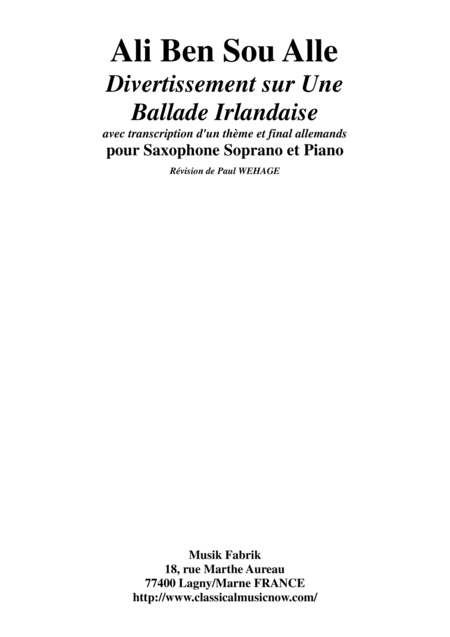
Ali Ben Sou Alle : Divertissement sur Une Ballade Irlandaise
Saxophone Soprano et Piano

$11.95 10.4 € Saxophone Soprano et Piano PDF SheetMusicPlus


1 16 31 ....76


Partitions Gratuites
Acheter des Partitions Musicales
Acheter des Partitions Digitales à Imprimer
Acheter des Instruments de Musique

© 2000 - 2026

Accueil - Version intégrale





