EUROPE
1224 articles
USA
0 articles
DIGITAL
5 articles (à imprimer)
Partitions Digitales
Partitions à imprimer
5 partitions trouvées


Piano,Soprano Saxophone - Level 3 - Digital Download SKU: A0.862378 Composed by Clemence de Grandval. Arranged by Paul Wehage (editor). Classical,Contest,Festival. Score and part. 26 pages. Musik Fabrik Music Publishing #468858. Published by Musik Fabrik Music Publishing (A0.862378). Maria-Félicie-Clémence de Grandval (1828–1907) was born on January 28, 1828 at Saint- Rémy-des-Monts, France and died on January 15, 1907 in Paris.After the death of her mother, Louise Adèle du Temple de Mésières, her father the Baron de Reiset, a military officer remarried with an Englishwoman and moved his family to London. After beginning her musical studies privately, she studied the piano with the German composer Friedrich von Flotow, who was a family friend. Returning to France, she studied the piano briefly with Chopin and composition with Camille Saint-Saëns. At first writing mostly sacred music, most of her public success was due to her comic operas: la Comtesse Eva, la Pénitente, Piccolino and Mazeppa. She also wrote orchestral music, chamber music, and over 60 songs (to poets such as Sully Prudhomme, Michel Carré, Henri Meilhac, Georges Hartmann, Charles Grandmougin and Louis Gallet.) She is chiefly known today for her music for wind instruments, especially for the oboe.
Deux Pièces: Lamento et Scherzetto for Bb soprano saxophone and piano
Saxophone Soprano et Piano

$20.00 17.37 € Saxophone Soprano et Piano PDF SheetMusicPlus

Instrumental Duet,Piano Cello,Instrumental Duet,Piano,Soprano Saxophone - Level 4 - Digital Download SKU: A0.534730 Composed by Clémence de Grandval. Arranged by Jean-Thierry Boisseau. Romantic Period. Score and parts. 30 pages. Musik Fabrik Music Publishing #6362081. Published by Musik Fabrik Music Publishing (A0.534730). Maria-Félicie-Clémence de Grandval (1828–1907) was born on January 28, 1828 at Saint-Rémy-des-Monts, France and died on January 15, 1907 in Paris.After the death of her mother, Louise Adèle du Temple de Mésières, her father the Baron de Reiset, a military officer remarried with an Englishwoman and moved his family to London. After beginning her musical studies privately, she studied the piano with the German composer Friedrich von Flotow, who was a family friend. Returning to France, she studied the piano briefly with Chopin and composition with Camille Saint-Saëns. At first writing mostly sacred music, most of her public success was due to her comic operas: la Comtesse Eva, la Pénitente, Piccolino and Mazeppa. She also wrote orchestral music, chamber music, and over 60 songs (to poets such as Sully Prudhomme, Michel Carré, Henri Meilhac, Georges Hartmann, Charles Grandmougin and Louis Gallet.) She is chiefly known today for her music for wind instruments, especially for the oboe.
Clémence de Grandval: Deux Pièces: Romance et Gavotte for Bb soprano saxophone, violoncello and pian
Saxophone Soprano et Piano

$19.95 17.33 € Saxophone Soprano et Piano PDF SheetMusicPlus

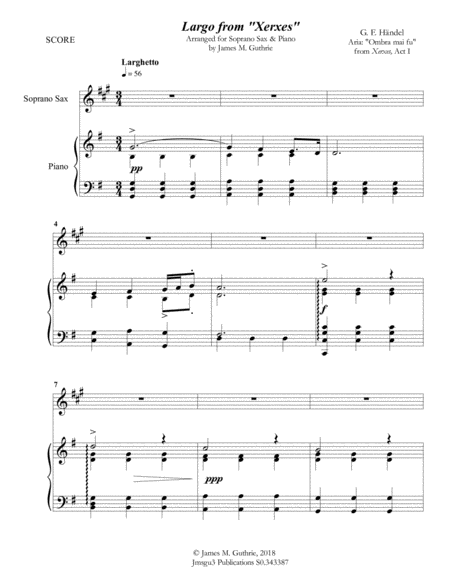
Piano,Soprano Saxophone - Level 3 - Digital Download SKU: A0.549382 Composed by George Frideric Handel. Arranged by James M. Guthrie, ASCAP. Baroque,Sacred,Standards,Wedding. Score and part. 9 pages. Jmsgu3 #3492289. Published by jmsgu3 (A0.549382). Duration: 4:55, Score: 6 pages, Solo part: 1 page, piano part: 2 pages. A very famous aria (Ombra mai fu) from XerxesSuitable for any venue requiring meditative music. Excellent choice for a recital encore. Xerxes Xerxes is, in fact, an opera seria in three acts by Handel. Moreover, Handel conducted the premiere performance in London in 1738. Handel casts the opera in Persia in 470 BC. The part of Xerxes was indeed originally sung by a soprano castrato. Nowadays, the part is generally sung by a mezzo-soprano or conversely a counter-tenor. In the first place, Xerxes sings an opening aria, Ombra mai fu to a plane tree. Handel sets this aria to one of his most truly famous melodies. Although many refer to it traditionally as Handel’s Largo, Handel has, on the contrary, clearly marked Larghetto in the score. Handel Background George Frideric Handel (1685 - 1759) was born in Germany but eventually became a British citizen. Nonetheless, he was a famous Baroque composer. In fact, he became famous for his operas, oratorios, anthems, and organ concertos. Handel studied music and, by and large, worked as a composer in Germany and Italy before moving to London. On the whole, Handel was very familiar with the contemporary music of Italy and Germany. Career in England It is essential to realize that Italian opera was all the rage in England at the time. Moreover, Handel was really good at writing them. Therefore, he started not one but three opera companies in England. Alexander's Feast was a huge success in 1736, but Handel began composing English choral works. After success with the Messiah in 1742) he certainly never again wrote an Italian opera. Consequently, he died in 1759, a treasured genius. Accordingly, the English government gave him full state honors at his funeral. Hence, he is buried in Westminster Abbey in London. Legacy Music historians agree that Handel was in general one of the greatest composers of the Baroque era.  To demonstrate, his works such as the Messiah, Water Music, and Music for the Royal Fireworks remain consistently popular up to the present time. He especially composed the coronation anthem, Zadok the Priest for the coronation of George II. Nevertheless, it has specifically been performed at every succeeding British coronation since. His oratorio Solomon has by all means also continued to be prevalent. As a matter of fact, Sinfonia from act 3 was featured in the 2012 London Olympics opening ceremony. Handel was particularly prolific. To enumerate, he wrote over forty operas.  Since the late 1960s, we have expressly experienced a revival of baroque music. Similarly, we have especially seen a pique of interest in historically informed musical performances. Since his death in 1779, interest in Handel's music has all in all, expanded.  
Handel: Largo from Xerxes for Soprano Sax & Piano
Saxophone Soprano et Piano

$32.95 28.62 € Saxophone Soprano et Piano PDF SheetMusicPlus


Partitions Gratuites
Acheter des Partitions Musicales
Acheter des Partitions Digitales à Imprimer
Acheter des Instruments de Musique

© 2000 - 2025

Accueil - Version intégrale