EUROPE
3294 articles
USA
0 articles
DIGITAL
25 articles (à imprimer)
Partitions Digitales
Partitions à imprimer
25 partitions trouvées


Piano,Soprano Saxophone - Level 3 - Digital Download SKU: A0.1454421 Composed by Maurice Ravel. Arranged by Harry Walker. 19th Century,20th Century,Classical,Romantic Period. Score and part. 9 pages. SCORE EDITIONS #1033525. Published by SCORE EDITIONS (A0.1454421). La Pavane pour une infante défunte est à l'origine une pièce pour piano de Maurice Ravel composée en 1899 et dédiée à la princesse de Polignac. La création de la version pianistique eut lieu à Paris le 5 avril 1902 par le pianiste Ricardo Viñes. Son exécution dure environ six minutes. La Pavane a été orchestrée par Ravel en 1910. L'œuvre porte la référence M.19 dans le catalogue des œuvres du compositeur établi par le musicologue Marcel Marnat. In this version, the composition was arranged for Soprano Saxophone and Piano by Harry Walker.
Pavane Pour Une Infante Défunte (Maurice Ravel) for Soprano Saxophone and Piano
Saxophone Soprano et Piano

$5.99 5.04 € Saxophone Soprano et Piano PDF SheetMusicPlus

Piano,Soprano Saxophone - Level 4 - Digital Download SKU: A0.533493 Composed by Ali Ben Sou Alle. Concert,Romantic Period,Standards. Score and part. 15 pages. Musik Fabrik Music Publishing #3000187. Published by Musik Fabrik Music Publishing (A0.533493). Souvenirs d’Île Maurice begins with a lyrical pastorale in 12/8 time which features chromatic harmonies in the piano. The Rondo section presents first a Waltz theme in minor mode and then reprises the pastorale theme which is then varied in several brilliant passages.One of the most enigmatic figures in the history of the Saxophone, Ali Ben Sou Alle (Charles-Valentin Soualle) was born in1820 in Arras, France. After receiving his first prize in Clarinet at the Paris Conservatory in 1844. he served as the director ofmusic of The French Marine Band in Senegal, and then was named first clarinet solo at the Opéra-Comique in Paris. However, after the Revolution of 1848, Soualle was forced to flee France to England where he settled in London, playing in the Orchestra of the Queen's Theatre. His songs and piano pieces were published in London.While in London, Soualle met another exiled French musician, Louis Antoine Jullien, who conducted a light music series inLondon. Jullien encouraged Soualle to take up the saxophone, and after modifying the instrument by adding a single octavemechanism (the modern system used today) and keys for the lower register, Soualle became known as a virtuoso and begantouring performing solo recitals (or mono-concerts, as they were called at the time) calling his modified saxophone the«turcophone ». He performed in all the European capitals and then traveled to Australia, New Zealand, Manilla, Java, throughChina and then to India where he finally settled in Mysore, becoming the director of the Royal Music for the Maharadjah. It wasduring this period that he converted to Islam and changed his nmae to Ali ben Sou Alle (or Ali, son of Soualle). Hesubsequently travaled to Ile Maurice, to French Polynesia, the Cap of Natal and the Cap of Good Hope. All of these voyageswere subjects of musical works which Soualle entitled Souvenirs de... and may perhaps have been part of a collection knownas The Royal Album which was presented to the Prince of Wales after a royal concert. Soualle returned to Mysore in 1858 and was almost killed in the Indian Revolution.Around 1860, Soualle returned to France for health reasons and began publishing his own music. On March 27 1865, heperformed a command performance for the Emperor Napoleon III at the Tuileries Palace in the presence of the entire ImperialFamily. After 1865, nothing more is known about him.
Ali Ben Sou Alle: Souvenirs d'Île Maurice for soprano saxophone and piano
Saxophone Soprano et Piano

$11.95 10.06 € Saxophone Soprano et Piano PDF SheetMusicPlus

Piano,Soprano Saxophone - Level 1 - Digital Download SKU: A0.548675 Composed by Adam. Arranged by James M. Guthrie, ASCAP. Christian,Christmas. Score and part. 10 pages. Jmsgu3 #3410437. Published by jmsgu3 (A0.548675). Duration: 4:56. Score 5 pg. 44 ms. Solo part: 2 pg. Piano part: 3 pg.Cantique de Noël The French composer Adolphe Adam was already famous as a composer of many successful ballets and operas. Then, in the 1840’s he wrote his most famous work - O Holy Night. The original song title was Minuit Chretiens or Cantique de Noël.  Placide Cappeau provided the original song lyrics. The song was first performed in Roquemaure by the opera singer Emily Laurey at midnight mass in 1847. It became very popular among the French, much the way that Silent Night was famous elsewhere. In the 1850’s John S. Dwight, a Unitarian minister and music teacher translated the song into English.   Adolphe Adam In his younger years, Adam studied organ and composition at the Paris Conservatoire. He also played the timpani in the Conservatoire orchestra. Adam used his savings and borrowed money to open a new opera house - the fourth opera house in Paris in 1847. Unfortunately, the Revolution of 1848 forced him to close. He taught composition at the Paris Conservatoire from 1849 until his death in 1856. Placide Cappeau The poet Cappeau was an advocate of the French Enlightenment philosopher Voltaire.  Voltaire was renowned for criticizing the Catholic church, religious intolerance, and dogma in general. Consequently, Cappeau made the Redeemer figure in his song a kind of reformer of injustices, in particular, the problem of original sin. To begin with, people recognized Cappeau’s theology as eccentric, probably even doubtful. Theology In the earlier form of Minuit, the Christ figure descends to intervene with His Father’s plan to punish mankind.  Traditional doctrine pronounces that Christ came from love, not to intervene. This version also declares that Christ appeared to expunge the original sin of Adam. Cappeau removed this part from his poem years later, because he just didn’t believe it.  He preferred to portray Christ as the reformer of disparity and unfairness. Before long, the writer/politician Alphonse de Lamartine referred to the Minuit as the the Marseillaise of religion. Most French churchmen agreed with this idea but certainly did not consider it a tribute.  Register for free lifetime updates and revisions at www.jamesguthrie.com
O Holy Night for Soprano Sax & Piano
Saxophone Soprano et Piano

$24.95 21.01 € Saxophone Soprano et Piano PDF SheetMusicPlus

Piano,Soprano Saxophone - Level 3 - Digital Download SKU: A0.1487777 By Gala. By Filippo Carmeni, Gala Rizzatto, and Maurizio Molella. Arranged by Bruno Monteferrante. 21st Century,Disco,Pop. Score and part. 10 pages. Bruno Monteferrante #1064716. Published by Bruno Monteferrante (A0.1487777). Experience the vibrant energy of Gala's iconic hit Freed from Desire with our exclusive arrangement for saxophone solo and piano accompaniment. Perfectly tailored for musicians looking to add a contemporary and dynamic piece to their repertoire, this arrangement captures the essence of the original song while providing a fresh and engaging musical experience.Key Features:Ideal for Musicians: This arrangement is perfect for those seeking a unique and exciting piece to showcase their skills, with an accompanying piano part that complements the solo beautifully.Authentic and Captivating: Faithfully adapted from Gala's original, this arrangement maintains the song's powerful rhythm and infectious melody, making it a standout choice for performances.Clear Notation: The sheet music features clear, easy-to-read notation for both the saxophone and piano parts, ensuring a smooth and enjoyable playing experience.Perfect for Performances: Whether for a recital, concert, or personal enjoyment, this arrangement brings the spirited energy of Freed from Desire to any setting, captivating audiences and players alike.Why Choose This Arrangement?Our Freed from Desire arrangement for saxophone solo with piano accompaniment is crafted to provide an exhilarating playing experience while staying true to the original song's vibrant character. Ideal for intermediate to advanced players, this piece is a must-have for anyone looking to add a contemporary classic to their music collection.Order Your Copy Today!Bring the infectious energy of Gala's Freed from Desire to life with this unique arrangement. Order now and let your performance shine with this captivating saxophone and piano duo!
Freed From Desire
Saxophone Soprano et Piano
Gala
$5.99 5.04 € Saxophone Soprano et Piano PDF SheetMusicPlus

Piano,Soprano Saxophone - Level 3 - Digital Download SKU: A0.524439 Composed by Isaac Watts, Maurice Ravel. Arranged by John A. Dempsey. Christian,Folk,Praise & Worship,Sacred,Traditional. Score and part. 14 pages. John A. Dempsey #5742257. Published by John A. Dempsey (A0.524439). In this duet for soprano sax and piano, the lush, gorgeous harmonies of Maurice Ravel have been inlaid into the solid stonework of Isaac Watts' inspirational hymn based on Psalm 23, My Shepherd Will Supply My Need.  Recommended for church services and other worship events as a prelude, postlude, an offertory or special music.  Also popular as a performance piece for concerts and recitals.  10 pages of music (that includes a separate two-page soprano sax part).  Concert Key (Piano): F major.  Soprano Sax Key: G major.
My Shepherd Will Supply My Need (Psalm 23): Soprano Sax and Piano
Saxophone Soprano et Piano

$6.99 5.89 € Saxophone Soprano et Piano PDF SheetMusicPlus

Piano,Soprano Saxophone - Level 4 - Digital Download SKU: A0.1501338 By Bee Gees. By Barry Gibb, Maurice Gibb, and Robin Gibb. Arranged by Ygor Nunes. 21st Century,Contemporary,Disco,Film/TV,Singer/Songwriter. Score and part. 9 pages. Ygor Nunes #1077299. Published by Ygor Nunes (A0.1501338). **Feel the Groove of Stayin' Alive by Bee Gees**Have you felt the energy of Bee Gees' Stayin' Alive? This disco anthem is iconic, bursting with rhythm and unforgettable beats.Now, picture it arranged for soprano sax solo. Every beat and melody gets a fresh, dynamic twist. Rediscover the groove of Stayin' Alive like never before.Don't miss this electrifying musical experience. Let Stayin' Alive move you again.
Stayin' Alive
Saxophone Soprano et Piano
Bee Gees
$5.99 5.04 € Saxophone Soprano et Piano PDF SheetMusicPlus

Piano,Soprano Saxophone - Level 3 - Digital Download SKU: A0.1314331 Composed by Camille Saint-Saens. Arranged by James M. Guthrie. 19th Century,Chamber,Contest,Festival,Historic,Romantic Period. Score and part. 11 pages. Jmsgu3 #903074. Published by jmsgu3 (A0.1314331). Saint-Saëns: The Swan (Le Cygne) movement 13 from the Carnival of the Animals Suite. One of his most popular and widely recognized works, it is the only movement from the Carnival Suite that Saint-Saëns permitted to be performed publicly during his lifetime. This is an excellent recital encore to demonstrate melodic playing and strategic phrasing.The Carnival of the AnimalsThe Carnival of the Animals is an entertaining musical suite of fourteen movements by Camille Saint-Saëns. The work was composed for private performance by an ensemble of two pianos and solo instruments. The Swan (No. 13) is among the fourteen most famous movements. In its entirety, it lasts about 25 minutes.Saint-Saëns BackgroundCharles-Camille Saint-Saëns 1835 – 1921) was, by all means, in particular, a famous French composer, brilliant organist, and significant musical mastermind of the Romantic era. Indeed, his most famous compositions, in the long run, include his Piano Concerto No. 2 (1868), Cello Concerto No. 1 (1872), and the Danse macabre (1874). Notwithstanding, we must also add Violin Concerto No. 3 (1880), Symphony No. 3 (the Organ Symphony, 1886), and, it must be remembered, Carnival of the Animals (1886) to the list.ChildhoodIt is essential to realize that Saint-Saëns was undoubtedly, in fact, a child musical prodigy. Consequently, with this in mind, he made his concert debut, albeit at ten years old. Another critical point to remember is that he expressly studied at the Paris Conservatoire, then, despite reality, conversely followed a traditional career path as a church organist. Nevertheless, twenty years later, on the other hand, he left to become a successful freelance pianist and composer despite, as has been noted, his former employment situation. Furthermore, his performances were, after all, markedly in demand - not only in Europe but, above all, in the Americas all in all as well.YouthA point often overlooked is that in his youth, Saint-Saëns was undoubtedly excited about the modern music of the day. He was, in essence, fond of the music of his contemporaries, particularly Schumann, Liszt, and, for the most part, Wagner. In contrast, however, his compositions seemed, in fact, primarily confined within the conservative classical tradition. Be that as it may, he was, at the same time, nevertheless, a scholar of musical history.CriticismOn the whole, his conservatism, in fact, ultimately brought him into frequent conflict in his later years with composers of the impressionist and, in particular, the dodecaphonic schools of musical thought. A point often overlooked is that he included neoclassical elements in his music, contrary to some critics. Furthermore, in so doing, he provided the most compelling evidence that he predicted the techniques and works by Stravinsky and Les Six. To put it another way, given these points, he was regarded, perhaps for the most part unfairly, as a non-progressive reactionary henceforth around the time of his passing.LegacySaint-Saëns taught briefly in Paris, where his students included Gabriel Fauré. Maurice Ravel later studied with Fauré. In conclusion, both Ravel and Fauré were powerfully influenced by Saint-Saëns, whom they respected as a musical mastermind.
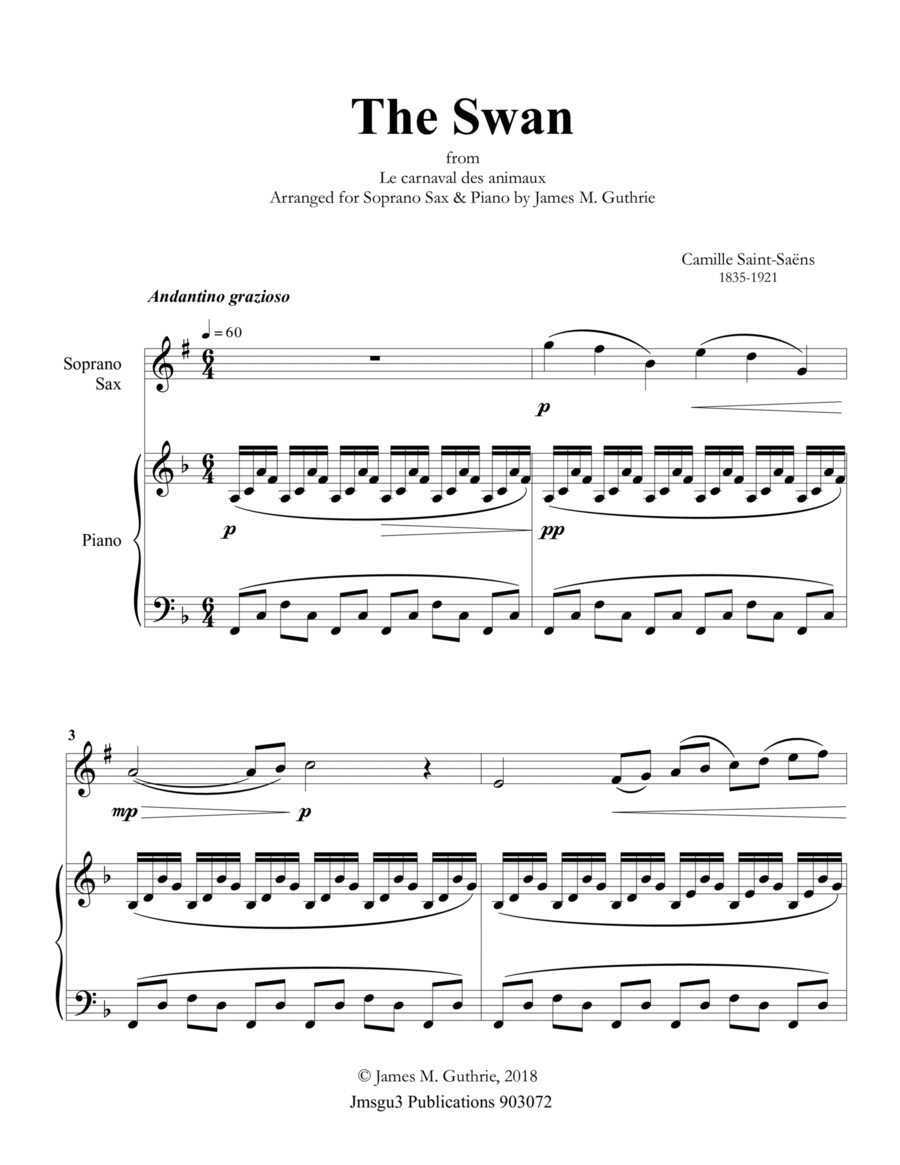
Saint-Saëns: The Swan for Soprano Sax & Piano
Saxophone Soprano et Piano

$32.95 27.75 € Saxophone Soprano et Piano PDF SheetMusicPlus

Instrumental Duet Instrumental Duet,Piano,Soprano Saxophone - Level 4 - Digital Download SKU: A0.533210 Composed by Ali Ben Sou Alle. Arranged by Paul Wehage. Concert,Folk,Holiday,Romantic Period. Score and parts. 17 pages. Musik Fabrik Music Publishing #1986205. Published by Musik Fabrik Music Publishing (A0.533210). One of the most enigmatic figures in the history of the Saxophone, Ali Ben Sou Alle (c was born in 1820 in Arras, France. After receiving his first prize in Clarinet at the Paris Conservatory in 1844. he served as the director of music of The French Marine Band in Senegal, and then was named first clarinet solo at the Opéra-Comique in Paris. However, after the Revolution of 1848, Soualle was forced to flee France to England where he settled in London, playing in the Orchestra of the Queen's Theatre. His songs and piano pieces were published in London. While in London, Soualle met another exiled French musician, Louis Antoine Jullien, who conducted a light music series in London. Jullien encouraged Soualle to take up the saxophone, and after modifying the instrument by adding a single octave mechanism (the modern system used today) and keys for the lower register, Soualle became known as a virtuoso and began touring performing solo recitals (or mono-concerts, as they were called at the time). He performed in all the European capitals and then traveled to Australia, New Zealand, Manilla, Java, through China and then to India where he finally settled in Mysore, becoming the director of the Royal Music for the Maharadjah. It was during this period that he converted to Islam and changed his nmae to Ali ben Sou Alle (or Ali, son of Soualle). He subsequently travaled to Ile Maurice, to French Polynesia, the Cap of Natal and the Cap of Good Hope. All of these voyages were subjects of musical works which Soualle entitled Souvenirs de... and may perhaps have been part of a collection known as The Royal Album which was presented to the Prince of Wales after a royal concert. Soualle returned to Mysore in 1858 and was almost killed in the Indian Revolution. Around 1860, Soualle returned to France for health reasons and began publishing his own music. On March 27 1865, he performed a command performance for the Emperor Napoleon III at the Tuileries Palace in the presence of the entire Imperial Family. After 1865, nothing more is known about him. Divertissement sur Une Ballade Irlandaise begins with a lyric introduction in bel canto style. The Irish Ballade is named in the score as « My Lodging is on the Cold Ground », but is sometimes known as « Believe Me If All Those Endearing Young Charms » and is followed by a brilliant variation. After an ornamented modal passage in 6/8, the allemande theme is presented first in a moderate tempo, and then in a more rapid variant which uses « cross string » figerations similar to those used by fiddlers.
Ali Ben Sou Alle : Divertissement sur Une Ballade Irlandaise
Saxophone Soprano et Piano

$11.95 10.06 € Saxophone Soprano et Piano PDF SheetMusicPlus


Partitions Gratuites
Acheter des Partitions Musicales
Acheter des Partitions Digitales à Imprimer
Acheter des Instruments de Musique

© 2000 - 2026

Accueil - Version intégrale





