EUROPE
108 articles
USA
0 articles
DIGITAL
11 articles (à imprimer)
Partitions Digitales
Partitions à imprimer
11 partitions trouvées


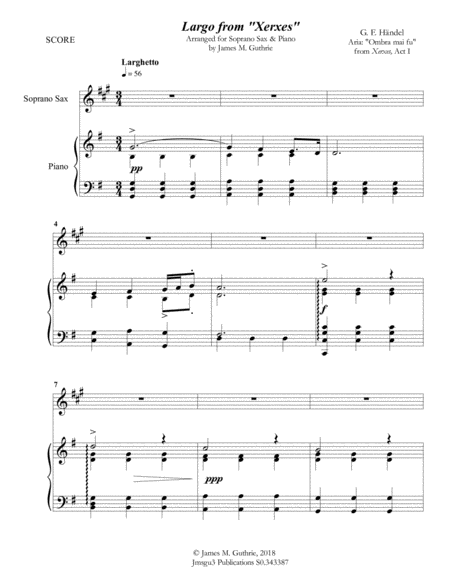
Piano,Soprano Saxophone - Level 3 - Digital Download SKU: A0.549382 Composed by George Frideric Handel. Arranged by James M. Guthrie, ASCAP. Baroque,Sacred,Standards,Wedding. Score and part. 9 pages. Jmsgu3 #3492289. Published by jmsgu3 (A0.549382). Duration: 4:55, Score: 6 pages, Solo part: 1 page, piano part: 2 pages. A very famous aria (Ombra mai fu) from XerxesSuitable for any venue requiring meditative music. Excellent choice for a recital encore. Xerxes Xerxes is, in fact, an opera seria in three acts by Handel. Moreover, Handel conducted the premiere performance in London in 1738. Handel casts the opera in Persia in 470 BC. The part of Xerxes was indeed originally sung by a soprano castrato. Nowadays, the part is generally sung by a mezzo-soprano or conversely a counter-tenor. In the first place, Xerxes sings an opening aria, Ombra mai fu to a plane tree. Handel sets this aria to one of his most truly famous melodies. Although many refer to it traditionally as Handel’s Largo, Handel has, on the contrary, clearly marked Larghetto in the score. Handel Background George Frideric Handel (1685 - 1759) was born in Germany but eventually became a British citizen. Nonetheless, he was a famous Baroque composer. In fact, he became famous for his operas, oratorios, anthems, and organ concertos. Handel studied music and, by and large, worked as a composer in Germany and Italy before moving to London. On the whole, Handel was very familiar with the contemporary music of Italy and Germany. Career in England It is essential to realize that Italian opera was all the rage in England at the time. Moreover, Handel was really good at writing them. Therefore, he started not one but three opera companies in England. Alexander's Feast was a huge success in 1736, but Handel began composing English choral works. After success with the Messiah in 1742) he certainly never again wrote an Italian opera. Consequently, he died in 1759, a treasured genius. Accordingly, the English government gave him full state honors at his funeral. Hence, he is buried in Westminster Abbey in London. Legacy Music historians agree that Handel was in general one of the greatest composers of the Baroque era.  To demonstrate, his works such as the Messiah, Water Music, and Music for the Royal Fireworks remain consistently popular up to the present time. He especially composed the coronation anthem, Zadok the Priest for the coronation of George II. Nevertheless, it has specifically been performed at every succeeding British coronation since. His oratorio Solomon has by all means also continued to be prevalent. As a matter of fact, Sinfonia from act 3 was featured in the 2012 London Olympics opening ceremony. Handel was particularly prolific. To enumerate, he wrote over forty operas.  Since the late 1960s, we have expressly experienced a revival of baroque music. Similarly, we have especially seen a pique of interest in historically informed musical performances. Since his death in 1779, interest in Handel's music has all in all, expanded.  
Handel: Largo from Xerxes for Soprano Sax & Piano
Saxophone Soprano et Piano

$32.95 28.59 € Saxophone Soprano et Piano PDF SheetMusicPlus

Piano,Soprano Saxophone - Level 4 - Digital Download SKU: A0.533470 Composed by Ali Ben Sou Alle. Concert,Romantic Period,Standards. Score and part. 15 pages. Musik Fabrik Music Publishing #2994069. Published by Musik Fabrik Music Publishing (A0.533470). One of the most enigmatic figures in the history of the Saxophone, Ali Ben Sou Alle (Charles-Valentin Soualle) was born in1820 in Arras, France. After receiving his first prize in Clarinet at the Paris Conservatory in 1844. he served as the director ofmusic of The French Marine Band in Senegal, and then was named first clarinet solo at the Opéra-Comique in Paris. However, after the Revolution of 1848, Soualle was forced to flee France to England where he settled in London, playing in the Orchestra of the Queen's Theatre. His songs and piano pieces were published in London.While in London, Soualle met another exiled French musician, Louis Antoine Jullien, who conducted a light music series inLondon. Jullien encouraged Soualle to take up the saxophone, and after modifying the instrument by adding a single octavemechanism (the modern system used today) and keys for the lower register, Soualle became known as a virtuoso and begantouring performing solo recitals (or mono-concerts, as they were called at the time) calling his modified saxophone the«turcophone ». He performed in all the European capitals and then traveled to Australia, New Zealand, Manilla, Java, throughChina and then to India where he finally settled in Mysore, becoming the director of the Royal Music for the Maharadjah. It wasduring this period that he converted to Islam and changed his nmae to Ali ben Sou Alle (or Ali, son of Soualle). Hesubsequently travaled to Ile Maurice, to French Polynesia, the Cap of Natal and the Cap of Good Hope. All of these voyageswere subjects of musical works which Soualle entitled Souvenirs de... and may perhaps have been part of a collection knownas The Royal Album which was presented to the Prince of Wales after a royal concert. Soualle returned to Mysore in 1858 and was almost killed in the Indian Revolution.Around 1860, Soualle returned to France for health reasons and began publishing his own music. On March 27 1865, heperformed a command performance for the Emperor Napoleon III at the Tuileries Palace in the presence of the entire ImperialFamily. After 1865, nothing more is known about him.Alexandra was written on the occasion of the concert that Soualle gave fire Prince of Wales and is dedicated to the Princess of Wales. This piece opens « The Royal Album ». The dynamics, articulations and expressive markings were added by the editor.
Ali Ben Sou Alle: Alexandre: Polka-Royale for soprano saxophone and piano
Saxophone Soprano et Piano

$10.35 8.98 € Saxophone Soprano et Piano PDF SheetMusicPlus

Piano,Soprano Saxophone - Level 3 - Digital Download SKU: A0.549466 Composed by Alexander Scriabin. Arranged by James M. Guthrie, ASCAP. Concert,Instructional,Romantic Period,Sacred,Standards. Score and part. 12 pages. Jmsgu3 #3499743. Published by jmsgu3 (A0.549466). Score: 8 pages, solo part: 2 pages, piano part: 2 pages. Duration: 3:10. An introspective and meditative work with a lot of dynamic and phrasing nuance. Works well for church meditations or recital encores. Background Op.11/2 Alto Clarinet version. First of all, Scriabin composed mostly for the solo piano and also the orchestra. This is probably because he was a gifted pianist and therefore certainly appreciated the piano. Scriabin grew up in the late Romantic period, consequently, he was fond of the great piano masters of the time. As a result, he wrote his first noteworthy compositions in the manner of Chopin and Liszt. Forms Likewise, Scriabin used many of the same forms as Chopin. These certainly include the étude, prelude, nocturne, and even the mazurka. In contrast, as he developed his own sense of style his music became more and more unusual. So, the last five of his Piano Sonatas do not have a key signature and therefore lean towards atonality. Philosophy Scriabin also developed a keen interest in philosophy and likewise poetry. He was above all particularly fascinated by Nietzsche, Delville, and Blavatsky. Consequently, he finally established his own ideas about metaphysics and certainly mysticism. Scriabin consequently advanced theories about the relationship between color and musical keys. Synesthesia He also may have experienced a condition called synesthesia where he could probably sense a response created from a different stimulus. Therefore, it was almost as if he could see music and hear colors. Scriabin, therefore, arranged the colors in a circle similar to the circle-of-fifths and assigned each key area a color. Finally, he assigned the key of C to the color red, while the key of G was orange. Similarly, he assigned D to yellow, A to green, and so forth. Strangely, he did not differentiate between major and minor key colors.  Multimedia Hence, his ability to translate colors into music certainly gave Scriabin a most noteworthy interest in creating multimedia events. Furthermore, He designed his biggest work, the Mysterium, to last an entire week. Even more, Scriabin made plans not only for music, but also colored lights, incense, and dancing. He designed the performance to occur in the foothills of the Himalaya mountains. The Mysterium was never performed, and only sketches of the work remain. Modern Performances In modern times, we often experience performances of Scriabin’s most famous completed works accompanied by colored laser lights and incense. These are the Poem of Ecstasy (completed in 1908) and the Poem of Fire (completed in 1910). The lighting effects for these early performances were accomplished by the clavier à lumiéres. It was a keyboard instrument that projected colored light onto a screen.
Scriabin: Prelude Op. 11 No. 2 for Soprano Sax & Piano
Saxophone Soprano et Piano

$19.95 17.31 € Saxophone Soprano et Piano PDF SheetMusicPlus

Instrumental Duet,Piano Alto Saxophone,Instrumental Duet,Piano,Soprano Saxophone - Level 2 - Digital Download SKU: A0.620011 By Third Day. By Brenton Brown, David Carr, Mac Powell, Mark Lee, Matt Maher, and Tai Anderson. Arranged by Stephen DeCesare. Christian,Contemporary,Praise & Worship,Rock,Sacred. Score and parts. 17 pages. Exultet Music #3101917. Published by Exultet Music (A0.620011). The popular Christian rock song by Third Day has been freshly arranged as a duet for Soprano and an Alto Saxophone with Piano accompaniment.  Accessible and appropriate for any church or concert setting.  Can be used for many times throughout the liturgical year but especially when the themes are about revival or coming back to God.
Soul On Fire
Saxophone Soprano et Piano
Third Day
$4.99 4.33 € Saxophone Soprano et Piano PDF SheetMusicPlus

Piano,Soprano Saxophone - Level 2 - Digital Download SKU: A0.844551 Composed by Robert Franz. Arranged by Phil Beaman. Instructional,Romantic Period,Standards,Wedding. Score and part. 6 pages. Phil Beaman #3517847. Published by Phil Beaman (A0.844551). Robert Franz was a Romantic Era composer of lieder (German Art Song) whose pieces were highly praised by Schumann. When I removed the important lyrics from Feast of Love in order to make an accompanied instrumental solo I needed to convey the passionate drama just in the music. I changed a simple strophic form into an ABA Coda with every verse getting a different treatment. My harmony is much richer and more varied than the original. I added new articulations, dynamics, and other markings as well as a cadenza for one of the bridges.  Excellent piece for a student to learn Romantic characteristics of expression, phrase shaping, and sempre rubato.  This song is also excellent for Weddings. Alternative translations of the title are Celebration of Love and Love's Fire. You can definitely feel the fire and passion in this beautiful piece!This arrangement is not difficult to play, but is marked Early Intermediate because it requires musicianship to play well.3 minutes4 pages score, 2 page solo partTemporary recording of piano reduction of full score.
Feast of Love - Soprano Saxophone/Piano
Saxophone Soprano et Piano

$4.99 4.33 € Saxophone Soprano et Piano PDF SheetMusicPlus

Small Ensemble Accordion,Bass Clarinet,Cello,Percussion,Piano,Soprano Saxophone - Digital Download SKU: A0.799434 Composed by Drake Mabry. 20th Century,Contemporary. Score and parts. 25 pages. Drake Mabry #518831. Published by Drake Mabry (A0.799434). Soleil Luisant was written for the French ensemble 'Aleph' and benefits from the diversity of their instrumentation. Included are the voice, contrabass clarinet, cello, accordion, percussion and piano. The text comes from the 15th century French prince and poet Charles d'Orleans. His life story reads like a soap opera. In three movements, the first line of each poem can be translated as: The weather has left its coat, There is no point in having an unhappy heart and In winter the fire, fire. The score includes written and spatial notation. The last movement is basically a tavern song. The duration is 7'30. This is a manuscript score, thus the reduced price.Soleil Luisant was premiered by the Ensemble Aleph at the Theatre Dunois, Paris, France on December 9, 1996.
Soleil Luisant (score)
Saxophone Soprano et Piano

$9.99 8.67 € Saxophone Soprano et Piano PDF SheetMusicPlus


Partitions Gratuites
Acheter des Partitions Musicales
Acheter des Partitions Digitales à Imprimer
Acheter des Instruments de Musique

© 2000 - 2026

Accueil - Version intégrale