EUROPE
404 articles
USA
0 articles
DIGITAL
9 articles (à imprimer)
Partitions Digitales
Partitions à imprimer
9 partitions trouvées


Woodwind Ensemble Clarinet - Level 3 - Digital Download SKU: A0.813963 Composed by Franz Xaver Gruber. Arranged by Regis Bookshar. Christmas,Instructional,Multicultural,World. 7 pages. Regis Bookshar #6632975. Published by Regis Bookshar (A0.813963). Clarinet Quintet - Intermediate - Digital Download. This arrangement of Silent Night, or in German, Stille Nacht, would be a wonderful addition to any music library and could be performed for Christmas concerts, recitals, and, especially, church services. It is equally suitable for junior and senior high school students and even older musicians. Depending on their ability, younger musicians would also enjoy playing this selection. Included are a score and a complete set of parts (7 pages). This selection is one of the many arrangements from The Regis Bookshar Trumpet Ensemble's extensive music library which are being made available for the first time.Silent Night is probably the most popular Christmas carol ever written. It was composed in 1818 by Franz Xaver Gruber to lyrics by Joseph Mohr and was first performed on Christmas Eve at St. Nicholas parish church in Oberndorf, a small village in present-day Austria. A young Catholic priest, Father Joseph Mohr, had written the poem, Stille Nacht, in 1816 and had gone to Oberndorf in 1817. The melody was composed by Franz Xaver Gruber, schoolmaster and organist in the nearby village of Arnsdorf. On Christmas Eve, 1818, Mohr brought the words to Gruber and asked him to compose a melody and guitar accompaniment for that night's mass, after river flooding had possibly damaged the church organ. The church was eventually destroyed by repeated flooding and has since been replaced with the Silent-Night-Chapel.According to Gruber, Karl Mauracher, an organ builder who serviced the instrument at the Oberndorf church, was enamored with the song, and took the composition home with him to the Ziller Valley in Tyrol, Austria. From there, two traveling families of folk singers, the Strassers and the Rainers, included the tune in their shows. The Rainers were already singing it around Christmas, 1819, and once performed it for an audience that included Franz I of Austria and Alexander I of Russia. They also gave the first performance of the song in the United States in New York City in 1839. By the 1840's, the song was well known and was reported to be a favorite of Frederick William IV of Prussia. During this period, the melody changed slightly to become the version that is commonly heard today. The version of the melody that is generally used today is a slow, meditative lullaby, or pastoral, differing slightly from Gruber's original which has a moderate tempo. The song has been translated into about 140 languages and has been recorded by many singers across many music genres. The version sung by Bing Crosby in 1935, has sold over 10 million copies as a single.In this arrangement of Silent Night, Regis Bookshar has kept the basic form of this familiar Christmas carol, but has also included a descant during the third verse. Also, in addition to this version for a Clarinet Quinet, there are other arrangements of Silent Night available for a variety of instrumental ensembles. There are Quintets and Octets readily available for purchase. Please take the time to look for other versions of this composition. You may find something else that might also suit your needs.I would also encourage you to search for other arrangements by Regis Bookshar, as well, as there are numerous arrangements in a wide variety of styles, also available for purchase. You may find something else which might interest you. Please continue to check periodically because new arrangements are being added as often as possible. I'm certain that this wonderful arrangement of Silent Night will continue to entertain both performers and audiences alike for years to come.
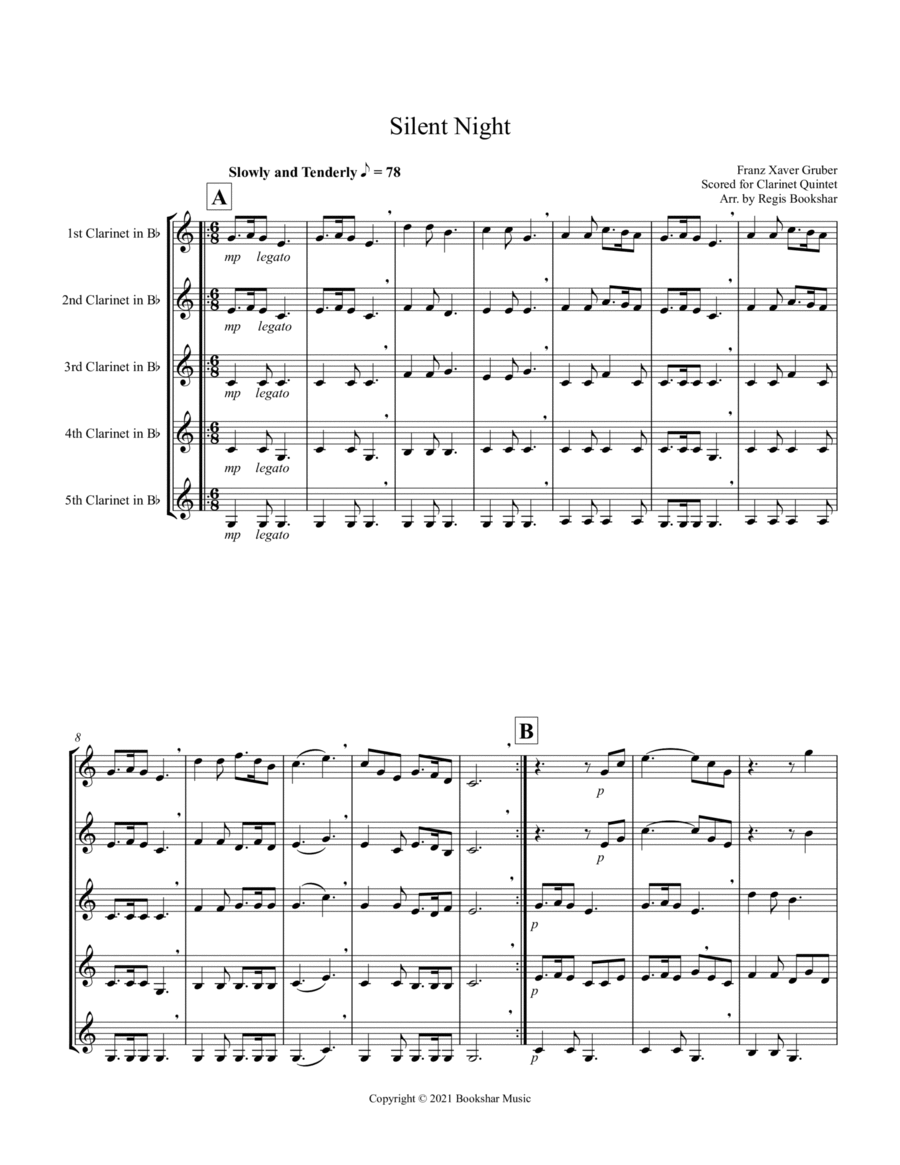
Silent Night (Bb) (Clarinet Quintet)
Ensemble de Clarinettes
the 1840's, the song was well known and was reported to be a favorite of Frederick William IV of Prussia During this period, the melody changed slightly to become the version that is commonly heard today
$5.00 4.34 € Ensemble de Clarinettes PDF SheetMusicPlus

Woodwind Ensemble Clarinet - Level 3 - Digital Download SKU: A0.813985 Composed by Franz Xaver Gruber. Arranged by Regis Bookshar. Christmas,Instructional,Multicultural,World. 12 pages. Regis Bookshar #6636625. Published by Regis Bookshar (A0.813985). Clarinet Octet - Intermediate - Digital Download. This arrangement of Silent Night, or in German, Stille Nacht, would be a wonderful addition to any music library and could be performed for Christmas concerts, recitals, and, especially, church services. It is equally suitable for junior and senior high school students and even older musicians. Depending on their ability, younger musicians would also enjoy playing this selection. Included are a score and a complete set of parts (12 pages). This selection is one of the many arrangements from The Regis Bookshar Trumpet Ensemble's extensive music library which are being made available for the first time.Silent Night is probably the most popular Christmas carol ever written. It was composed in 1818 by Franz Xaver Gruber to lyrics by Joseph Mohr and was first performed on Christmas Eve at St. Nicholas parish church in Oberndorf, a small village in present-day Austria. A young Catholic priest, Father Joseph Mohr, had written the poem, Stille Nacht, in 1816 and had gone to Oberndorf in 1817. The melody was composed by Franz Xaver Gruber, schoolmaster and organist in the nearby village of Arnsdorf. On Christmas Eve, 1818, Mohr brought the words to Gruber and asked him to compose a melody and guitar accompaniment for that night's mass, after river flooding had possibly damaged the church organ. The church was eventually destroyed by repeated flooding and has since been replaced with the Silent-Night-Chapel.According to Gruber, Karl Mauracher, an organ builder who serviced the instrument at the Oberndorf church, was enamored with the song, and took the composition home with him to the Ziller Valley in Tyrol, Austria. From there, two traveling families of folk singers, the Strassers and the Rainers, included the tune in their shows. The Rainers were already singing it around Christmas, 1819, and once performed it for an audience that included Franz I of Austria and Alexander I of Russia. They also gave the first performance of the song in the United States in New York City in 1839. By the 1840's, the song was well known and was reported to be a favorite of Frederick William IV of Prussia. During this period, the melody changed slightly to become the version that is commonly heard today. The version of the melody that is generally used today is a slow, meditative lullaby, or pastoral, differing slightly from Gruber's original which has a moderate tempo. The song has been translated into about 140 languages and has been recorded by many singers across many music genres. The version sung by Bing Crosby in 1935, has sold over 10 million copies as a single.In this arrangement of Silent Night, Regis Bookshar has kept the basic form of this familiar Christmas carol, but has also included a descant during the third verse. Also, in addition to this version for a Clarinet Octet, there are other arrangements of Silent Night available for a variety of instrumental ensembles. There are Quintets and Octets readily available for purchase. Please take the time to look for other versions of this composition. You may find something else that might also suit your needs.I would also encourage you to search for other arrangements by Regis Bookshar, as well, as there are numerous arrangements in a wide variety of styles, also available for purchase. You may find something else which might interest you. Please continue to check periodically because new arrangements are being added as often as possible. I'm certain that this wonderful arrangement of Silent Night will continue to entertain both performers and audiences alike for years to come.
Silent Night (Bb) (Clarinet Octet)
Ensemble de Clarinettes
the 1840's, the song was well known and was reported to be a favorite of Frederick William IV of Prussia During this period, the melody changed slightly to become the version that is commonly heard today
$8.00 6.94 € Ensemble de Clarinettes PDF SheetMusicPlus

Woodwind Ensemble Clarinet - Level 3 - Digital Download SKU: A0.814006 Composed by James R. Murray. Arranged by Regis Bookshar. Christmas,Instructional,Standards. 10 pages. Regis Bookshar #6658467. Published by Regis Bookshar (A0.814006). Clarinet Quintet - Intermediate - Digital Download. This arrangement of Away in a Manger, would be a fine addition to any music library and could be performed for Christmas concerts, recitals and church services. It is equally suitable for junior and senior high school students, and, depending on their ability, even younger students, too. Included are a score and a complete set of parts (10 pages). This selection is one of the many arrangements from The Regis Bookshar Trumpet Ensemble's extensive music library which are being made available for the first time.Away in a Manger is one of the most popular Christmas carols and there are a number of musical settings of it. The most popular musical setting of it in the United States is the tune commonly known as Mueller. It was composed by James R. Murray and was first published under the name Luther's Cradle Hymn, in his collection Dainty Songs for Little Lads and Lasses, in 1887. It was intended for use in kindergarten, school and home.In this selection, Regis Bookshar has arranged three verses of this popular Christmas carol for a Clarinet Quintet. The first verse is a traditional setting of the tune while the second verse has a more complex accompaniment. The third verse also includes a descant. Between the second and third verses, he has included a short interlude. In addition to this arrangement for a Clarinet Quintet, there are also other Quintet arrangements of Away in a Manger for a variety of instrumental ensembles, as well as quite a few other Christmas selections, readily available for purchase. Please take the time to look for other versions of this composition and other selections. You may find something else that may also suit your needs.I would also encourage you to search for other arrangements by Regis Bookshar, as well, as there are numerous arrangements in a wide variety of styles, also available for purchase. You may find something else which might interest you. Please continue to check periodically because new arrangements are being added as often as possible. I'm certain that this wonderful arrangement of Away in a Manger will continue to entertain both performers and audiences alike for years to come.

Away in a Manger (G) (Clarinet Quintet)
Ensemble de Clarinettes

$8.00 6.94 € Ensemble de Clarinettes PDF SheetMusicPlus

Clarinet Choir,Woodwind Ensemble Bass Clarinet,Contra Alto Clarinet,E-Flat Clarinet - Level 4 - Digital Download SKU: A0.720552 Composed by Richard Rodgers. Arranged by Ralph Raymond Hays. Broadway,Film/TV,Musical/Show. 25 pages. Ralph Raymond Hays #3591135. Published by Ralph Raymond Hays (A0.720552). This clever and unique arrangement of the well known Do-Re-Mi distinguishes itself from others in numerous ways, and is certain to captivate performers and audience members alike. Not merely a transcription from the score, the arranger strove to make the work idiomatic to the clarinet choir, and included the do-mi-mi -- mi-sol-sol... strain absent from most other instrumental arrangements. Each voice is featured, and the accompaniment varies from the mundane barrage of downbeats and afterbeats so often mechanically transcribed in other arrangements. The arranger has above all striven to encapsulate the joy and elation he felt many years ago when he was responsible for la while portraying Friedrich Von Trapp in a theatrical production. This arrangement can be combined with Professor Hays' other arrangements to create a SOUND OF MUSIC suite:https://www.sheetmusicplus.com/publishers/ralph-raymond-hays-sheet-music/3002340?narrow_by=the+sound...
Do-Re-Mi
Ensemble de Clarinettes

$12.99 11.27 € Ensemble de Clarinettes PDF SheetMusicPlus

Woodwind Ensemble Clarinet - Level 3 - Digital Download SKU: A0.549213 Composed by Gabrieli. Arranged by James M. Guthrie, ASCAP. Renaissance,Standards. 45 pages. Jmsgu3 #3464933. Published by jmsgu3 (A0.549213). A musical monument: the first composition to employ dynamics. Minimum Instrumentation:  8 Bb clarinets, 1 alto clarinet, 1 contralto clarinet, 1 contrabass clarinet. Duration: 3:45 at half-note = 86. Innovations First of all, Gabrieli preferred sacred vocal and certainly instrumental music. Hence, he concentrated on music that consequently took advantage of resonance and likewise reverberation for maximum effect. Seems like Gabrieli may have invented dynamics – or was rather the first to indicate them such as in his Sonata Pian’ e Forte. Consequently, he was also a pioneer in spatial techniques. He therefore developed and used very specific notation to indicate instrumentation. Gabrieli experimented with assembling massive instrumental forces into isolated groups separated by space. In this way, he consequently contributed heavily to the Baroque Concertato style. Polychoral Works Gabrieli probably used the layout of the San Marco church for his experiments. This is because he worked there as a musician and composer. Furthermore, the church had two choir lofts facing each other. He certainly used these to create striking spatial effects between instrumental forces. Certainly, many of his works are composed such that a choir or instrumental group could first be heard on one side, then consequently followed by a response from the group on the other side. Sometimes there was probably a third group positioned near the main altar as well. Spatial Music Above all, Gabrieli studied carefully detailed groups of instruments and singers. Furthermore, it seems like he created precise directions for instrumentation in rather than two groups. The instruments, because they could be appropriately situated, could consequently be heard with perfect clearness at distant locations. As a result, arrangements that seem bizarre on paper, can in contrast sound perfectly in balance. First Works Finally, Gabrieli published his first motets along with his uncle Andrea's compositions in Concerti (1587). These compositions furthermore indicate considerable usage of dialogue and echo effects. Consequently, here we see low and high choirs with the variance between their ranges indicated by instrumental accompaniment. Seems like Gabrieli’s later motets Sacrae Symphoniae (1597) move away from close antiphony. In contrast, he moves towards not simply echoing the material, but developing it through sequential choral entrances. Even more, he takes this procedure to the extreme in the Motet Omnes Gentes. Unlike earlier works, here the instruments are certainly an essential part of the presentation. Also, only parts marked: Capella are supposed to be sung. Homophony Hence, after 1605, Gabrieli moves to a much more homophonic style. He writes sections purely for instruments – which calls Sinfonia – and smaller sections for vocal soloists, accompanied by a basso continuo.  
Gabrieli: Sonata Pian e Forte Ch. 175 for Clarinet Choir
Ensemble de Clarinettes

$47.95 41.58 € Ensemble de Clarinettes PDF SheetMusicPlus

Woodwind Ensemble Clarinet - Level 3 - Digital Download SKU: A0.549204 Composed by Gabrieli. Arranged by James M. Guthrie, ASCAP. Renaissance,Standards. 56 pages. Jmsgu3 #3461855. Published by jmsgu3 (A0.549204). Instrumentation: 2 Eb clarinets, 4 Bb clarinets, 2 bass clarinets. Arranged as a double quartet. Includes Full Score: 28 pg. Study Score: 14 pg. and instrumental parts: 2 pg. Duration: ca. 3:00. Innovations First of all, Gabrieli preferred sacred vocal and certainly instrumental music. Hence, he concentrated on music that consequently took advantage of resonance and likewise reverberation for maximum effect. Seems like Gabrieli may have invented dynamics – or was rather the first to indicate them such as in his Sonata Pian’ e Forte. Consequently, he was also a pioneer in spatial techniques. He therefore developed and used very specific notation to indicate instrumentation. Gabrieli experimented with assembling massive instrumental forces into isolated groups separated by space. In this way, he consequently contributed heavily to the Baroque Concertato style. Polychoral Works Gabrieli probably used the layout of the San Marco church for his experiments. This is because he worked there as a musician and composer. Furthermore, the church had two choir lofts facing each other. He certainly used these to create striking spatial effects between instrumental forces. Certainly, many of his works are composed such that a choir or instrumental group could first be heard on one side, then consequently followed by a response from the group on the other side. Sometimes there was probably a third group positioned near the main altar as well. Spatial Music Above all, Gabrieli studied carefully detailed groups of instruments and singers. Furthermore, it seems like he created precise directions for instrumentation in rather more than two groups. The instruments, because they could be appropriately situated, could consequently be heard with perfect clearness at distant locations. As a result, arrangements which seem bizarre on paper, can in contrast sound perfectly in-balance. First Works Finally, Gabrieli published his first motets along with his uncle Andrea's compositions in Concerti (1587). These compositions furthermore indicate considerable usage of dialogue and echo effects. Consequently, here we see low and high choirs with the variance between their ranges indicated by instrumental accompaniment. Seems like Gabrieli’s later motets Sacrae Symphoniae (1597) move away from close antiphony. In contrast, he moves towards not simply echoing the material, but developing it by sequential choral entrances. Even more, he takes this procedure to the extreme in the Motet Omnes Gentes. Unlike earlier works, here the instruments are certainly an essential part of the presentation. Also, only parts marked: Capella are supposed to be sung. Homophony Hence, after 1605, Gabrieli moves to a much more homophonic style. He writes sections purely for instruments – which calls Sinfonia – and smaller sections for vocal soloists, accompanied by a basso continuo.
Gabrieli: Canzon Septimi Toni Ch 172 for Clarinet Choir
Ensemble de Clarinettes

$47.95 41.58 € Ensemble de Clarinettes PDF SheetMusicPlus

Woodwind Ensemble Clarinet - Level 5 - Digital Download SKU: A0.767258 Composed by Claudio Monteverdi. Arranged by Mike Lyons. Baroque,Renaissance. 62 pages. Lyons Music Services #3121649. Published by Lyons Music Services (A0.767258). The Fifth book of madrigals starts to see much more development towards operatic style writing, with more songs being strung together to form scenas and with the addition of accompaniment on instruments. Some of these songs can be written by incorporating the accompaniment into the parts for those instruments which are resting, some will require more than a quintet. Certainly as we get into the next three books, reduction to a quintet will become increasingly more difficult, if not impossible. The final song from book 5 shows quite an advance on the previously (relatively) simple writing. Here we have a full SATB ensemble plus a quite detailed continuo. Questi vaghi (These wandering little birds) also has a more complex structure, being, by itself a scena, split into sections by ritornelli which he calls Sinfonias. At this stage, they are by no means substantial enough to be considered preludes or interludes, but merely dances between the sections of the song. Because of this added complexity, I have had to arrange the piece for a 9-part brass choir. There is some overlap and crossover between the continuo and choral parts to accommodate the different groupings needed for each section. The ritornello sections need to be played more lightly and in a skipping style to add contrast between the 'vocal sections'.
Monteverdi - The Fifth Book of Madrigals (1605) - 19. Questi vaghi
Ensemble de Clarinettes

$8.99 7.8 € Ensemble de Clarinettes PDF SheetMusicPlus

Clarinet Choir,Woodwind Ensemble Bass Clarinet,Contra Alto Clarinet,E-Flat Clarinet - Level 4 - Digital Download SKU: A0.764956 Composed by Lori Archer Sutherland. Contemporary,Folk,Standards. 50 pages. Lori Archer Sutherland #4597193. Published by Lori Archer Sutherland (A0.764956). For clarinet choir (Eb, 4 Bb, Alto, Bass, Eb Contra, Bb Contra. Alternate Bb parts included for Eb and Alto. Basset horn part included (doubles Alto)).You may print multiple parts as needed for your ensemble.The Monk’s Turned Topsy-Turvy is an original fantasy for clarinet choir, based on the old French-Canadian children’s song, Ah! Si mon moine voulait danser! (Danse, mon moine, danse). The title is a play on words: moine means both monk and spinning top in French. The lyrics speak of persuading mon moine to dance by offering various articles of clothing, such as a hood or cap.After a brief, yet bold, introduction, the piece jumps into a straightforward rendition of the tune. From there, the melody is repeated, bringing in other voices and added flourishes. While the tune starts to repeat a third time, it doesn’t get to finish its full statement. It’s interrupted by a run up through the ensemble into a rollicking 7/8 section.With a rhythmic accompaniment underneath, the jaunty melody begins in the third clarinets. The upper instruments take over briefly in 6/8, then the tune returns to 7/8. After a quick breather, the accompaniment introduces an upward sweep motif. This alternates with the accompaniment pattern heard at the beginning of the 7/8 section.The lower voices then take control, driving downward into a different tonality and mood. An undulating accompaniment sets a dreamlike feel, with different voices quoting fragments of the theme. The accompaniment transfers between voices throughout the section, eventually changing back into a 3/4, then a 2/4 feel, resulting in a transition back to the original feel of the piece.The low voices get the melody, with rhythmic accompaniment and racing runs throughout the other sections. The melody goes a bit topsy-turvy before the group comes together in the descending quarter note motif from the beginning of the piece, bringing us to the coda. There’s one final quote of the opening of the main theme from the low voices, leading to a whirlwind in the first and Eb with accented notes and suspensions underneath. The Eb pipes up with one last comment and the group closes out the piece.Also available for concert band (S0.708971)
The Monk's Turned Topsy-Turvy
Ensemble de Clarinettes

$25.00 21.68 € Ensemble de Clarinettes PDF SheetMusicPlus


Partitions Gratuites
Acheter des Partitions Musicales
Acheter des Partitions Digitales à Imprimer
Acheter des Instruments de Musique

© 2000 - 2026

Accueil - Version intégrale




