EUROPE
61 articles
USA
0 articles
DIGITAL
32 articles (à imprimer)
Partitions Digitales
Partitions à imprimer
32 partitions trouvées


Woodwind Ensemble Clarinet - Level 3 - Digital Download SKU: A0.549213 Composed by Gabrieli. Arranged by James M. Guthrie, ASCAP. Renaissance,Standards. 45 pages. Jmsgu3 #3464933. Published by jmsgu3 (A0.549213). A musical monument: the first composition to employ dynamics. Minimum Instrumentation:  8 Bb clarinets, 1 alto clarinet, 1 contralto clarinet, 1 contrabass clarinet. Duration: 3:45 at half-note = 86. Innovations First of all, Gabrieli preferred sacred vocal and certainly instrumental music. Hence, he concentrated on music that consequently took advantage of resonance and likewise reverberation for maximum effect. Seems like Gabrieli may have invented dynamics – or was rather the first to indicate them such as in his Sonata Pian’ e Forte. Consequently, he was also a pioneer in spatial techniques. He therefore developed and used very specific notation to indicate instrumentation. Gabrieli experimented with assembling massive instrumental forces into isolated groups separated by space. In this way, he consequently contributed heavily to the Baroque Concertato style. Polychoral Works Gabrieli probably used the layout of the San Marco church for his experiments. This is because he worked there as a musician and composer. Furthermore, the church had two choir lofts facing each other. He certainly used these to create striking spatial effects between instrumental forces. Certainly, many of his works are composed such that a choir or instrumental group could first be heard on one side, then consequently followed by a response from the group on the other side. Sometimes there was probably a third group positioned near the main altar as well. Spatial Music Above all, Gabrieli studied carefully detailed groups of instruments and singers. Furthermore, it seems like he created precise directions for instrumentation in rather than two groups. The instruments, because they could be appropriately situated, could consequently be heard with perfect clearness at distant locations. As a result, arrangements that seem bizarre on paper, can in contrast sound perfectly in balance. First Works Finally, Gabrieli published his first motets along with his uncle Andrea's compositions in Concerti (1587). These compositions furthermore indicate considerable usage of dialogue and echo effects. Consequently, here we see low and high choirs with the variance between their ranges indicated by instrumental accompaniment. Seems like Gabrieli’s later motets Sacrae Symphoniae (1597) move away from close antiphony. In contrast, he moves towards not simply echoing the material, but developing it through sequential choral entrances. Even more, he takes this procedure to the extreme in the Motet Omnes Gentes. Unlike earlier works, here the instruments are certainly an essential part of the presentation. Also, only parts marked: Capella are supposed to be sung. Homophony Hence, after 1605, Gabrieli moves to a much more homophonic style. He writes sections purely for instruments – which calls Sinfonia – and smaller sections for vocal soloists, accompanied by a basso continuo.  
Gabrieli: Sonata Pian e Forte Ch. 175 for Clarinet Choir
Ensemble de Clarinettes

$47.95 41.32 € Ensemble de Clarinettes PDF SheetMusicPlus

Woodwind Ensemble Clarinet - Level 4 - Digital Download SKU: A0.813852 Composed by Peter Ilyich Tchaikovsky. Arranged by Regis Bookshar. Christmas,Instructional,Romantic Period,Standards. 24 pages. Regis Bookshar #6612461. Published by Regis Bookshar (A0.813852). Clarinet Quintet - Advanced/Intermediate - Digital Download. This marvelous arrangement of the March from Peter Ilyich Tchaikovsky's extremely popular, The Nutcracker Suite, would be a fabulous addition to any music library and could be performed for concerts and recitals but would be most appropriate during the Holiday season. This selection has been arranged to keep all of the intensity and excitement of the original composition and is suitable for high school and college students but professional musicians would also enjoy playing this selection. Included are a score and a complete set of parts (24 pages). This selection is one of the many arrangements from The Regis Bookshar Trumpet Ensemble's extensive music library which are being made available for the first time.The Nutcracker is an 1892 two-act ballet with a score by Peter Ilyich Tchaikovsky. It has enjoyed enormous popularity since the late 1960's and is performed by countless ballet companies, primarily during the Christmas season, especially in North America. Tchaikovsky's score has become one of his most famous compositions. Some critics have called it astonishingly rich in detailed inspiration and from beginning to end, beautiful, melodious, original and characteristic. The ballet's first complete performance outside Russia took place in England in 1934. The first complete United States performance was on December 24, 1944, by the San Francisco Ballet. It was such an enormous success that the San Francisco Ballet has presented The Nutcracker every Christmas Eve and throughout the winter season, debuting new productions in 1944, 1954, 1967 and 2004. In Salt Lake City, it has been performed every year since 1963. The New York City Ballet gave its first annual performance in 1954. In addition to annual live stagings of the work, many productions have also been televised or released on home video.The Nutcracker continues to be one of Tchaikovsky's most popular compositions and contains some of his most memorable works. Tchaikovsky made a selection of eight of the numbers from the ballet before the ballet's December 1892 premiere, forming The Nutcracker Suite, Op. 71a, and is intended for concert performance. The suite was first performed, under the composer's direction, on March 19, 1892. The suite became instantly popular with almost every number encored at its premiere.Regis Bookshar thought that it would be wonderful if other instrumentalists could also have the opportunity to play some of these wonderful compositions, originally scored for a full orchestra, and has arranged two of the selections, the popular March and the Russian Dance for a wide variety of instrumental ensembles. So, in addition to this version of the March for a Clarinet Quintet, he has made quite a few other arrangements of this selection for various Quintets and Octets and are readily available. If you should decide to purchase this arrangement of the March, I would highly encourage you to also consider purchasing the arrangement of the Russian Dance as well. Scheduling the March followed by the Russian Dance would be a very satisfying addition to any concert or recital. Please take the time to look for other versions of these compositions. You may find something else that might also suit your needs.I would also encourage you to search for other arrangements by Regis Bookshar, as there are numerous selections in a variety of styles, also available for purchase. You may find something else which might interest you. Please continue to check periodically because new arrangements are being added as often as possible. I'm certain that this wonderful arrangement of the March from Tchaikovsky's marvelous holiday favorite, The Nutcracker Suite, will continue to entertain both performers and audiences alike for years to come.
March (from "The Nutcracker Suite") (F) (Clarinet Quintet)
Ensemble de Clarinettes

$20.00 17.23 € Ensemble de Clarinettes PDF SheetMusicPlus

Woodwind Ensemble Clarinet - Level 4 - Digital Download SKU: A0.813875 Composed by Peter Ilyich Tchaikovsky. Arranged by Regis Bookshar. Christmas,Instructional,Romantic Period,Standards. 43 pages. Regis Bookshar #6612649. Published by Regis Bookshar (A0.813875). Clarinet Octet - Advanced/Intermediate - Digital Download. This marvelous arrangement of the March from Peter Ilyich Tchaikovsky's extremely popular, The Nutcracker Suite, would be a fabulous addition to any music library and could be performed for concerts and recitals but would be most appropriate during the Holiday season. This selection has been arranged to keep all of the intensity and excitement of the original composition and is suitable for high school and college students but professional musicians would also enjoy playing this selection. Included are a score and a complete set of parts (43 pages). This selection is one of the many arrangements from The Regis Bookshar Trumpet Ensemble's extensive music library which are being made available for the first time.The Nutcracker is an 1892 two-act ballet with a score by Peter Ilyich Tchaikovsky. It has enjoyed enormous popularity since the late 1960's and is performed by countless ballet companies, primarily during the Christmas season, especially in North America. Tchaikovsky's score has become one of his most famous compositions. Some critics have called it astonishingly rich in detailed inspiration and from beginning to end, beautiful, melodious, original and characteristic. The ballet's first complete performance outside Russia took place in England in 1934. The first complete United States performance was on December 24, 1944, by the San Francisco Ballet. It was such an enormous success that the San Francisco Ballet has presented The Nutcracker every Christmas Eve and throughout the winter season, debuting new productions in 1944, 1954, 1967 and 2004. In Salt Lake City, it has been performed every year since 1963. The New York City Ballet gave its first annual performance in 1954. In addition to annual live stagings of the work, many productions have also been televised or released on home video.The Nutcracker continues to be one of Tchaikovsky's most popular compositions and contains some of his most memorable works. Tchaikovsky made a selection of eight of the numbers from the ballet before the ballet's December 1892 premiere, forming The Nutcracker Suite, Op. 71a, and is intended for concert performance. The suite was first performed, under the composer's direction, on March 19, 1892. The suite became instantly popular with almost every number encored at its premiere.Regis Bookshar thought that it would be wonderful if other instrumentalists could also have the opportunity to play some of these wonderful compositions, originally scored for a full orchestra, and has arranged two of the selections, the popular March and the Russian Dance for a wide variety of instrumental ensembles. So, in addition to this version of the March for a Clarinet Octet, he has made quite a few other arrangements of this selection for various Quintets and Octets and are readily available. If you should decide to purchase this arrangement of the March, I would highly encourage you to also consider purchasing the arrangement of the Russian Dance as well. Scheduling the March followed by the Russian Dance would be a very satisfying addition to any concert or recital. Please take the time to look for other versions of these compositions. You may find something else that might also suit your needs.I would also encourage you to search for other arrangements by Regis Bookshar, as there are numerous selections in a variety of styles, also available for purchase. You may find something else which might interest you. Please continue to check periodically because new arrangements are being added as often as possible. I'm certain that this wonderful arrangement of the March from Tchaikovsky's marvelous holiday favorite, The Nutcracker Suite, will continue to entertain both performers and audiences alike for years to come.
March (from "The Nutcracker Suite") (F) (Clarinet Octet)
Ensemble de Clarinettes

$32.00 27.57 € Ensemble de Clarinettes PDF SheetMusicPlus

Woodwind Ensemble Clarinet - Level 4 - Digital Download SKU: A0.813921 Composed by Peter Ilyich Tchaikovsky. Arranged by Regis Bookshar. Christmas,Romantic Period,Standards. 15 pages. Regis Bookshar #6615137. Published by Regis Bookshar (A0.813921). Clarinet Octet - Advanced/Intermediate - Digital Download. This marvelous arrangement of the Russian Dance from Peter Ilyich Tchaikovsky's extremely popular, The Nutcracker Suite, would be a fabulous addition to any music library and could be performed for concerts and recitals but would be most appropriate during the Holiday season. This selection has been arranged to keep all of the intensity and excitement of the original composition and is suitable for high school and college students but professional musicians would also enjoy playing this selection. Included are a score and a complete set of parts (15 pages). This selection is one of the many arrangements from The Regis Bookshar Trumpet Ensemble's extensive music library which are being made available for the first time.The Nutcracker is an 1892 two-act ballet with a score by Peter Ilyich Tchaikovsky. It has enjoyed enormous popularity since the late 1960's and is performed by countless ballet companies, primarily during the Christmas season, especially in North America. Tchaikovsky's score has become one of his most famous compositions. Some critics have called it astonishingly rich in detailed inspiration and from beginning to end, beautiful, melodious, original and characteristic. The ballet's first complete performance outside Russia took place in England in 1934. The first complete United States performance was on December 24, 1944, by the San Francisco Ballet. It was such an enormous success that the San Francisco Ballet has presented The Nutcracker every Christmas Eve and throughout the winter season, debuting new productions in 1944, 1954, 1967 and 2004. In Salt Lake City, it has been performed every year since 1963. The New York City Ballet gave its first annual performance in 1954. In addition to annual live stagings of the work, many productions have also been televised or released on home video.The Nutcracker continues to be one of Tchaikovsky's most popular compositions and contains some of his most memorable works. Tchaikovsky made a selection of eight of the numbers from the ballet before the ballet's December 1892 premiere, forming The Nutcracker Suite, Op. 71a, and is intended for concert performance. The suite was first performed, under the composer's direction, on March 19, 1892. The suite became instantly popular with almost every number encored at its premiere.Regis Bookshar thought that it would be wonderful if other instrumentalists could also have the opportunity to play some of these wonderful compositions, originally scored for a full orchestra, and has arranged two of the selections, the popular March and the Russian Dance, one of the character dances, based on the Russian and Ukrainian folk dance, Trepak, for a wide variety of instrumental ensembles. So, in addition to this version of the Russian Dance, for a Clarinet Octet, he has made quite a few other arrangements of this selection for various Quintets and Octets and are readily available. If you should decide to purchase this arrangement of the Russian Dance, I would highly encourage you to also consider purchasing the arrangement of the March as well. Scheduling the March followed by the Russian Dance would be a very satisfying addition to any concert or recital. Please take the time to look for other versions of these compositions. You may find something else that might also suit your needs.I would also encourage you to search for other arrangements by Regis Bookshar, as there are numerous selections in a variety of styles, also available for purchase. You may find something else which might interest you. Please continue to check periodically because new arrangements are being added as often as possible. I'm certain that this wonderful arrangement of the Russian Dance from Tchaikovsky's marvelous holiday favorite, The Nutcracker Suite, will continue to entertain both performers and audiences.
Russian Dance ("Trepak") (from "The Nutcracker Suite") (F) (Clarinet Octet)
Ensemble de Clarinettes

$16.00 13.79 € Ensemble de Clarinettes PDF SheetMusicPlus

Woodwind Ensemble Clarinet - Level 3 - Digital Download SKU: A0.549204 Composed by Gabrieli. Arranged by James M. Guthrie, ASCAP. Renaissance,Standards. 56 pages. Jmsgu3 #3461855. Published by jmsgu3 (A0.549204). Instrumentation: 2 Eb clarinets, 4 Bb clarinets, 2 bass clarinets. Arranged as a double quartet. Includes Full Score: 28 pg. Study Score: 14 pg. and instrumental parts: 2 pg. Duration: ca. 3:00. Innovations First of all, Gabrieli preferred sacred vocal and certainly instrumental music. Hence, he concentrated on music that consequently took advantage of resonance and likewise reverberation for maximum effect. Seems like Gabrieli may have invented dynamics – or was rather the first to indicate them such as in his Sonata Pian’ e Forte. Consequently, he was also a pioneer in spatial techniques. He therefore developed and used very specific notation to indicate instrumentation. Gabrieli experimented with assembling massive instrumental forces into isolated groups separated by space. In this way, he consequently contributed heavily to the Baroque Concertato style. Polychoral Works Gabrieli probably used the layout of the San Marco church for his experiments. This is because he worked there as a musician and composer. Furthermore, the church had two choir lofts facing each other. He certainly used these to create striking spatial effects between instrumental forces. Certainly, many of his works are composed such that a choir or instrumental group could first be heard on one side, then consequently followed by a response from the group on the other side. Sometimes there was probably a third group positioned near the main altar as well. Spatial Music Above all, Gabrieli studied carefully detailed groups of instruments and singers. Furthermore, it seems like he created precise directions for instrumentation in rather more than two groups. The instruments, because they could be appropriately situated, could consequently be heard with perfect clearness at distant locations. As a result, arrangements which seem bizarre on paper, can in contrast sound perfectly in-balance. First Works Finally, Gabrieli published his first motets along with his uncle Andrea's compositions in Concerti (1587). These compositions furthermore indicate considerable usage of dialogue and echo effects. Consequently, here we see low and high choirs with the variance between their ranges indicated by instrumental accompaniment. Seems like Gabrieli’s later motets Sacrae Symphoniae (1597) move away from close antiphony. In contrast, he moves towards not simply echoing the material, but developing it by sequential choral entrances. Even more, he takes this procedure to the extreme in the Motet Omnes Gentes. Unlike earlier works, here the instruments are certainly an essential part of the presentation. Also, only parts marked: Capella are supposed to be sung. Homophony Hence, after 1605, Gabrieli moves to a much more homophonic style. He writes sections purely for instruments – which calls Sinfonia – and smaller sections for vocal soloists, accompanied by a basso continuo.
Gabrieli: Canzon Septimi Toni Ch 172 for Clarinet Choir
Ensemble de Clarinettes

$47.95 41.32 € Ensemble de Clarinettes PDF SheetMusicPlus

Woodwind Ensemble Clarinet - Level 4 - Digital Download SKU: A0.813899 Composed by Peter Ilyich Tchaikovsky. Arranged by Regis Bookshar. Christmas,Instructional,Romantic Period,Standards. 9 pages. Regis Bookshar #6612903. Published by Regis Bookshar (A0.813899). Clarinet Quintet - Advanced/Intermediate - Digital Download. This marvelous arrangement of the Russian Dance (Trepak), from Peter Ilyich Tchaikovsky's extremely popular, The Nutcracker Suite, would be a fabulous addition to any music library and could be performed for concerts and recitals but would be most appropriate during the Holiday season. This selection has been arranged to keep all of the intensity and excitement of the original composition and is suitable for high school and college students but professional musicians would also enjoy playing this selection. Included are a score and a complete set of parts (9 pages). This selection is one of the many arrangements from The Regis Bookshar Trumpet Ensemble's extensive music library which are being made available for the first time.The Nutcracker is an 1892 two-act ballet with a score by Peter Ilyich Tchaikovsky. It has enjoyed enormous popularity since the late 1960's and is performed by countless ballet companies, primarily during the Christmas season, especially in North America. Tchaikovsky's score has become one of his most famous compositions. Some critics have called it astonishingly rich in detailed inspiration and from beginning to end, beautiful, melodious, original and characteristic. The ballet's first complete performance outside Russia took place in England in 1934. The first complete United States performance was on December 24, 1944, by the San Francisco Ballet. It was such an enormous success that the San Francisco Ballet has presented The Nutcracker every Christmas Eve and throughout the winter season, debuting new productions in 1944, 1954, 1967 and 2004. In Salt Lake City, it has been performed every year since 1963. The New York City Ballet gave its first annual performance in 1954. In addition to annual live stagings of the work, many productions have also been televised or released on home video.The Nutcracker continues to be one of Tchaikovsky's most popular compositions and contains some of his most memorable works. Tchaikovsky made a selection of eight of the numbers from the ballet before the ballet's December 1892 premiere, forming The Nutcracker Suite, Op. 71a, and is intended for concert performance. The suite was first performed, under the composer's direction, on March 19, 1892. The suite became instantly popular with almost every number encored at its premiere.Regis Bookshar thought that it would be wonderful if other instrumentalists could also have the opportunity to play some of these wonderful compositions, originally scored for a full orchestra, and has arranged two of the selections, the popular March and the Russian Dance, one of the character dances, based on the traditional Russian and Ukrainian folk dance, Trepak, for a wide variety of instrumental ensembles. So, in addition to this version of the Russian Dance for a Clarinet Quintet, he has made quite a few other arrangements of this selection for various Quintets and Octets and are readily available. If you should decide to purchase this arrangement of the Russian Dance, I would highly encourage you to also consider purchasing the arrangement of the March as well. Scheduling the March followed by the Russian Dance would be a very satisfying addition to any concert or recital. Please take the time to look for other versions of these compositions. You may find something else that might also suit your needs.I would also encourage you to search for other arrangements by Regis Bookshar, as there are numerous selections in a variety of styles, also available for purchase. You may find something else which might interest you. Please continue to check periodically because new arrangements are being added as often as possible. I'm certain that this wonderful arrangement of the Russian Dance from Tchaikovsky's marvelous holiday favorite, The Nutcracker Suite, will continue to entertai.
Russian Dance ("Trepak") (from "The Nutcracker Suite") (F) (Clarinet Quintet)
Ensemble de Clarinettes

$10.00 8.62 € Ensemble de Clarinettes PDF SheetMusicPlus

Woodwind Ensemble Clarinet - Level 3 - Digital Download SKU: A0.548650 Composed by J. S. Bach, 1685 - 1750. Arranged by James M. Guthrie, ASCAP. Christmas,Easter,Wedding. 32 pages. Jmsgu3 #3407883. Published by jmsgu3 (A0.548650). Jesu, Joy of Man's Desiring from Bach's Cantata 147, arranged for the clarinet choir.1 Eb Clarinet3 Bb Clarinets1 Alto Clarinet1 Bass Clarinet1 Contrabass ClarinetScore: 18 pg. Parts: 2 pg. Duration: 5:00 with optional repeat. Jesu, Joy of Man’s Desiring Bach composed a cantata called Herz und Mund und Tat und Leben. Though it is the 32nd cantata, it is listed as BWV 147. Jesu, Joy of Man’s Desiring is the 10th movement of the cantata. It was customary to use previous melodies as a basis for a new work - a practice called Cantus prius factus. So, the chorale melody for this piece is a historic tune called Werde munter, mein Gemüthe. Jesu, Joy of Man’s Desiring is customarily performed at weddings and during major church seasons such as Easter and Christmas. Bach Overview First, Johann Sebastian Bach may be the greatest composer in music history. Indeed, he was prolific. As a result, everyone has heard of his works. Furthermore, these works number well over a thousand. People are probably most familiar with instrumental works such as the Brandenburg Concertos and the Goldberg Variations. But, similarly famous are such noteworthy works as the Well-Tempered Clavier, the Musical Offering, and certainly the Art of Fugue. His most famous vocal works seem to include the most noteworthy Mass in B Minor. Also, the St. John Passion and certainly the Christmas Oratorio are the most noteworthy.  History Bach came from a long line of musicians and, above all, composers. Consequently, he first pursued a career as a church organist. As a result, he gained employment in various Protestant churches in Germany. He worked as a court musician in Weimar and Köthen for a while. Here he probably developed his organ style and, likewise, his chamber music style. Eventually, he gained an appointment as Cantor of St. Thomas in Leipzig. Here he worked until difficulties with his employer ultimately drove him away. The King of Poland finally appointed him as court composer.  Style It seems like Bach created a fascinating new international style. He synthesized elements of the most noteworthy European music ideas into his new style. This new style was probably his synthesis of European musical rhythm and form. Furthermore, in addition to his complete mastery of counterpoint and motivic development, his sense of harmonic organization probably propelled him to the top. Revival                Mendelssohn conducted a Bach revival in the nineteenth century. His effort probably helped to re-familiarize the public with the magnitude of Bach’s works. During this period, scholars published many noteworthy Bach biographies. Moreover, Wolfgang Schmieder published the BWV (Bach Werke Verzeichnis). As a result, this is now the official catalog of his entire artistic output. The BWV number allows us to locate a work in the catalog. Sometimes scholars will use an S (Schmieder) as an abbreviation for BWV.
Bach: Jesu, Joy of Man's Desiring for Clarinet Choir
Ensemble de Clarinettes

$49.95 43.04 € Ensemble de Clarinettes PDF SheetMusicPlus

Woodwind Ensemble Clarinet - Level 3 - Digital Download SKU: A0.813963 Composed by Franz Xaver Gruber. Arranged by Regis Bookshar. Christmas,Instructional,Multicultural,World. 7 pages. Regis Bookshar #6632975. Published by Regis Bookshar (A0.813963). Clarinet Quintet - Intermediate - Digital Download. This arrangement of Silent Night, or in German, Stille Nacht, would be a wonderful addition to any music library and could be performed for Christmas concerts, recitals, and, especially, church services. It is equally suitable for junior and senior high school students and even older musicians. Depending on their ability, younger musicians would also enjoy playing this selection. Included are a score and a complete set of parts (7 pages). This selection is one of the many arrangements from The Regis Bookshar Trumpet Ensemble's extensive music library which are being made available for the first time.Silent Night is probably the most popular Christmas carol ever written. It was composed in 1818 by Franz Xaver Gruber to lyrics by Joseph Mohr and was first performed on Christmas Eve at St. Nicholas parish church in Oberndorf, a small village in present-day Austria. A young Catholic priest, Father Joseph Mohr, had written the poem, Stille Nacht, in 1816 and had gone to Oberndorf in 1817. The melody was composed by Franz Xaver Gruber, schoolmaster and organist in the nearby village of Arnsdorf. On Christmas Eve, 1818, Mohr brought the words to Gruber and asked him to compose a melody and guitar accompaniment for that night's mass, after river flooding had possibly damaged the church organ. The church was eventually destroyed by repeated flooding and has since been replaced with the Silent-Night-Chapel.According to Gruber, Karl Mauracher, an organ builder who serviced the instrument at the Oberndorf church, was enamored with the song, and took the composition home with him to the Ziller Valley in Tyrol, Austria. From there, two traveling families of folk singers, the Strassers and the Rainers, included the tune in their shows. The Rainers were already singing it around Christmas, 1819, and once performed it for an audience that included Franz I of Austria and Alexander I of Russia. They also gave the first performance of the song in the United States in New York City in 1839. By the 1840's, the song was well known and was reported to be a favorite of Frederick William IV of Prussia. During this period, the melody changed slightly to become the version that is commonly heard today. The version of the melody that is generally used today is a slow, meditative lullaby, or pastoral, differing slightly from Gruber's original which has a moderate tempo. The song has been translated into about 140 languages and has been recorded by many singers across many music genres. The version sung by Bing Crosby in 1935, has sold over 10 million copies as a single.In this arrangement of Silent Night, Regis Bookshar has kept the basic form of this familiar Christmas carol, but has also included a descant during the third verse. Also, in addition to this version for a Clarinet Quinet, there are other arrangements of Silent Night available for a variety of instrumental ensembles. There are Quintets and Octets readily available for purchase. Please take the time to look for other versions of this composition. You may find something else that might also suit your needs.I would also encourage you to search for other arrangements by Regis Bookshar, as well, as there are numerous arrangements in a wide variety of styles, also available for purchase. You may find something else which might interest you. Please continue to check periodically because new arrangements are being added as often as possible. I'm certain that this wonderful arrangement of Silent Night will continue to entertain both performers and audiences alike for years to come.
Silent Night (Bb) (Clarinet Quintet)
Ensemble de Clarinettes
the 1840's, the song was well known and was reported to be a favorite of Frederick William IV of Prussia During this period, the melody changed slightly to become the version that is commonly heard today
$5.00 4.31 € Ensemble de Clarinettes PDF SheetMusicPlus

Woodwind Ensemble Clarinet - Level 3 - Digital Download SKU: A0.813985 Composed by Franz Xaver Gruber. Arranged by Regis Bookshar. Christmas,Instructional,Multicultural,World. 12 pages. Regis Bookshar #6636625. Published by Regis Bookshar (A0.813985). Clarinet Octet - Intermediate - Digital Download. This arrangement of Silent Night, or in German, Stille Nacht, would be a wonderful addition to any music library and could be performed for Christmas concerts, recitals, and, especially, church services. It is equally suitable for junior and senior high school students and even older musicians. Depending on their ability, younger musicians would also enjoy playing this selection. Included are a score and a complete set of parts (12 pages). This selection is one of the many arrangements from The Regis Bookshar Trumpet Ensemble's extensive music library which are being made available for the first time.Silent Night is probably the most popular Christmas carol ever written. It was composed in 1818 by Franz Xaver Gruber to lyrics by Joseph Mohr and was first performed on Christmas Eve at St. Nicholas parish church in Oberndorf, a small village in present-day Austria. A young Catholic priest, Father Joseph Mohr, had written the poem, Stille Nacht, in 1816 and had gone to Oberndorf in 1817. The melody was composed by Franz Xaver Gruber, schoolmaster and organist in the nearby village of Arnsdorf. On Christmas Eve, 1818, Mohr brought the words to Gruber and asked him to compose a melody and guitar accompaniment for that night's mass, after river flooding had possibly damaged the church organ. The church was eventually destroyed by repeated flooding and has since been replaced with the Silent-Night-Chapel.According to Gruber, Karl Mauracher, an organ builder who serviced the instrument at the Oberndorf church, was enamored with the song, and took the composition home with him to the Ziller Valley in Tyrol, Austria. From there, two traveling families of folk singers, the Strassers and the Rainers, included the tune in their shows. The Rainers were already singing it around Christmas, 1819, and once performed it for an audience that included Franz I of Austria and Alexander I of Russia. They also gave the first performance of the song in the United States in New York City in 1839. By the 1840's, the song was well known and was reported to be a favorite of Frederick William IV of Prussia. During this period, the melody changed slightly to become the version that is commonly heard today. The version of the melody that is generally used today is a slow, meditative lullaby, or pastoral, differing slightly from Gruber's original which has a moderate tempo. The song has been translated into about 140 languages and has been recorded by many singers across many music genres. The version sung by Bing Crosby in 1935, has sold over 10 million copies as a single.In this arrangement of Silent Night, Regis Bookshar has kept the basic form of this familiar Christmas carol, but has also included a descant during the third verse. Also, in addition to this version for a Clarinet Octet, there are other arrangements of Silent Night available for a variety of instrumental ensembles. There are Quintets and Octets readily available for purchase. Please take the time to look for other versions of this composition. You may find something else that might also suit your needs.I would also encourage you to search for other arrangements by Regis Bookshar, as well, as there are numerous arrangements in a wide variety of styles, also available for purchase. You may find something else which might interest you. Please continue to check periodically because new arrangements are being added as often as possible. I'm certain that this wonderful arrangement of Silent Night will continue to entertain both performers and audiences alike for years to come.
Silent Night (Bb) (Clarinet Octet)
Ensemble de Clarinettes
the 1840's, the song was well known and was reported to be a favorite of Frederick William IV of Prussia During this period, the melody changed slightly to become the version that is commonly heard today
$8.00 6.89 € Ensemble de Clarinettes PDF SheetMusicPlus

Woodwind Ensemble Clarinet - Digital Download SKU: A0.813826 Composed by Antonin Dvorak. Arranged by Regis Bookshar. Contemporary,Folk,Romantic Period,Standards. 18 pages. Regis Bookshar #6533907. Published by Regis Bookshar (A0.813826). Largo (from Symphony No. 9 in E minor) (From the New World) (Db) (Clarinet Quintet) - Intermediate - Digital Download. This marvelous arrangement of the Largo, based on the second movement of Antonin Dvorak's Symphony No. 9 in E minor, would be a fabulous addition to any music library and could be performed for concerts, recitals and church services, especially Funerals, but would be appropriate any time during the church year. This arrangement is suitable for high school and college students but professional musicians would also enjoy playing this selection. Included are a score and a complete set of parts (18 pages). This selection is one of the many arrangements from the The Regis Bookshar Trumpet Ensemble's extensive music library which are being made available for the first time.Symphony No. 9 in E minor, Op. 95 (subtitled From the New World and popularly know as the New World Symphony), was composed by Antonin Dvorak in 1893 while he was the director of the National Conservatory of Music of America from 1892 to 1895. It premiered at Carnegie Hall in New York City on December 16, 1893 and has been described as one of the most popular of all symphonies. The second movement of the symphony, upon which this arrangement is based, is marked Largo, and begins with a harmonic progression of chords which is then followed by a solo instrument playing the famous main theme.Dvorak was interested in Native American music and the African-American spirituals he heard in North America. While director of the National Conservatory he encountered an African-American student, Harry T. Burleigh, who sang traditional spirituals to him. Burleigh, later a composer himself, said that Dvorak had absorbed their spirit before writing his own melodies. Dvorak stated:    I am convinced that the future music of this country must be founded on what are called Negro melodies. These can be the foundation of a serious and original school of composition to be developed in the United States. These beautiful and varied themes are the product of the soil. They are folk songs of America and your composers must turn to them.He further explained how Native American music influenced his symphony:  I have not actually used any of these (Native American) melodies. I have simply written original themes embodying the peculiarities of the Indian music, and, using these themes as subjects, have developed them with all the resources of modern rhythms, counterpoint, and orchestral colour.In 1893, a newspaper interview quoted Dvorak as saying, I found that the music of the negroes and of the Indians was practically identical, and that the music of the two races bore a remarkable similarity to the music of Scotland. Most historians agree that Dvorak is referring to the pentatonic scale, which is typical of each of these musical traditions.Dvorak was influenced not only by music he heard, but also by what he had seen, in America. He wrote that he would not have composed his American pieces as he had if he had not seen America. It has been said that Dvorak was inspired by the wide open spaces of America, such as the prairies he may have seen on his trip to Iowa in the summer of 1893. Notices about several performances of the symphony include the phrase wide open spaces about what inspired the symphony and/or about the feelings it conveys to listeners.The theme from the Largo was adapted into the spiritual Goin' Home (often mistakenly considered a folk song or traditional spiritual) by Dvorak's pupil, William Arms Fisher, who wrote the lyrics in 1922. Regis Bookshar thought it would be wonderful if other instrumentalists could have the opportunity to play this beautiful melody, so, in addition to this version for a Clarinet Quintet, he has made quite a few other arrangements of this selection which are readily available for a wide variety of instrumenta.
Largo (from "Symphony No. 9") ("From the New World") (Db) (Clarinet Quintet)
Ensemble de Clarinettes

$15.00 12.93 € Ensemble de Clarinettes PDF SheetMusicPlus

Woodwind Ensemble Clarinet - Level 3 - Digital Download SKU: A0.813767 Composed by Gustav Holst. Arranged by Regis Bookshar. 20th Century,Contemporary,Sacred,Standards,Wedding. 9 pages. Regis Bookshar #6476673. Published by Regis Bookshar (A0.813767). Thaxted (Bb) (Clarinet Quintet) - Intermediate - Digital Download. This marvelous arrangement of Thaxted, a hymn tune based on the Andante Maestoso section from Jupiter, the Bringer of Jollity from Gustav Holst's The Planets, would be a fabulous addition to any music library and could be performed for church services, especially Weddings and Funerals, but would be appropriate any time during the church year. However, if you are looking to perform this selection for concerts or recitals, I would suggest you look for the arrangement of Jupiter (Andante Maestoso from Jupiter, the Bringer of Jollity from The Planets), also by Regis Bookshar. These arrangements are suitable for high school and college students but professional musicians would also enjoy playing these selections as well. Included are a score and a complete set of parts (9 pages). This selection is one of the many arrangements from The Regis Bookshar Trumpet Ensemble's extensive music library which are being made available for the first time. We have performed the Trumpet Quintet version of this composition quite often for numerous weddings and other special occasions.The Planets, written between 1914 and 1917 by the English composer Gustav Holst, premiered at the Queen's Hall in London, on September 29, 1918 for an invited audience of about 250 people. In the fourth movement, Jupiter, the Bringer of Jollity, Holst portrays Jupiter's supposedly characteristic abundance of life and vitality. Nobility and generosity are allegedly characteristics of those born under Jupiter, and in the slower, middle section marked Andante Maestoso, perhaps the most well-known theme from The Planets (and the theme on which this arrangement is based), Holst provides a broad tune embodying these traits. In 1921, Holst adapted the theme to fit the patriotic poem I Vow to Thee, My Country by Cecil Spring Rice, and was written as a unison song with orchestra. It did not appear as the hymn tune until 1926, when Holst harmonized this melody, named Thaxted, named after the English village where he had lived for many years. Holst's friend Ralph Vaughan Williams included it in Songs of Praise. It has since been performed at numerous occasions, most notably for the wedding of Prince Charles and Diana, Princess of Wales in 1981, and also at the funerals of Princess Diana in 1997, Margaret Thatcher in 2013 and Senator John McCain where it was performed at the Washington National Cathedral on September 1, 2018. In addition to being used as the melody for the solemn, patriotic hymn I Vow to Thee, My Country, other settings of this hymn tune also include O God, Beyond All Praising, by Michael Perry in 1982, O Spirit All Embracing by Delores Dufner in 1995 and We Praise You and Acknowledge You, O God, a paraphrase of the Te Deum Laudemus by Stephen P. Starke in 1999.Regis Bookshar thought that it would be wonderful if other instrumentalists could have the opportunity to play this beautiful melody, so, in addition to the Trumpet Quintet version and this version for a Clarinet Quintet, he has made quite a few other arrangements of this selection. There are Quintets readily available for a wide variety of instrumental ensembles. Please take the time to look for other versions of this composition. You may find something else that may also suit your needs. I would also encourage you to search for other arrangements by Regis Bookshar, as well, as there are numerous arrangements in a variety of styles, also available for purchase. You may find something else which might interest you. Please continue to check periodically because new arrangements are added as often as possible. I'm certain that this beautiful arrangement of Thaxted based on the Andante Maestoso section from Jupiter, the Bringer of Jollity from Gustav Holst's The Planets, will continue to entertain both performers and audiences alike for years to come.
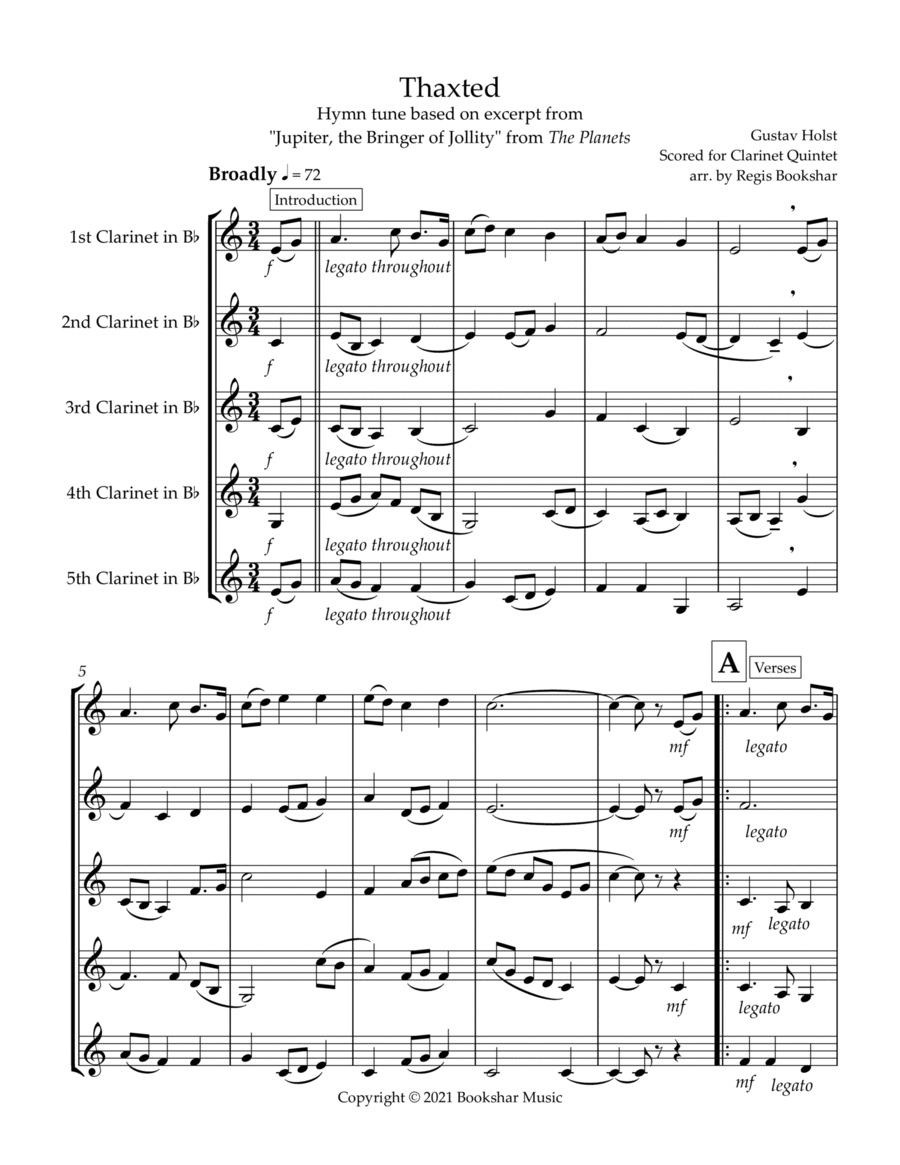
Thaxted (hymn tune based on excerpt from "Jupiter" from The Planets) (Bb) (Clarinet Quintet)
Ensemble de Clarinettes

$10.00 8.62 € Ensemble de Clarinettes PDF SheetMusicPlus

Woodwind Ensemble Clarinet - Level 4 - Digital Download SKU: A0.813463 Composed by Johann Pachelbel. Arranged by Regis Bookshar. Baroque,Multicultural,Standards,Wedding,World. 30 pages. Regis Bookshar #6264781. Published by Regis Bookshar (A0.813463). Canon in D (Pachelbel) (D) (Clarinet Quintet) - Advanced/Intermediate - Digital Download. This selection, Johann Pachelbel's celebrated Canon in D, is perhaps the most famous canon ever written and has been one of my favorite compositions to arrange. A canon is a polyphonic device in which several voices play the same music, entering in sequence. Pachelbel's Canon in D, was originally written in the key of D Major and was scored for three violins arranged in canon, accompanied by a basso continuo which repeats the same harmonic progression throughout the entire piece. The common musical term for this is ostinato or ground bass. Regis Bookshar has now arranged this music for a Clarinet Quintet. Three Clarinets play the melody in canon while the ostinato accompaniment is played by the other two Clarinets. This arrangement is suitable for high school and college students but could also be performed by professional performers. It is perfect for concerts and church services, especially for Weddings, but could be performed for any occasion. Included are a score and a complete set of parts (30 pages). This version is written in the key of D Major, as is the original version, but another version is also available, if you prefer, written in the key of Bb Major, to make it a little easier for some younger performers. Other versions of Pachelbel's Canon in D have also been arranged by Regis Bookshar and are available for a wide variety of instrumental Quintets and Octets, in both the keys of D Major and Bb Major. I think that String players would probably prefer to play the versions in the key of D Major while the Brass and Woodwind musicians might prefer to play the Bb Major versions. I hope you take the time to compare the different versions to find the right version for you. To help you decide which version, or versions, you may want to choose, I have included several musical samples for you to listen to and to hear what these arrangements may sound like and so that you may compare the various arrangements. Also, just to let you know, the Octets written in the key of Bb Major have full-length recordings while the Octets in D Major and all Quintets have only the first 25 measures, or so, available to hear. Please feel free to search for other arrangements by Regis Bookshar which are also available. There are quite a few other arrangements in a variety of styles and I'm certain you will find something else which might interest you as well. Please keep checking because I plan to continue to add new arrangements as often as I can. I'm certain that this exciting arrangement of Pachelbel's Canon in D will be a challenge to some performers but will continue to entertain both performers and audiences alike for years to come.
Canon in D (Pachelbel) (D) (Clarinet Quintet)
Ensemble de Clarinettes

$20.00 17.23 € Ensemble de Clarinettes PDF SheetMusicPlus

Woodwind Ensemble Clarinet - Level 4 - Digital Download SKU: A0.813417 Composed by Johann Pachelbel. Arranged by Regis Bookshar. Baroque,Multicultural,Standards,Wedding,World. 30 pages. Regis Bookshar #6259463. Published by Regis Bookshar (A0.813417). Canon (Pachelbel) (Bb) (Clarinet Quintet) - Advanced/Intermediate - Digital Download. This selection, Johann Pachelbel's celebrated Canon, is perhaps the most famous canon ever written and has been one of my favorite compositions to arrange. A canon is a polyphonic device in which several voices play the same music, entering in sequence. Pachelbel's Canon, was originally written in the key of D Major and was scored for three violins arranged in canon, accompanied by a basso continuo which repeats the same harmonic progression throughout the entire piece. The common musical term for this is ostinato or ground bass. Regis Bookshar has now arranged this music for a Clarinet Quintet. Three Clarinets play the melody in canon while the ostinato accompaniment is played by the other two Clarinets. This arrangement is suitable for high school and college students but could also be performed by professional performers. It is perfect for concerts and church services, especially for Weddings, but could be performed for any occasion. Included are a score and a complete set of parts (30 pages). This version is written in the key of Bb Major, to make it a little easier for some younger performers, but another version is also available in the key of D Major if you would prefer. Other versions of Pachelbel's Canon have also been arranged by Regis Bookshar and are available for a wide variety of instrumental Quintets and Octets, in both the keys of D Major and Bb Major. I think that String players would probably prefer to play the versions in the key of D Major while the Brass and Woodwind musicians might prefer to play the Bb Major versions. I hope you take the time to compare the different versions to find the right version for you. To help you decide which version, or versions, you may want to choose, I have included several musical samples for you to listen to and to hear what these arrangements may sound like and so that you may compare the various arrangements. Also, just to let you know, the Octets written in the key of Bb Major have full-length recordings while the Octets in D Major and all Quintets have only the first 25 measures, or so, available to hear. Please feel free to search for other arrangements by Regis Bookshar which are also available. There are quite a few other arrangements in a variety of styles and I'm certain you will find something else which might interest you as well. Please keep checking because I plan to continue to add new arrangements as often as I can. I'm certain that this exciting arrangement of Pachelbel's Canon will be a challenge to some performers but will continue to entertain both performers and audiences alike for years to come.

Canon (Pachelbel) (Bb) (Clarinet Quintet)
Ensemble de Clarinettes

$20.00 17.23 € Ensemble de Clarinettes PDF SheetMusicPlus

Woodwind Ensemble Clarinet - Level 4 - Digital Download SKU: A0.813438 Composed by Johann Pachelbel. Arranged by Regis Bookshar. Baroque,Multicultural,Standards,Wedding,World. 36 pages. Regis Bookshar #6260467. Published by Regis Bookshar (A0.813438). Canon (Pachelbel) (Bb) (Clarinet Octet) - Advanced/Intermediate - Digital Download. This selection, Johann Pachelbel's celebrated Canon, is perhaps the most famous canon ever written and has been one of my favorite compositions to arrange. A canon is a polyphonic device in which several voices play the same music, entering in sequence. Pachelbel's Canon, was originally written in the key of D Major and was scored for three violins arranged in canon, accompanied by a basso continuo which repeats the same harmonic progression throughout the entire piece. The common musical term for this is ostinato or ground bass. Regis Bookshar has now arranged this music for a Clarinet Octet. Three Clarinets play the melody in canon while the ostinato accompaniment is played by the other five instruments. This arrangement is suitable for high school and college students but could also be performed by professional performers. It is perfect for concerts and church services, especially for Weddings, but could be performed for any occasion. Included are a score and a complete set of parts (36 pages). This version is written in the key of Bb Major, to make it a little easier for some younger performers, but another version is also available in the key of D Major if you would prefer. Other versions of Pachelbel's Canon have also been arranged by Regis Bookshar and are available for a wide variety of instrumental Quintets and Octets, in both the keys of D Major and Bb Major. I think that String players would probably prefer to play the versions in the key of D Major while the Brass and Woodwind musicians might prefer to play the Bb Major versions. I hope you take the time to compare the different versions to find the right version for you. To help you decide which version, or versions, you may want to choose, I have included several musical samples for you to listen to and to hear what these arrangements may sound like and so that you may compare the various arrangements. Also, just to let you know, the Octets written in the key of Bb Major have full-length recordings while the Octets in D Major and all Quintets have only the first 25 measures, or so, available to hear. Please feel free to search for other arrangements by Regis Bookshar which are also available. There are quite a few other arrangements in a variety of styles and I'm certain you will find something else which might interest you as well. Please keep checking because I plan to continue to add new arrangements as often as I can. I'm certain that this exciting arrangement of Pachelbel's Canon will be a challenge to some performers but will continue to entertain both performers and audiences alike for years to come.

Canon (Pachelbel) (Bb) (Clarinet Octet)
Ensemble de Clarinettes

$28.00 24.13 € Ensemble de Clarinettes PDF SheetMusicPlus


Partitions Gratuites
Acheter des Partitions Musicales
Acheter des Partitions Digitales à Imprimer
Acheter des Instruments de Musique

© 2000 - 2026

Accueil - Version intégrale



