EUROPE
2069 articles
USA
0 articles
DIGITAL
19 articles (à imprimer)
Partitions Digitales
Partitions à imprimer
19 partitions trouvées


Clarinet Ensemble,Woodwind Ensemble - Level 4 - Digital Download SKU: A0.1381045 Composed by Gustav Mahler. Arranged by Stephen Davies. 20th Century,Chamber,Classical. 24 pages. Stephen Davies #965760. Published by Stephen Davies (A0.1381045). 'Adagietto' From Symphony No.5 By Gustav Mahler.Arranged for Clarinet Sextet by Stephen Davies. If a composer could say what he had to say in words, he would not bother trying to say it in music.So said Mahler about the Adagietto, originally written for the love of his life Alma Schindler as a present, but there hangs a tale available on most youtubes' and wikipedias' !! Indeed Mahler wrote a poem for Alma, the German text of which can easily match the main opening motiv; (c,d,e, E...F.. etc)Wie ich Dich liebe, Du meine Sonne               In which way I love you, my Sunbeamich kann mit Worten Dir's nicht sagen           I cannot tell you with wordsNur meine Sehnsucht kann ich Dir klagen     Only my longing, my love and my blissund meine Liebe, meine Wonne!                     Can I with anguish declare!Anyhow, here it is arranged for Clarinet Sextet, best played delicately and soulfully or listened to on a decent pair of headphones!!
'Adagietto' from Symphony No.5
Ensemble de Clarinettes
Gustav Mahler
Arranged for Clarinet Sextet by Stephen Davies

$21.99 18.37 € Ensemble de Clarinettes PDF SheetMusicPlus

Woodwind Ensemble Clarinet - Level 3 - Digital Download SKU: A0.736278 Composed by Katherine K. Davis. Arranged by Phyllis Avidan Louke. Christmas,Holiday,Pop. 31 pages. Louke Publishing #3578281. Published by Louke Publishing (A0.736278). For Clarinet Choir Carol of the DrumWords and Music by Katherine K. Davis Program NotesOriginally titled Carol of the Drum, this song later became known as The Little Drummer Boy. A Christmas staple since the late 1950’s, it continues to be a holiday favorite. HolidayChristmasPopTraditional It is scored for Clarinet Choir:  Eb Clarinet (or Bb Clarinet), 5 Bb Clarinets, and optional Bass or Alto Clarinet. There is some flexibility in number of parts, since the Bass and Alto Clarinet parts double Clarinet 5. Phyllis Avidan Louke is an award-winning composer and arranger with more than 70 published pieces to her credit.  www.phyllislouke.com
Carol Of The Drum
Ensemble de Clarinettes

$16.00 13.37 € Ensemble de Clarinettes PDF SheetMusicPlus

Woodwind Ensemble Clarinet - Level 3 - Digital Download SKU: A0.813963 Composed by Franz Xaver Gruber. Arranged by Regis Bookshar. Christmas,Instructional,Multicultural,World. 7 pages. Regis Bookshar #6632975. Published by Regis Bookshar (A0.813963). Clarinet Quintet - Intermediate - Digital Download. This arrangement of Silent Night, or in German, Stille Nacht, would be a wonderful addition to any music library and could be performed for Christmas concerts, recitals, and, especially, church services. It is equally suitable for junior and senior high school students and even older musicians. Depending on their ability, younger musicians would also enjoy playing this selection. Included are a score and a complete set of parts (7 pages). This selection is one of the many arrangements from The Regis Bookshar Trumpet Ensemble's extensive music library which are being made available for the first time.Silent Night is probably the most popular Christmas carol ever written. It was composed in 1818 by Franz Xaver Gruber to lyrics by Joseph Mohr and was first performed on Christmas Eve at St. Nicholas parish church in Oberndorf, a small village in present-day Austria. A young Catholic priest, Father Joseph Mohr, had written the poem, Stille Nacht, in 1816 and had gone to Oberndorf in 1817. The melody was composed by Franz Xaver Gruber, schoolmaster and organist in the nearby village of Arnsdorf. On Christmas Eve, 1818, Mohr brought the words to Gruber and asked him to compose a melody and guitar accompaniment for that night's mass, after river flooding had possibly damaged the church organ. The church was eventually destroyed by repeated flooding and has since been replaced with the Silent-Night-Chapel.According to Gruber, Karl Mauracher, an organ builder who serviced the instrument at the Oberndorf church, was enamored with the song, and took the composition home with him to the Ziller Valley in Tyrol, Austria. From there, two traveling families of folk singers, the Strassers and the Rainers, included the tune in their shows. The Rainers were already singing it around Christmas, 1819, and once performed it for an audience that included Franz I of Austria and Alexander I of Russia. They also gave the first performance of the song in the United States in New York City in 1839. By the 1840's, the song was well known and was reported to be a favorite of Frederick William IV of Prussia. During this period, the melody changed slightly to become the version that is commonly heard today. The version of the melody that is generally used today is a slow, meditative lullaby, or pastoral, differing slightly from Gruber's original which has a moderate tempo. The song has been translated into about 140 languages and has been recorded by many singers across many music genres. The version sung by Bing Crosby in 1935, has sold over 10 million copies as a single.In this arrangement of Silent Night, Regis Bookshar has kept the basic form of this familiar Christmas carol, but has also included a descant during the third verse. Also, in addition to this version for a Clarinet Quinet, there are other arrangements of Silent Night available for a variety of instrumental ensembles. There are Quintets and Octets readily available for purchase. Please take the time to look for other versions of this composition. You may find something else that might also suit your needs.I would also encourage you to search for other arrangements by Regis Bookshar, as well, as there are numerous arrangements in a wide variety of styles, also available for purchase. You may find something else which might interest you. Please continue to check periodically because new arrangements are being added as often as possible. I'm certain that this wonderful arrangement of Silent Night will continue to entertain both performers and audiences alike for years to come.
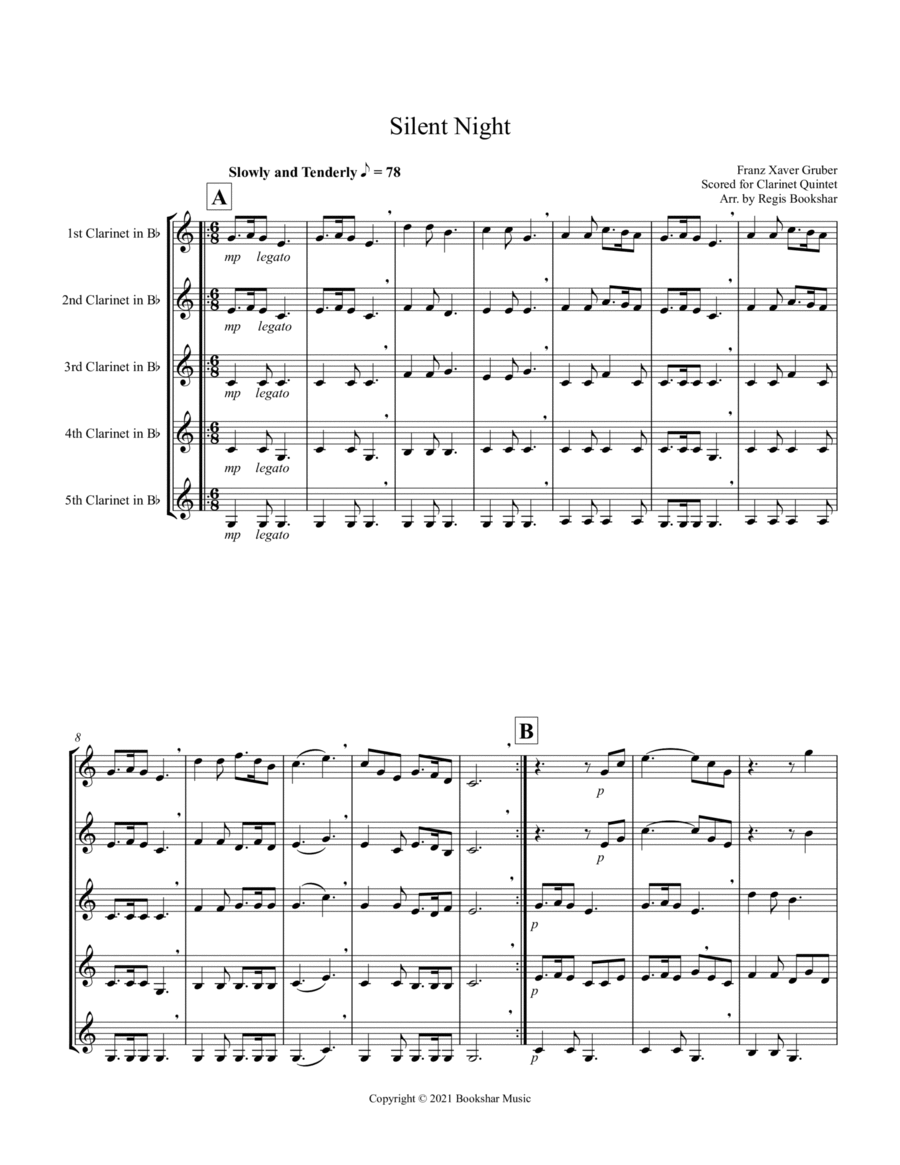
Silent Night (Bb) (Clarinet Quintet)
Ensemble de Clarinettes
the 1840's, the song was well known and was reported to be a favorite of Frederick William IV of Prussia During this period, the melody changed slightly to become the version that is commonly heard today
$5.00 4.18 € Ensemble de Clarinettes PDF SheetMusicPlus

Clarinet Choir,Woodwind Ensemble Bass Clarinet,E-Flat Clarinet - Level 4 - Digital Download SKU: A0.559607 Composed by Sergei Rachmaninoff. Arranged by Lisa Ochoco. 20th Century,Contemporary,Romantic Period. 24 pages. Lisa L Ochoco #3502013. Published by Lisa L Ochoco (A0.559607). Sergei Rachmaninoff is one of my favorite composers. Vocalise is such a beautiful piece that it has been arranged for every instrument and vocal combination out there. This piece was originally written for voice and piano, without any words, but sung with just a vowel sound - most times, ah. Because there are no lyrics, Rachmaninoff left it up to the musicians and listeners to interpret it as they wished.
Vocalise Op34 No14 for Clarinet Choir
Ensemble de Clarinettes

$14.00 11.7 € Ensemble de Clarinettes PDF SheetMusicPlus

Woodwind Ensemble Clarinet - Level 4 - Digital Download SKU: A0.1111646 Composed by Wolfgang Amadeus Mozart. Arranged by Regis Bookshar. Chamber,Christian,Classical,Instructional,Religious. 40 pages. Regis Bookshar #713940. Published by Regis Bookshar (A0.1111646). Recordare (from Requiem (K. 626) - Wolfgang Amadeus Mozart/Franz Xaver Sussmayr - Clarinet Septet - Advanced/Intermediate - Digital Download. Hauntingly beautiful is how the Recordare from Mozart's Requiem is often described. Originally written for an orchestra and four vocal soloists, it has now been transcribed by Regis Bookshar for a Clarinet Septet, consisting of 7 Bb Clarinets, and would be a wonderful addition to any music library. This arrangement will provide students with the opportunity to practice breath control because of its long, sustained phrases, and also to give them the chance to play this beautiful composition, something which they may not have had the opportunity to do, otherwise. This selection could be performed for concerts, recitals and church services and is suitable for high school and college students but professional musicians would also enjoy playing this arrangement. Included are a score and a complete set of parts (40 pages). The Regis Bookshar Trumpet Ensemble has performed the Trumpet Quintet version of the Recordare for funerals, providing beautiful, introspective music for the occasion. There is some controversy surrounding the circumstances of the Requiem's composition because Mozart died before he could complete it. Count Franz von Walsegg had commissioned a Requiem Mass but Mozart had received only half of the payment in advance. So, upon his death on December 5th, 1791, his widow, Constanze, wished to have the work completed secretly by someone else and submit it to the count as having been completed by Mozart to collect the final payment. Joseph von Eybler was one of the first composers to be asked to complete the score and had worked on a number of movements but felt unable to complete the remainder and gave the manuscript back to Constanze Mozart. The task was then given to another composer, Franz Xaver Sussmayr. Sussmayr borrowed some of Eybler's work in making his completion, added his own orchestration to other movements and added several new movements which a Requiem Mass would normally comprise. He then added a final section by adapting the opening two movements which Mozart had written to the different words which finish the Requiem Mass, which according to both Sussmayr and Mozart's wife, was done according to Mozart's directions. The completed score, initially by Mozart but largely finished by Sussmayr, was then dispatched to Count Walsegg complete with a counterfeited signature of Mozart dated 1792. Despite the controversy over how much of the music is actually Mozart's, the commonly performed Sussmayr version has become widely accepted by the public, and is considered one of Mozart's finest compositions. The Recordare is considered by many people to be one of the most beautiful compositions in Mozart's entire catalogue. Regis Bookshar, a trumpet player, has performed the Requiem in concert with a full orchestra, soloists and a chorus and felt that other musicians should have the opportunity to play the hauntingly beautiful Recordare as well. So, in addition to this arrangement for a Clarinet Septet, he has made quite a few other arrangements of this beautiful composition. There are Quintets, Sextets, Septets and Octets readily available for a wide variety of instrumental ensembles. Please take the time to look for other versions of this composition. You may fine something else which may also suit your needs. I would also encourage you to search for other arrangements by Regis Bookshar as well, as there are numerous arrangements in a variety of styles, also available for purchase. You may find something else which might interest you. Please continue to check periodically because new arrangements are being added as often as possible. I'm certain that this beautiful arrangement of Mozart's Recordare, will continue to entertain both performers and audiences alike for years to come.
Recordare (from "Requiem") (F) (Clarinet Septet)
Ensemble de Clarinettes

$36.00 30.08 € Ensemble de Clarinettes PDF SheetMusicPlus

Woodwind Ensemble Clarinet - Level 4 - Digital Download SKU: A0.1108227 Composed by Wolfgang Amadeus Mozart. Arranged by Regis Bookshar. Chamber,Christian,Classical,Instructional,Religious. 25 pages. Regis Bookshar #710854. Published by Regis Bookshar (A0.1108227). Recordare (from Requiem (K. 626) - Wolfgang Amadeus Mozart/Franz Xaver Sussmayr - Clarinet Quintet - Advanced/Intermediate - Digital Download. Hauntingly beautiful is how the Recordare from Mozart's Requiem is often described. Originally written for an orchestra and four vocal soloists, it has now been transcribed by Regis Bookshar for a Clarinet Quintet, consisting of 5 Bb Clarinets and would be a wonderful addition to any music library. This arrangement will provide students with the opportunity to practice breath control because of its long, sustained phrases, and also to give them the chance to play this beautiful composition, something which they may not have had the opportunity to do, otherwise. This selection could be performed for concerts, recitals and church services and is suitable for high school and college students but professional musicians would also enjoy playing this arrangement. Included are a score and a complete set of parts (25 pages). The Regis Bookshar Trumpet Ensemble has performed the Trumpet Quintet version of the Recordare for funerals, providing beautiful, introspective music for the occasion. There is some controversy surrounding the circumstances of the Requiem's composition because Mozart died before he could complete it. Count Franz von Walsegg had commissioned a Requiem Mass but Mozart had received only half of the payment in advance. So, upon his death on December 5th, 1791, his widow, Constanze, wished to have the work completed secretly by someone else and submit it to the count as having been completed by Mozart to collect the final payment. Joseph von Eybler was one of the first composers to be asked to complete the score and had worked on a number of movements but felt unable to complete the remainder and gave the manuscript back to Constanze Mozart. The task was then given to another composer, Franz Xaver Sussmayr. Sussmayr borrowed some of Eybler's work in making his completion, added his own orchestration to other movements and added several new movements which a Requiem Mass would normally comprise. He then added a final section by adapting the opening two movements which Mozart had written to the different words which finish the Requiem Mass, which according to both Sussmayr and Mozart's wife, was done according to Mozart's directions. The completed score, initially by Mozart but largely finished by Sussmayr, was then dispatched to Count Walsegg complete with a counterfeited signature of Mozart dated 1792. Despite the controversy over how much of the music is actually Mozart's, the commonly performed Sussmayr version has become widely accepted by the public, and is considered one of Mozart's finest compositions. The Recordare is considered by many people to be one of the most beautiful compositions in Mozart's entire catalogue. Regis Bookshar, a trumpet player, has performed the Requiem in concert with a full orchestra, soloists and a chorus and felt that other musicians should have the opportunity to play the hauntingly beautiful Recordare as well. So, in addition to this arrangement for a Clarinet Quintet, he has made quite a few other arrangements of this beautiful composition. There are Quintets, Sextets, Septets and Octets readily available for a wide variety of instrumental ensembles. Please take the time to look for other versions of this composition. You may fine something else which may also suit your needs. I would also encourage you to search for other arrangements by Regis Bookshar as well, as there are numerous arrangements in a variety of styles, also available for purchase. You may find something else which might interest you. Please continue to check periodically because new arrangements are being added as often as possible. I'm certain that this beautiful arrangement of Mozart's Recordare, will continue to entertain both performers and audiences alike for years to come.
Recordare (from "Requiem") (F) (Clarinet Quintet)
Ensemble de Clarinettes

$28.00 23.4 € Ensemble de Clarinettes PDF SheetMusicPlus

Clarinet Choir,Woodwind Ensemble Bass Clarinet,Contra Alto Clarinet,E-Flat Clarinet - Level 4 - Digital Download SKU: A0.764956 Composed by Lori Archer Sutherland. Contemporary,Folk,Standards. 50 pages. Lori Archer Sutherland #4597193. Published by Lori Archer Sutherland (A0.764956). For clarinet choir (Eb, 4 Bb, Alto, Bass, Eb Contra, Bb Contra. Alternate Bb parts included for Eb and Alto. Basset horn part included (doubles Alto)).You may print multiple parts as needed for your ensemble.The Monk’s Turned Topsy-Turvy is an original fantasy for clarinet choir, based on the old French-Canadian children’s song, Ah! Si mon moine voulait danser! (Danse, mon moine, danse). The title is a play on words: moine means both monk and spinning top in French. The lyrics speak of persuading mon moine to dance by offering various articles of clothing, such as a hood or cap.After a brief, yet bold, introduction, the piece jumps into a straightforward rendition of the tune. From there, the melody is repeated, bringing in other voices and added flourishes. While the tune starts to repeat a third time, it doesn’t get to finish its full statement. It’s interrupted by a run up through the ensemble into a rollicking 7/8 section.With a rhythmic accompaniment underneath, the jaunty melody begins in the third clarinets. The upper instruments take over briefly in 6/8, then the tune returns to 7/8. After a quick breather, the accompaniment introduces an upward sweep motif. This alternates with the accompaniment pattern heard at the beginning of the 7/8 section.The lower voices then take control, driving downward into a different tonality and mood. An undulating accompaniment sets a dreamlike feel, with different voices quoting fragments of the theme. The accompaniment transfers between voices throughout the section, eventually changing back into a 3/4, then a 2/4 feel, resulting in a transition back to the original feel of the piece.The low voices get the melody, with rhythmic accompaniment and racing runs throughout the other sections. The melody goes a bit topsy-turvy before the group comes together in the descending quarter note motif from the beginning of the piece, bringing us to the coda. There’s one final quote of the opening of the main theme from the low voices, leading to a whirlwind in the first and Eb with accented notes and suspensions underneath. The Eb pipes up with one last comment and the group closes out the piece.Also available for concert band (S0.708971)
The Monk's Turned Topsy-Turvy
Ensemble de Clarinettes

$25.00 20.89 € Ensemble de Clarinettes PDF SheetMusicPlus

Woodwind Ensemble Clarinet - Level 3 - Digital Download SKU: A0.813985 Composed by Franz Xaver Gruber. Arranged by Regis Bookshar. Christmas,Instructional,Multicultural,World. 12 pages. Regis Bookshar #6636625. Published by Regis Bookshar (A0.813985). Clarinet Octet - Intermediate - Digital Download. This arrangement of Silent Night, or in German, Stille Nacht, would be a wonderful addition to any music library and could be performed for Christmas concerts, recitals, and, especially, church services. It is equally suitable for junior and senior high school students and even older musicians. Depending on their ability, younger musicians would also enjoy playing this selection. Included are a score and a complete set of parts (12 pages). This selection is one of the many arrangements from The Regis Bookshar Trumpet Ensemble's extensive music library which are being made available for the first time.Silent Night is probably the most popular Christmas carol ever written. It was composed in 1818 by Franz Xaver Gruber to lyrics by Joseph Mohr and was first performed on Christmas Eve at St. Nicholas parish church in Oberndorf, a small village in present-day Austria. A young Catholic priest, Father Joseph Mohr, had written the poem, Stille Nacht, in 1816 and had gone to Oberndorf in 1817. The melody was composed by Franz Xaver Gruber, schoolmaster and organist in the nearby village of Arnsdorf. On Christmas Eve, 1818, Mohr brought the words to Gruber and asked him to compose a melody and guitar accompaniment for that night's mass, after river flooding had possibly damaged the church organ. The church was eventually destroyed by repeated flooding and has since been replaced with the Silent-Night-Chapel.According to Gruber, Karl Mauracher, an organ builder who serviced the instrument at the Oberndorf church, was enamored with the song, and took the composition home with him to the Ziller Valley in Tyrol, Austria. From there, two traveling families of folk singers, the Strassers and the Rainers, included the tune in their shows. The Rainers were already singing it around Christmas, 1819, and once performed it for an audience that included Franz I of Austria and Alexander I of Russia. They also gave the first performance of the song in the United States in New York City in 1839. By the 1840's, the song was well known and was reported to be a favorite of Frederick William IV of Prussia. During this period, the melody changed slightly to become the version that is commonly heard today. The version of the melody that is generally used today is a slow, meditative lullaby, or pastoral, differing slightly from Gruber's original which has a moderate tempo. The song has been translated into about 140 languages and has been recorded by many singers across many music genres. The version sung by Bing Crosby in 1935, has sold over 10 million copies as a single.In this arrangement of Silent Night, Regis Bookshar has kept the basic form of this familiar Christmas carol, but has also included a descant during the third verse. Also, in addition to this version for a Clarinet Octet, there are other arrangements of Silent Night available for a variety of instrumental ensembles. There are Quintets and Octets readily available for purchase. Please take the time to look for other versions of this composition. You may find something else that might also suit your needs.I would also encourage you to search for other arrangements by Regis Bookshar, as well, as there are numerous arrangements in a wide variety of styles, also available for purchase. You may find something else which might interest you. Please continue to check periodically because new arrangements are being added as often as possible. I'm certain that this wonderful arrangement of Silent Night will continue to entertain both performers and audiences alike for years to come.
Silent Night (Bb) (Clarinet Octet)
Ensemble de Clarinettes
the 1840's, the song was well known and was reported to be a favorite of Frederick William IV of Prussia During this period, the melody changed slightly to become the version that is commonly heard today
$8.00 6.68 € Ensemble de Clarinettes PDF SheetMusicPlus

Woodwind Ensemble Clarinet - Digital Download SKU: A0.751005 Composed by Traditional. Arranged by Brendan Elliget MAGA 537. Christian,Folk,Sacred. 19 pages. BJE Music #6103835. Published by BJE Music (A0.751005). Morning Has Broken is a popular and well-known Christian hymn first published in 1931. It has words by English author Eleanor Farjeon and was inspired by the village of Alfriston in East Sussex, then set to a traditional Scottish Gaelic tune known as Bunessan. It is often sung in children's services and in Funeral services.This lovely traditional tune has been arranged for a Clarinet Choir or Septet with plenty of interest in each of the seven parts. There are parts for Eb Clarinet, Bb Clarinets, Eb Alto Clarinet, and Bb Bass Clarinet… The Alto Clarinet part is a combination of a few of the other parts and could be omitted if unavailable.The MP3 was recorded with NotePerformer 3.Grade = 4 Duration = 2:30 mins
Morning Has Broken - Clarinet Choir
Ensemble de Clarinettes

$10.00 8.36 € Ensemble de Clarinettes PDF SheetMusicPlus


Partitions Gratuites
Acheter des Partitions Musicales
Acheter des Partitions Digitales à Imprimer
Acheter des Instruments de Musique

© 2000 - 2026

Accueil - Version intégrale





