EUROPE
38976 articles
USA
66 articles
DIGITAL
275 articles (à imprimer)
Partitions Digitales
Partitions à imprimer
275 partitions trouvées

1 16 31 ....271

Bass Clarinet,Piano - Level 2 - Digital Download SKU: A0.548977 Composed by Johann Sebastian Bach. Arranged by James M. Guthrie, ASCAP. Baroque,Holiday,Standards,Wedding. Score and part. 11 pages. Jmsgu3 #3444571. Published by jmsgu3 (A0.548977). Was mir behagt, ist nur die muntre Jagd (The lively hunt is all my heart's desire), BWV 208 is the earliest secular cantata by Bach composed in 1713 for the birthday of the Duke of Weissenfels. It is also called the Hunting Cantata, and/or the Birthday Cantata. The most famous piece from this collection is the soprano aria Sheep may safely graze. Duration: 5:50, Score - 6 pg. Solo part - 2 pg. Piano part - 3 pg. 41 ms. Melodic range: M10
Bach: Sheep May Safely Graze for Bass Clarinet & Piano
Clarinette Basse, Piano

$32.95 28.27 € Clarinette Basse, Piano PDF SheetMusicPlus

Small Ensemble Bass Clarinet,Piano - Level 2 - Digital Download SKU: A0.592635 Composed by John Newton. Arranged by David McKeown. Praise & Worship,Sacred,Spiritual. Score and part. 3 pages. David McKeown #6411221. Published by David McKeown (A0.592635). Amazing Grace is a beautiful hymn arranged here for Solo Bass Clarinet and Piano.Amazing Grace is perhaps the best-known and best-loved hymn in the world. The writer, John Newton, led a dissolute life as sailor in the slave trade for many years before marriage, along with a close encounter with death at sea, dramatically changed his perspective. He lived out his later years as a devout and charismatic clergyman in the English countryside, renowned for his direct and personal style. The words he wrote in Amazing Grace are an intimate retelling of his spiritual journey.The hymn was written in 1773, and was sung to many different melodies initially, but since the mid nineteenth century it has become most closely associated with the famous folk tune melody presented here, New Britain.
Amazing Grace, Gospel Hymn for Bass Clarinet and Piano
Clarinette Basse, Piano

$2.49 2.14 € Clarinette Basse, Piano PDF SheetMusicPlus

Bass Clarinet,Piano - Level 2 - Digital Download SKU: A0.550920 Composed by J. S. Bach - Gounod. Arranged by James M. Guthrie, ASCAP. Christmas,Easter,Standards. Score and part. 12 pages. Jmsgu3 #4888299. Published by jmsgu3 (A0.550920). This arrangement features the controversial Schwencke measure (ms. 27) that was originally introduced in 1783 by Christian Friedrich Gottlieb Schwencke. The convenient 1st & 2nd endings provide an option for extended performance. Duration with repeat - 4:50. Score: 7 pages. Solo part: 1 page, piano part: 4 pages. Based on Prelude #1 in C Major from the Well-Tempered Clavier, Book 1. Well suited for church meditations or school programs or recital encores.  Ave Maria Ave Maria is a Catholic prayer that consequently asks for the mother of Jesus (Mary) to intercede. Charles Gounod composed a famous version of the Ave Maria. He was a French Romantic composer who overlaid a new melody on an existing Bach chord progression. The progression is from Bach’s Prelude No. 1 from Well-Tempered Clavier I. This version, as well as Schubert’s version, have become essential items at weddings, masses, and funerals. Bach Overview First of all, Johann Sebastian Bach is maybe the greatest composer in music history. Certainly, he was prolific. As a result, everyone has heard of his works. Furthermore, these works number well over a thousand. It seems like people are probably most familiar with instrumental works such as the Brandenburg Concertos, and the Goldberg Variations. But, similarly famous are such noteworthy works as the Well-Tempered Clavier, the Musical Offering, and the Art of Fugue. Seems like his most famous vocal works include the most noteworthy Mass in B Minor. Also, most noteworthy, though, are the St. John Passion, and certainly the Christmas Oratorio.  History Bach came from a long line of musicians and above all, composers. Consequently, he, first of all, pursued a career as a church organist. So as a result, he gained employment in various Protestant churches in Germany. For a while, he worked as a court musician in Weimar and Köthen. Here he probably developed his organ style and likewise his chamber music style. Eventually, he, therefore, gained an appointment as Cantor of St. Thomas in Leipzig. Here he worked until difficulties with his employer ultimately drove him away. The King of Poland finally appointed him as a court composer.  Style It seems like Bach created an engaging new international style. He synthesized elements of the most noteworthy European music ideas into his new style. Even more, this new style was probably his synthesis of European musical rhythm and form. Furthermore, he demonstrated a complete mastery of counterpoint and motivic development. His sense of harmonic organization probably propelled him to the top. Revival               Mendelssohn conducted a Bach revival in the nineteenth century. His effort probably helped to re-familiarize the public with the magnitude of Bach’s works. During this period, scholars published many noteworthy Bach biographies. Moreover, Wolfgang Schmieder published the BWV (Bach Werke Verzeichnis). As a result, this is now the official catalog of his entire artistic output. The BWV number allows us to locate a work in the catalog. Sometimes scholars will simply use an S (Schmieder) as an abbreviation for BWV.  Voyager NASA launched two Voyager spacecraft in 1977. Onboard are phonograph records with sounds, music, and images of life on Earth. The purpose of the launch was to inform intelligent extraterrestrial life forms about conditions on Earth. The music on the disc is varied. There is Bach, Mozart, Beethoven, and Stravinsky among others. However, because Bach is so important in our music history, it contains three times more Bach than all the others combined.
Bach-Gounod: Ave Maria, Schwencke version for Bass Clarinet & Piano
Clarinette Basse, Piano

$32.95 28.27 € Clarinette Basse, Piano PDF SheetMusicPlus

Bass Clarinet,Piano - Level 4 - Digital Download SKU: A0.549451 Composed by Sir Arthur Seymour Sullivan. Arranged by James M. Guthrie, ASCAP. Instructional,Romantic Period,Sacred,Standards. Score and part. 15 pages. Jmsgu3 #3497171. Published by jmsgu3 (A0.549451). Score: 10 pages, solo part: 2 pages, piano part: 3 pages. Duration: 4:25. Not difficult, but requires sensitivity & dynamic control. Suitable for recitals, church meditations, or school programs. School Years First of all, Sullivan attended music school at the Royal Academy of Music. Because Sullivan was so talented, the Academy awarded him the Mendelssohn Scholarship for two years in a row. He, therefore, studied with John Goss, who studied with Thomas Atwood, who in turn studied with Mozart. Sullivan similarly studied the piano at the Academy with Arthur O’Leary. Study Abroad During his first year, he also earned money by singing solos in the Chapel Royal. At the end of his second year, the Academy consequently continued his scholarship and sent him to study at the Leipzig Conservatoire. He certainly studied composition, and likewise counterpoint and piano. Hence, during his final year in Leipzig, Sullivan finally completed his graduation composition project: Incidental Music for Shakespeare’s The Tempest. Association with Gilbert It seems like Sullivan built the bulk of his composing career largely in the 1860s. As a result, he became famous for his incidental music for the Tempest and his Irish Symphony. He, therefore, began collaborating with the poet W. S. Gilbert in the 1870s. Rather than focus on serious opera, Gilbert and Sullivan, in contrast, concentrated on comic opera such as H. M. S. Pinafore, the Pirates of Penzance, and the Mikado. Therefore, certainly as a result of his education and experience, Sullivan composed a total of 24 operas, 11 symphonic works, 10 choral pieces. Even more, he wrote a large number of noteworthy hymns such as Onward Christian Soldiers. Lost Chord The general style of his music is maybe similar to Mendelssohn, Schumann, and perhaps Liszt. It seems like Sullivan was fond of writing distinct melodies for each character in his operettas. His melodies combine together as the characters did. Furthermore, he was a master orchestrator, and therefore played the flute, clarinet, trumpet, and trombone fluently. The Lost Chord Sullivan wrote his most noteworthy song the Lost Chord in 1877. As a result, it was a great success and was certainly performed all over the world by a variety of singers such as Enrico Caruso. Because Sullivan was the most famous composer in England, the Lost Chord became the most famous of all British or American songs of the 1870s and 1890s. Consequently, in 1888 Thomas Edison recorded The Lost Chord for the phonograph. It was one of the first songs ever recorded. Furthermore, Queen Victoria knighted Sullivan in 1883.  
Sullivan: The Lost Chord for Bass Clarinet & Piano
Clarinette Basse, Piano

$26.95 23.13 € Clarinette Basse, Piano PDF SheetMusicPlus

Bass Clarinet,Piano - Level 2 - Digital Download SKU: A0.549231 Composed by Johann Sebastian Bach. Arranged by James M. Guthrie, ASCAP. Baroque,Easter,Standards,Wedding. Score and part. 9 pages. Jmsgu3 #3468714. Published by jmsgu3 (A0.549231). J. S. Bach BWV 508.  Bist du bei mir Bach adapted this aria from a lost Stölzel opera called Diomedes. He changed the original orchestral instrumentation to soprano, strings, and continuo.  He also modified the voice-leading making it sound more like a Bach composition. The work appears as BWV 508 No. 25 in the Anna Magdalena Notebook No. 2.   Source Only a few remnants of the original opera have survived. Historians speculate that Anna Magdalena got the song from the Leipzig Opera after the bankruptcy of 1720. Chances are good, though, that the tune was a favorite of everyone in Leipzig at the time.   Lyrics When thou art near, I go with joyTo death and to my rest.O how joyous would my end be,If your fair hands            Would close my faithful eyes. - Unknown Bach Overview First of all, Johann Sebastian Bach is maybe the greatest composer in music history. Certainly, he was prolific. As a result, everyone has heard of his works. Furthermore, these works number well over a thousand. It seems like people are probably most familiar with the instrumental works such as the Brandenburg Concertos, and the Goldberg Variations. But, similarly famous are such noteworthy works as the Well-Tempered Clavier, the Musical Offering, and certainly the Art of Fugue. Seems like his most famous vocal works include the most noteworthy Mass in B Minor. Also, most noteworthy, though, are the St. John Passion, and certainly the Christmas Oratorio.  History Bach came from a long line of musicians and above all, composers. Consequently, he, first of all, pursued a career as a church organist. So as a result, he gained employment in various Protestant churches in Germany. For a while, he worked as a court musician in Weimar and Köthen. Here he probably developed his organ style and likewise his chamber music style. Eventually, he, therefore, gained an appointment as Cantor of St. Thomas in Leipzig. Here he worked until difficulties with his employer ultimately drove him away. The King of Poland finally appointed him as court composer.  Style It seems like Bach created a fascinating new international style. He synthesized elements of the most noteworthy European music ideas into his new style. Even more, this new style was probably his synthesis of European musical rhythm and form. Furthermore, he demonstrated a complete mastery of counterpoint and motivic development. His sense of harmonic organization probably propelled him to the top. Revival                Mendelssohn conducted a Bach revival in the nineteenth century. His effort probably helped to re-familiarize the public with the magnitude of Bach’s works. During this period, scholars published many noteworthy Bach biographies. Moreover, Wolfgang Schmieder published the BWV (Bach Werke Verzeichnis). As a result, this is now the official catalog of his entire artistic output. The BWV number allows us to locate a work in the catalog. Sometimes scholars will simply use an S (Schmieder) as an abbreviation for BWV.  Voyager NASA launched two Voyager spacecraft in 1977. Onboard are phonograph records with sounds, music, and images of life on Earth. The purpose of the launch was to inform intelligent extraterrestrial life forms about conditions on Earth. The music on the disc is varied. There is Bach, Mozart, Beethoven, and Stravinsky among others. However, because Bach is so important in our music history, it contains three times more Bach than all the others combined.
Bach: Bist du bei mir BWV 508 for Bass Clarinet & Piano
Clarinette Basse, Piano

$32.95 28.27 € Clarinette Basse, Piano PDF SheetMusicPlus

Bass Clarinet,Piano - Level 2 - Digital Download SKU: A0.549358 Composed by Bach-Gounod. Arranged by James M. Guthrie, ASCAP. Christmas,Contemporary,Easter,Wedding. Score and part. 11 pages. Jmsgu3 #3490039. Published by jmsgu3 (A0.549358). This arrangement follows the original Bach prelude and so excludes the extra measure that Schwencke introduced in 1783. If you prefer the extra measure, please see Bach-Gounod: Ave Maria, Schwencke version for Bass Clarinet & Piano, S0.661771. The convenient 1st & 2nd endings provide an option for extended performance with minimal page turns for the accompanist. The duration with repeat is about 4:50. Score: 6 pages. Solo part: 1 page, piano part: 4 pages. Based on Prelude #1 in C Major from the Well-Tempered Clavier, Book 1. Well suited for church meditations or school programs or recital encores. Ave Maria Ave Maria is a Catholic prayer that consequently asks for the mother of Jesus (Mary) to intercede. Charles Gounod composed a famous version of the Ave Maria. He was a French Romantic composer who overlaid a new melody on an existing Bach chord progression. The progression is from Bach’s Prelude No. 1 from Well-Tempered Clavier I. This version, as well as Schubert’s version, have become essential items at weddings, masses, and funerals. Bach Overview First of all, Johann Sebastian Bach is maybe the greatest composer in music history. Certainly, he was prolific. As a result, everyone has heard of his works. Furthermore, these works number well over a thousand. It seems like people are probably most familiar with instrumental works such as the Brandenburg Concertos, and the Goldberg Variations. But, similarly famous are such noteworthy works as the Well-Tempered Clavier, the Musical Offering, and the Art of Fugue. Seems like his most famous vocal works include the most noteworthy Mass in B Minor. Also, most noteworthy, though, are the St. John Passion, and certainly the Christmas Oratorio.  History Bach came from a long line of musicians and above all, composers. Consequently, he, first of all, pursued a career as a church organist. So as a result, he gained employment in various Protestant churches in Germany. For a while, he worked as a court musician in Weimar and Köthen. Here he probably developed his organ style and likewise his chamber music style. Eventually, he gained an appointment as Cantor of St. Thomas in Leipzig. Here he worked until difficulties with his employer ultimately drove him away. The King of Poland finally appointed him as court composer.  Style It seems like Bach created an engaging new international style. He synthesized elements of the most noteworthy European music ideas into his new style. Even more, this new style was probably his synthesis of European musical rhythm and form. Furthermore, he demonstrated a complete mastery of counterpoint and motivic development. His sense of harmonic organization probably propelled him to the top. Revival               Mendelssohn conducted a Bach revival in the nineteenth century. His effort probably helped to re-familiarize the public with the magnitude of Bach’s works. During this period, scholars published many noteworthy Bach biographies. Moreover, Wolfgang Schmieder published the BWV (Bach Werke Verzeichnis). As a result, this is now the official catalog of his entire artistic output. The BWV number allows us to locate a work in the catalog. Sometimes scholars will simply use an S (Schmieder) as an abbreviation for BWV.  
Bach-Gounod: Ave Maria for Bass Clarinet & Piano
Clarinette Basse, Piano

$32.95 28.27 € Clarinette Basse, Piano PDF SheetMusicPlus

Bass Clarinet,Piano - Level 3 - Digital Download SKU: A0.549498 Composed by Felix Bartholdy Mendelssohn. Arranged by James M. Guthrie, ASCAP. Instructional,Romantic Period,Sacred,Standards. Score and part. 20 pages. Jmsgu3 #3501033. Published by jmsgu3 (A0.549498). BASS CLARINET & PIANO - Score: 11 pages, solo part: 3 pages, piano part: 5 pages. Duration: 4:20. This is a popular recital piece that would work well also in church or school programs. Mendelssohn Background Felix Mendelssohn (1809 –1847) was, by all means, a German mastermind composer, musician, and orchestra conductor of the Romantic period. Consequently, Mendelssohn composed in the usual forms of the time - symphonies, concertos, oratorios, piano music, and chamber music. To summarize, his most famous works include his music for A Midsummer Night's Dream, the Italian Symphony, the Scottish Symphony, The Hebrides Overture, his later Concerto for Violin & Orchestra, and his Octet for Strings. His most well-known piano pieces, by and large, are the Songs Without Words.  Artistic Standing  Musical tastes change from time to time. Moreover, just such a change occurred in the late 19th and early 20th centuries. This plus rampant antisemitism brought a corresponding amount of undue criticism. Fortunately, however, his artistic inventiveness has indeed been critically re-evaluated. As a result, Mendelssohn is once again among the most prevalent composers of the Romantic era. Early Family Life Mendelssohn was, in fact, born into a prominent Jewish family. His grandfather was, notably, the philosopher Moses Mendelssohn. Felix was, in fact, raised without religion. At the age of seven, he was suddenly baptized as a Reformed Christian. He was, moreover, a child musical prodigy. Nevertheless, his parents did not attempt to exploit his talent. Early Adulthood Mendelssohn was, in general, successful in Germany. He conducted, in particular, a revival of the music of Johann Sebastian Bach, specifically with his presentation of the St Matthew Passion in 1829. Felix was truly in demand throughout Europe as a composer, conductor, and soloist. For example, he visited Britain ten times. There, he premiered, namely, many of his significant works. His taste in music was. To be sure, inventive and well-crafted yet markedly conservative. This conservatism separated him by all means from more audacious musical colleagues like Liszt, Wagner, and Berlioz. Mendelssohn founded the Leipzig Conservatoire which, to clarify, became a defender of this conservative viewpoint. Mature Adulthood Schumann notably wrote that Mendelssohn was the Mozart of the nineteenth century, the most brilliant musician, the one who most clearly sees through the contradictions of the age and for the first time reconciles them. This observation points to a couple of features in particular that illustrate Mendelssohn's works and his artistic procedure. Musical Features In the first place, his musical style was fixed in his systematic mastery of the style of preceding masters. This being said, he certainly recognized and even developed early romanticism from the music of Beethoven and Weber. Secondly, it indicates that Mendelssohn sought to strengthen his inherited musical legacy rather than to exchange it with new forms and styles or replace it with exotic orchestration. Consequently, he diverged his contemporaries in the romantic period, such as Wagner, Berlioz, and Liszt. Mendelssohn revered Liszt's virtuosity at the keyboard but found his music rather insubstantial.
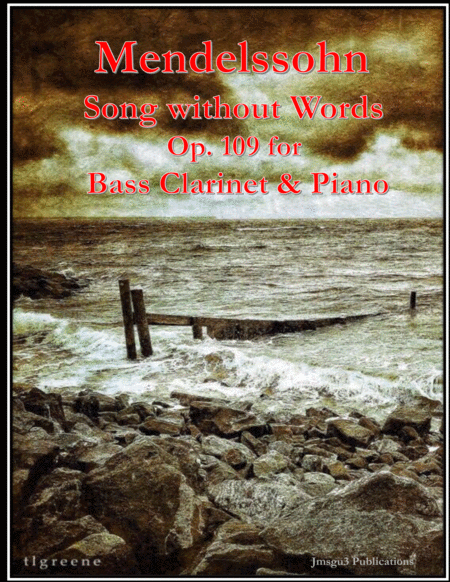
Mendelssohn: Song Without Words Op. 109 for Bass Clarinet & Piano
Clarinette Basse, Piano

$32.95 28.27 € Clarinette Basse, Piano PDF SheetMusicPlus

Bass Clarinet,Piano - Level 3 - Digital Download SKU: A0.1505026 By Celine Dion. By James Horner and Will Jennings. Arranged by Harry Walker. 20th Century,Chamber,Film/TV,Pop,Wedding. Score and part. 11 pages. SCORE EDITIONS #1080429. Published by SCORE EDITIONS (A0.1505026). My Heart Will Go On, composed by James Horner with lyrics by Will Jennings and famously performed by Céline Dion, is the iconic love theme from the 1997 film Titanic. This powerful ballad, which has become one of the best-selling singles of all time, encapsulates the timeless love story between Jack and Rose, conveying themes of eternal love and remembrance. The song's structure features a haunting flute introduction, expressive verses, a full orchestral chorus, and a dramatic instrumental bridge, concluding with a gentle outro. Winning the Academy Award, Golden Globe, and four Grammy Awards, My Heart Will Go On remains a cultural staple and a key part of Céline Dion's repertoire. Its beautiful melody, poignant lyrics, and emotional depth ensure its enduring popularity in concert programs worldwide. In this version, the composition was arranged for Bass Clarinet and Piano by Harry Walker.
My Heart Will Go On (Love Theme From 'titanic')
Clarinette Basse, Piano
Celine Dion
$5.99 5.14 € Clarinette Basse, Piano PDF SheetMusicPlus

Bass Clarinet,Piano - Level 3 - Digital Download SKU: A0.547820 By James Taylor. By Carole King. Arranged by James M. Guthrie, ASCAP. Contemporary,Pop. Score and part. 9 pages. Jmsgu3 #3056313. Published by jmsgu3 (A0.547820). Carole King: You've Got A Friend arranged for Bass Clarinet & Piano.Includes solo instrument part.Duration: 5″08″ Score: 7 pages. Part: 2 pages.This is the famous song that made Carole King the first woman to win the GrammyGrand Slam: Record of the Year (It’s Too Late), Album of the Year andBest Female Pop Vocal (Tapestry), and Song of the Year (You’ve Got A Friend).This arrangement is suitable for church, nightclub or recital hall performance.
You've Got A Friend
Clarinette Basse, Piano
James Taylor
$67.95 58.31 € Clarinette Basse, Piano PDF SheetMusicPlus

Bass Clarinet,Piano - Level 3 - Digital Download SKU: A0.549345 By Barry Manilow. By Bruce Johnston. Arranged by James M. Guthrie, ASCAP. Contemporary,Rock. Score and part. 8 pages. Jmsgu3 #3486713. Published by jmsgu3 (A0.549345). Duration: ca. 3:00, score: 5 pages, solo part: 1 page, piano part: 2 pages.Very famous song suitable for church, recital or nightclub. I Write the Songs is a popular song written by Bruce Johnston in 1975 and made famous by Barry Manilow. Manilow's version reached number one on the Billboard Hot 100 chart in January 1976[2] after spending two weeks atop the Billboard adult contemporary chart in December 1975.[3] It won a Grammy Award for Song of the Year and was nominated for Record of the Year in 1977.[3] Billboard ranked it as the No. 13 song of 1976.[4]The original version was recorded by The Captain & Tennille, who worked with Johnston in the early 1970s with The Beach Boys. It appears on their 1975 album, Love Will Keep Us Together. The first release of I Write the Songs as a single was by then teen-idol David Cassidy from his 1975 solo album The Higher They Climb, which was also produced by Bruce Johnston. Cassidy's version reached #11 on the UK Singles Chart in August of that year.[5]Johnston has stated that, for him, the I in the song is God,[2] and that songs come from the spirit of creativity in all of us. He has said that the song is not about his Beach Boys bandmate Brian Wilson.[6]Manilow was initially reluctant to record the song, stating in his autobiography Sweet Life: The problem with the song was that if you didn't listen carefully to the lyric, you would think that the singer was singing about himself. It could be misinterpreted as a monumental ego trip.[3] After persuasion by Clive Davis, then president of Arista Records, Manilow recorded the song, and his version of I Write the Songs was the first single taken from the album Tryin' to Get the Feeling. It first charted on the Billboard Hot 100 on November 15, 1975, reaching the top of the chart nine weeks later, on January 17, 1976. Wikipedia
I Write The Songs
Clarinette Basse, Piano
Barry Manilow
$39.95 34.28 € Clarinette Basse, Piano PDF SheetMusicPlus

Bass Clarinet,Piano - Level 4 - Digital Download SKU: A0.549934 Composed by Modest MUSSORGSKY (1839 - 1881). Arranged by James M. Guthrie. Easter,Instructional,Romantic Period,Standards. Score and part. 90 pages. Jmsgu3 #4303885. Published by jmsgu3 (A0.549934). A classic selection of epic proportions. Score: 75 pages, Solo part: 16 pages, 924 measures. Duration: 34:30 Pictures at an Exhibition (Картинки Ñ Ð²Ñ‹Ñтавки) by Modest PetroviÄ Musorgskij, 1874 (МодеÑÑ‚ Петрович МуÑоргÑкий) Promenade 1  Allegro giusto, nel modo russico; senza allegrezza, ma poco sostenuto    page 1 1. GNOMUS (The Gnome)  Sempre vivo page 4 Promenade 2  Moderato commodo assai e con delicatezza page 10  2. IL VECCHIO CASTELLO (The Old Castle) Andante molto cantabile e con dolore page 12  Promenade 3 Moderato non tanto, pesamente page 18  3. TUILLERIES Dispute d'enfants après jeux (Children's Quarrel after Games) Allegretto non troppo, capriccioso page 19                                                                              4. BYDLO (Cattle) Sempre moderato pesante  page 22 Promenade 4 Tranquillo page 26 5. Ballet of the Unhatched Chicks Балет невылупившихÑÑ Ð¿Ñ‚ÐµÐ½Ñ†Ð¾Ð²Â Scherzino  page 27 6. Samuel Goldenberg und Schmuÿle  Еврей в меховой шапке. Cандомир  Andante page 30 Promenade 5  Allegro giusto, nel modo russico, poco sostenuto page 36 7. LIMOGES. LE MARCHÉ. (La grande nouvelle) The Market (The Great News) Allegretto vivo, sempre scherzando   page 39 8. CATACOMBAE (Sepulchrum romanum) (Roman Tomb) ПарижÑкие катакомбы  Largo page 46    CON MORTUIS IN LINGUA MORTUA (With the Dead in a Dead Language) Andante non troppo, con lamento page 47 9. The Hut on Hen's Legs (Baba Yaga) Избушка Бабы-Яги на курьих ожках. ЧаÑÑ‹ в руÑÑком Ñтиле Allegro con brio, feroce page 50 10. The Bogatyr Gates (In the Capital in Kiev) Проект городÑких ворот в Киеве. Главный фаÑад The Great Gates of Kiev Allegro alla breve Maestoso con grandezza page 63Mussorgsky is known for his ability to evoke vivid pictures through his music. He creates soundscapes that transport listeners to other places and times. Through the use of complex harmonies and shifting tonalities, Mussorgsky creates sonic paintings that are as diverse and varied as any works of art in a museum. He takes listeners on a journey through different landscapes and environments, ranging from pastoral settings to the depths of the underworld. In his famous suite, Pictures at an Exhibition, Mussorgsky gives each movement a title that references a painting, sculpture, or architectural feature from an art museum. The suite is composed in such a way that it captures the moods and emotions evoked by the artworks. From the bright and energetic Promenade to the somber and mysterious Catacombs, Mussorgsky's Pictures at an Exhibition paints a vivid sonic landscape that brings the listener into the art museum.
Mussorgsky: Pictures at an Exhibition for Bass Clarinet & Piano
Clarinette Basse, Piano

$32.95 28.27 € Clarinette Basse, Piano PDF SheetMusicPlus


1 16 31 ....271


Partitions Gratuites
Acheter des Partitions Musicales
Acheter des Partitions Digitales à Imprimer
Acheter des Instruments de Musique

© 2000 - 2026

Accueil - Version intégrale





