EUROPE
4944 articles
USA
0 articles
DIGITAL
17 articles (à imprimer)
Partitions Digitales
Partitions à imprimer
17 partitions trouvées


Bass Clarinet,Piano - Level 2 - Digital Download SKU: A0.549432 Composed by Antonin Dvorak. Arranged by James M. Guthrie, ASCAP. Instructional,Romantic Period,Sacred,Standards. Score and part. 12 pages. Jmsgu3 #3494207. Published by jmsgu3 (A0.549432). Score: 7 pages, solo part: 2 pages, piano part: 3 pages. Duration: 4:25 Not difficult, but requires sensitivity & dynamic control. Suitable for recitals, church meditations, or school programs. Dvořák Background Antonín Dvořák (1841 –1904) was, of course, a composer from Czechoslovakia. As a matter of fact, he was among the first Bohemian composers to attain universal recognition. It is important to realize that the late Romantic Nationalist period featured composers who used traditional and folk elements to portray the character of their nation. In particular, we see this in the music of Grieg (Norway), Finland (Sibelius), and Smetana (Bohemia).  Dvořák relied markedly on rhythms and other characteristics of Moravian and Bohemian folk music. Ascent to Fame Dvořák was truly a child musical prodigy on the violin. The premiere performances of his compositions notably occurred in 1872 and 1873. He submitted his First Symphony in particular to a German competition, but it failed to win. Consequently, in 1874 he presented two more symphonies to the Austrian State Prize for Composition. Johannes Brahms was the principal of the jury and was accordingly very impressed. They forthwith awarded the prize to Dvořák in 1874, 1876, and 1877. At this point, Brahms thereupon endorsed Dvořák to the publisher Simrock. Later, the publisher commissioned Dvořák to compose the Slavonic Dances, Op. 46. These became popular overnight and, as a result, Dvořák's worldwide status was launched. International Status Dvořák visited England upon invitation nine times. On each visit, he frequently conducted performances of his own compositions. He conducted concerts of his music, especially in Moscow and St. Petersburg. Eventually, the Prague Conservatory in fact appointed Dvořák as a professor. There, to be sure, he wrote his famous Dumky Trio. United States Consequently, the National Conservatory of Music of America appointed him as director in 1892. As a result, Dvořák composed his two most famous symphonic works: the Symphony No. 9 (From the New World), which spread his name universally, and his Concerto for Cello and Orchestra, one of the most famous of all cello works. Moreover, he wrote his most celebrated American String Quartet during this time. At the same time, because of his growing recognition in Europe and his homesickness for his own country, he left to return to Bohemia in 1895.
DvoÅ™ák: Largo from the New World Symphony for Bass Clarinet & Piano
Clarinette Basse, Piano

$32.95 28.59 € Clarinette Basse, Piano PDF SheetMusicPlus

Bass Clarinet,Instrumental Solo,Piano - Level 3 - Digital Download SKU: A0.968454 Composed by Thomas Hastings. Arranged by Lawrence H. Underwood. Christian,Contemporary,Praise & Worship,Sacred. Score and individual part. 11 pages. Lawrence H Underwood #6566865. Published by Lawrence H Underwood (A0.968454). Arranged by veteran performer and music educator, Lawrence Underwood, as the ninth installment in his 2021 Hymn Song Collection series, this brand-new setting of Rock of Ages begins as with a classical treatment of the tune in 3 before reimagining the piece in 4, moving into a minor setting of the melody, through a waltz-feel, and into 9/8 time. . .all before returning home to the classical setting for this beloved melody. Suitable for use as special music in church or as a recital piece, this new arrangement is sure to be a favorite for listener and performer alike!
Rock of Ages for Bass Clarinet
Clarinette Basse, Piano

$5.99 5.2 € Clarinette Basse, Piano PDF SheetMusicPlus

Bass Clarinet,Piano - Level 3 - Digital Download SKU: A0.549585 Composed by Edvard Grieg. Arranged by James M. Guthrie, ASCAP. Concert,Instructional,Romantic Period,Standards,World. Score and part. 18 pages. Jmsgu3 #3511273. Published by jmsgu3 (A0.549585). Duration: ca. 2:17 Score: 10 pages, solo part: 2 pages, piano part: 5 pages. A proven audience pleaser - perfect for a recital encore! Grieg Background In the first place, Edvard Grieg (1843 –1907) was a Norwegian composer as well as a concert pianist. As a matter of fact, most music historians consider him one of the foremost Romantic era composers. Consequently, his music is part of the international standard classical repertoire. Grieg moreover used Norwegian folk music in his own compositions.  Consequently, he ushered Norwegian music to transnational consciousness. Furthermore, he forged a national musical identity for Norway. It is important to realize that he did this in a manner similar to Jean Sibelius in Finland, and BedÅ™ich Smetana in Bohemia. Legacy Grieg is especially celebrated in the city of Bergen. For example, the city has erected numerous statues depicting Grieg. Specifically, the city has named a concert hall (Grieg Hall), a music school (Grieg Academy) and a professional choir (Edvard Grieg Kor) after him. As a matter of fact, there is also a museum located at his former home in Troldhaugen. Peer Gynt Suite No. 1 (Op. 46) Grieg wrote incidental music for the purpose of illustrating a play by Ibsen known as Peer Gynt. The play includes, in particular, the famous selection entitled, In the Hall of the Mountain King. In this composition, Grieg indeed depicts the exploits of the scoundrel, Peer Gynt. In one famous episode, for example, Peer steals a bride at her wedding. For this reason, the people chase him, but soon Peer falls, thereupon striking his skull on a boulder. He wakens forthwith in a highland bounded by angry gnomes. Consequently, the music of In the Hall of the Mountain King represents the mad gnomes taunting Peer. Therefore, each time the theme repeats it gets louder and faster. In the end, Peer surprisingly escapes from the mountain. Holberg Suite and Misc. Summary It must be remembered that Grieg originally wrote his Holberg Suite for the piano. In other words, he only later arranged it for strings. Further, Grieg composed by and large many songs with lyrics by famous writers such as Heine, Goethe, Ibsen, Hans Christian Andersen, Rudyard Kipling, and others. On balance, Norwegian pianist Eva Knardahl recorded altogether Grieg’s whole piano catalog on LP in 1980. These recordings were released again on CD in 2006. In any event, Grieg himself performed and recorded the bulk of these pieces toward the end of his life.  Register for free lifetime revisions and updates at www.jamesguthrie.com
Grieg: Hall of the Mountain King from Peer Gynt Suite for Bass Clarinet & Piano
Clarinette Basse, Piano

$24.95 21.65 € Clarinette Basse, Piano PDF SheetMusicPlus

Bass Clarinet,Instrumental Solo,Piano - Level 4 - Digital Download SKU: A0.814740 Composed by Richard E Brown. Concert,Contemporary,Standards. Score and individual part. 36 pages. Dacker Music #3049201. Published by Dacker Music (A0.814740). As the title indicates, Sonatina for Bass Clarinet and Piano closely follows sonata form on a somewhat smaller scale. Tonality and tonal relationships are basic to sonata form, and in this sonatina, the tonal relationships within the movements are all based on seconds, while the second movement is in the relative major of the sonatina's home key. The first movement, Allegro appassionato, is a fairly strict sonata-allegro in F minor. The second movement, Adagio cantabile, is a theme and variations in Ab major. The finale, Allegretto giocoso, is an abridged sonata-rondo in F minor. The B episode is derived from the inverted second subject of the first movement.Although not obvious on casual listening, this provides a degree of thematic unity to  the composition.Grade 4+               Duration:7:40
Sonatina for Bass Clarinet and Piano
Clarinette Basse, Piano

$14.00 12.15 € Clarinette Basse, Piano PDF SheetMusicPlus

Bass Clarinet,Piano - Level 3 - Digital Download SKU: A0.549541 Composed by Edvard Grieg. Arranged by James M. Guthrie, ASCAP. Concert,Contemporary,Romantic Period,Sacred,Standards. Score and part. 11 pages. Jmsgu3 #3506173. Published by jmsgu3 (A0.549541). Duration: ca. 4:00, Score: 9 pages, solo part: 3 pages, piano part: 4 pages. Super-famous instantly recognizable tune, not very difficult - suitable for a recital or church meditation.Grieg Background In the first place, Edvard Grieg (1843 –1907) was a Norwegian composer as well as a concert pianist. As a matter of fact, most music historians consider him one of the foremost Romantic era composers. Consequently, his music is part of the international standard classical repertoire. Grieg moreover used Norwegian folk music in his own compositions.  Consequently, he ushered Norwegian music to transnational consciousness. Furthermore, he forged a national musical identity for Norway. It is important to realize that he did this in a manner similar to Jean Sibelius in Finland, and BedÅ™ich Smetana in Bohemia. Legacy Grieg is especially celebrated in the city of Bergen. For example, the city has erected numerous statues depicting Grieg. Specifically, the city has named a concert hall (Grieg Hall), a music school (Grieg Academy) and a professional choir (Edvard Grieg Kor) after him. As a matter of fact, there is also a museum located at his former home in Troldhaugen. Peer Gynt Suite No. 1 (Op. 46) Grieg wrote incidental music for the purpose of illustrating a play by Ibsen known as Peer Gynt. The play includes, in particular, the famous selection entitled, In the Hall of the Mountain King. In this composition, Grieg indeed depicts the exploits of the scoundrel, Peer Gynt. In one famous episode, for example, Peer steals a bride at her wedding. For this reason, the people chase him, but soon Peer falls, thereupon striking his skull on a boulder. He wakens forthwith in a highland bounded by angry gnomes. Consequently, the music of In the Hall of the Mountain King represents the mad gnomes taunting Peer. Therefore, each time the theme repeats it gets louder and faster. In the end, Peer surprisingly escapes from the mountain. Holberg Suite and Misc. Summary It must be remembered that Grieg originally wrote his Holberg Suite for the piano. In other words, he only later arranged it for strings. Further, Grieg composed by and large many songs with lyrics by famous writers such as Heine, Goethe, Ibsen, Hans Christian Andersen, Rudyard Kipling, and others. On balance, Norwegian pianist Eva Knardahl recorded altogether Grieg’s whole piano catalog on LP in 1980. These recordings were released again on CD in 2006. In any event, Grieg himself performed and recorded the bulk of these pieces toward the end of his life.Register for free lifetime revisions and updates at www.jamesguthrie.com
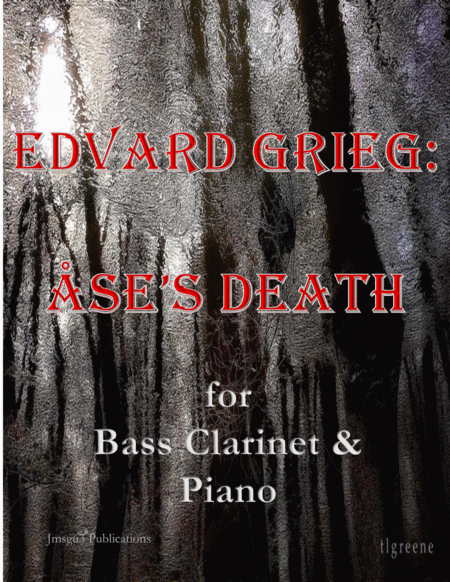
Grieg: Ase's Death from Peer Gynt Suite for Bass Clarinet & Piano
Clarinette Basse, Piano

$24.95 21.65 € Clarinette Basse, Piano PDF SheetMusicPlus

Bass Clarinet,Piano - Level 3 - Digital Download SKU: A0.549562 Composed by Edvard Grieg. Arranged by James M. Guthrie, ASCAP. Concert,Instructional,Romantic Period,Standards,World. Score and part. 16 pages. Jmsgu3 #3508013. Published by jmsgu3 (A0.549562). Duration: ca. 3:20, Score: 10 pages, solo part: 2 pages, piano part: 3 pages. Delicate, not very difficult - suitable for a recital encore. Grieg Background In the first place, Edvard Grieg (1843 –1907) was a Norwegian composer as well as a concert pianist. As a matter of fact, most music historians consider him one of the foremost Romantic era composers. Consequently, his music is part of the international standard classical repertoire. Grieg moreover used Norwegian folk music in his own compositions.  Consequently, he ushered Norwegian music to transnational consciousness. Furthermore, he forged a national musical identity for Norway. It is important to realize that he did this in a manner similar to Jean Sibelius in Finland, and BedÅ™ich Smetana in Bohemia. Legacy Grieg is especially celebrated in the city of Bergen. For example, the city has erected numerous statues depicting Grieg. Specifically, the city has named a concert hall (Grieg Hall), a music school (Grieg Academy) and a professional choir (Edvard Grieg Kor) after him. As a matter of fact, there is also a museum located at his former home in Troldhaugen. Peer Gynt Suite No. 1 (Op. 46) Grieg wrote incidental music for the purpose of illustrating a play by Ibsen known as Peer Gynt. The play includes, in particular, the famous selection entitled, In the Hall of the Mountain King. In this composition, Grieg indeed depicts the exploits of the scoundrel, Peer Gynt. In one famous episode, for example, Peer steals a bride at her wedding. For this reason, the people chase him, but soon Peer falls, thereupon striking his skull on a boulder. He wakens forthwith in a highland bounded by angry gnomes. Consequently, the music of In the Hall of the Mountain King represents the mad gnomes taunting Peer. Therefore, each time the theme repeats it gets louder and faster. In the end, Peer surprisingly escapes from the mountain. Holberg Suite and Misc. Summary It must be remembered that Grieg originally wrote his Holberg Suite for the piano. In other words, he only later arranged it for strings. Further, Grieg composed by and large many songs with lyrics by famous writers such as Heine, Goethe, Ibsen, Hans Christian Andersen, Rudyard Kipling, and others. On balance, Norwegian pianist Eva Knardahl recorded altogether Grieg’s whole piano catalog on LP in 1980. These recordings were released again on CD in 2006. In any event, Grieg himself performed and recorded the bulk of these pieces toward the end of his life.Register for free lifetime revisions and updates at www.jamesguthrie.com
Grieg: Anitra's Dance from Peer Gynt Suite for Bass Clarinet & Piano
Clarinette Basse, Piano

$24.95 21.65 € Clarinette Basse, Piano PDF SheetMusicPlus

Bass Clarinet,Piano - Level 3 - Digital Download SKU: A0.1373979 Composed by Lawrence H Underwood. Classical,Contemporary,Contest,Festival,Funk,Jazz. Score and part. 10 pages. Lawrence H Underwood #958546. Published by Lawrence H Underwood (A0.1373979). This original composition by veteran performer and music educator, Lawrence Underwood, is the eighth installment in a new 2024 series of pieces for solo instrument with piano accompaniment.  Feelin' It brings the funk from its very first notes! From sassy strut of its opening section, to the jazzy bridge, and classical-tinged counterpoint that leads us home to the opening melody, this piece is a joy to play and to hear. Suitable for use as a recital, festival, or contest piece - as well as special music in church - this new piece is sure to be an audience and performer favorite!
Feelin' It
Clarinette Basse, Piano

$6.99 6.07 € Clarinette Basse, Piano PDF SheetMusicPlus


Partitions Gratuites
Acheter des Partitions Musicales
Acheter des Partitions Digitales à Imprimer
Acheter des Instruments de Musique

© 2000 - 2026

Accueil - Version intégrale





