EUROPE
12132 articles
USA
0 articles
DIGITAL
24 articles ( imprimer)
Partitions Digitales
Partitions à imprimer
24 partitions trouvées


Bass Clarinet,Piano - Level 3 - Digital Download SKU: A0.549476 Composed by Alexander Scriabin. Arranged by James M. Guthrie, ASCAP. Concert,Instructional,Romantic Period,Sacred,Standards. Score and part. 12 pages. Jmsgu3 #3499849. Published by jmsgu3 (A0.549476). Alexander Scriabin Op. 11 No. 2. Score: 8 pages, solo part: 2 pages, piano part: 2 pages. Duration: 3:10. An introspective and meditative work with a lot of dynamic and phrasing nuance. Works well for church meditations or recital encores. Background Op.11/2 Alto Clarinet version. First of all, Scriabin composed mostly for the solo piano and also the orchestra. This is probably because he was a gifted pianist and therefore certainly appreciated the piano. Scriabin grew up in the late Romantic period, consequently, he was fond of the great piano masters of the time. As a result, he wrote his first noteworthy compositions in the manner of Chopin and Liszt. Forms Likewise, Scriabin used many of the same forms as Chopin. These certainly include the étude, prelude, nocturne, and even the mazurka. In contrast, as he developed his own sense of style his music became more and more unusual. So, the last five of his Piano Sonatas do not have a key signature and therefore lean towards atonality. Philosophy Scriabin also developed a keen interest in philosophy and likewise poetry. He was above all particularly fascinated by Nietzsche, Delville, and Blavatsky. Consequently, he finally established his own ideas about metaphysics and certainly mysticism. Scriabin consequently advanced theories about the relationship between color and musical keys. Synesthesia He also may have experienced a condition called synesthesia where he could probably sense a response created from a different stimulus. Therefore, it was almost as if he could see music and hear colors. Scriabin, therefore, arranged the colors in a circle similar to the circle-of-fifths and assigned each key area a color. Finally, he assigned the key of C to the color red, while the key of G was orange. Similarly, he assigned D to yellow, A to green, and so forth. Strangely, he did not differentiate between major and minor key colors.  Multimedia Hence, his ability to translate colors into music certainly gave Scriabin a most noteworthy interest in creating multimedia events. Furthermore, He designed his biggest work, the Mysterium, to last an entire week. Even more, Scriabin made plans not only for music, but also colored lights, incense, and dancing. He designed the performance to occur in the foothills of the Himalaya mountains. The Mysterium was never performed, and only sketches of the work remain. Modern Performances In modern times, we often experience performances of Scriabin’s most famous completed works accompanied by colored laser lights and incense. These are the Poem of Ecstasy (completed in 1908) and the Poem of Fire (completed in 1910). The lighting effects for these early performances were accomplished by the clavier à lumiéres. It was a keyboard instrument that projected colored light onto a screen.
Scriabin: Prelude Op. 11 No. 2 for Bass Clarinet & Piano
Clarinette Basse, Piano

$19.95 17.35 € Clarinette Basse, Piano PDF SheetMusicPlus

Bass Clarinet,Piano - Level 3 - Digital Download SKU: A0.549498 Composed by Felix Bartholdy Mendelssohn. Arranged by James M. Guthrie, ASCAP. Instructional,Romantic Period,Sacred,Standards. Score and part. 20 pages. Jmsgu3 #3501033. Published by jmsgu3 (A0.549498). BASS CLARINET & PIANO - Score: 11 pages, solo part: 3 pages, piano part: 5 pages. Duration: 4:20. This is a popular recital piece that would work well also in church or school programs. Mendelssohn Background Felix Mendelssohn (1809 –1847) was, by all means, a German mastermind composer, musician, and orchestra conductor of the Romantic period. Consequently, Mendelssohn composed in the usual forms of the time - symphonies, concertos, oratorios, piano music, and chamber music. To summarize, his most famous works include his music for A Midsummer Night's Dream, the Italian Symphony, the Scottish Symphony, The Hebrides Overture, his later Concerto for Violin & Orchestra, and his Octet for Strings. His most well-known piano pieces, by and large, are the Songs Without Words.  Artistic Standing  Musical tastes change from time to time. Moreover, just such a change occurred in the late 19th and early 20th centuries. This plus rampant antisemitism brought a corresponding amount of undue criticism. Fortunately, however, his artistic inventiveness has indeed been critically re-evaluated. As a result, Mendelssohn is once again among the most prevalent composers of the Romantic era. Early Family Life Mendelssohn was, in fact, born into a prominent Jewish family. His grandfather was, notably, the philosopher Moses Mendelssohn. Felix was, in fact, raised without religion. At the age of seven, he was suddenly baptized as a Reformed Christian. He was, moreover, a child musical prodigy. Nevertheless, his parents did not attempt to exploit his talent. Early Adulthood Mendelssohn was, in general, successful in Germany. He conducted, in particular, a revival of the music of Johann Sebastian Bach, specifically with his presentation of the St Matthew Passion in 1829. Felix was truly in demand throughout Europe as a composer, conductor, and soloist. For example, he visited Britain ten times. There, he premiered, namely, many of his significant works. His taste in music was. To be sure, inventive and well-crafted yet markedly conservative. This conservatism separated him by all means from more audacious musical colleagues like Liszt, Wagner, and Berlioz. Mendelssohn founded the Leipzig Conservatoire which, to clarify, became a defender of this conservative viewpoint. Mature Adulthood Schumann notably wrote that Mendelssohn was the Mozart of the nineteenth century, the most brilliant musician, the one who most clearly sees through the contradictions of the age and for the first time reconciles them. This observation points to a couple of features in particular that illustrate Mendelssohn's works and his artistic procedure. Musical Features In the first place, his musical style was fixed in his systematic mastery of the style of preceding masters. This being said, he certainly recognized and even developed early romanticism from the music of Beethoven and Weber. Secondly, it indicates that Mendelssohn sought to strengthen his inherited musical legacy rather than to exchange it with new forms and styles or replace it with exotic orchestration. Consequently, he diverged his contemporaries in the romantic period, such as Wagner, Berlioz, and Liszt. Mendelssohn revered Liszt's virtuosity at the keyboard but found his music rather insubstantial.
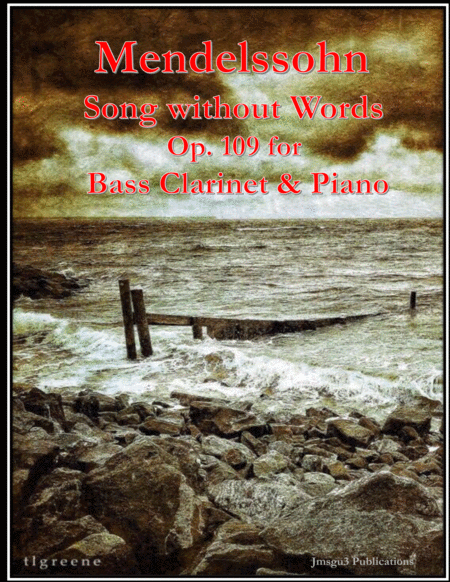
Mendelssohn: Song Without Words Op. 109 for Bass Clarinet & Piano
Clarinette Basse, Piano

$32.95 28.66 € Clarinette Basse, Piano PDF SheetMusicPlus

Small Ensemble Bass Clarinet,Piano - Level 4 - Digital Download SKU: A0.790008 Composed by Richard Rodgers. Arranged by W. Brent Sawyer. Broadway,Musical/Show. Score and part. 18 pages. Diamond S Music #3533745. Published by Diamond S Music (A0.790008). THIS NEARLY WAS MINE from South Pacific. For SOLO BASS CLARINET AND PIANO ACCOMPANIMENT (with optional Double Bass).This beautiful and exciting arrangement is from the beloved Rodgers & Hammerstein ground-breaking 1949  Broadway musical, South Pacific. This arrangement begins very simply with the soloist unaccompanied. Then the piano comes in with a dream-like delicacy with expands into a rich and lush accompaniment. The bridge gets a little spicier with a jazz waltz feel and then expands back to a warmth before a final key change that turns into a big theatrical ending. This is sure to be a real crowd pleaser. The piano accompaniment is quite difficult but there are alternate passages included to simplify the most difficult passages. There is an optional BASS part included that would add to the performance. There is no drum part included, but a drummer could easily improvised from the Bass part which would add a lot as well. Other similar arrangements from this publisher can be found at:  https://www.sheetmusicplus.com/publishers/diamond-s-music/6940
This Nearly Was Mine from South Pacific
Clarinette Basse, Piano

$10.00 8.7 € Clarinette Basse, Piano PDF SheetMusicPlus

Bass Clarinet,Piano - Level 3 - Digital Download SKU: A0.786644 Composed by Samuel Francis Smith, Henry Carey. Arranged by Beka Wilson. Christian,Folk,Holiday,Patriotic,Sacred. Score and part. 5 pages. Beka Wilson #6332719. Published by Beka Wilson (A0.786644). This beloved patriotic hymn is perfect for any patriotic function, or for a church offertory or prelude for Independence Day, Memorial Day, or Veterans Day. Length: around 2.5 minutesLevel: intermediate for most instruments5 pages (includes score and separate solo part)This arrangement is available as a solo for voice, piano, flute, oboe, clarinet, bassoon, alto sax, tenor sax, F horn, trumpet, trombone, violin, viola, and cello. It is also available for SATB Choir.Want this arrangement in a different key or for a different set of instruments? Shoot me an email at bekmars10@gmail.com for a custom version of this arrangement that I can post on Sheet Music Plus for you.
America (My Country 'Tis of Thee)--clarinet solo
Clarinette Basse, Piano

$6.99 6.08 € Clarinette Basse, Piano PDF SheetMusicPlus

Bass Clarinet,Piano - Level 2 - Digital Download SKU: A0.844629 Composed by Phil Beaman. 20th Century,Pop,Romantic Period,Wedding. Score and part. 9 pages. Phil Beaman #4413093. Published by Phil Beaman (A0.844629). Vintage pop romance! This accompanied instrumental solo is a Theme and Variations. For the Theme I used an extract from the 1906 hit pop song I Love You Truly by Carrie Jacobs-Bond, a celebrated female composer at the turn of century.  With each variation the melody and rhythm evolve further from the original Theme. The tempo also increases slightly as you progress to each new variation. The first variation adds chromatic embellishment, the second variation syncopates the rhythm, and the third variation uses triplet patterns. More life is added to your romance with each variation!Each person who has heard this piece hears something different, but in all of them it conjures up vintage courting; and most say it would fit a soundtrack to an early silent movie. So, at heart, this piece is still a turn of the century love ballad, but livened up and fused with subtle influences from other styles and periods.  Perfect for weddings where you are trying to please everyone; a bit pop, a bit classical, and totally romantic!Works equally well in a classroom or lesson studying Theme and Variations. The easy-going melody only has a range of just over an octave. Its beauty and technique suits it for any recital as well.6 minutes with repeats, 3 minutes without; 6 page score; 3 page solo partRecording is of the Cello/Piano version and doesn't take the repeats.
I Love You Truly-Bass clarinet/piano
Clarinette Basse, Piano

$5.99 5.21 € Clarinette Basse, Piano PDF SheetMusicPlus

B-Flat Bass Clarinet,Piano - Level 4 - Digital Download SKU: A0.844892 Composed by Phil Beaman. Classical,New Age,Romantic Period. Score and part. 10 pages. Phil Beaman #5986457. Published by Phil Beaman (A0.844892). This brilliant Contemporary Classical piece borrows from many different styles. It is a Sonatina in 3 sections. The buoyant first section is quite Classical with a bit of fanfare, and then an Alberti Bass section that is an homage to Mozart. The expressive middle section is New Age in style and is in 7/4 Time Signature (3/4 then 4/4 in alternating sets, so not hard). The final section goes through several themes and a key change; having an ornamented Baroque theme, then a Classical theme reminiscent of the opening, then concluding with a Romantic era toccata. There are Chorale-like bridges linking the many sections and themes.  
The Brass Clarinet-bass clarinet/piano
Clarinette Basse, Piano

$6.99 6.08 € Clarinette Basse, Piano PDF SheetMusicPlus

Bass Clarinet,Instrumental Solo,Piano - Level 1 - Digital Download SKU: A0.964376 Composed by Johann Sebastian Bach. Arranged by Leyandder Trustworthy. Baroque,Instructional,Sacred,Standards,World. Score and individual part. 2 pages. Leyandder Trustworthy #6321025. Published by Leyandder Trustworthy (A0.964376). Cantata 156 was written for the third Sunday after Epiphany in 1729, and was first performed on January 23 of that year. The text is by Picander, one of Bach's favorite librettists. of the four cantatas written by Bach for the feast (72, 73, 111 and 156), it was the last, and the only one scored for solo voice. Like Cantatas 73 and 111, it is a choral cantata, employing a choral melody in several movements. Cantata 156, in fact, employs two different melodies and choral texts in the second and sixth (final) movements, respectively; the second uses Machs mit mir, Gott, nach deiner Güt (Schein, 1628), which Herr, wie du willt, so schicks mit mir (Binemann, 1582) is reserved for the finale. This version of the piece was adapted for A Bass Clarinet along with a piano accompaniment that comes with the product.
ARIOSO, by J. S. Bach (sinfonia) - for A Bass Clarinet and accompaniment
Clarinette Basse, Piano

$1.99 1.73 € Clarinette Basse, Piano PDF SheetMusicPlus

B-Flat Bass Clarinet,Instrumental Solo,Piano - Level 3 - Digital Download SKU: A0.1092446 By Emily Gray. By Frederic Chopin. Arranged by Emily Gray. Romantic Period. Score and individual part. 4 pages. Emily Gray #696538. Published by Emily Gray (A0.1092446). Chopin's Prelude in B Minor was originally written for piano, with a melody that fits well on the bass clarinet. This version is for extended-range bass clarinet and piano, but an alternative part has been included for bass clarinets that only go to a low E-flat. This piece would be a good piece for a bass clarinetist to practice breathing, phrasing, more advanced key signatures, and playing in the different registers of the instrument. This edition includes score, bass clarinet part, and alternative bass clarinet part.
Prelude in B Minor (Bass Clarinet and Piano)
Clarinette Basse, Piano
Emily Gray
$10.00 8.7 € Clarinette Basse, Piano PDF SheetMusicPlus

Bass Clarinet,Piano - Level 3 - Digital Download SKU: A0.549829 Composed by Peter Ilyich Tchaikovsky. Arranged by James M. Guthrie, ASCAP. Children,Christmas,Romantic Period,Standards. Score and part. 48 pages. Jmsgu3 #3549769. Published by jmsgu3 (A0.549829). Duration: 6:12, Score: 29 pages, Solo part: 6 pages, Piano part: 12 pages. This is the grand finale of the Nutcracker Suite. Pyotr Ilyich Tchaikovsky Tchaikovsky is probably the most popular of the great composers in America. His music certainly appeals to musicians. Likewise, it appeals even to folks who don’t normally listen to serious music. This is probably because of his most noteworthy melodies. Above all, he writes with great emotion. This certainly makes a most noteworthy if not an unforgettable impact. Education First of all, He attended classes at the Russian Musical Society. Even more, He also attended the St. Petersburg Conservatory. There he studied music theory with Nikolai Zaremba. He also consequently studied composition with Anton Rubenstein. It seems like Rubenstein came under criticism from a group of Russian composers known as the Five. The Five The Five certainly rejected Western musical influences. They rather sought to use elements from Russian music. They furthermore wanted to use more exotic musical materials. Western Techniques More than other Russian composers, Tchaikovsky studied modern Western music. He certainly develops his music like the European masters. So, rather than repeating a motive, he moves to a new key. He then introduces a different theme in the new key. Hence, he maintained his independence from the Five. Even more, he became the first Russian composer of international stature. Influences Tchaikovsky was probably influenced in his ballet scoring by Léo Delibes. Richard Wagner influenced his symphonic writing. Tchaikovsky’s most famous works include the 1812 Overture, The Nutcracker Suite, and Swan Lake. Also famous are the Violin Concerto in D and the six symphonies. The greatest of the six symphonies may be No. 6, the Pathétique. Nutcracker Suite, Op. 71a The Nutcracker Suite is a ballet that was performed for the first time in December 1892 in St. Petersburg. To begin with, the original ballet failed to attract a positive reception. However, the ballet suite became probably one of the most popular of all of Tchaikovsky’s works. The ballet suite became even more famous in the 1960s. It is now performed all over the world, particularly during the Christmas season.  
Tchaikovsky: Waltz of the Flowers from Nutcracker Suite for Bass Clarinet & Piano
Clarinette Basse, Piano

$32.95 28.66 € Clarinette Basse, Piano PDF SheetMusicPlus

Bass Clarinet,Piano - Level 4 - Digital Download SKU: A0.549934 Composed by Modest MUSSORGSKY (1839 - 1881). Arranged by James M. Guthrie. Easter,Instructional,Romantic Period,Standards. Score and part. 90 pages. Jmsgu3 #4303885. Published by jmsgu3 (A0.549934). A classic selection of epic proportions. Score: 75 pages, Solo part: 16 pages, 924 measures. Duration: 34:30 Pictures at an Exhibition (Картинки с выставки) by Modest Petrovič Musorgskij, 1874 (Модест Петрович Мусоргский) Promenade 1  Allegro giusto, nel modo russico; senza allegrezza, ma poco sostenuto    page 1 1. GNOMUS (The Gnome)  Sempre vivo page 4 Promenade 2  Moderato commodo assai e con delicatezza page 10  2. IL VECCHIO CASTELLO (The Old Castle) Andante molto cantabile e con dolore page 12  Promenade 3 Moderato non tanto, pesamente page 18  3. TUILLERIES Dispute d'enfants après jeux (Children's Quarrel after Games) Allegretto non troppo, capriccioso page 19                                                                              4. BYDLO (Cattle) Sempre moderato pesante  page 22 Promenade 4 Tranquillo page 26 5. Ballet of the Unhatched Chicks Балет невылупившихся птенцов Scherzino  page 27 6. Samuel Goldenberg und Schmuÿle  Еврей в меховой шапке. Cандомир  Andante page 30 Promenade 5  Allegro giusto, nel modo russico, poco sostenuto page 36 7. LIMOGES. LE MARCHÉ. (La grande nouvelle) The Market (The Great News) Allegretto vivo, sempre scherzando   page 39 8. CATACOMBAE (Sepulchrum romanum) (Roman Tomb) Парижские катакомбы  Largo page 46    CON MORTUIS IN LINGUA MORTUA (With the Dead in a Dead Language) Andante non troppo, con lamento page 47 9. The Hut on Hen's Legs (Baba Yaga) Избушка Бабы-Яги на курьих ожках. Часы в русском стиле Allegro con brio, feroce page 50 10. The Bogatyr Gates (In the Capital in Kiev) Проект городских ворот в Киеве. Главный фасад The Great Gates of Kiev Allegro alla breve Maestoso con grandezza page 63Mussorgsky is known for his ability to evoke vivid pictures through his music. He creates soundscapes that transport listeners to other places and times. Through the use of complex harmonies and shifting tonalities, Mussorgsky creates sonic paintings that are as diverse and varied as any works of art in a museum. He takes listeners on a journey through different landscapes and environments, ranging from pastoral settings to the depths of the underworld. In his famous suite, Pictures at an Exhibition, Mussorgsky gives each movement a title that references a painting, sculpture, or architectural feature from an art museum. The suite is composed in such a way that it captures the moods and emotions evoked by the artworks. From the bright and energetic Promenade to the somber and mysterious Catacombs, Mussorgsky's Pictures at an Exhibition paints a vivid sonic landscape that brings the listener into the art museum.
Mussorgsky: Pictures at an Exhibition for Bass Clarinet & Piano
Clarinette Basse, Piano

$32.95 28.66 € Clarinette Basse, Piano PDF SheetMusicPlus

Bass Clarinet,Piano - Level 3 - Digital Download SKU: A0.1373694 Composed by Lawrence H Underwood. 21st Century,Classical,Contemporary,Contest,Festival. Score and part. 8 pages. Lawrence H Underwood #958087. Published by Lawrence H Underwood (A0.1373694). This original composition by veteran performer and music educator, Lawrence Underwood, is the fourth installment in a new 2024 series of pieces for solo instrument with piano accompaniment.  Sunshine After Rain is a musical exploration of the joy that comes after sadness; the new hope that springs when sunshine breaks through the clouds. The piece takes the soloist through different meters, modes, and a cadenza before drawing to its gentle close. Suitable for use as a recital, festival, or contest piece - as well as special music in church - this new piece is a perfect chance to add a little feeling to any program!
Sunshine After Rain
Clarinette Basse, Piano

$6.99 6.08 € Clarinette Basse, Piano PDF SheetMusicPlus

Bass Clarinet,Piano - Level 1 - Digital Download SKU: A0.964375 Composed by Johann Sebastian Bach. Arranged by Leyandder Trustworthy. Baroque,Instructional,Sacred,Standards,World. Score and part. 2 pages. Leyandder Trustworthy #6320863. Published by Leyandder Trustworthy (A0.964375). Cantata 156 was written for the third Sunday after Epiphany in 1729, and was first performed on January 23 of that year. The text is by Picander, one of Bach's favorite librettists. of the four cantatas written by Bach for the feast (72, 73, 111 and 156), it was the last, and the only one scored for solo voice. Like Cantatas 73 and 111, it is a choral cantata, employing a choral melody in several movements. Cantata 156, in fact, employs two different melodies and choral texts in the second and sixth (final) movements, respectively; the second uses Machs mit mir, Gott, nach deiner Güt (Schein, 1628), which Herr, wie du willt, so schicks mit mir (Binemann, 1582) is reserved for the finale. This version of the piece was adapted for B♭ Bass Clarinet along with a piano accompaniment that comes with the product.
ARIOSO, by J. S. Bach (sinfonia) - for B♭ Bass Clarinet and accompaniment
Clarinette Basse, Piano

$1.99 1.73 € Clarinette Basse, Piano PDF SheetMusicPlus

Small Ensemble Bass Clarinet,Piano - Level 2 - Digital Download SKU: A0.592635 Composed by John Newton. Arranged by David McKeown. Praise & Worship,Sacred,Spiritual. Score and part. 3 pages. David McKeown #6411221. Published by David McKeown (A0.592635). Amazing Grace is a beautiful hymn arranged here for Solo Bass Clarinet and Piano.Amazing Grace is perhaps the best-known and best-loved hymn in the world. The writer, John Newton, led a dissolute life as sailor in the slave trade for many years before marriage, along with a close encounter with death at sea, dramatically changed his perspective. He lived out his later years as a devout and charismatic clergyman in the English countryside, renowned for his direct and personal style. The words he wrote in Amazing Grace are an intimate retelling of his spiritual journey.The hymn was written in 1773, and was sung to many different melodies initially, but since the mid nineteenth century it has become most closely associated with the famous folk tune melody presented here, New Britain.
Amazing Grace, Gospel Hymn for Bass Clarinet and Piano
Clarinette Basse, Piano

$2.49 2.17 € Clarinette Basse, Piano PDF SheetMusicPlus


Partitions Gratuites
Acheter des Partitions Musicales
Acheter des Partitions Digitales à Imprimer
Acheter des Instruments de Musique

© 2000 - 2026

Accueil - Version intégrale





