EUROPE
155 articles
USA
0 articles
DIGITAL
45 articles (à imprimer)
Partitions Digitales
Partitions à imprimer
45 partitions trouvées


Bass Clarinet,Piano - Level 2 - Digital Download SKU: A0.550920 Composed by J. S. Bach - Gounod. Arranged by James M. Guthrie, ASCAP. Christmas,Easter,Standards. Score and part. 12 pages. Jmsgu3 #4888299. Published by jmsgu3 (A0.550920). This arrangement features the controversial Schwencke measure (ms. 27) that was originally introduced in 1783 by Christian Friedrich Gottlieb Schwencke. The convenient 1st & 2nd endings provide an option for extended performance. Duration with repeat - 4:50. Score: 7 pages. Solo part: 1 page, piano part: 4 pages. Based on Prelude #1 in C Major from the Well-Tempered Clavier, Book 1. Well suited for church meditations or school programs or recital encores.  Ave Maria Ave Maria is a Catholic prayer that consequently asks for the mother of Jesus (Mary) to intercede. Charles Gounod composed a famous version of the Ave Maria. He was a French Romantic composer who overlaid a new melody on an existing Bach chord progression. The progression is from Bach’s Prelude No. 1 from Well-Tempered Clavier I. This version, as well as Schubert’s version, have become essential items at weddings, masses, and funerals. Bach Overview First of all, Johann Sebastian Bach is maybe the greatest composer in music history. Certainly, he was prolific. As a result, everyone has heard of his works. Furthermore, these works number well over a thousand. It seems like people are probably most familiar with instrumental works such as the Brandenburg Concertos, and the Goldberg Variations. But, similarly famous are such noteworthy works as the Well-Tempered Clavier, the Musical Offering, and the Art of Fugue. Seems like his most famous vocal works include the most noteworthy Mass in B Minor. Also, most noteworthy, though, are the St. John Passion, and certainly the Christmas Oratorio.  History Bach came from a long line of musicians and above all, composers. Consequently, he, first of all, pursued a career as a church organist. So as a result, he gained employment in various Protestant churches in Germany. For a while, he worked as a court musician in Weimar and Köthen. Here he probably developed his organ style and likewise his chamber music style. Eventually, he, therefore, gained an appointment as Cantor of St. Thomas in Leipzig. Here he worked until difficulties with his employer ultimately drove him away. The King of Poland finally appointed him as a court composer.  Style It seems like Bach created an engaging new international style. He synthesized elements of the most noteworthy European music ideas into his new style. Even more, this new style was probably his synthesis of European musical rhythm and form. Furthermore, he demonstrated a complete mastery of counterpoint and motivic development. His sense of harmonic organization probably propelled him to the top. Revival               Mendelssohn conducted a Bach revival in the nineteenth century. His effort probably helped to re-familiarize the public with the magnitude of Bach’s works. During this period, scholars published many noteworthy Bach biographies. Moreover, Wolfgang Schmieder published the BWV (Bach Werke Verzeichnis). As a result, this is now the official catalog of his entire artistic output. The BWV number allows us to locate a work in the catalog. Sometimes scholars will simply use an S (Schmieder) as an abbreviation for BWV.  Voyager NASA launched two Voyager spacecraft in 1977. Onboard are phonograph records with sounds, music, and images of life on Earth. The purpose of the launch was to inform intelligent extraterrestrial life forms about conditions on Earth. The music on the disc is varied. There is Bach, Mozart, Beethoven, and Stravinsky among others. However, because Bach is so important in our music history, it contains three times more Bach than all the others combined.
Bach-Gounod: Ave Maria, Schwencke version for Bass Clarinet & Piano
Clarinette Basse, Piano

$32.95 28.65 € Clarinette Basse, Piano PDF SheetMusicPlus

Bass Clarinet,Piano - Level 2 - Digital Download SKU: A0.549231 Composed by Johann Sebastian Bach. Arranged by James M. Guthrie, ASCAP. Baroque,Easter,Standards,Wedding. Score and part. 9 pages. Jmsgu3 #3468714. Published by jmsgu3 (A0.549231). J. S. Bach BWV 508.  Bist du bei mir Bach adapted this aria from a lost Stölzel opera called Diomedes. He changed the original orchestral instrumentation to soprano, strings, and continuo.  He also modified the voice-leading making it sound more like a Bach composition. The work appears as BWV 508 No. 25 in the Anna Magdalena Notebook No. 2.   Source Only a few remnants of the original opera have survived. Historians speculate that Anna Magdalena got the song from the Leipzig Opera after the bankruptcy of 1720. Chances are good, though, that the tune was a favorite of everyone in Leipzig at the time.   Lyrics When thou art near, I go with joyTo death and to my rest.O how joyous would my end be,If your fair hands            Would close my faithful eyes. - Unknown Bach Overview First of all, Johann Sebastian Bach is maybe the greatest composer in music history. Certainly, he was prolific. As a result, everyone has heard of his works. Furthermore, these works number well over a thousand. It seems like people are probably most familiar with the instrumental works such as the Brandenburg Concertos, and the Goldberg Variations. But, similarly famous are such noteworthy works as the Well-Tempered Clavier, the Musical Offering, and certainly the Art of Fugue. Seems like his most famous vocal works include the most noteworthy Mass in B Minor. Also, most noteworthy, though, are the St. John Passion, and certainly the Christmas Oratorio.  History Bach came from a long line of musicians and above all, composers. Consequently, he, first of all, pursued a career as a church organist. So as a result, he gained employment in various Protestant churches in Germany. For a while, he worked as a court musician in Weimar and Köthen. Here he probably developed his organ style and likewise his chamber music style. Eventually, he, therefore, gained an appointment as Cantor of St. Thomas in Leipzig. Here he worked until difficulties with his employer ultimately drove him away. The King of Poland finally appointed him as court composer.  Style It seems like Bach created a fascinating new international style. He synthesized elements of the most noteworthy European music ideas into his new style. Even more, this new style was probably his synthesis of European musical rhythm and form. Furthermore, he demonstrated a complete mastery of counterpoint and motivic development. His sense of harmonic organization probably propelled him to the top. Revival                Mendelssohn conducted a Bach revival in the nineteenth century. His effort probably helped to re-familiarize the public with the magnitude of Bach’s works. During this period, scholars published many noteworthy Bach biographies. Moreover, Wolfgang Schmieder published the BWV (Bach Werke Verzeichnis). As a result, this is now the official catalog of his entire artistic output. The BWV number allows us to locate a work in the catalog. Sometimes scholars will simply use an S (Schmieder) as an abbreviation for BWV.  Voyager NASA launched two Voyager spacecraft in 1977. Onboard are phonograph records with sounds, music, and images of life on Earth. The purpose of the launch was to inform intelligent extraterrestrial life forms about conditions on Earth. The music on the disc is varied. There is Bach, Mozart, Beethoven, and Stravinsky among others. However, because Bach is so important in our music history, it contains three times more Bach than all the others combined.
Bach: Bist du bei mir BWV 508 for Bass Clarinet & Piano
Clarinette Basse, Piano

$32.95 28.65 € Clarinette Basse, Piano PDF SheetMusicPlus

Bass Clarinet,Piano - Level 3 - Digital Download SKU: A0.549498 Composed by Felix Bartholdy Mendelssohn. Arranged by James M. Guthrie, ASCAP. Instructional,Romantic Period,Sacred,Standards. Score and part. 20 pages. Jmsgu3 #3501033. Published by jmsgu3 (A0.549498). BASS CLARINET & PIANO - Score: 11 pages, solo part: 3 pages, piano part: 5 pages. Duration: 4:20. This is a popular recital piece that would work well also in church or school programs. Mendelssohn Background Felix Mendelssohn (1809 –1847) was, by all means, a German mastermind composer, musician, and orchestra conductor of the Romantic period. Consequently, Mendelssohn composed in the usual forms of the time - symphonies, concertos, oratorios, piano music, and chamber music. To summarize, his most famous works include his music for A Midsummer Night's Dream, the Italian Symphony, the Scottish Symphony, The Hebrides Overture, his later Concerto for Violin & Orchestra, and his Octet for Strings. His most well-known piano pieces, by and large, are the Songs Without Words.  Artistic Standing  Musical tastes change from time to time. Moreover, just such a change occurred in the late 19th and early 20th centuries. This plus rampant antisemitism brought a corresponding amount of undue criticism. Fortunately, however, his artistic inventiveness has indeed been critically re-evaluated. As a result, Mendelssohn is once again among the most prevalent composers of the Romantic era. Early Family Life Mendelssohn was, in fact, born into a prominent Jewish family. His grandfather was, notably, the philosopher Moses Mendelssohn. Felix was, in fact, raised without religion. At the age of seven, he was suddenly baptized as a Reformed Christian. He was, moreover, a child musical prodigy. Nevertheless, his parents did not attempt to exploit his talent. Early Adulthood Mendelssohn was, in general, successful in Germany. He conducted, in particular, a revival of the music of Johann Sebastian Bach, specifically with his presentation of the St Matthew Passion in 1829. Felix was truly in demand throughout Europe as a composer, conductor, and soloist. For example, he visited Britain ten times. There, he premiered, namely, many of his significant works. His taste in music was. To be sure, inventive and well-crafted yet markedly conservative. This conservatism separated him by all means from more audacious musical colleagues like Liszt, Wagner, and Berlioz. Mendelssohn founded the Leipzig Conservatoire which, to clarify, became a defender of this conservative viewpoint. Mature Adulthood Schumann notably wrote that Mendelssohn was the Mozart of the nineteenth century, the most brilliant musician, the one who most clearly sees through the contradictions of the age and for the first time reconciles them. This observation points to a couple of features in particular that illustrate Mendelssohn's works and his artistic procedure. Musical Features In the first place, his musical style was fixed in his systematic mastery of the style of preceding masters. This being said, he certainly recognized and even developed early romanticism from the music of Beethoven and Weber. Secondly, it indicates that Mendelssohn sought to strengthen his inherited musical legacy rather than to exchange it with new forms and styles or replace it with exotic orchestration. Consequently, he diverged his contemporaries in the romantic period, such as Wagner, Berlioz, and Liszt. Mendelssohn revered Liszt's virtuosity at the keyboard but found his music rather insubstantial.
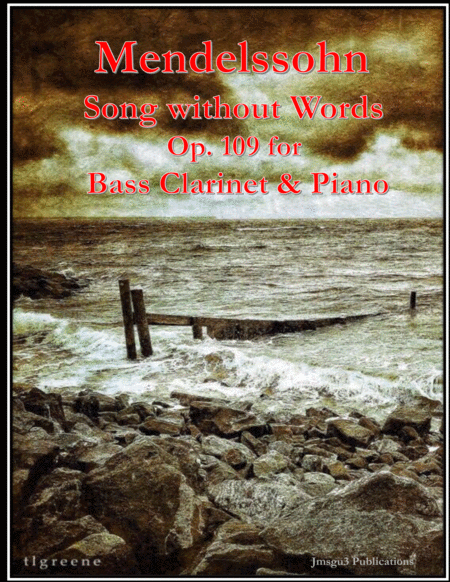
Mendelssohn: Song Without Words Op. 109 for Bass Clarinet & Piano
Clarinette Basse, Piano

$32.95 28.65 € Clarinette Basse, Piano PDF SheetMusicPlus

Bass Clarinet,Piano - Level 1 - Digital Download SKU: A0.548691 Composed by Franz Schubert. Arranged by James M. Guthrie, ASCAP. Christmas,Easter,Standards. Score and part. 4 pages. Jmsgu3 #3411127. Published by jmsgu3 (A0.548691). A Bass Clarinet Christmas/Easter classic! Duration: 4:55 Score: 3 pg. Bass Clarinet part: 1 pg. Piano reads from the score. Schubert seems to have composed this piece as a song-setting. This is because he wanted to portray a poignant emotional event from a poem. The poem was Walter Scott's The Lady of the Lake. Consequently, this song became an integral part of Schubert's Song cycle. Therefore the cycle is called: the Lady of the Lake. In the poem, Ellen Douglas is the Lady of the Lake. The lake is probably Loch Katrine in the Scottish Highlands. First of all, Ellen goes with her father to stay in the Goblin's cave. They go because he earlier refused to join in a rebellion against King James. Roderick Dhu, the chief of the rebellious Alpine Clan, marches up the mountain with his army. But before the battle, he, first of all, hears Ellen singing. She is singing a prayer calling for help from the Virgin Mary. Schubert's piece was first performed at the castle of Countess Sophie Weissenwolff in Steyregg, Austria.  Schubert dedicated the arrangement to her, and as a result, she became famous as the lady of the lake.The incipit of Ellen's song is Ave Maria which is Latin for Hail Mary. It seems like this similarity led Schubert to adapt the melody to accommodate the Roman Catholic prayer Ave Maria. Consequently, the Latin version of Ave Maria finally became more famous than the original so that consequently many believe he wrote the Latin version first. Schubert Franz Schubert (1797–1828) was, in fact, a famous Austrian composer. Moreover, he composed during the late Classical and early Romantic periods. Schubert was comparatively prolific. He wrote more than 600 secular vocal works, seven symphonies, and, correspondingly, a massive amount of piano and chamber music. Critics agree, as a matter of fact, that his most famous works include his Piano Quintet in A major, D. 667 (also known as the Trout Quintet), the Symphony No. 8 in B minor, D. 759 (Unfinished Symphony), the last sonatas for piano (D. 958–960), and the song cycles Die schöne Müllerin (D. 795) and Winterreise (D. 911). Education Schubert was furthermore a musical child prodigy. He studied violin with his father as well as piano with his older brother. In addition, when Schubert was eleven he studied at Stadtkonvikt school, where he became familiar with the orchestral music of Haydn, Mozart, and likewise Beethoven. In due time he left school and returned home where he studied to become an educator; nevertheless, he continued studying composition with Antonio Salieri. Performance Eventually, Schubert was admitted to the Gesellschaft der Musikfreunde as a performer. This appointment straightaway established his name in Vienna as a composer and pianist. Finally, he gave his only composition recital in 1828. He died suddenly a few months later probably due to typhoid fever. Legacy Schubert’s music was by and large underappreciated while he was alive. There were all in all only a few enthusiasts in Vienna. After he died, however, interest in his work in fact increased. Felix Mendelssohn, Robert Schumann, Franz Liszt, Johannes Brahms and other famous composers in due time discovered his compositions. Nowadays, historians rank Schubert expressly among the greatest composers of the era, and his music remains in general very popular.  
Schubert: Ave Maria for Bass Clarinet & Piano
Clarinette Basse, Piano

$29.95 26.04 € Clarinette Basse, Piano PDF SheetMusicPlus

Bass Clarinet,Piano - Level 2 - Digital Download SKU: A0.549358 Composed by Bach-Gounod. Arranged by James M. Guthrie, ASCAP. Christmas,Contemporary,Easter,Wedding. Score and part. 11 pages. Jmsgu3 #3490039. Published by jmsgu3 (A0.549358). This arrangement follows the original Bach prelude and so excludes the extra measure that Schwencke introduced in 1783. If you prefer the extra measure, please see Bach-Gounod: Ave Maria, Schwencke version for Bass Clarinet & Piano, S0.661771. The convenient 1st & 2nd endings provide an option for extended performance with minimal page turns for the accompanist. The duration with repeat is about 4:50. Score: 6 pages. Solo part: 1 page, piano part: 4 pages. Based on Prelude #1 in C Major from the Well-Tempered Clavier, Book 1. Well suited for church meditations or school programs or recital encores. Ave Maria Ave Maria is a Catholic prayer that consequently asks for the mother of Jesus (Mary) to intercede. Charles Gounod composed a famous version of the Ave Maria. He was a French Romantic composer who overlaid a new melody on an existing Bach chord progression. The progression is from Bach’s Prelude No. 1 from Well-Tempered Clavier I. This version, as well as Schubert’s version, have become essential items at weddings, masses, and funerals. Bach Overview First of all, Johann Sebastian Bach is maybe the greatest composer in music history. Certainly, he was prolific. As a result, everyone has heard of his works. Furthermore, these works number well over a thousand. It seems like people are probably most familiar with instrumental works such as the Brandenburg Concertos, and the Goldberg Variations. But, similarly famous are such noteworthy works as the Well-Tempered Clavier, the Musical Offering, and the Art of Fugue. Seems like his most famous vocal works include the most noteworthy Mass in B Minor. Also, most noteworthy, though, are the St. John Passion, and certainly the Christmas Oratorio.  History Bach came from a long line of musicians and above all, composers. Consequently, he, first of all, pursued a career as a church organist. So as a result, he gained employment in various Protestant churches in Germany. For a while, he worked as a court musician in Weimar and Köthen. Here he probably developed his organ style and likewise his chamber music style. Eventually, he gained an appointment as Cantor of St. Thomas in Leipzig. Here he worked until difficulties with his employer ultimately drove him away. The King of Poland finally appointed him as court composer.  Style It seems like Bach created an engaging new international style. He synthesized elements of the most noteworthy European music ideas into his new style. Even more, this new style was probably his synthesis of European musical rhythm and form. Furthermore, he demonstrated a complete mastery of counterpoint and motivic development. His sense of harmonic organization probably propelled him to the top. Revival               Mendelssohn conducted a Bach revival in the nineteenth century. His effort probably helped to re-familiarize the public with the magnitude of Bach’s works. During this period, scholars published many noteworthy Bach biographies. Moreover, Wolfgang Schmieder published the BWV (Bach Werke Verzeichnis). As a result, this is now the official catalog of his entire artistic output. The BWV number allows us to locate a work in the catalog. Sometimes scholars will simply use an S (Schmieder) as an abbreviation for BWV.  
Bach-Gounod: Ave Maria for Bass Clarinet & Piano
Clarinette Basse, Piano

$32.95 28.65 € Clarinette Basse, Piano PDF SheetMusicPlus

Bass Clarinet,Piano - Level 2 - Digital Download SKU: A0.549432 Composed by Antonin Dvorak. Arranged by James M. Guthrie, ASCAP. Instructional,Romantic Period,Sacred,Standards. Score and part. 12 pages. Jmsgu3 #3494207. Published by jmsgu3 (A0.549432). Score: 7 pages, solo part: 2 pages, piano part: 3 pages. Duration: 4:25 Not difficult, but requires sensitivity & dynamic control. Suitable for recitals, church meditations, or school programs. Dvořák Background Antonín Dvořák (1841 –1904) was, of course, a composer from Czechoslovakia. As a matter of fact, he was among the first Bohemian composers to attain universal recognition. It is important to realize that the late Romantic Nationalist period featured composers who used traditional and folk elements to portray the character of their nation. In particular, we see this in the music of Grieg (Norway), Finland (Sibelius), and Smetana (Bohemia).  Dvořák relied markedly on rhythms and other characteristics of Moravian and Bohemian folk music. Ascent to Fame Dvořák was truly a child musical prodigy on the violin. The premiere performances of his compositions notably occurred in 1872 and 1873. He submitted his First Symphony in particular to a German competition, but it failed to win. Consequently, in 1874 he presented two more symphonies to the Austrian State Prize for Composition. Johannes Brahms was the principal of the jury and was accordingly very impressed. They forthwith awarded the prize to Dvořák in 1874, 1876, and 1877. At this point, Brahms thereupon endorsed Dvořák to the publisher Simrock. Later, the publisher commissioned Dvořák to compose the Slavonic Dances, Op. 46. These became popular overnight and, as a result, Dvořák's worldwide status was launched. International Status Dvořák visited England upon invitation nine times. On each visit, he frequently conducted performances of his own compositions. He conducted concerts of his music, especially in Moscow and St. Petersburg. Eventually, the Prague Conservatory in fact appointed Dvořák as a professor. There, to be sure, he wrote his famous Dumky Trio. United States Consequently, the National Conservatory of Music of America appointed him as director in 1892. As a result, Dvořák composed his two most famous symphonic works: the Symphony No. 9 (From the New World), which spread his name universally, and his Concerto for Cello and Orchestra, one of the most famous of all cello works. Moreover, he wrote his most celebrated American String Quartet during this time. At the same time, because of his growing recognition in Europe and his homesickness for his own country, he left to return to Bohemia in 1895.
DvoÅ™ák: Largo from the New World Symphony for Bass Clarinet & Piano
Clarinette Basse, Piano

$32.95 28.65 € Clarinette Basse, Piano PDF SheetMusicPlus

B-Flat Bass Clarinet,Piano - Level 2 - Digital Download SKU: A0.1247481 Composed by Johann Strauss Jr., STRAUSS II, and Strauss 2. Arranged by Rodrigo Faleiros. 19th Century,Chamber,Contest,Festival,Romantic Period,Wedding. Score and part. 6 pages. Rodrigo Faleiros #841892. Published by Rodrigo Faleiros (A0.1247481). This delightful rendition of The Blue Danube Waltz, composed by Johann Strauss II, is specifically tailored for a solo bass clarinet with piano accompaniment, making it accessible and enjoyable for musicians of varying skill levels. This arrangement offers a harmonious blend of the original composition's enchanting melodies and the intimate charm of the main line simplified for an easy-to-follow reading, creating a captivating musical experience for both performers and listeners alike. This easy sheet music contains both the full score with the piano notated with chords and the separate part of the bass clarinet.
The Blue Danube Waltz
Clarinette Basse, Piano

$2.99 2.6 € Clarinette Basse, Piano PDF SheetMusicPlus

B-Flat Bass Clarinet,Piano - Level 2 - Digital Download SKU: A0.1247498 Composed by Johann Strauss Jr., STRAUSS II, and Strauss 2. Arranged by Rodrigo Faleiros. 19th Century,Chamber,Contest,Festival,Romantic Period,Wedding. Score and part. 6 pages. Rodrigo Faleiros #841915. Published by Rodrigo Faleiros (A0.1247498). This delightful rendition of The Blue Danube Waltz, composed by Johann Strauss II, is specifically tailored for a solo bass clarinet with piano accompaniment, making it accessible and enjoyable for musicians of varying skill levels. This arrangement offers a harmonious blend of the original composition's enchanting melodies and the intimate charm of the main line simplified for an easy-to-follow reading, creating a captivating musical experience for both performers and listeners alike. This easy sheet music contains both the full score with the piano and the separate part of the bass clarinet.
The Blue Danube Waltz
Clarinette Basse, Piano

$2.99 2.6 € Clarinette Basse, Piano PDF SheetMusicPlus

Bass Clarinet,Piano - Level 3 - Digital Download SKU: A0.549410 Composed by Carl Bohm. Arranged by James M. Guthrie, ASCAP. Romantic Period,Sacred,Standards,Wedding. Score and part. 12 pages. Jmsgu3 #3493691. Published by jmsgu3 (A0.549410). Duration: ca. 4:00, Score: 7 pages, solo part: 2 pages, piano part: 3 pages. A very popular number for weddings, also effective for meditations and recital encores. Carl Bohm Carl Bohm, sometimes spelled with a K as in Karl Bohm, was born in 1844 and died in 1920. Bohm was a German composer, pianist, and songwriter. He was famous for writing songs with a light and optimistic atmosphere. Some of his most famous songs are Calm as the Night, Twilight, May Bells, Enfant Cheri, and The Fountain. In addition to his songs, he was a very popular composer of string quartets and string trios. His music was very popular and profitable. His publisher used some of the profits from sales of Bohm’s work to prepare the works of Johannes Brahms for publication. Output He certainly was prolific, not only with individual compositions but collections and albums of original music, such as the Bohm Album for the Pianoforte. The quality of his melodies is remarkable. They have a familiar quality similar to folk-songs. It’s no wonder they have become so popular.   His greatest masterpiece may well be the famous Calm as the Night as it is so well finished and refined. This song comes to us from a collection known simply as Lieder Op. 326. Calm as the Night (Still wie die Nacht) is listed as Number 27 in the collection. The song is scored for vocal duet and piano. The lyrics for Bohm’s Still wie die Nacht are anonymous. Lyrics: Still wie die Nacht Und tief wie das Meer, Soll deine Liebe sein! Wenn du mich liebst, So wie ich dich, Will ich dein eigen sein. Heiß wie der Stahl Und fest wie der Stein Soll deine Liebe sein! English: As quiet as the night And deep as the sea, Your love should be! If you love me The same as I love you, I want to be yours. As hot as steel And as firm as a rock, Your love should be!
Bohm: Calm as the Night for Bass Clarinet & Piano
Clarinette Basse, Piano

$26.95 23.43 € Clarinette Basse, Piano PDF SheetMusicPlus


Partitions Gratuites
Acheter des Partitions Musicales
Acheter des Partitions Digitales à Imprimer
Acheter des Instruments de Musique

© 2000 - 2026

Accueil - Version intégrale





