EUROPE
4672 articles
USA
0 articles
DIGITAL
16 articles (à imprimer)
Partitions Digitales
Partitions à imprimer
16 partitions trouvées


Bass Clarinet,Piano - Level 3 - Digital Download SKU: A0.549541 Composed by Edvard Grieg. Arranged by James M. Guthrie, ASCAP. Concert,Contemporary,Romantic Period,Sacred,Standards. Score and part. 11 pages. Jmsgu3 #3506173. Published by jmsgu3 (A0.549541). Duration: ca. 4:00, Score: 9 pages, solo part: 3 pages, piano part: 4 pages. Super-famous instantly recognizable tune, not very difficult - suitable for a recital or church meditation.Grieg Background In the first place, Edvard Grieg (1843 –1907) was a Norwegian composer as well as a concert pianist. As a matter of fact, most music historians consider him one of the foremost Romantic era composers. Consequently, his music is part of the international standard classical repertoire. Grieg moreover used Norwegian folk music in his own compositions.  Consequently, he ushered Norwegian music to transnational consciousness. Furthermore, he forged a national musical identity for Norway. It is important to realize that he did this in a manner similar to Jean Sibelius in Finland, and BedÅ™ich Smetana in Bohemia. Legacy Grieg is especially celebrated in the city of Bergen. For example, the city has erected numerous statues depicting Grieg. Specifically, the city has named a concert hall (Grieg Hall), a music school (Grieg Academy) and a professional choir (Edvard Grieg Kor) after him. As a matter of fact, there is also a museum located at his former home in Troldhaugen. Peer Gynt Suite No. 1 (Op. 46) Grieg wrote incidental music for the purpose of illustrating a play by Ibsen known as Peer Gynt. The play includes, in particular, the famous selection entitled, In the Hall of the Mountain King. In this composition, Grieg indeed depicts the exploits of the scoundrel, Peer Gynt. In one famous episode, for example, Peer steals a bride at her wedding. For this reason, the people chase him, but soon Peer falls, thereupon striking his skull on a boulder. He wakens forthwith in a highland bounded by angry gnomes. Consequently, the music of In the Hall of the Mountain King represents the mad gnomes taunting Peer. Therefore, each time the theme repeats it gets louder and faster. In the end, Peer surprisingly escapes from the mountain. Holberg Suite and Misc. Summary It must be remembered that Grieg originally wrote his Holberg Suite for the piano. In other words, he only later arranged it for strings. Further, Grieg composed by and large many songs with lyrics by famous writers such as Heine, Goethe, Ibsen, Hans Christian Andersen, Rudyard Kipling, and others. On balance, Norwegian pianist Eva Knardahl recorded altogether Grieg’s whole piano catalog on LP in 1980. These recordings were released again on CD in 2006. In any event, Grieg himself performed and recorded the bulk of these pieces toward the end of his life.Register for free lifetime revisions and updates at www.jamesguthrie.com
Grieg: Ase's Death from Peer Gynt Suite for Bass Clarinet & Piano
Clarinette Basse, Piano

$24.95 21.74 € Clarinette Basse, Piano PDF SheetMusicPlus

Bass Clarinet,Piano - Level 3 - Digital Download SKU: A0.549562 Composed by Edvard Grieg. Arranged by James M. Guthrie, ASCAP. Concert,Instructional,Romantic Period,Standards,World. Score and part. 16 pages. Jmsgu3 #3508013. Published by jmsgu3 (A0.549562). Duration: ca. 3:20, Score: 10 pages, solo part: 2 pages, piano part: 3 pages. Delicate, not very difficult - suitable for a recital encore. Grieg Background In the first place, Edvard Grieg (1843 –1907) was a Norwegian composer as well as a concert pianist. As a matter of fact, most music historians consider him one of the foremost Romantic era composers. Consequently, his music is part of the international standard classical repertoire. Grieg moreover used Norwegian folk music in his own compositions.  Consequently, he ushered Norwegian music to transnational consciousness. Furthermore, he forged a national musical identity for Norway. It is important to realize that he did this in a manner similar to Jean Sibelius in Finland, and BedÅ™ich Smetana in Bohemia. Legacy Grieg is especially celebrated in the city of Bergen. For example, the city has erected numerous statues depicting Grieg. Specifically, the city has named a concert hall (Grieg Hall), a music school (Grieg Academy) and a professional choir (Edvard Grieg Kor) after him. As a matter of fact, there is also a museum located at his former home in Troldhaugen. Peer Gynt Suite No. 1 (Op. 46) Grieg wrote incidental music for the purpose of illustrating a play by Ibsen known as Peer Gynt. The play includes, in particular, the famous selection entitled, In the Hall of the Mountain King. In this composition, Grieg indeed depicts the exploits of the scoundrel, Peer Gynt. In one famous episode, for example, Peer steals a bride at her wedding. For this reason, the people chase him, but soon Peer falls, thereupon striking his skull on a boulder. He wakens forthwith in a highland bounded by angry gnomes. Consequently, the music of In the Hall of the Mountain King represents the mad gnomes taunting Peer. Therefore, each time the theme repeats it gets louder and faster. In the end, Peer surprisingly escapes from the mountain. Holberg Suite and Misc. Summary It must be remembered that Grieg originally wrote his Holberg Suite for the piano. In other words, he only later arranged it for strings. Further, Grieg composed by and large many songs with lyrics by famous writers such as Heine, Goethe, Ibsen, Hans Christian Andersen, Rudyard Kipling, and others. On balance, Norwegian pianist Eva Knardahl recorded altogether Grieg’s whole piano catalog on LP in 1980. These recordings were released again on CD in 2006. In any event, Grieg himself performed and recorded the bulk of these pieces toward the end of his life.Register for free lifetime revisions and updates at www.jamesguthrie.com
Grieg: Anitra's Dance from Peer Gynt Suite for Bass Clarinet & Piano
Clarinette Basse, Piano

$24.95 21.74 € Clarinette Basse, Piano PDF SheetMusicPlus

Bass Clarinet,Piano - Level 3 - Digital Download SKU: A0.549648 Composed by Ludwig van Beethoven. Arranged by James M. Guthrie, ASCAP. Concert,Instructional,Romantic Period,Sacred,Standards. Score and part. 16 pages. Jmsgu3 #3516889. Published by jmsgu3 (A0.549648). Duration: ca 5:20, Score: 8 pages, solo part: 3 pages, piano part: 4 pages. One of Beethoven's finest and most famous works. Program for a recital, church meditation or school program. Bring your best espressivo and plan to rehearse the many subtle dynamic changes.Sonata Pathétique Op. 13 First of all, this is an arrangement of the second movement of Beethoven’s Sonata Pathétique. It seems like Beethoven wrote this piece before becoming troubled by deafness. Published in 1799, it consequently remains one of the most celebrated pieces Beethoven ever wrote. As a result of its popularity, the movement was therefore performed by Karl Haas. Hass recorded it for a popular radio show called: Adventures in Good Music. Beethoven Background Ludwig van Beethoven (1770 –1827) was certainly a German pianist. Above all, he was probably one of the greatest composers in history. As a result, he is a pivotal character in the progress between the Classical and Romantic periods. He is certainly one of the most famous and hence important of all composers. Seems like his most familiar and noteworthy works include symphonies 1-9; piano concertos 1-5; and furthermore, the violin concerto. Also, certainly of extreme importance are the noteworthy 32 sonatas for the piano; the string quartets 1-16; the Missa solemnis; and likewise, his only opera, Fidelio. Beethoven Overview First of all, Beethoven was born and consequently raised in Bonn. Upon turning 21 he moved to Vienna probably to study composition with Haydn. That’s when he consequently grew a reputation as a brilliant pianist. Furthermore, he probably stayed in Vienna for the rest of his life. In his late 20s, it seems like his hearing certainly began to decline. It slowly declined until consequently, he was nearly totally deaf probably by the last decade of his life. As a result, he stopped conducting and performing. Nevertheless, he continued to compose. As a result, some of his greatest works probably come from this period. First Period Seems like we often divide Beethoven’s life into three periods. Period 1 begins with Beethoven’s arrival in Vienna. Hence, during this period, he mastered the Viennese style of Haydn & Mozart. He consequently began increasing the size and scale of his works. Furthermore, he experimented with extreme dynamics, and likewise extreme tempi. He worked similarly with chromatic harmony. His First and Second Symphonies, therefore, belong to this period. Other important works also belong here: the first six string quartets and the Sonata Pathétique, Op. 13. Second Period His second period probably began as soon as he realized that he was going deaf. During this period, it seems like he became obsessed with the idea of heroism. His works consequently become even larger and more massive. The most noteworthy of these include the symphonies 3 – 8, piano concertos 5& 6, 5 string quartets, several important piano sonatas (Waldstein and Appassionata), the Kreutzer violin sonata, the violin concerto and his only opera: Fidelio. Third Period In contrast, Beethoven's third period is branded above all by works of incredible intellectual depth, formal innovation, and penetrating expression. It seems like he continued to expand his works. Consequently, the string quartet Op. 131 spills over into seven connected movements. Likewise, in the Ninth Symphony, he adds choral forces to his orchestra probably for the first time in history. Even more, other works from this period include his Missa solemnis, the final 5 string quartets (including the enormous Große Fuge) and the final five sonatas for piano.    Register for free lifetime revisions and updates at www.jamesguthrie.com
Beethoven: Adagio from Sonata Pathetique for Bass Clarinet & Piano
Clarinette Basse, Piano

$24.95 21.74 € Clarinette Basse, Piano PDF SheetMusicPlus

Bass Clarinet,Piano - Level 4 - Digital Download SKU: A0.1112353 Composed by Scott Joplin. Arranged by David McKeown. 20th Century,Jazz,Ragtime. Score and part. 8 pages. David McKeown #714427. Published by David McKeown (A0.1112353). The most popular of Scott Joplin’s piano rags during his lifetime, The Maple Leaf Rag was published in 1899. Joplin lived for a while in Sedalia, Missouri and the Maple Leaf Club in that town is thought to have provided the name for this composition. It provided Joplin with a steady income for the rest of his life, and while he requested that it be played at his funeral, his wife refused as she felt it inappropriate. It was the first track on Joshua Rifkin’s famous 1970 revival recording of Joplin’s music and, never waning in popularity, it has featured in hundreds of films. This version for Bass Clarinet and Piano includes all four sections of the original composition. The tempo in recorded versions varies widely between 72 and 126, so the marking of 92 is a suggestion only. Musicians at an advanced intermediate level and above will find this ideal for formal and informal performances. The overall performance time is around four minutes. Teachers will enjoy using this arrangement as a fun way to help with phrasing, syncopated rhythms and light articulation.  Click the YouTube link to hear a full performance of the clarinet version of this arrangement. There are many more top quality arrangements and compositions by David McKeown for you to browse at http://www.sheetmusicplus.com/publishers/david-mckeown/6203
Maple Leaf Rag, by Scott Joplin, for Bass Clarinet and Piano
Clarinette Basse, Piano

$3.99 3.48 € Clarinette Basse, Piano PDF SheetMusicPlus

Bass Clarinet,Piano - Level 3 - Digital Download SKU: A0.549585 Composed by Edvard Grieg. Arranged by James M. Guthrie, ASCAP. Concert,Instructional,Romantic Period,Standards,World. Score and part. 18 pages. Jmsgu3 #3511273. Published by jmsgu3 (A0.549585). Duration: ca. 2:17 Score: 10 pages, solo part: 2 pages, piano part: 5 pages. A proven audience pleaser - perfect for a recital encore! Grieg Background In the first place, Edvard Grieg (1843 –1907) was a Norwegian composer as well as a concert pianist. As a matter of fact, most music historians consider him one of the foremost Romantic era composers. Consequently, his music is part of the international standard classical repertoire. Grieg moreover used Norwegian folk music in his own compositions.  Consequently, he ushered Norwegian music to transnational consciousness. Furthermore, he forged a national musical identity for Norway. It is important to realize that he did this in a manner similar to Jean Sibelius in Finland, and BedÅ™ich Smetana in Bohemia. Legacy Grieg is especially celebrated in the city of Bergen. For example, the city has erected numerous statues depicting Grieg. Specifically, the city has named a concert hall (Grieg Hall), a music school (Grieg Academy) and a professional choir (Edvard Grieg Kor) after him. As a matter of fact, there is also a museum located at his former home in Troldhaugen. Peer Gynt Suite No. 1 (Op. 46) Grieg wrote incidental music for the purpose of illustrating a play by Ibsen known as Peer Gynt. The play includes, in particular, the famous selection entitled, In the Hall of the Mountain King. In this composition, Grieg indeed depicts the exploits of the scoundrel, Peer Gynt. In one famous episode, for example, Peer steals a bride at her wedding. For this reason, the people chase him, but soon Peer falls, thereupon striking his skull on a boulder. He wakens forthwith in a highland bounded by angry gnomes. Consequently, the music of In the Hall of the Mountain King represents the mad gnomes taunting Peer. Therefore, each time the theme repeats it gets louder and faster. In the end, Peer surprisingly escapes from the mountain. Holberg Suite and Misc. Summary It must be remembered that Grieg originally wrote his Holberg Suite for the piano. In other words, he only later arranged it for strings. Further, Grieg composed by and large many songs with lyrics by famous writers such as Heine, Goethe, Ibsen, Hans Christian Andersen, Rudyard Kipling, and others. On balance, Norwegian pianist Eva Knardahl recorded altogether Grieg’s whole piano catalog on LP in 1980. These recordings were released again on CD in 2006. In any event, Grieg himself performed and recorded the bulk of these pieces toward the end of his life.  Register for free lifetime revisions and updates at www.jamesguthrie.com
Grieg: Hall of the Mountain King from Peer Gynt Suite for Bass Clarinet & Piano
Clarinette Basse, Piano

$24.95 21.74 € Clarinette Basse, Piano PDF SheetMusicPlus

Bass Clarinet,Piano - Level 2 - Digital Download SKU: A0.550920 Composed by J. S. Bach - Gounod. Arranged by James M. Guthrie, ASCAP. Christmas,Easter,Standards. Score and part. 12 pages. Jmsgu3 #4888299. Published by jmsgu3 (A0.550920). This arrangement features the controversial Schwencke measure (ms. 27) that was originally introduced in 1783 by Christian Friedrich Gottlieb Schwencke. The convenient 1st & 2nd endings provide an option for extended performance. Duration with repeat - 4:50. Score: 7 pages. Solo part: 1 page, piano part: 4 pages. Based on Prelude #1 in C Major from the Well-Tempered Clavier, Book 1. Well suited for church meditations or school programs or recital encores.  Ave Maria Ave Maria is a Catholic prayer that consequently asks for the mother of Jesus (Mary) to intercede. Charles Gounod composed a famous version of the Ave Maria. He was a French Romantic composer who overlaid a new melody on an existing Bach chord progression. The progression is from Bach’s Prelude No. 1 from Well-Tempered Clavier I. This version, as well as Schubert’s version, have become essential items at weddings, masses, and funerals. Bach Overview First of all, Johann Sebastian Bach is maybe the greatest composer in music history. Certainly, he was prolific. As a result, everyone has heard of his works. Furthermore, these works number well over a thousand. It seems like people are probably most familiar with instrumental works such as the Brandenburg Concertos, and the Goldberg Variations. But, similarly famous are such noteworthy works as the Well-Tempered Clavier, the Musical Offering, and the Art of Fugue. Seems like his most famous vocal works include the most noteworthy Mass in B Minor. Also, most noteworthy, though, are the St. John Passion, and certainly the Christmas Oratorio.  History Bach came from a long line of musicians and above all, composers. Consequently, he, first of all, pursued a career as a church organist. So as a result, he gained employment in various Protestant churches in Germany. For a while, he worked as a court musician in Weimar and Köthen. Here he probably developed his organ style and likewise his chamber music style. Eventually, he, therefore, gained an appointment as Cantor of St. Thomas in Leipzig. Here he worked until difficulties with his employer ultimately drove him away. The King of Poland finally appointed him as a court composer.  Style It seems like Bach created an engaging new international style. He synthesized elements of the most noteworthy European music ideas into his new style. Even more, this new style was probably his synthesis of European musical rhythm and form. Furthermore, he demonstrated a complete mastery of counterpoint and motivic development. His sense of harmonic organization probably propelled him to the top. Revival               Mendelssohn conducted a Bach revival in the nineteenth century. His effort probably helped to re-familiarize the public with the magnitude of Bach’s works. During this period, scholars published many noteworthy Bach biographies. Moreover, Wolfgang Schmieder published the BWV (Bach Werke Verzeichnis). As a result, this is now the official catalog of his entire artistic output. The BWV number allows us to locate a work in the catalog. Sometimes scholars will simply use an S (Schmieder) as an abbreviation for BWV.  Voyager NASA launched two Voyager spacecraft in 1977. Onboard are phonograph records with sounds, music, and images of life on Earth. The purpose of the launch was to inform intelligent extraterrestrial life forms about conditions on Earth. The music on the disc is varied. There is Bach, Mozart, Beethoven, and Stravinsky among others. However, because Bach is so important in our music history, it contains three times more Bach than all the others combined.
Bach-Gounod: Ave Maria, Schwencke version for Bass Clarinet & Piano
Clarinette Basse, Piano

$32.95 28.71 € Clarinette Basse, Piano PDF SheetMusicPlus

Bass Clarinet,Piano - Level 2 - Digital Download SKU: A0.549231 Composed by Johann Sebastian Bach. Arranged by James M. Guthrie, ASCAP. Baroque,Easter,Standards,Wedding. Score and part. 9 pages. Jmsgu3 #3468714. Published by jmsgu3 (A0.549231). J. S. Bach BWV 508.  Bist du bei mir Bach adapted this aria from a lost Stölzel opera called Diomedes. He changed the original orchestral instrumentation to soprano, strings, and continuo.  He also modified the voice-leading making it sound more like a Bach composition. The work appears as BWV 508 No. 25 in the Anna Magdalena Notebook No. 2.   Source Only a few remnants of the original opera have survived. Historians speculate that Anna Magdalena got the song from the Leipzig Opera after the bankruptcy of 1720. Chances are good, though, that the tune was a favorite of everyone in Leipzig at the time.   Lyrics When thou art near, I go with joyTo death and to my rest.O how joyous would my end be,If your fair hands            Would close my faithful eyes. - Unknown Bach Overview First of all, Johann Sebastian Bach is maybe the greatest composer in music history. Certainly, he was prolific. As a result, everyone has heard of his works. Furthermore, these works number well over a thousand. It seems like people are probably most familiar with the instrumental works such as the Brandenburg Concertos, and the Goldberg Variations. But, similarly famous are such noteworthy works as the Well-Tempered Clavier, the Musical Offering, and certainly the Art of Fugue. Seems like his most famous vocal works include the most noteworthy Mass in B Minor. Also, most noteworthy, though, are the St. John Passion, and certainly the Christmas Oratorio.  History Bach came from a long line of musicians and above all, composers. Consequently, he, first of all, pursued a career as a church organist. So as a result, he gained employment in various Protestant churches in Germany. For a while, he worked as a court musician in Weimar and Köthen. Here he probably developed his organ style and likewise his chamber music style. Eventually, he, therefore, gained an appointment as Cantor of St. Thomas in Leipzig. Here he worked until difficulties with his employer ultimately drove him away. The King of Poland finally appointed him as court composer.  Style It seems like Bach created a fascinating new international style. He synthesized elements of the most noteworthy European music ideas into his new style. Even more, this new style was probably his synthesis of European musical rhythm and form. Furthermore, he demonstrated a complete mastery of counterpoint and motivic development. His sense of harmonic organization probably propelled him to the top. Revival                Mendelssohn conducted a Bach revival in the nineteenth century. His effort probably helped to re-familiarize the public with the magnitude of Bach’s works. During this period, scholars published many noteworthy Bach biographies. Moreover, Wolfgang Schmieder published the BWV (Bach Werke Verzeichnis). As a result, this is now the official catalog of his entire artistic output. The BWV number allows us to locate a work in the catalog. Sometimes scholars will simply use an S (Schmieder) as an abbreviation for BWV.  Voyager NASA launched two Voyager spacecraft in 1977. Onboard are phonograph records with sounds, music, and images of life on Earth. The purpose of the launch was to inform intelligent extraterrestrial life forms about conditions on Earth. The music on the disc is varied. There is Bach, Mozart, Beethoven, and Stravinsky among others. However, because Bach is so important in our music history, it contains three times more Bach than all the others combined.
Bach: Bist du bei mir BWV 508 for Bass Clarinet & Piano
Clarinette Basse, Piano

$32.95 28.71 € Clarinette Basse, Piano PDF SheetMusicPlus

Bass Clarinet,Piano - Level 3 - Digital Download SKU: A0.1458235 Composed by Alan Menken and Tim Rice. Arranged by Harry Walker. Broadway,Film/TV,Musical/Show,Pop,Singer/Songwriter,Wedding. Score and part. 11 pages. SCORE EDITIONS #1037211. Published by SCORE EDITIONS (A0.1458235). A Whole New World is the signature song from Disney's 1992 animated feature film Aladdin, with music by Alan Menken and lyrics by Tim Rice. A duet originally recorded by singers Brad Kane and Lea Salonga in their respective roles as the singing voices of the main characters Aladdin and Jasmine, the ballad serves as both the film's love and theme song. Lyrically, A Whole New World describes Aladdin showing the confined princess a life of freedom and the pair's acknowledgment of their love for each other while riding on a magic carpet. In this version, the composition was arranged for Bass Clarinet and Piano by Harry Walker. Score and partes available in:.
A Whole New World
Clarinette Basse, Piano

$5.99 5.22 € Clarinette Basse, Piano PDF SheetMusicPlus

Bass Clarinet,Piano - Level 3 - Digital Download SKU: A0.549498 Composed by Felix Bartholdy Mendelssohn. Arranged by James M. Guthrie, ASCAP. Instructional,Romantic Period,Sacred,Standards. Score and part. 20 pages. Jmsgu3 #3501033. Published by jmsgu3 (A0.549498). BASS CLARINET & PIANO - Score: 11 pages, solo part: 3 pages, piano part: 5 pages. Duration: 4:20. This is a popular recital piece that would work well also in church or school programs. Mendelssohn Background Felix Mendelssohn (1809 –1847) was, by all means, a German mastermind composer, musician, and orchestra conductor of the Romantic period. Consequently, Mendelssohn composed in the usual forms of the time - symphonies, concertos, oratorios, piano music, and chamber music. To summarize, his most famous works include his music for A Midsummer Night's Dream, the Italian Symphony, the Scottish Symphony, The Hebrides Overture, his later Concerto for Violin & Orchestra, and his Octet for Strings. His most well-known piano pieces, by and large, are the Songs Without Words.  Artistic Standing  Musical tastes change from time to time. Moreover, just such a change occurred in the late 19th and early 20th centuries. This plus rampant antisemitism brought a corresponding amount of undue criticism. Fortunately, however, his artistic inventiveness has indeed been critically re-evaluated. As a result, Mendelssohn is once again among the most prevalent composers of the Romantic era. Early Family Life Mendelssohn was, in fact, born into a prominent Jewish family. His grandfather was, notably, the philosopher Moses Mendelssohn. Felix was, in fact, raised without religion. At the age of seven, he was suddenly baptized as a Reformed Christian. He was, moreover, a child musical prodigy. Nevertheless, his parents did not attempt to exploit his talent. Early Adulthood Mendelssohn was, in general, successful in Germany. He conducted, in particular, a revival of the music of Johann Sebastian Bach, specifically with his presentation of the St Matthew Passion in 1829. Felix was truly in demand throughout Europe as a composer, conductor, and soloist. For example, he visited Britain ten times. There, he premiered, namely, many of his significant works. His taste in music was. To be sure, inventive and well-crafted yet markedly conservative. This conservatism separated him by all means from more audacious musical colleagues like Liszt, Wagner, and Berlioz. Mendelssohn founded the Leipzig Conservatoire which, to clarify, became a defender of this conservative viewpoint. Mature Adulthood Schumann notably wrote that Mendelssohn was the Mozart of the nineteenth century, the most brilliant musician, the one who most clearly sees through the contradictions of the age and for the first time reconciles them. This observation points to a couple of features in particular that illustrate Mendelssohn's works and his artistic procedure. Musical Features In the first place, his musical style was fixed in his systematic mastery of the style of preceding masters. This being said, he certainly recognized and even developed early romanticism from the music of Beethoven and Weber. Secondly, it indicates that Mendelssohn sought to strengthen his inherited musical legacy rather than to exchange it with new forms and styles or replace it with exotic orchestration. Consequently, he diverged his contemporaries in the romantic period, such as Wagner, Berlioz, and Liszt. Mendelssohn revered Liszt's virtuosity at the keyboard but found his music rather insubstantial.
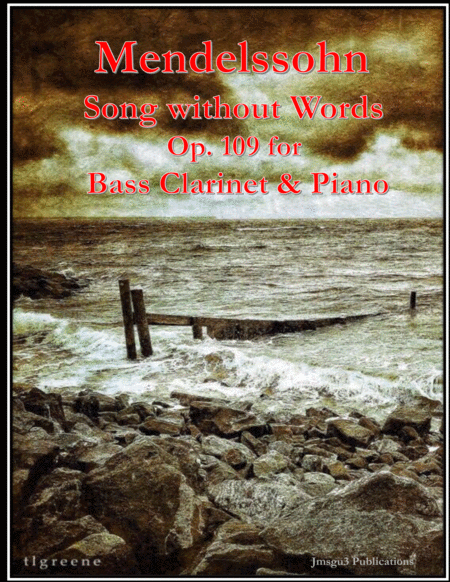
Mendelssohn: Song Without Words Op. 109 for Bass Clarinet & Piano
Clarinette Basse, Piano

$32.95 28.71 € Clarinette Basse, Piano PDF SheetMusicPlus

Bass Clarinet,Piano - Level 3 - Digital Download SKU: A0.549345 By Barry Manilow. By Bruce Johnston. Arranged by James M. Guthrie, ASCAP. Contemporary,Rock. Score and part. 8 pages. Jmsgu3 #3486713. Published by jmsgu3 (A0.549345). Duration: ca. 3:00, score: 5 pages, solo part: 1 page, piano part: 2 pages.Very famous song suitable for church, recital or nightclub. I Write the Songs is a popular song written by Bruce Johnston in 1975 and made famous by Barry Manilow. Manilow's version reached number one on the Billboard Hot 100 chart in January 1976[2] after spending two weeks atop the Billboard adult contemporary chart in December 1975.[3] It won a Grammy Award for Song of the Year and was nominated for Record of the Year in 1977.[3] Billboard ranked it as the No. 13 song of 1976.[4]The original version was recorded by The Captain & Tennille, who worked with Johnston in the early 1970s with The Beach Boys. It appears on their 1975 album, Love Will Keep Us Together. The first release of I Write the Songs as a single was by then teen-idol David Cassidy from his 1975 solo album The Higher They Climb, which was also produced by Bruce Johnston. Cassidy's version reached #11 on the UK Singles Chart in August of that year.[5]Johnston has stated that, for him, the I in the song is God,[2] and that songs come from the spirit of creativity in all of us. He has said that the song is not about his Beach Boys bandmate Brian Wilson.[6]Manilow was initially reluctant to record the song, stating in his autobiography Sweet Life: The problem with the song was that if you didn't listen carefully to the lyric, you would think that the singer was singing about himself. It could be misinterpreted as a monumental ego trip.[3] After persuasion by Clive Davis, then president of Arista Records, Manilow recorded the song, and his version of I Write the Songs was the first single taken from the album Tryin' to Get the Feeling. It first charted on the Billboard Hot 100 on November 15, 1975, reaching the top of the chart nine weeks later, on January 17, 1976. Wikipedia
I Write The Songs
Clarinette Basse, Piano
Barry Manilow
$39.95 34.81 € Clarinette Basse, Piano PDF SheetMusicPlus

Bass Clarinet,Piano - Level 3 - Digital Download SKU: A0.550107 Composed by Claude Debussy. Arranged by James M. Guthrie. 20th Century,Holiday,Multicultural,Standards,World. Score and part. 15 pages. Jmsgu3 #4595923. Published by jmsgu3 (A0.550107). Moonlight * лунный Ñвет * 月光 * Σεληνόφωτο * MÄ›síÄní svit, Claude Debussy, 1890. Monumental impressionist masterpiece - perfect for Valentine's Day.Duration ca. 3:50 Score: 8 pages. Debussy was inspired by this poem by Paul Verlaine to compose this work:Your soul is a chosen landscapeWhere charming masquerades and dancers are promenading,Playing the lute and dancing, and almostSad beneath their fantastic disguises.While singing in a minor keyOf victorious love, and the pleasant lifeThey seem not to believe in their own happinessAnd their song blends with the moonlight,With the sad and beautiful moonlight,Which sets the birds in the trees dreaming,And makes the fountains sob with ecstasy,The tall slim water streams among the marble statues.Paul Verlaine, 1869
Debussy: Claire de Lune for Bass Clarinet & Piano
Clarinette Basse, Piano

$32.95 28.71 € Clarinette Basse, Piano PDF SheetMusicPlus

Bass Clarinet,Piano - Level 4 - Digital Download SKU: A0.786577 Composed by Fanny Crosby, Phoebe Palmer Knapp. Arranged by Beka Wilson. Christian,Gospel,Sacred. Score and part. 5 pages. Beka Wilson #6260799. Published by Beka Wilson (A0.786577). One of Fanny Crosby’s most beloved hymns is Blessed Assurance, and this song was given life by composer Phoebe Palmer Knapp. This intermediate instrumental arrangement of Blessed Assurance is perfect as part of a prelude, a short offertory for a smaller church, or any other special music needs for a church service.This arrangement is also available as a solo for flute, oboe, bassoon, alto sax, tenor sax, F horn, trumpet, trombone, violin, viola, and cello, and as a duet for two harps, harp/flute, harp/violin, harp/viola, or harp/cello. A vocal version of this arrangement will be made available soon.Length: approximately 2:40 Key: Concert D (E for B flat instruments, B for E flat instruments, A for F instruments)5 pages (includes score and separate solo part)
Blessed Assurance--clarinet solo
Clarinette Basse, Piano

$6.99 6.09 € Clarinette Basse, Piano PDF SheetMusicPlus

B-Flat Bass Clarinet,Piano - Level 1 - Digital Download SKU: A0.1280704 Composed by Peter Ilyich Tchaikovsky. Arranged by Rodrigo Faleiros. 19th Century,Children,Christmas,Romantic Period. Score and part. 4 pages. Rodrigo Faleiros #871764. Published by Rodrigo Faleiros (A0.1280704). Immerse yourself in the enchanting world of Tchaikovsky's The Nutcracker with this delightful easy bass clarinet arrangement tailored for beginners. This easy bass clarinet piano sheet music focuses on the iconic main theme of the Sugar Plum Fairy, allowing novice players to effortlessly bring the magical melody to life. Even those new to the bass clarinet can evoke the whimsy and elegance of this timeless ballet classic in a charming and accessible rendition. This easy bass clarinet sheet music contains a piano accompaniment.
Sugar Plum Fairy theme
Clarinette Basse, Piano

$2.99 2.61 € Clarinette Basse, Piano PDF SheetMusicPlus

B-Flat Bass Clarinet,Piano - Level 1 - Digital Download SKU: A0.1280684 Composed by Peter Ilyich Tchaikovsky. Arranged by Rodrigo Faleiros. 19th Century,Children,Christmas,Romantic Period. Score and part. 4 pages. Rodrigo Faleiros #871720. Published by Rodrigo Faleiros (A0.1280684). Immerse yourself in the enchanting world of Tchaikovsky's The Nutcracker with this delightful easy bass clarinet arrangement tailored for beginners. This easy bass clarinet piano sheet music focuses on the iconic main theme of the Sugar Plum Fairy, allowing novice players to effortlessly bring the magical melody to life. Even those new to the bass clarinet can evoke the whimsy and elegance of this timeless ballet classic in a charming and accessible rendition. This easy bass clarinet sheet music contains a piano accompaniment with chords markings.
Sugar Plum Fairy theme
Clarinette Basse, Piano

$2.99 2.61 € Clarinette Basse, Piano PDF SheetMusicPlus


Partitions Gratuites
Acheter des Partitions Musicales
Acheter des Partitions Digitales à Imprimer
Acheter des Instruments de Musique

© 2000 - 2026

Accueil - Version intégrale





