EUROPE
25062 articles
USA
0 articles
DIGITAL
82 articles (à imprimer)
Partitions Digitales
Partitions à imprimer
82 partitions trouvées

1 16 31 ....76

Percussion Ensemble - Level 3 - Digital Download SKU: A0.1005298 Composed by Jean-Christophe Urbain, Jean-Philippe Nataf, Michael Rushton, and Richard Ganivet. Arranged by Stephane ELSINY. Contemporary. Score and parts. 2 pages. Stephane Elsiny #5720103. Published by Stephane Elsiny (A0.1005298). I am not a singer. When I love a pop rock song, I would like to play it with my instrument. And you ? The original tone is respected. So add karaoke online and go ! Example for this title: https://youtu.be/7eYdwuD7hTM Professors, these titles are ideal for motivating your students. Students, bring these titles to your teacher and have fun. Soon other French songs, pop, variety and also international songs… Do you have a question about your purchase? You can contact me by e-mail: musicaccess.se@gmail.com Be informed of new products by subscribing to my YouTube channel: https://www.youtube.com/user/musicaccessse
L'autre Finistere
Ensemble de Percussions

$4.99 4.35 € Ensemble de Percussions PDF SheetMusicPlus

Percussion Ensemble - Level 3 - Digital Download SKU: A0.939386 Composed by Adam Grim. Contemporary. Score and parts. 49 pages. Adam B. Grim #6200515. Published by Adam B. Grim (A0.939386). This piece is a diaspora-music inspired piece with a combination of high life (from Ghana) and soca (from Trinidad and Tobago). Written as an encore for the Ohio Northern University West African Drumming and Dancing Ensemble for their final performance with the Ghana Dance Ensemble's Ben Ayettey. Written and performed in 2016 for marimba, lead (tenor) pan, cello pans, electric guitar (finger picking style), bass guitar (tab included), and drum set. Quite a fun piece to play, and it will definitely get your audience on their feet!
For Ben
Ensemble de Percussions

$15.00 13.06 € Ensemble de Percussions PDF SheetMusicPlus

Percussion Ensemble - Level 5 - Digital Download SKU: A0.962405 Composed by Salvador Rojo Gamón. Concert,Contemporary,Instructional,Standards. Score and parts. 255 pages. Salvador Rojo-Gamon #5801921. Published by Salvador Rojo-Gamon (A0.962405). Four ForcesReviewsScherzohttps://scherzo.es/badajoz-vanguardias-lugarenas/Periodico Extremadurahttps://www.elperiodicoextremadura.com/noticias/badajoz/fuerzas_1214372.html NotesThis work was commissioned by Extremadura Orchestra for Percussion and Chamber orchestra.It has two movements. The first one has been done for mallets and the second one was built on a base of a drums work (GEA).The duration of those movements is 26 minutes, being around 11 minutes the first and 15 minutes the second one.The chamber music is formed by:Woodwind quintet (Flute, Oboe, Clarinet, Horn & Bassoon)Brasswind quintet (Trumpet 1, Trumpet 2, Horn, Trombone & Tuba)Strings orchestraThree firsts violinsThree seconds violinsThree violasTwo cellosFor the second movement is high recommendable to enlarge the strings, a good number of musician could be doubling.I. Strong ForcesThe work is inspired by the four fundamental forces of nature. These forces explain any phenomena which can be produced in the universe.Throughout all composition, it is latent the mathematic construction based in the series Fibonacci. In the first of the movements, Fibonacci's series is present in the notes' sequence that forms the series of 16 sounds and it is going to be present throughout the whole work. This series is taking form along the movement and it is getting melody and harmony.Although it is far away from the sonata form, as we know it in its period of highest glory, it takes elements of it and updates to our days. In this movement, we can find sonata form elements as the exposition, development, transitions or coda.The central part of the first movement becomes in the slow movement, being more intimate and lyrical, free of the serials ties although it uses resources before cited -now called common practice-.The movement finish with a short re-exposition that concludes with the virtuosic of the soloist doubling the series and adding more tension until conforming the series in its full whole.II. Weak ForcesIt is the most tribal of both movements. Its structure is more complex and in it, we also can find clear reminiscences to the sonata form.We can divide the movement into two big blocks. The first one is formed for the introduction and sections one and two.IntroducciónIt is based in one ostinato of three notes where the accent is changing provoking unsymmetric, this ostinato represents the nucleus of our existence. The piccolo and the trombone introduce us to the human element representing the two elements that form the development of the whole movement.The two elements of thematics are taken from the series, the first one is easily recognizable because it appears in his primary form.First section & cadenzaIn this movement, the rhythm, the melody, and the harmony are based on the sequence of Fibonacci. As the theme ostinato of the soloist as the melody is formed under the rhythm of 1, 2, 3 and 5. This section leads us to the second section with a clear mode of cadence. In the cadenza, the elements of the rhythm are varied freely with an accompaniment of the Spring Drum.DevelopmentIt is formed by two Rondo sub-sections in which the solo part has been created through the mirror technique.Both sections have the next form:Intro-A-B-A-B-(B(minor)+A)Intro-A-B-A-B-(B(major)+A)First section & CodaThe movement ends with the repetition of the first section and the final code. 
Four Forces (Second movement) II. Weak Forces
Ensemble de Percussions

$150.00 130.62 € Ensemble de Percussions PDF SheetMusicPlus

Percussion Ensemble - Level 5 - Digital Download SKU: A0.962406 Composed by Salvador Rojo Gamón. Concert,Contemporary,Instructional,Standards. Score and parts. 173 pages. Salvador Rojo-Gamon #5801913. Published by Salvador Rojo-Gamon (A0.962406). Four ForcesReviewsScherzohttps://scherzo.es/badajoz-vanguardias-lugarenas/Periodico Extremadurahttps://www.elperiodicoextremadura.com/noticias/badajoz/fuerzas_1214372.html NotesThis work was commissioned by Extremadura Orchestra for Percussion and Chamber orchestra.It has two movements. The first one has been done for mallets and the second one was built on a base of a drums work (GEA).The duration of those movements is 26 minutes, being around 11 minutes the first and 15 minutes the second one.The chamber music is formed by:Woodwind quintet (Flute, Oboe, Clarinet, Horn & Bassoon)Brasswind quintet (Trumpet 1, Trumpet 2, Horn, Trombone & Tuba)Strings orchestraThree firsts violinsThree seconds violinsThree violasTwo cellosFor the second movement is high recommendable to enlarge the strings, a good number of musician could be doubling.I. Strong ForcesThe work is inspired by the four fundamental forces of nature. These forces explain any phenomena which can be produced in the universe.Throughout all composition, it is latent the mathematic construction based in the series Fibonacci. In the first of the movements, Fibonacci's series is present in the notes' sequence that forms the series of 16 sounds and it is going to be present throughout the whole work. This series is taking form along the movement and it is getting melody and harmony.Although it is far away from the sonata form, as we know it in its period of highest glory, it takes elements of it and updates to our days. In this movement, we can find sonata form elements as the exposition, development, transitions or coda.The central part of the first movement becomes in the slow movement, being more intimate and lyrical, free of the serials ties although it uses resources before cited -now called common practice-.The movement finish with a short re-exposition that concludes with the virtuosic of the soloist doubling the series and adding more tension until conforming the series in its full whole.II. Weak ForcesIt is the most tribal of both movements. Its structure is more complex and in it, we also can find clear reminiscences to the sonata form.We can divide the movement into two big blocks. The first one is formed for the introduction and sections one and two.IntroducciónIt is based in one ostinato of three notes where the accent is changing provoking unsymmetric, this ostinato represents the nucleus of our existence. The piccolo and the trombone introduce us to the human element representing the two elements that form the development of the whole movement.The two elements of thematics are taken from the series, the first one is easily recognizable because it appears in his primary form.First section & cadenzaIn this movement, the rhythm, the melody, and the harmony are based on the sequence of Fibonacci. As the theme ostinato of the soloist as the melody is formed under the rhythm of 1, 2, 3 and 5. This section leads us to the second section with a clear mode of cadence. In the cadenza, the elements of the rhythm are varied freely with an accompaniment of the Spring Drum.DevelopmentIt is formed by two Rondo sub-sections in which the solo part has been created through the mirror technique.Both sections have the next form:Intro-A-B-A-B-(B(minor)+A)Intro-A-B-A-B-(B(major)+A)First section & CodaThe movement ends with the repetition of the first section and the final code. 
Four Forces (First movement) I. Strong Forces
Ensemble de Percussions

$300.00 261.23 € Ensemble de Percussions PDF SheetMusicPlus

Percussion Ensemble - Level 5 - Digital Download SKU: A0.1027778 Composed by MohammadHadi Ayanbod. 20th Century,Contemporary. Score and parts. 25 pages. Rimorarte Edition #5996957. Published by Rimorarte Edition (A0.1027778). In GRAVITY I explored different gravities as forces we not only feel them in every moments of our lives, but also thinking of living without or escaping from them seems impossible. Likewise, those gravities exist in the music, make us feel the music continuous, desirable, logical and an integrated language of art. The exploration of the path from chaos to unity, and from unity to multiplicity, is where the title came from. GRAVITY consists of two main sections. The first section, which shows the fully-grown and flourished musical ecosystem, and the second part; a flashback to just after big-bang, which tries to musicalize the creation of the gravity! In the first section, I’ve used the concept of horizontal and vertical minimalism. At the very beginning of the piece we have a structure that bring the idea of the vertical minimalism out. In every moment, each instrument plays the same note as others. However, the narrative line is divided into different octaves, so, the melody is not the same in spite of the fact that each instrument plays the same tone. This structure also reminds the paradoxical ladder or optical staircase illusion. The narration is built up until it reaches temporal climax. At the same time, this melody starts again from the beginning with some microscopic differences visible vividly to musicians. This semi reciprocating musical narration, could be observed as a musical example of the staircase illusion. After this part, but still in the first section of the music, I’ve used the horizontal (traditional) minimalism idioms to explore the bounding forces present in the music. Although, what interesting here is the creation of synthetic voices which is the result of different amounts of the nuances and different combinations of the sound. For keen ears, it seems like shades of neon lights, penetrate into one another in the scale of time and create a big picture of micro fluctuating objects. In the second section or just after big-bang, I’ve observed and recreate musically, the very moment of creation of the gravity just after the big-bang. Here, we don’t have melody, rhythm, structure, narration and other aspects of the music in the traditional way, although all of them are present in the music. very single sound or noise is meaningful and showing the assemblage process of the forces in the music to create a melody line. I’ve occupied idioms of contemporary Sonorism genre to create the atmosphere. This highly complex texture shows the virtuosity of interpreters and the capability of the instruments in avant-garde literature and extended techniques. The music is concluded by a fast-tempo finale, with the instruction of fortissimo possiblile (as loud as possible). The piece, in fact, will not be finished as a morendo, but, it opens a space for hypothetically living structure; constantly grows, flourishes, shines and decays.
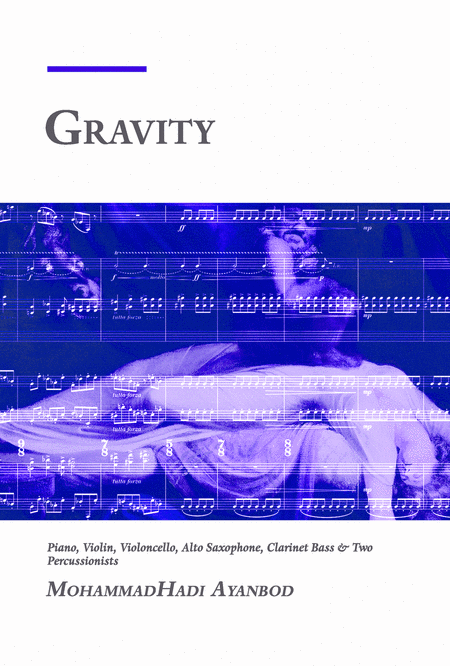
Gravity for Septet
Ensemble de Percussions

$16.99 14.79 € Ensemble de Percussions PDF SheetMusicPlus

Percussion Ensemble - Digital Download SKU: A0.1028382 Composed by Ben Calkins. Instructional. Score and parts. 12 pages. Ben Calkins #3493837. Published by Ben Calkins (A0.1028382). Why play Sapphire?Sapphire can be used my mallet percussion/ front ensembles to warm up. It includes sections that require 4 mallets for both block and arpeggiated chords. Many other common pit instruments have parts as well.Who would want this piece? Mallet percussion ensembles, probably marching band groups would get the most use from this piece. About Me:This is my first piece I have ever published. I have written several others but I finally made something I felt comfortable posting. I just bought Finale v25 and can't wait to continue writing more music for front ensemble/ piano in the future. I'm also in a small band and I may post our arrangements here too if the copyrights are okay.
Sapphire (Parts)
Ensemble de Percussions

$1.99 1.73 € Ensemble de Percussions PDF SheetMusicPlus

Percussion Ensemble - Level 3 - Digital Download SKU: A0.1028381 Composed by Ben Calkins. Instructional. Score and parts. 11 pages. Ben Calkins #3493833. Published by Ben Calkins (A0.1028381). Why play Sapphire?Sapphire can be used my mallet percussion/ front ensembles to warm up. It includes sections that require 4 mallets for both block and arpeggiated chords. Many other common pit instruments have parts as well.Who would want this piece? Mallet percussion ensembles, probably marching band groups would get the most use from this piece. About Me:This is my first piece I have ever published. I have written several others but I finally made something I felt comfortable posting. I just bought Finale v25 and can't wait to continue writing more music for front ensemble/ piano in the future. I'm also in a small band and I may post our arrangements here too if the copyrights are okay.
Sapphire (Full Score)
Ensemble de Percussions

$1.99 1.73 € Ensemble de Percussions PDF SheetMusicPlus

Percussion Ensemble - Level 5 - Digital Download SKU: A0.939795 Composed by Richard St. Clair. 20th Century. Score and parts. 231 pages. Richard St. Clair #3896021. Published by Richard St. Clair (A0.939795). This 15-minute light-hearted piano concerto for full-size symphony orchestra was composed in sketch form in 1970 and the orchestration was finalized in 2018. Listeners will undoubtedly hear references to the neoclassical music of the earlier part of the 20th century, which was a major influence on the composer in the late 1960s and early 1970s. The full score and complete parts are for sale all contained on the provided PDF file, and a Finale-generated MP3 sound clip is provided here.
Concerto a Capriccio (Concerto on a Lark) for Piano and Orchestra (Complete Full Score and Instrume
Ensemble de Percussions

$60.00 52.25 € Ensemble de Percussions PDF SheetMusicPlus


1 16 31 ....76


Partitions Gratuites
Acheter des Partitions Musicales
Acheter des Partitions Digitales à Imprimer
Acheter des Instruments de Musique

© 2000 - 2026

Accueil - Version intégrale





