EUROPE
3015 articles
USA
0 articles
DIGITAL
53 articles (à imprimer)
Partitions Digitales
Partitions à imprimer
53 partitions trouvées


Percussion Ensemble - Level 2 - Digital Download SKU: A0.908406 Composed by Richard Rodgers. Arranged by John M. Licari. Broadway,Film/TV. Score and parts. 13 pages. Music Preparation Services #5196201. Published by Music Preparation Services (A0.908406). Edelweiss - Rodgers & Hammerstein (Percussion Ensemble)Arranged by John M. LicariMusic Preparation Serviceswww.musicprepservices.com Edelweiss is a show tune from the 1959 Rodgers and Hammerstein musical The Sound of Music. It is named after the edelweiss, a white flower found high in the Alps. The song was created for the 1959 Broadway production of The Sound of Music, as a song for the character Captain Georg von Trapp (originated by the performer Theodore Bikel). In the musical, Captain von Trapp and his family sing this song during the concert near the end of Act II, as a statement of Austrian patriotism in the face of the pressure put upon him to join the navy of Nazi Germany following the Anschluss (Nazi annexation of their homeland). It is also Captain von Trapp's subliminal goodbye to his beloved homeland, using the flower as a symbol of his loyalty to Austria. In the 1965 film adaptation, the song is also sung by the Captain earlier in the film when he rediscovers music with his children. It was the last song ever written by Oscar Hammerstein II, prior to his death in August, 1960. This arrangement is written for a percussion ensemble, featuring glockenspiel, marimba, snare, bass, triangle, tambourine, and timpani.
Edelweiss
Ensemble de Percussions

$12.99 11.22 € Ensemble de Percussions PDF SheetMusicPlus

Percussion Ensemble - Level 5 - Digital Download SKU: A0.1027778 Composed by MohammadHadi Ayanbod. 20th Century,Contemporary. Score and parts. 25 pages. Rimorarte Edition #5996957. Published by Rimorarte Edition (A0.1027778). In GRAVITY I explored different gravities as forces we not only feel them in every moments of our lives, but also thinking of living without or escaping from them seems impossible. Likewise, those gravities exist in the music, make us feel the music continuous, desirable, logical and an integrated language of art. The exploration of the path from chaos to unity, and from unity to multiplicity, is where the title came from. GRAVITY consists of two main sections. The first section, which shows the fully-grown and flourished musical ecosystem, and the second part; a flashback to just after big-bang, which tries to musicalize the creation of the gravity! In the first section, I’ve used the concept of horizontal and vertical minimalism. At the very beginning of the piece we have a structure that bring the idea of the vertical minimalism out. In every moment, each instrument plays the same note as others. However, the narrative line is divided into different octaves, so, the melody is not the same in spite of the fact that each instrument plays the same tone. This structure also reminds the paradoxical ladder or optical staircase illusion. The narration is built up until it reaches temporal climax. At the same time, this melody starts again from the beginning with some microscopic differences visible vividly to musicians. This semi reciprocating musical narration, could be observed as a musical example of the staircase illusion. After this part, but still in the first section of the music, I’ve used the horizontal (traditional) minimalism idioms to explore the bounding forces present in the music. Although, what interesting here is the creation of synthetic voices which is the result of different amounts of the nuances and different combinations of the sound. For keen ears, it seems like shades of neon lights, penetrate into one another in the scale of time and create a big picture of micro fluctuating objects. In the second section or just after big-bang, I’ve observed and recreate musically, the very moment of creation of the gravity just after the big-bang. Here, we don’t have melody, rhythm, structure, narration and other aspects of the music in the traditional way, although all of them are present in the music. very single sound or noise is meaningful and showing the assemblage process of the forces in the music to create a melody line. I’ve occupied idioms of contemporary Sonorism genre to create the atmosphere. This highly complex texture shows the virtuosity of interpreters and the capability of the instruments in avant-garde literature and extended techniques. The music is concluded by a fast-tempo finale, with the instruction of fortissimo possiblile (as loud as possible). The piece, in fact, will not be finished as a morendo, but, it opens a space for hypothetically living structure; constantly grows, flourishes, shines and decays.
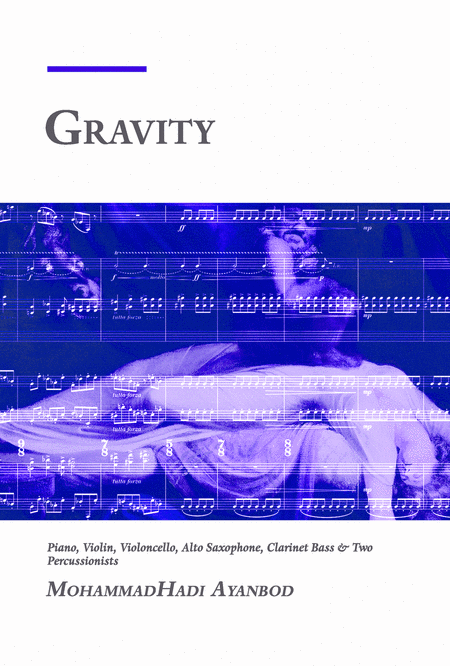
Gravity for Septet
Ensemble de Percussions

$16.99 14.67 € Ensemble de Percussions PDF SheetMusicPlus

Percussion Ensemble - Level 5 - Digital Download SKU: A0.937755 Composed by Dan Heslink. Contemporary,World. Score and parts. 128 pages. Pharaoh Publications #5983475. Published by Pharaoh Publications (A0.937755). Alexandriana for percussion ensemble (12 performers)            by Dan Heslink   The term Alexandriana is popularly used to reference the Great Library of antiquity in Alexandria, Egypt. Rooted in Alexander the Great’s global military and exploratory exploits (334 - 323 BCE), the library symbolizes the ancient Greek ever expanding worldview, especially under the influence of Alexander and his tutor, Aristotle. Alexander died long before construction of the Ancient Museum and Library of Alexandria, but the concept of a universal library was uniquely his.  The mixing of Hellenistic columns with Egyptian architecture and the housing of thousands of scrolls in Greek, Turkish, Babylonian, Egyptian and Hebrew, intensify the division of the library broadly into two large sections, one for eastern knowledge and one for western knowledge. In this musical score, typically western is the thematic concept (expressed most clearly in the chimes), the tonal, triadic-based harmony and sectional concept of form.  The music’s sectional nature parallels the library’s different rooms, each containing their own genre of knowledge (history, mathematics, poetry, etc.) Evocative of eastern musical practices are the simultaneous layers of different rhythmic subdivisions, oriental modes, and florid lines in the xylophone and vibe parts. In this score, eastern musical procedures are expressed with instruments commonly found in the Western orchestra or wind band.  The performers are encouraged to always emphasize the score’s contrasts. Passages for indefinitely pitched percussion featuring the song within the drums contrast with other passages of purely quantitative rhythm. Complexity in the interaction of parts contrast with simple rhythmic unison. Passages of thick harmony contrast with modal monophonic melodies accompanied only by indefinitely pitched sounds. Overall, there is a wide dynamic range.  During long passages of gradually accruing energy, take care to not build dynamics too quickly, and during fortissimo passages, drums should be stroked in a manner that avoids excessive aggression. The rhythmic background of 16th notes must be consistent among all players so that interlocking rhythmic motifs are consistent. Often the tom-toms have melodic passages that imitate the shape of mallet or timpani melodies. Tune the drums for a warm, round sound and select mallets accordingly. Bar percussion players should apply a flowing legato to their passage work. Soft sections are intended to sound mysterious: be sure to use mallets that match that character.  The composer assigns a performance level of difficult to this work. Performance time is 9:15. The composer, Dan Heslink, can be reached at dan@dheslink.com.
Alexandriana for Percussion Ensemble
Ensemble de Percussions

$9.99 8.63 € Ensemble de Percussions PDF SheetMusicPlus

Percussion Ensemble - Digital Download SKU: A0.935390 Arranged by Dan Heslink. Christian,Christmas. Score and parts. 16 pages. Pharaoh Publications #6117165. Published by Pharaoh Publications (A0.935390). Christmas Calypso for Marimba Quartet . . . . . . . . . . . . . . arr. Dan HeslinkThe calypso style referenced in the title is not the calypso of Afro-Caribbean music from Trinidad and Tobago. Rather, it is the especially toned-down but still rhythmic commercial variant popularized by folk singers. Couched in this style, the arrangement offers Christmas favorites Deck the Halls, Angels We Have Heard On High, God Rest Ye Merry Gentlemen and Good Christian Men, Rejoice.  This if one of two versions of the calypso arrangement by Dan Heslink, both of which are available through Sheet Music Plus. The other arrangement, for percussion sextet, follows similar musical contours and is available separately. Both versions are intended to elicit one primary response from both performers and audience – fun. It does not tax the players technically, but delivers a satisfying sound with carols that the performers likely know and love. General audiences will be enchanted by the familiar melodies delivered in percussion, especially at Christmas time.  The introduction opens with a brisk and rhythmic introduction based on Deck the Halls, and establishes the fun calypso rhythm immediately. Deck the Halls is the much-loved welsh air that was arranged by Haydn, Nos galan (Hob. XXXIb:29, 1803). Then, Angels We Have Heard on High breaks out in double-stops with a continuation of the rhythmic impetus. The birth of Jesus Christ as narrated in the Gospel of Luke is the subject of Angels We Have Heard on High, a traditional French song of unknown origin. The gloria section provides some flowing contrast, portraying the shepherds’ impressions as they encounter a multitude of angels singing and praising. The performers are encouraged to use a relaxed stroke to glide through these passages. Following is God Rest Ye Merry Gentlemen, a 16th century English traditional Christmas carol also known under the title, The old Christmas Carol. It provides a contrast in tonality (minor mode) and texture. The xylophone part likely will lay most comfortably when executed with four mallets, although there are no three or four mallet chords in these passages. Good Christian Men, Rejoice is the closing selection in this Christmas medley. It’s title is an English translation of In dulci jubilo  (Latin for In sweet rejoicing). The work ends happily with a summation of the calypso rhythm.  This medley will be especially effective programmed on a winter holiday concert. Duration is 2:30. The arranger, Dan Heslink, assigned a difficulty level of medium easy, and can be contacted at dan@dheslink.com.  
Christmas Calypso for Marimba Quartet
Ensemble de Percussions

$4.99 4.31 € Ensemble de Percussions PDF SheetMusicPlus

Percussion Ensemble - Level 2 - Digital Download SKU: A0.935389 Arranged by Dan Heslink. Christian,Christmas. Score and parts. 18 pages. Pharaoh Publications #6117159. Published by Pharaoh Publications (A0.935389). Christmas Calypso for Percussion Sextet . . . . . . . . . . . . . . arr. Dan Heslink  The calypso style referenced in the title is not the calypso of Afro-Caribbean music from Trinidad and Tobago. Rather, it is the especially toned-down but still rhythmic commercial variant popularized by folk singers. Couched in this style, the arrangement offers Christmas favorites Deck the Halls, Angels We Have Heard On High, God Rest Ye Merry Gentlemen and Good Christian Men, Rejoice.  This if one of two versions of the calypso arrangement by Dan Heslink, both of which are available through Sheet Music Plus. The other arrangement, percussion sextet, follows similar musical contours and is available separately. Both versions are intended to elicit one primary response from both performers and audience – fun. It does not tax the players technically, but delivers a satisfying sound with carols that the performers likely know and love. General audiences will be enchanted by the familiar melodies delivered in percussion, especially at Christmas time. The introduction opens with a brisk and rhythmic introduction based on Deck the Halls, and establishes the fun calypso rhythm immediately. Deck the Halls is the much-loved welsh air that was arranged by Haydn, Nos galan (Hob. XXXIb:29, 1803). Then, Angels We Have Heard on High breaks out in double-stops with a continuation of the rhythmic impetus. The birth of Jesus Christ as narrated in the Gospel of Luke is the subject of Angels We Have Heard on High, a traditional French song of unknown origin. The gloria section provides some flowing contrast, portraying the shepherds’ impressions as they encounter a multitude of angels singing and praising. The performers are encouraged to use a relaxed stroke to glide through these passages. Following is God Rest Ye Merry Gentlemen, a 16th century English traditional Christmas carol also known under the title, The old Christmas Carol. It provides a contrast in tonality (minor mode) and texture. The xylophone part likely will lay most comfortably when executed with four mallets, although there are no three or four mallet chords in these passages. Good Christian Men, Rejoice is the closing selection in this Christmas medley. It’s title is an English translation of In dulci jubilo  (Latin for In sweet rejoicing). The work ends happily with a summation of the calypso rhythm.  This medley will be especially effective programmed on a winter holiday concert. Duration is 2:30. The arranger, Dan Heslink, assigned a difficulty level of medium easy, and can be contacted at dan@dheslink.com.
Christmas Calypso for Percussion Sextet
Ensemble de Percussions

$4.99 4.31 € Ensemble de Percussions PDF SheetMusicPlus

Percussion Ensemble - Digital Download SKU: A0.961994 Composed by Ma Shui Long 馬水é¾. 20th Century,Contemporary. Score and parts. 20 pages. SpringAutumnmusic #48525. Published by SpringAutumnmusic (A0.961994). Introduction:The Lament of Tou-Ehr, for Suona, Timpani, Percussion, and Chorus ã€€ã€€This work was composed for a Chinese dance drama Snow Festival. The drama was based on an extremely touching story about a lady named Doue E, and was written by the author Guan Hanqing during the Yuan Dynasty. It is divided into three sections in a cyclic form, with one theme. The instrumentation includes voices for male and female, suona (Chinese cornet), there are more than ten traditional Chinese percussions are used, such as the wind gong, large and small luo (as used in Beijing opera), and the Chinese clapper, Paiban. The sound of suona indicates the lady Dou E with her battle cry and strong faith. The music begins after lady Dou E’s faint narrative. â€»The Lament of Tou-Ehr was commissioned by the Neo Classical Music Group. The dance was arranged by Fon-xuei Liu, with orchestra and chorus conducted by the composer, Shui-long Ma himself. It was recorded by the Yun-de Company, and premiered at the Taiwan National Dr. Sun Yat-sen Memorial Hall in April 1981. ã€Šç«‡å¨¥å†¤ã€‹æœ¬æ›²æ”¹ç·¨è‡ªã€ŒèˆžåŠ‡é›ªç¥­ã€ï¼Œå–æè‡ªä¸­åœ‹å…ƒä»£æˆ²æ›²ä¸­é—œæ¼¢å¿çš„作å“-「感天動地竇娥冤ã€ã€‚本曲略分三段,連樂章形å¼ï¼Œæ¨‚æ›²çµæ§‹ç‚ºä¸€è²«æ€§çš„主題延展。作曲者在編制上使用人è²(男女混è²)ã€å—©å¶ï¼Œä»¥åŠå多件傳統擊樂器,如風鑼ã€å¹³åЇ大å°é‘¼ã€æ‹æ¿ç­‰ç­‰ã€‚在整曲進行中,凡是有竇娥出ç¾ä¹‹è™•,嗩å¶ä¹Ÿå°‡éš¨ä¹‹å¥å‡ºï¼Œé‚£æ˜¯å¤©ç†çš„å¶å–Šã€ç²¾ç¥žä¿¡å¿µä¹‹æ‰€åœ¨ã€‚全曲在一段竇娥幽幽的é“白之後,å¾å¾å±•開。※本曲為新å¤å…¸æ¨‚團委託創作之作å“,由舞蹈家劉鳳學編舞ã€é¦¬æ°´é¾æŒ‡æ®æ¨‚團與人è²ã€éŸ»å¾·éŒ„音公å¸éŒ„音,於1980å¹´4月在å°åŒ—國父紀念館舉行世界首演。 .
The Lament of Tou-Her 竇娥冤
Ensemble de Percussions

$14.99 12.94 € Ensemble de Percussions PDF SheetMusicPlus

Percussion Ensemble - Level 4 - Digital Download SKU: A0.1013929 Composed by Tsoof Baras. Concert,Contemporary,Instructional,Standards. Score and parts. 16 pages. Tsoof Baras #6663587. Published by Tsoof Baras (A0.1013929). Players - 4Instrumentation - Body Percussion‘Up the Body and Down the Page’ is a body percussion piece for percussion quartet. This piece involves the playing of one’s body as an instrument. For musicians, this piece is short, easy to setup, exciting for the crowd, a bit of a workout, fun to play and a challenge.My aim for this piece was to emulate the concept of ‘seeing sounds’ by only creating sound in the light. It was a challenge to get the lighting effect that provided us with a sharp difference between light and dark.Because it is such a physical piece, I would encourage the performers to add in choreography and to exercise the power of choice in terms of sticking (‘handings’ and ‘footings’) and the choice between standing and sitting. The performers may also experiment with visual mediums like talcum powder and other sound choices like using toy hammers instead of hands and choosing extremely thick shoes.
Up the Body and Down the Page
Ensemble de Percussions

$45.00 38.86 € Ensemble de Percussions PDF SheetMusicPlus

Percussion Ensemble - Level 3 - Digital Download SKU: A0.935375 Composed by Dan Heslink. Christmas,Contemporary,Hanukkah. Score and parts. 24 pages. Pharaoh Publications #4885579. Published by Pharaoh Publications (A0.935375). Winter Bells                                                            composed by Dan Heslink Imagine a cold winter evening in which church bells, sleigh bells, and other bell sounds are mixed into a tantalizing soundscape. Winter Bells explores the interaction of these sounds through chimes, sleigh bells, orchestra bells, marimba, vibraphone, two triangles, large suspended cymbal, large tam-tam, and two timpani. Winter Bells requires seven performers; the two chime players share one rack of chimes and one part. It presents mostly modest demands, both in performing technique in the number and type of percussion instruments. Challenges include rapid passage work in the part for orchestra bells, requiring smooth and even negotiation of the instrument, and a tour de force of polyrhythms at the end, where all bell timbres of the soundscape are juxtaposed. Some parts present more challenge than others, making it an ideal selection for ensembles populated by players of uneven levels of experience. To some listeners Winter Bells is possibly reminiscent of a sleigh ride without the horse’s hooves. It is sure to be an audience pleaser during a winter concert, especially close to Christmas and Hanukkah.
Winter Bells
Ensemble de Percussions

$3.99 3.45 € Ensemble de Percussions PDF SheetMusicPlus

Percussion Ensemble - Level 2 - Digital Download SKU: A0.711110 By The Turtles. By Alan Gordon and Garry Bonner. Arranged by Tsuyoshi Yoroiguma. Oldies. Score and parts. 60 pages. Tsuyoshi Yoroiguma #3480495. Published by Tsuyoshi Yoroiguma (A0.711110). Playing this music,students will become happy.This item is good for educational use(e.g. school band/orchestra or music class etc.).This sheet music is EZ Trio Set including 6 scores and parts. Score-A for 3 Flutes or any Keyboard Instruments Score-B for 3 Clarinets Score-C for 3 Saxophones(AAT) Score-D for Low Brass Trio(2 Euphoniums or Trombones and Tuba) Score-E for 3 Violins Score-F for 3 Cellos (or Bassoons)Teachers choose a score from these 6 kinds of instrumentation.MP3 sound sample of this page is Score-A (for 3 Flutes).Following youtube sample score is Score-E (for 3 Violins).https://youtu.be/h46Wdr0Z6qwPDF file includes 24 pages(4 pages×6) of score and  36 pages of parts.Playing time is 2min 05sec.Please visit arranger's blog to listen full sound of 6 scores.http://yoroiguma.seesaa.net/page of 2018/03/22
Happy Together
Ensemble de Percussions
The Turtles
$38.00 32.81 € Ensemble de Percussions PDF SheetMusicPlus

Percussion Ensemble - Level 4 - Digital Download SKU: A0.1345315 By Soundgarden. By Chris Cornell. Arranged by David R. Peoples. Classical,Contemporary,Grunge,Rock. 68 pages. Bluesilhouettes Music #930151. Published by Bluesilhouettes Music (A0.1345315). What I really like about this song is its uniqueness... is it grunge? Psychedelic? Alternative? Hard Rock? Contemporary chamber music? Theoretically - is it some sort of jazz-fuzed harmonic progression or a clever soundscape of melody notes outside of chords? This version is not a cover. Fragments of musical elements are translated into the ensemble. While occasionally exhibiting moments of rock, the composition evolves into a more profound expression, capitalizing on the musical possibilities of a percussion ensemble. This arrangement was crafted for the University of North Georgia’s percussion ensemble, directed by Dr. Steven Walker.Hear full digital audio mockup offsite
Black Hole Sun
Ensemble de Percussions
Soundgarden
$34.99 30.21 € Ensemble de Percussions PDF SheetMusicPlus

Percussion Ensemble - Level 5 - Digital Download SKU: A0.962406 Composed by Salvador Rojo Gamón. Concert,Contemporary,Instructional,Standards. Score and parts. 173 pages. Salvador Rojo-Gamon #5801913. Published by Salvador Rojo-Gamon (A0.962406). Four ForcesReviewsScherzohttps://scherzo.es/badajoz-vanguardias-lugarenas/Periodico Extremadurahttps://www.elperiodicoextremadura.com/noticias/badajoz/fuerzas_1214372.html NotesThis work was commissioned by Extremadura Orchestra for Percussion and Chamber orchestra.It has two movements. The first one has been done for mallets and the second one was built on a base of a drums work (GEA).The duration of those movements is 26 minutes, being around 11 minutes the first and 15 minutes the second one.The chamber music is formed by:Woodwind quintet (Flute, Oboe, Clarinet, Horn & Bassoon)Brasswind quintet (Trumpet 1, Trumpet 2, Horn, Trombone & Tuba)Strings orchestraThree firsts violinsThree seconds violinsThree violasTwo cellosFor the second movement is high recommendable to enlarge the strings, a good number of musician could be doubling.I. Strong ForcesThe work is inspired by the four fundamental forces of nature. These forces explain any phenomena which can be produced in the universe.Throughout all composition, it is latent the mathematic construction based in the series Fibonacci. In the first of the movements, Fibonacci's series is present in the notes' sequence that forms the series of 16 sounds and it is going to be present throughout the whole work. This series is taking form along the movement and it is getting melody and harmony.Although it is far away from the sonata form, as we know it in its period of highest glory, it takes elements of it and updates to our days. In this movement, we can find sonata form elements as the exposition, development, transitions or coda.The central part of the first movement becomes in the slow movement, being more intimate and lyrical, free of the serials ties although it uses resources before cited -now called common practice-.The movement finish with a short re-exposition that concludes with the virtuosic of the soloist doubling the series and adding more tension until conforming the series in its full whole.II. Weak ForcesIt is the most tribal of both movements. Its structure is more complex and in it, we also can find clear reminiscences to the sonata form.We can divide the movement into two big blocks. The first one is formed for the introduction and sections one and two.IntroducciónIt is based in one ostinato of three notes where the accent is changing provoking unsymmetric, this ostinato represents the nucleus of our existence. The piccolo and the trombone introduce us to the human element representing the two elements that form the development of the whole movement.The two elements of thematics are taken from the series, the first one is easily recognizable because it appears in his primary form.First section & cadenzaIn this movement, the rhythm, the melody, and the harmony are based on the sequence of Fibonacci. As the theme ostinato of the soloist as the melody is formed under the rhythm of 1, 2, 3 and 5. This section leads us to the second section with a clear mode of cadence. In the cadenza, the elements of the rhythm are varied freely with an accompaniment of the Spring Drum.DevelopmentIt is formed by two Rondo sub-sections in which the solo part has been created through the mirror technique.Both sections have the next form:Intro-A-B-A-B-(B(minor)+A)Intro-A-B-A-B-(B(major)+A)First section & CodaThe movement ends with the repetition of the first section and the final code. 
Four Forces (First movement) I. Strong Forces
Ensemble de Percussions

$300.00 259.04 € Ensemble de Percussions PDF SheetMusicPlus

Percussion Ensemble - Level 5 - Digital Download SKU: A0.962405 Composed by Salvador Rojo Gamón. Concert,Contemporary,Instructional,Standards. Score and parts. 255 pages. Salvador Rojo-Gamon #5801921. Published by Salvador Rojo-Gamon (A0.962405). Four ForcesReviewsScherzohttps://scherzo.es/badajoz-vanguardias-lugarenas/Periodico Extremadurahttps://www.elperiodicoextremadura.com/noticias/badajoz/fuerzas_1214372.html NotesThis work was commissioned by Extremadura Orchestra for Percussion and Chamber orchestra.It has two movements. The first one has been done for mallets and the second one was built on a base of a drums work (GEA).The duration of those movements is 26 minutes, being around 11 minutes the first and 15 minutes the second one.The chamber music is formed by:Woodwind quintet (Flute, Oboe, Clarinet, Horn & Bassoon)Brasswind quintet (Trumpet 1, Trumpet 2, Horn, Trombone & Tuba)Strings orchestraThree firsts violinsThree seconds violinsThree violasTwo cellosFor the second movement is high recommendable to enlarge the strings, a good number of musician could be doubling.I. Strong ForcesThe work is inspired by the four fundamental forces of nature. These forces explain any phenomena which can be produced in the universe.Throughout all composition, it is latent the mathematic construction based in the series Fibonacci. In the first of the movements, Fibonacci's series is present in the notes' sequence that forms the series of 16 sounds and it is going to be present throughout the whole work. This series is taking form along the movement and it is getting melody and harmony.Although it is far away from the sonata form, as we know it in its period of highest glory, it takes elements of it and updates to our days. In this movement, we can find sonata form elements as the exposition, development, transitions or coda.The central part of the first movement becomes in the slow movement, being more intimate and lyrical, free of the serials ties although it uses resources before cited -now called common practice-.The movement finish with a short re-exposition that concludes with the virtuosic of the soloist doubling the series and adding more tension until conforming the series in its full whole.II. Weak ForcesIt is the most tribal of both movements. Its structure is more complex and in it, we also can find clear reminiscences to the sonata form.We can divide the movement into two big blocks. The first one is formed for the introduction and sections one and two.IntroducciónIt is based in one ostinato of three notes where the accent is changing provoking unsymmetric, this ostinato represents the nucleus of our existence. The piccolo and the trombone introduce us to the human element representing the two elements that form the development of the whole movement.The two elements of thematics are taken from the series, the first one is easily recognizable because it appears in his primary form.First section & cadenzaIn this movement, the rhythm, the melody, and the harmony are based on the sequence of Fibonacci. As the theme ostinato of the soloist as the melody is formed under the rhythm of 1, 2, 3 and 5. This section leads us to the second section with a clear mode of cadence. In the cadenza, the elements of the rhythm are varied freely with an accompaniment of the Spring Drum.DevelopmentIt is formed by two Rondo sub-sections in which the solo part has been created through the mirror technique.Both sections have the next form:Intro-A-B-A-B-(B(minor)+A)Intro-A-B-A-B-(B(major)+A)First section & CodaThe movement ends with the repetition of the first section and the final code. 
Four Forces (Second movement) II. Weak Forces
Ensemble de Percussions

$150.00 129.52 € Ensemble de Percussions PDF SheetMusicPlus

Percussion Ensemble - Level 2 - Digital Download SKU: A0.835744 Composed by Paul Burnell. 20th Century,Contemporary. Score and parts. 3 pages. Paul Burnell #548979. Published by Paul Burnell (A0.835744). Composed 2000. Duration: 4:00. For ensemble with instruments in C, Bb, F Eb, voices and percussion as directed in the score. The music is presented as a performing score. Where no clef is given, play with as if with a clef as directed in the score text (see Minute two). Transposing instruments play as written and do not transpose. It is allowed, however, for special transposed parts to be created in order to ensure an even distribution of the intended chordal harmony where this would otherwise be missing. There should be a few seconds silence between each of the four sections. During Minute one players other than the soloist strum their fingers rapidly on the body of their instruments, chairs etc., very quietly - producing an almost imperceptible dull sound (not 'tinny' or 'bright'). Programme Note: 'Four Minutes - Four Daydreams' was composed by Paul Burnell in 2000. It was first performed by the London CoMA Ensemble, conductor Simon Foxley, at Morley College, London on the 29th October 2000. The piece has four distinct sections, each 1 minute long. Like an extended daydream each section is progressively more developed. The piece was included on the 2013 album 'Cabbage Heads'.
Four Minutes - Four Daydreams
Ensemble de Percussions

$1.99 1.72 € Ensemble de Percussions PDF SheetMusicPlus

Percussion Ensemble - Level 2 - Digital Download SKU: A0.1028124 Composed by Anders Wall. 20th Century,Contemporary. Score and parts. 23 pages. WallofSound #3374791. Published by WallofSound (A0.1028124). En ReÌ‚ve, In Dream, was conceived when I studied composition for Tobias Broström. Every day I was commuting from Skurup to BaÌŠstad and every day I was struck by BaÌŠstads almost continental beauty; I felt like I was in France.  Cobble stone roads, houses with towers and that mountain ridge close to the ocean...One day on the train, I ran into three French girls on holiday.Patiently they listened to my ideas and kindly helped me translate the tempo markings to French. The piece begins with us falling to sleep. The marimbas rocks us slowly In Dream.After sudden movements in the vibraphone we are happily strolling on the cobble stones, sun shining and children riding their bikes across the streets not noticing the rocky ride.Bells chime in the distance and the world – or the dream – vanish. As sudden as it started it is gone.The dissonance of the beginning is now gone and our sleep is peaceful and calm - or is it..? Originally a solo piece for Marimba dedicated to Kasper Grøn.Thanks to Camille, Carole, Raphaëlle for the help with the French.
En Rêve for Percussion Ensemble
Ensemble de Percussions

$10.00 8.63 € Ensemble de Percussions PDF SheetMusicPlus


Partitions Gratuites
Acheter des Partitions Musicales
Acheter des Partitions Digitales à Imprimer
Acheter des Instruments de Musique

© 2000 - 2026

Accueil - Version intégrale





