EUROPE
1415 articles
USA
0 articles
DIGITAL
180 articles (à imprimer)
Partitions Digitales
Partitions à imprimer
180 partitions trouvées

1 16 31 ....166

Solo Guitar - Level 3 - Digital Download SKU: A0.899127 Composed by Richard Strauss. Arranged by Rod Whittle. 20th Century. Individual part. 4 pages. Maggie Creek Music #3037161. Published by Maggie Creek Music (A0.899127). Transcription for solo classical guitar. 4 pages. Richard Strauss (1864 -1949) Strauss's music amounts to a huge body of symphonic and operatic work written over 60 years. Full of vitality, endlessly melodic, brilliantly orchestrated, it begins and ends in the romantic tradition, but for the most part expresses something more modern and individualistic, not without controversy in its time. Variation of style and structure is drawn from the descriptive (literary) nature of compositions, and an extraordinary inventiveness enlivens the scenes, moods and situations. Strauss said once that he produced music the way cows give milk, and indeed his music rarely seems contrived. The opera Strauss wrote 15 operas on a variety of subjects and across the whole spectrum of drama. He acknowledged being enchanted by the soprano voice, and his writing for it highlights many of the works, including Adriane auf Naxos (composed in 1912). The opera has been described as 'sparkling', which sums it up well, and passages influenced by Bach, Mozart, Puccini, and Wagner add to the interest. The storyline is a play within a play, the second part being the mythological 'Opera' staged in the story. The three pieces transcribed* are from this Opera. The guitar arrangements All classical guitar pieces are compromises. The instrument has only six strings, the left hand four fingers able to be used, and with the right hand its rare to use more than three fingers and the thumb. So, despite the amount of noise possible, it's inevitable that passages occur where either harmony, bass or fragments of counterpoint that would be beneficial are left out. In particular, the higher up the neck music is played the simpler it tends to be, if harder to play, and unless the low bass is an open string there wont be any. So I think the main part of attaining a fair transcription (better to be called an arrangement if the original musical structure is not strictly followed, as in this case) is determining how a good compromise can be reached. Melody, counterpoint, bass and main harmonies demand inclusion, and register is important. One may generally assume the original score can't be improved on. However, if the music may sound well on guitar, and the above elements can be incorporated without the playing becoming very difficult, something enjoyable to play and worthwhile listening to should be able to be achieved. Overture; 'A golden time …' Here the Mozart influence, better, inspiration, is wonderfully evident. A gentle waltz time (only the first section of the overture is transcribed) carries the colourful harmonies, strong melodic threads and connecting flourishes that stamp both pieces. The aria is alluded to in the Overture several times, which as you would expect, is intricately woven with the hints themes later to be established in the Opera. It has a kind of 'jazzy' freedom, and it's always miraculous to me that composition so involved can retain its musical line, here done in Strauss's inimitable way. The aria, sung not far into the Opera, has the perfect inevitability of Mozart, but again it is Strauss. As explained, keys have been changed to suit the guitar. Chorus and Aria This selection from the finale has features well worth trying to translate. The device of having a strong chorus, in the style of a Bach chorale, stated and then counterpointed by a solo voice in a restatement, is potent, and that in the opera the chorus (of the three nymphs) isn't immediately followed by the accompanying aria (of Ariadne) means the latter comes as a moment of surprising beauty. Neither parts are complicated, and lovely arpeggios, a feature Strauss's music, often impart the assured progressions. A problem was to capture the distinct register of the soprano voices, som.
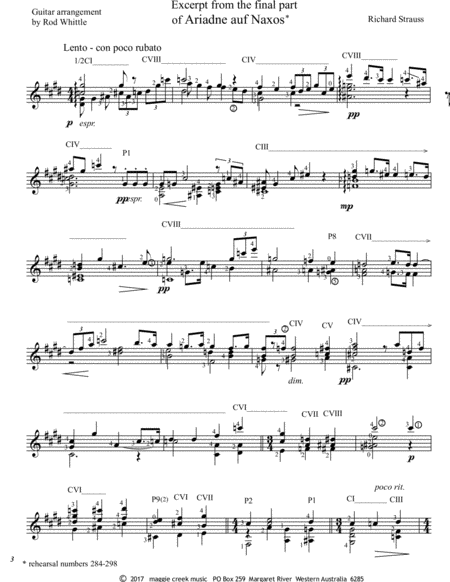
Excerpt from the Last Part of Ariadne Auf Naxos
Guitare

$7.00 6.09 € Guitare PDF SheetMusicPlus

Solo Guitar - Level 4 - Digital Download SKU: A0.899112 Composed by Richard Strauss. Arranged by Rod Whittle. 20th Century. Individual part. 2 pages. Maggie Creek Music #25789. Published by Maggie Creek Music (A0.899112). 2 pages; for solo classical guitar; published by Maggie Creek MusicRichard Strauss (1864 -1949) Strauss's music amounts to a huge body of symphonic and operatic work written over 60 years. Full of vitality, endlessly melodic, brilliantly orchestrated, it begins and ends in the romantic tradition, but for the most part expresses something more modern and individualistic, not without controversy in its time. Variation of style and structure is drawn from the descriptive (literary) nature of compositions, and an extraordinary inventiveness enlivens the scenes, moods and situations. Strauss said once that he produced music the way cows give milk, and indeed his music rarely seems contrived. The opera Strauss wrote 15 operas on a variety of subjects and across the whole spectrum of drama. He acknowledged being enchanted by the soprano voice, and his writing for it highlights many of the works, including Adriane auf Naxos (composed in 1912). The opera has been described as 'sparkling', which sums it up well, and passages influenced by Bach, Mozart, Puccini, and Wagner add to the interest. The storyline is a play within a play, the second part being the mythological 'Opera' staged in the story. The three pieces transcribed* are from this Opera. The guitar arrangements All classical guitar pieces are compromises. The instrument has only six strings, the left hand four fingers able to be used, and with the right hand its rare to use more than three fingers and the thumb. So, despite the amount of noise possible, it's inevitable that passages occur where either harmony, bass or fragments of counterpoint that would be beneficial are left out. In particular, the higher up the neck music is played the simpler it tends to be, if harder to play, and unless the low bass is an open string there wont be any. So I think the main part of attaining a fair transcription (better to be called an arrangement if the original musical structure is not strictly followed, as in this case) is determining how a good compromise can be reached. Melody, counterpoint, bass and main harmonies demand inclusion, and register is important. One may generally assume the original score can't be improved on. However, if the music may sound well on guitar, and the above elements can be incorporated without the playing becoming very difficult, something enjoyable to play and worthwhile listening to should be able to be achieved. Overture; 'A golden time …' Here the Mozart influence, better, inspiration, is wonderfully evident. A gentle waltz time (only the first section of the overture is transcribed) carries the colourful harmonies, strong melodic threads and connecting flourishes that stamp both pieces. The aria is alluded to in the Overture several times, which as you would expect, is intricately woven with the hints themes later to be established in the Opera. It has a kind of 'jazzy' freedom, and it's always miraculous to me that composition so involved can retain its musical line, here done in Strauss's inimitable way. The aria, sung not far into the Opera, has the perfect inevitability of Mozart, but again it is Strauss. As explained, keys have been changed to suit the guitar. Chorus and Aria This selection from the finale has features well worth trying to translate. The device of having a strong chorus, in the style of a Bach chorale, stated and then counterpointed by a solo voice in a restatement, is potent, and that in the opera the chorus (of the three nymphs) isn't immediately followed by the accompanying aria (of Ariadne) means the latter comes as a moment of surprising beauty. Neither parts are complicated, and lovely arpeggios, a feature Strauss's music, often impart the assured progressions. A problem was to capture the distinct register of the so.
'A golden time ...' from Ariadne auf Naxos
Guitare

$7.00 6.09 € Guitare PDF SheetMusicPlus

Solo Guitar - Level 4 - Digital Download SKU: A0.899109 Composed by Richard Strauss. Arranged by Rod Whittle. 20th Century. Individual part. 2 pages. Maggie Creek Music #25787. Published by Maggie Creek Music (A0.899109). 2 pages; for solo classical guitar; published by Maggie Creek MusicRichard Strauss (1864 -1949) Strauss's music amounts to a huge body of symphonic and operatic work written over 60 years. Full of vitality, endlessly melodic, brilliantly orchestrated, it begins and ends in the romantic tradition, but for the most part expresses something more modern and individualistic, not without controversy in its time. Variation of style and structure is drawn from the descriptive (literary) nature of compositions, and an extraordinary inventiveness enlivens the scenes, moods and situations. Strauss said once that he produced music the way cows give milk, and indeed his music rarely seems contrived. The opera Strauss wrote 15 operas on a variety of subjects and across the whole spectrum of drama. He acknowledged being enchanted by the soprano voice, and his writing for it highlights many of the works, including Adriane auf Naxos (composed in 1912). The opera has been described as 'sparkling', which sums it up well, and passages influenced by Bach, Mozart, Puccini, and Wagner add to the interest. The storyline is a play within a play, the second part being the mythological 'Opera' staged in the story. The three pieces transcribed* are from this Opera. The guitar arrangements All classical guitar pieces are compromises. The instrument has only six strings, the left hand four fingers able to be used, and with the right hand its rare to use more than three fingers and the thumb. So, despite the amount of noise possible, it's inevitable that passages occur where either harmony, bass or fragments of counterpoint that would be beneficial are left out. In particular, the higher up the neck music is played the simpler it tends to be, if harder to play, and unless the low bass is an open string there wont be any. So I think the main part of attaining a fair transcription (better to be called an arrangement if the original musical structure is not strictly followed, as in this case) is determining how a good compromise can be reached. Melody, counterpoint, bass and main harmonies demand inclusion, and register is important. One may generally assume the original score can't be improved on. However, if the music may sound well on guitar, and the above elements can be incorporated without the playing becoming very difficult, something enjoyable to play and worthwhile listening to should be able to be achieved. Overture; 'A golden time …' Here the Mozart influence, better, inspiration, is wonderfully evident. A gentle waltz time (only the first section of the overture is transcribed) carries the colourful harmonies, strong melodic threads and connecting flourishes that stamp both pieces. The aria is alluded to in the Overture several times, which as you would expect, is intricately woven with the hints themes later to be established in the Opera. It has a kind of 'jazzy' freedom, and it's always miraculous to me that composition so involved can retain its musical line, here done in Strauss's inimitable way. The aria, sung not far into the Opera, has the perfect inevitability of Mozart, but again it is Strauss. As explained, keys have been changed to suit the guitar. Chorus and Aria This selection from the finale has features well worth trying to translate. The device of having a strong chorus, in the style of a Bach chorale, stated and then counterpointed by a solo voice in a restatement, is potent, and that in the opera the chorus (of the three nymphs) isn't immediately followed by the accompanying aria (of Ariadne) means the latter comes as a moment of surprising beauty. Neither parts are complicated, and lovely arpeggios, a feature Strauss's music, often impart the assured progressions. A problem was to capture the distinct register o.
Chorus and Aria from Ariadne auf Naxos
Guitare

$7.00 6.09 € Guitare PDF SheetMusicPlus

Solo Guitar - Level 4 - Digital Download SKU: A0.899111 Composed by Richard Strauss. Arranged by Rod Whittle. 20th Century. Individual part. 2 pages. Maggie Creek Music #25793. Published by Maggie Creek Music (A0.899111). 2 pages; for solo classical guitar; published by Maggie Creek MusicRichard Strauss (1864 -1949) Strauss's music amounts to a huge body of symphonic and operatic work written over 60 years. Full of vitality, endlessly melodic, brilliantly orchestrated, it begins and ends in the romantic tradition, but for the most part expresses something more modern and individualistic, not without controversy in its time. Variation of style and structure is drawn from the descriptive (literary) nature of compositions, and an extraordinary inventiveness enlivens the scenes, moods and situations. Strauss said once that he produced music the way cows give milk, and indeed his music rarely seems contrived. The opera Strauss wrote 15 operas on a variety of subjects and across the whole spectrum of drama. He acknowledged being enchanted by the soprano voice, and his writing for it highlights many of the works, including Adriane auf Naxos (composed in 1912). The opera has been described as 'sparkling', which sums it up well, and passages influenced by Bach, Mozart, Puccini, and Wagner add to the interest. The storyline is a play within a play, the second part being the mythological 'Opera' staged in the story. The three pieces transcribed* are from this Opera. The guitar arrangements All classical guitar pieces are compromises. The instrument has only six strings, the left hand four fingers able to be used, and with the right hand its rare to use more than three fingers and the thumb. So, despite the amount of noise possible, it's inevitable that passages occur where either harmony, bass or fragments of counterpoint that would be beneficial are left out. In particular, the higher up the neck music is played the simpler it tends to be, if harder to play, and unless the low bass is an open string there wont be any. So I think the main part of attaining a fair transcription (better to be called an arrangement if the original musical structure is not strictly followed, as in this case) is determining how a good compromise can be reached. Melody, counterpoint, bass and main harmonies demand inclusion, and register is important. One may generally assume the original score can't be improved on. However, if the music may sound well on guitar, and the above elements can be incorporated without the playing becoming very difficult, something enjoyable to play and worthwhile listening to should be able to be achieved. Overture; 'A golden time …'Here the Mozart influence, better, inspiration, is wonderfully evident. A gentle waltz time (only the first section of the overture is transcribed) carries the colourful harmonies, strong melodic threads and connecting flourishes that stamp both pieces. The aria is alluded to in the Overture several times, which as you would expect, is intricately woven with the hints themes later to be established in the Opera. It has a kind of 'jazzy' freedom, and it's always miraculous to me that composition so involved can retain its musical line, here done in Strauss's inimitable way. The aria, sung not far into the Opera, has the perfect inevitability of Mozart, but again it is Strauss. As explained, keys have been changed to suit the guitar. Chorus and Aria This selection from the finale has features well worth trying to translate. The device of having a strong chorus, in the style of a Bach chorale, stated and then counterpointed by a solo voice in a restatement, is potent, and that in the opera the chorus (of the three nymphs) isn't immediately followed by the accompanying aria (of Ariadne) means the latter comes as a moment of surprising beauty. Neither parts are complicated, and lovely arpeggios, a feature Strauss's music, often impart the assured progressions. A problem was to capture the distinct register of the sopr.
Overture from Ariadne auf Naxos
Guitare

$7.00 6.09 € Guitare PDF SheetMusicPlus

Guitar - Level 1 - Digital Download SKU: A0.1319904 By DaCapo Primary Music. By Fred Plowright and Jane Cutler. Children,Classical,Contemporary,Folk,Instructional. Educational Method. 131 pages. DaCapo Primary Music #908466. Published by DaCapo Primary Music (A0.1319904). Welcome to The Singing Guitar which is one of the Singing Instrumentalist series of books written for beginners of all instruments.The book gives a selection of entertaining repertoire and a thorough and complete musical experience from the very beginning.It is presented in four sections, each designed to introduce a particular aspect of music making, whilst taking on board instrumental skills. We invite teachers to use The Singing Guitar as they see fit, mixing and matching sections and songs to give a balanced and enjoyable combination of singing, playing an accompaniment, playing the melody, rhythm work, composition and playing duets.The book enables pupils, teachers and parents to make a successful start with the chosen instrument.When the book has been completed, The Singing Guitarist will have developed a clear understanding of the function of notation, an ear that can hear tuning and two parts and also be able to enjoy more dissonance as well as pure harmony. The Singing Guitarist should be well on the way to becoming a ‘Complete Instrumentalist’, which is, coincidentally, the name of the book that follows this one!Jane Cutler Director of DaCapo MusicYou can find more DaCapo pieces for young instrumentalists at DaCapo Music Shop
The Singing Instrumentalist Guitar
Guitare
DaCapo Primary Music
$7.99 6.95 € Guitare PDF SheetMusicPlus

Solo Guitar - Level 3 - Digital Download SKU: A0.1334219 Composed by Traditional. Arranged by Bettina Schipp. Celtic,Folk,Irish,Traditional. Individual part. 2 pages. Songbooks.info #920458. Published by songbooks.info (A0.1334219). Songs from Ireland & Great Britain - arranged for Guitar fingerpicking. The songs were written in the well-known tablature for string instruments as well as in classical musical notation - for slightly intermediate and advanced guitarists. The songs were recorded at a slow tempo and with a metronome in the background. Have fun making music...!Songs aus Irland und Großbritannien - für das Fingerpicking mit der Gitarre arrangiert. Die Songs wurden in der bekannten Tabulatur für Saiteninstrumente sowie in der klassischen Notenschrift notiert - für leicht fortgeschrittene und fortgeschrittene GitarristInnen. Die Lieder wurden in einem langsamen Tempo und mit einem Metronom im Hintergrund aufgenommen. Viel Spaß beim Musizieren...!
Ceol brutha - a Fairy plaint
Guitare

$2.49 2.17 € Guitare PDF SheetMusicPlus

Solo Guitar - Level 1 - Digital Download SKU: A0.1476094 Composed by Various. Arranged by Socrates Arvanitakis. Baroque. Individual part. 79 pages. Socrates Arvanitakis #1053626. Published by Socrates Arvanitakis (A0.1476094). PrefaceThese 20+ Baroque pieces are selected from the repertoires of various string instruments like Lute, Baroque Guitar, Viola da Gamba, etc. Some of the pieces are much better known than others, but they all are of a high musical standard very rewarding for the beginner guitarist. I have tried to keep the level of technical difficulty within the first three grades (1-3) of the classification observed in the annual syllabuses of British musical academies such as the Royal Schools of Music, Trinity College, Guildhall College, etc, of prescribed examination pieces for these grades.The Metronome markings are only editorial suggestions provided as general guidance but should not be taken too literally. This volume is divided into two sections. In the first section the pieces are given in ordinary notation and in decorated pages such as this one, without any fingerings or other technical help, but only for the pleasure of users who prefer a Baroque decorated appearance of books containing Baroque music. In the second section the same pieces are presented in undecorated pages and in double systems of notation pentagrams and tablature hexagrams in which the fingerings for every piece become obvious by the tablature and without further need for more left hand guidance. Therefore this book can be printed on paper either in its complete given form, or in any other page arrangement the user may prefer. Blank pages are provided for insertion at correct places for the management of left and right sides of a two-side view, but the volume has been designed with a paperless environment in mind where a tablet and a score reading application would be used.The thematic index is provided for general navigation withinthis electronic book.1 Clicking on any image in the index takes the user to the relevant decorated page of music, or clicking within the square frame number beside each image links the user to the corresponding tablature pages.2 Clicking on the title of any piece takes the user back to the index.3 Clicking on the header of the page is used for interchanging between decorated and undecorated pages.Socrates ArvanitakisLondon 2024.
Baroque Anthology 2 - 20 easy Pieces for Guitar (from String Instrument Sources)
Guitare

$20.00 17.41 € Guitare PDF SheetMusicPlus

Guitar - Digital Download SKU: A0.1070390 Composed by Apostolos Paraskevas. 20th Century,Contemporary,World. Full Performance. Duration 205. Silver Sickle Publications #6103009. Published by Silver Sickle Publications (A0.1070390). Scenes from the Life of Death is the solo version of Apostolos Paraskevas' Fourth Guitar Concerto, The Life Of Death.  A three-movement work which describes the life of Death.  In this highly dramatic and sometimes humorous work, the composer portrays Death in a human attitude via twists, turns, variations, technical challenges and surprises.  Death is a guitarist, a composer, and a disgruntled employee.  He complains all the time and wants to retire.  Death's only consolation is to go home to his soul mates, his friends, and with them perform his favorite pieces with them. I. Awakening of Mournful Feelings on Arrival at Work II. A Visit at the Playground, andIII. Sad and Ungrateful Feelings After the Visit - What A Life!   Put down your beloved instrument Mr. Reaper!  It's time to pay a visit to a fellow musician down the street as if he had all the time in the world!
Scenes From the Life of Death, Part 2
Guitare

$1.99 1.73 € Guitare PDF SheetMusicPlus

Guitar - Digital Download SKU: A0.1070391 Composed by Apostolos Paraskevas. 20th Century,Contemporary,World. Full Performance. Duration 389. Silver Sickle Publications #6103007. Published by Silver Sickle Publications (A0.1070391). Scenes from the Life of Death is the solo version of Apostolos Paraskevas' Fourth Guitar Concerto, The Life Of Death.  A three-movement work which describes the life of Death.  In this highly dramatic and sometimes humorous work, the composer portrays Death in a human attitude via twists, turns, variations, technical challenges and surprises.  Death is a guitarist, a composer, and a disgruntled employee.  He complains all the time and wants to retire.  Death's only consolation is to go home to his soul mates, his friends, and with them perform his favorite pieces with them. I. Awakening of Mournful Feelings on Arrival at Work II. A Visit at the Playground, andIII. Sad and Ungrateful Feelings After the Visit - What A Life!   Put down your beloved instrument Mr. Reaper!  It's time to pay a visit to a fellow musician down the street as if he had all the time in the world!
Scenes From the Life of Death, Part 1
Guitare

$1.99 1.73 € Guitare PDF SheetMusicPlus

Guitar - Digital Download SKU: A0.1070392 Composed by Apostolos Paraskevas. 20th Century,Contemporary,World. Full Performance. Duration 264. Silver Sickle Publications #6103011. Published by Silver Sickle Publications (A0.1070392). Scenes from the Life of Death is the solo version of Apostolos Paraskevas' Fourth Guitar Concerto, The Life Of Death.  A three-movement work which describes the life of Death.  In this highly dramatic and sometimes humorous work, the composer portrays Death in a human attitude via twists, turns, variations, technical challenges and surprises.  Death is a guitarist, a composer, and a disgruntled employee.  He complains all the time and wants to retire.  Death's only consolation is to go home to his soul mates, his friends, and with them perform his favorite pieces with them. I. Awakening of Mournful Feelings on Arrival at Work II. A Visit at the Playground, andIII. Sad and Ungrateful Feelings After the Visit - What A Life!   Put down your beloved instrument Mr. Reaper!  It's time to pay a visit to a fellow musician down the street as if he had all the time in the world!
Scenes From the Life of Death, Part 3
Guitare

$1.99 1.73 € Guitare PDF SheetMusicPlus

Solo Guitar - Level 3 - Digital Download SKU: A0.1429935 By Keith Gehle. By Keith W. Gehle. New Age. Individual part. 21 pages. Keith Gehle #1010571. Published by Keith Gehle (A0.1429935). Released in the summer of 2016, Keith Gehle’s 5th full length commercial recording (Space and Time) is a sincere, heartfelt journey of healing through instrumental sounds and compositions. The album features 11 tracks of steel and nylon string guitars with accompanying piano, cello, flute, oboe, strings and synth pad sounds. Keith wrote the music and produced the recordings over several years after the unexpected death of his brother Ken in January of 2010. The process of grieving an unimaginable loss coupled with writing and recording music as a tribute to his late brother was extremely difficult and at times painful. The resulting work is honest, pure, and for Keith, a healing endeavor. This folio contains seven pieces from the album that work well as guitar solos and include detailed fingerings and interpretation. There's also a version with TAB available on this site. Some reviews of the Space and Time album:...the music is hopeful, heartfelt, and very sincere in addition to being exceptionally beautiful... one of the best guitar albums I heard this year. Highly recommended! - Mainlypiano.com...a lovely and peaceful album, ‘Space and Time’ is like a welcome breath of fresh air. - Journeyscapes Radio A masterpiece of New Age instrumental sounds, filled with moving melodies. - Music Web Express 3000...on Space and Time each track is a gorgeous representation of the new age and classical genre meeting half way to create a successful marriage of sound. There was not one track I could not appreciate. The simplicity, delicacy and arrangements were superb. - NewAgeMusicReviews.netI would say Space and Time is your most ‘spiritual’ work. With your album I feel lots of existential   longing… It’s apparent you’re drawing inspiration from the stillness of nature and dusky silhouettes. I’ve been very stressed lately so this is exactly what I needed. - David (a fan) 
"Seven Guitar Solos from Space and Time"
Guitare
Keith Gehle
$14.99 13.05 € Guitare PDF SheetMusicPlus

Guitar - Intermediate - Digital Download SKU: M0.93662EB Classical. Flute. E-book. Mel Bay Publications - Digital Sheet Music #93662EB. Published by Mel Bay Publications - Digital Sheet Music (M0.93662EB). ISBN 9781513455495. 8.75 x 11.75 inches.This book provides recorderists, flutists and guitarists interesting and entertaining music to play. Songs and instrumental pieces from the middle ages to the present have been chosen with regard to their educational and intrinsically musical value, and arranged with careful consideration to provide idiomatic parts for each instrument, while remaining faithful to the spirit of the original. Educators will find this book to be of value in their teaching. Ensemble playing is a pleasant and effective way to increase assurance of rhythm and pitch. The difficulty of these pieces range from lower to upper intermediate levels. Sometimes the recorder/flute part is easier than the guitar part, sometimes vice-versa. For the more advanced recorderist/flutist, variations in the proper style have been added to some pieces for further technical study, and as examples for improvisation.
Concert Selections for Guitar, Recorder or Flute
Guitare

$12.99 11.31 € Guitare PDF SheetMusicPlus

Guitar - Intermediate - Digital Download SKU: M0.30906MEB Country. Folk. Ebook and online audio. 41 pages. Mel Bay Publications - Digital Sheet Music #30906MEB. Published by Mel Bay Publications - Digital Sheet Music (M0.30906MEB). ISBN 9781513476667. 8.75X11.75 inches.This solo collection presents 19 iconic melodies from the American traditional song book plus 6 modern original compositions by William Bay, president of Mel Bay Publications; all selections have been arranged in tablature for the 5-string banjo in gDGBD tuning by Catalonian multi-instrumentalist and bluegrass specialist, Llu?s G?mez.Any collection of American ballads would be incomplete without settings of the beautiful melodies penned by Stephen Foster, several of which appear here including Beautiful Dreamer, Darling Nellie Gray, I Dream of Jeanie with the Light Brown Hair, and Hard Times, Come Again No More. Some of these tunes are arranged in uncommon banjo keys, all without retuning the banjo or using a capo. These keys may be challenging at first but will teach you a lot about the banjo fretboard.The authorÆs generous preface offers tips on practice, performance and interpretation rarely found in tablature collections such as these, but this book has it all, including online recordings of each arrangement.
Banjo Picking Tunes - Beautiful American Airs & Ballads
Guitare

$14.99 13.05 € Guitare PDF SheetMusicPlus


1 16 31 ....166


Partitions Gratuites
Acheter des Partitions Musicales
Acheter des Partitions Digitales à Imprimer
Acheter des Instruments de Musique

© 2000 - 2026

Accueil - Version intégrale





