EUROPE
971 articles
USA
36 articles
DIGITAL
30 articles (à imprimer)
Partitions Digitales
Partitions à imprimer
30 partitions trouvées


Solo Guitar - Level 2 - Digital Download SKU: A0.1264075 By The Police. By Sting. Arranged by Pablo Alcázar. Pop,Rock,Singer/Songwriter. Individual part. 3 pages. Pablo Alcázar #856983. Published by Pablo Alcázar (A0.1264075). This arrangement of Every Breath you Take (for solo guitar) fits perfectly for Classical (spanish) and acoustic guitars because every chord sounds fully along with the melody and the bass gives a unique feeling of the rhythm. It's made for solo guitar and it's appropiate for begginers that look for a challenge or intermediate guitarist that want something fresh and new to play. Also is a very good arrangement for professional players that need repertoire for wedding events.Every Breath You Take is a song by the English rock band the Police from their album Synchronicity (1983). Written by Sting, the single was the biggest US and Canadian hit of 1983, topping the Billboard Hot 100 singles chart for eight weeks (the band's only No. 1 hit on that chart), and the Canadian RPM Chart for four weeks. Their fifth UK No. 1, it topped the UK Singles Chart for four weeks. The song also reached the Top 10 in numerous other countries.Sting wrote the song in 1982 in the aftermath of his separation from Frances Tomelty and the beginning of his relationship with Trudie Styler. Their split was controversial. As The Independent reported in 2006, The problem was, he was already married – to actress Frances Tomelty, who just happened to be Trudie's best friend. Sting and Frances lived next door to Trudie in Bayswater, West London, for several years before the two of them became lovers. The affair was widely condemned.To escape the public eye, Sting retreated to the Caribbean. He started writing the song at Ian Fleming's writing desk on the Goldeneye estate in Oracabessa, Jamaica. The lyrics are the words of a possessive lover who is watching every breath you take; every move you make. Sting recalled:I woke up in the middle of the night with that line in my head, sat down at the piano and had written it in half an hour. The tune itself is generic, an aggregate of hundreds of others, but the words are interesting. It sounds like a comforting love song. I didn't realise at the time how sinister it is. I think I was thinking of Big Brother, surveillance and control..
Every Breath You Take
Guitare
The Police
$4.99 4.21 € Guitare PDF SheetMusicPlus

Solo Guitar - Level 4 - Digital Download SKU: A0.1080715 By The Candlelight Guitarist. By John Philip Sousa. Arranged by Bradley Powell. Classical,Contest,Festival,Holiday,Patriotic,Traditional. Individual part. 6 pages. Geofonica Artistworks #684944. Published by Geofonica Artistworks (A0.1080715). The very popular official march of the United States, composed by John Philip Sousa, arranged for solo classical guitar (in standard notation) by Bradley Powell, aka The Candlelight Guitarist. It is an advanced intermediate to advanced level of finger-style classical guitar. NOTE: This same arrangement is also available in Standard Notation WITH TAB). ABOUT: Bradley Powell (aka The Candlelight Guitarist) began guitar at age ten, inspired by The Beatles. At 15, he became a protégé of jazz guitarist Joe Pass, and later studied classical guitar under Vincent Macaluso and at California State University, Northridge under Ronald Purcell, with a master class under Andrés Segovia. Brad was featured performing Gerald Wilson's Sonata for Guitar and Orchestra at the Hollywood Bowl, with the composer conducting. Brad was mentored in composition by David Rose (composer for Little House on the Prairie). Brad has composed music for TV, including Hill Street Blues and The 'A' Team, working with Mike Post. Brad has ten albums as The Candlelight Guitarist. Brad is also the classical guitarist for Disney's Princess Breakfast Adventure at Disneyland's Grand Californian Resort. When not making music, Brad is often out hiking with his dogs. COMMENTS FROM ESTABLISHED REVIEWERS... Dr. Beth - Amazon.com #1 Hall of Fame reviewer Brad has a knack for putting together gentle, soothing guitar medleys which provide the perfect background or relaxation soundtrack. Bill Binkelman - Music Reviewer for Zone Music Reporter and New Age Retailer The Candlelight Guitarist is your tour guide to a land of easy-going, warm, and inviting instrumentals. Rebecca of Amazon - Amazon.com HALL OF FAME TOP 500 REVIEWER Bradley Powell's flawless playing allows you to completely relax into sleep or relax into an evening of candlelight and romance. I've fallen into a peaceful sleep while listening to this music and have also spent relaxing afternoons reading while The Candlelight Guitarist wove an intricate tapestry of sounds to nurture my heart. ... Bradley Powell's music is infused with natural ambience. As rich sounds renew your spirit, you can relax into a deep sigh of the heart. His style is artistic, heart healing and filled with romantic and cultural influences. Vicki Blizzard (Editor, PaperWorks and Crazy for Cross-Stitch! magazines) in CREATIVITY e-Letter: Music to filter into my dreams. My new favorite to listen to is classical guitar music by Bradley Powell. Jana L. Perskie Ceruleana (New York, NY USA) ~ Amazon.com TOP 50 Reviewer. The talented and creative Bradley Powell is the Candlelight Guitarist. His music is original and some of the most soul soothing I have ever heard. Bob McKillop, founder and publisher, MaineFolkMusic.com Brad Powell is a talented and highly trained California guitarist and composer who calls himself The Candlelight Guitarist, and for good reason. His music is perfect for situations in which candlelight figures prominently. Quiet meditation, romance, intellectual stimulation – the soft, pure tones of his Spanish and classic instrumental style open up your heart and render it more receptive to the spiritual messages that these pursuits engender. Grady Harp - HALL OF FAME TOP 100 REVIEWER music to soothe and calm and enrich the psyche. Would that there were more Brad Powells out there to help us all through these times. The world would be a saner place!.
Stars and Stripes Forever
Guitare
The Candlelight Guitarist
$3.76 3.17 € Guitare PDF SheetMusicPlus

Solo Guitar - Level 3 - Digital Download SKU: A0.742404 Composed by Matteo Carcassi. Arranged by Arte Nova Music Lab. Concert,Romantic Period,Standards,World. Individual part. 3 pages. Arte Nova Music Lab #3007597. Published by Arte Nova Music Lab (A0.742404). Carcassi was born in Florence, Italy, and first studied the piano, but learned guitar when still a child. He quickly gained a reputation as a virtuosoconcert guitarist.He moved to Germany in 1810, gaining almost immediate success. In 1815, he was living in Paris, earning his living as a teacher of both the piano and the guitar. On a concert tour in Germany in 1819, he met his friend Antoine Meissonnier for the first time. Also a famous guitarist, Meissonnier published many of Carcassi's works in his Paris publishing house. For Meissonnier he also arranged a number of popular songs for guitar that were originally written for piano, including works by Théodore Labarre and Loïsa Puget.From 1820 on, Carcassi spent the majority of his time in Paris. In 1823, he performed an extremely successful series of concerts in London that earned him great fame, both as a performing artist and as a teacher. However, in Paris, a long time passed before his talents were truly recognized, partly because of the presence of Ferdinando Carulli.Carcassi was in Germany again during autumn 1824. Afterwards he performed in London, where his reputation now gave him access to more prestigious concert halls. Finally he returned to Paris. For several years, he made concert trips from here to the most important cultural towns of Europe, including London. After a short return to performing in 1836, he quit his concert practice around 1840 and died in Paris in 1853. Taken from https://en.wikipedia.org/wiki/Matteo_Carcassi
Etude No 10 opus 60 for Guitar
Guitare

$5.00 4.22 € Guitare PDF SheetMusicPlus

Guitar - Intermediate - Digital Download SKU: ZY.DO-1522 Composed by Francis Bebey. Arranged by Ingrid Riollot. Score. 5 pages. Les Editions Doberman-Yppan (digital) #DO 1522. Published by Les Editions Doberman-Yppan (digital) (ZY.DO-1522). Francis Bebey est né à Douala en juillet 1929, dans une grande famille où son père, pasteur, luttait pour nourrir ses enfants. Mais Francis a eu l'opportunité d'aller à l'école. Admirant son frère aîné, Marcel Eyidi Bebey, il s'est éduqué, s'est distingué, et a finalement reçu une bourse pour passer son baccalauréat en France.Nous approchions de la fin des années 1950 lorsqu'il est arrivé à La Rochelle. Plus que jamais, dans cette France où les Africains étaient regardés avec curiosité, condescendance ou dédain, Francis s'appuyait sur ses ressources intellectuelles. Travailleur assidu, il a obtenu son baccalauréat, puis s'est installé à Paris où il a commencé des études d'anglais à la Sorbonne. Un jour, il a su ce qui l'attirait vraiment : il voulait faire de la radio. Francis a appris son métier en France et aux Ã?tats-Unis.Après avoir travaillé quelques années comme reporter, il a été embauché en 1961 en tant que fonctionnaire international au Département de l'information de l'UNESCO.Parallèlement, Francis a toujours été attiré par la création musicale. Son activité diurne très sérieuse ne l'empêchait pas de fréquenter les clubs de jazz le soir. Ã? Paris, le jazz, la musique à la mode à cette époque, mais aussi la rumba et la salsa l'attiraient. Il collectionnait les disques et assistait à de nombreux concerts. Avec son complice Manu Dibango, Francis montait sur scène et jouait de la musique.Francis aimait la musique classique depuis son enfance. Il avait grandi en écoutant les cantates et les oratorios de Bach ou Handel que son père chantait au temple. Il s'est passionné pour la guitare, impressionné par les maîtres espagnols et sud-américains, et a décidé d'apprendre à jouer de l'instrument lui-même.Il a commencé à composer des pièces pour guitare, mêlant les diverses influences qui le traversaient avec la musique traditionnelle africaine qu'il portait en lui depuis son enfance. Son approche a captivé le directeur du Centre culturel américain (alors situé dans le quartier de Saint-Germain à Paris), qui lui a offert l'opportunité de se produire devant un public. Francis y a donné son premier récital de guitare (1963) devant un public hypnotisé. Son premier album solo est sorti peu de temps après.Progressivement, Francis est devenu reconnu comme musicien et compositeur. Plusieurs albums de l'ambassadeur africain de la guitare, comme le décrivait la presse, sont sortis. Il a également écrit des livres, au point que sa carrière artistique est devenue difficile à concilier avec sa carrière de fonctionnaire. En 1974, même s'il était devenu le directeur général chargé de la musique à l'UNESCO, il a fait le saut audacieux et a démissionné de cette prestigieuse institution pour se consacrer aux trois activités qui l'intéressaient : la musique, la littérature et le journalisme.Il a exploré le patrimoine musical traditionnel du continent africain, notamment à travers le piano à pouce sanza et la musique polyphonique des pygmées d'Afrique centrale, ou en chantant dans sa langue maternelle et en composant des chansons humoristiques en français !Le succès a suivi. Francis Bebey a parcouru le monde : de la France au Brésil, du Cameroun à la Suède, de l'Allemagne aux Caraïbes, ou du Maroc au Japon... la liste des pays où il a été invité à se produire, à donner des conférences ou à rencontrer des lecteurs est très longue. En plus de la reconnaissance publique, il bénéficiait de la reconnaissance de ses collègues musiciens, tels que le guitariste John Williams ou le Vénézuélien Antonio Lauro, qui l'ont invité à faire partie du jury d'un concours de guitare classique à Caracas.Sa vie était le voyage d'un pionnier africain, un homme enraciné dans son patrimoine culturel et portant un message de partage et d'espoir pour le monde. Son originalité continue de résonner dans le monde entier depuis son décès à la fin du mois de mai 2001.Francis Bebey was born in Douala in July 1929, into a large family where his father, a pastor, struggled to feed his children. But Francis had the opportunity to go to school. Admiring his elder brother, Marcel Eyidi Bebey, he educated himself, distinguished himself, and eventually received a scholarship to go and take his baccalaureate in France.We approached the end of the 1950s when he arrived in La Rochelle. More than ever, in this France where Africans were looked at with curiosity, condescension, or disdain, Francis relied on his intellectual resources. A diligent worker, he obtained his Baccalaureate, then moved to Paris where he started English studies at the Sorbonne. One day, he knew what truly attracted him: he wanted to do radio. Francis learned his craft in France and in the USA.After working for a few years as a reporter, he was hired in 1961 as an international civil servant in the UNESCO Information Department.In parallel, Francis had always been drawn to musical creation. His very serious daytime activity didnâ??t prevent him from frequenting jazz clubs in the evenings. In Paris, the Jazz, the trendy music of that time, but also rumba and salsa attracted him. He collected records and attended numerous concerts. With his accomplice Manu Dibango, Francis took the stage and played music.Francis liked classical music since his childhood. He grew up listening to the cantatas and oratorios of Bach or Handel that his father had sung in the temple. He became passionate about the guitar, impressed by the Spanish and South American masters, and decided to learn to strum the instrument himself.He started composing guitar pieces, blending the various influences that flow through him with the traditional African music he had carried within since childhood. His approach captivated the director of the American Cultural Center (then located in the Saint-Germain neighborhood of Paris), who offered him the opportunity to perform in front of an audience. Francis gave his first guitar recital there (1963) in front of a mesmerized audience. His first solo album was released shortly thereafter.Gradually, Francis became recognized as a musician and composer. Several albums of the African guitar ambassador, as described by the press, were released. He also wrote books, to the point that his artistic career became challenging to reconcile with his career as a civil servant. In 1974, even though he had become the General Manager in charge of music at UNESCO, he took the bold leap and resigned from this prestigious institution to dedicated himself to the three activities that interested him: music, literature, and journalism. He explored the traditional musical heritage of the African continent, notably through the thumb piano sanza, and the polyphonic music of the Central African pygmies, or singing in his native language and composing humoristic songs in French!Success followed. Francis Bebey traveled the world: from France to Brazil, Cameroon to Sweden, Germany to the Carribean, or Morocco to Japan... the list of countries where he was invited to perform, gives lectures, or meets readers is very long. In addition to public recognition, he enjoyed the recognition of his fellow musicians, such as guitarist John Williams or Venezuelan Antonio Lauro, who invited him to be a part of the jury for a classical guitar competition in Caracas.His life was the journey of an African pioneer, a man rooted in his cultural heritage and carrying a message of sharing and hope for the world. His originality continues to vibrate around the world since his passing at the end of May 2001.
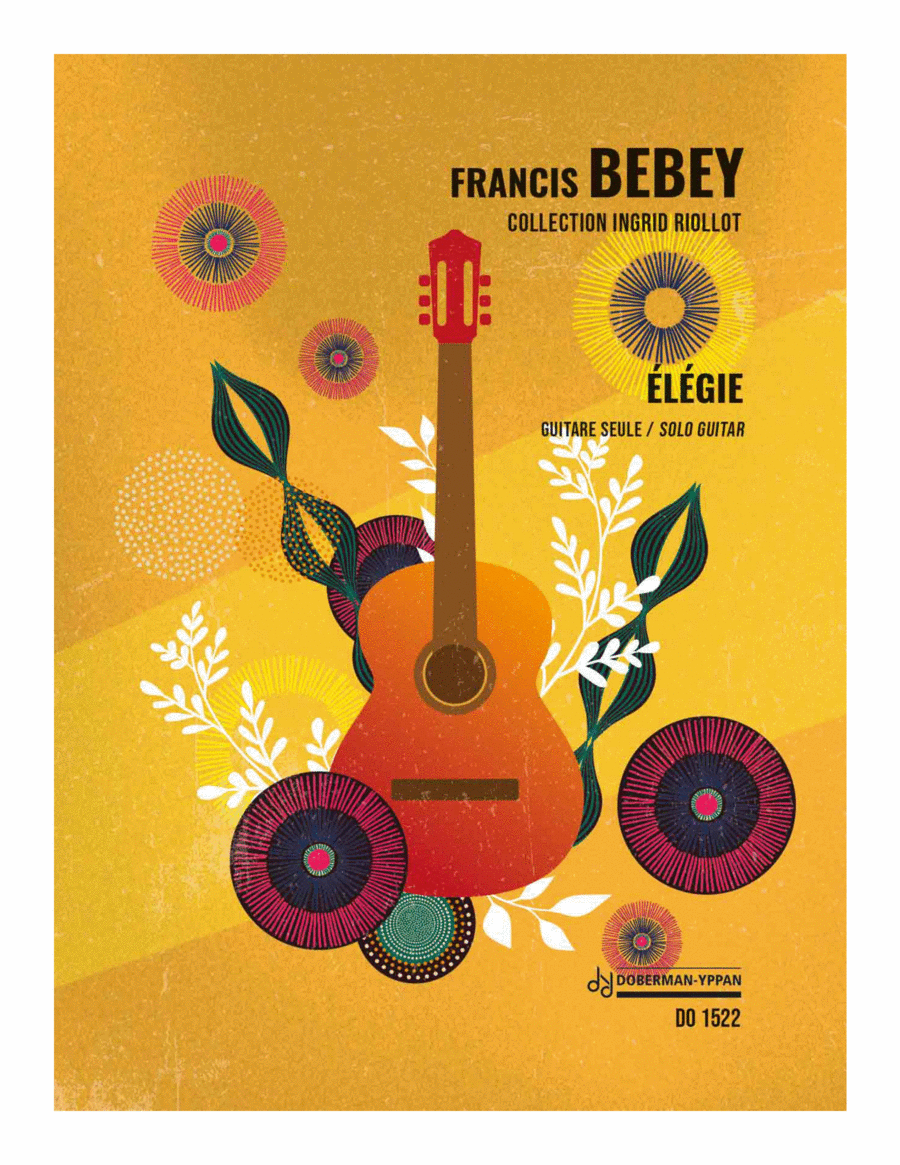
Élégie
Guitare

$3.95 3.33 € Guitare PDF SheetMusicPlus

Solo Guitar - Level 4 - Digital Download SKU: A0.1236980 By Andrew Howes. By Andrew Howes. 20th Century,21st Century,Classical. Individual part. 2 pages. Andrew Howes #832517. Published by Andrew Howes (A0.1236980). This is the finale of my 'Eyeworth Suite' for the classical guitar, and it describes a tranquil, sunny afternoon by Eyeworth Pond in the New Forest, Hampshire, UK, and is written as a response to a seasonal cycle of four poems by my friend, the poet, David Dayson. The work is gentle and reflective but demands a high level of technique as a lot of it takes place around and above the twelfth fret. There will be no 'dusty bits' on your guitar after playing this one! :-)The whole suite is available either as single movements or as a complete work. The complete work is also available with tab. and consists of 'Prelude', 'Autumn', 'Winter', 'Spring' and this movement, the 'Summer Idyll' and intersperses two episocdic, lively movements between the two rhapsodic outer movements, with the doleful Winter in the middle - this does however, have a lively Yule Dance in 6/4 at its heart.
Summer Idyll
Guitare
Andrew Howes
$4.00 3.37 € Guitare PDF SheetMusicPlus

Solo Guitar - Level 4 - Digital Download SKU: A0.1308881 By Frederic Chopin. By Frederic Chopin. Arranged by Tondi. FR. 19th Century,Classical,Contemporary,Early Music,Standards. Individual part. 14 pages. ToRa Swarna Diva #898138. Published by ToRa Swarna Diva (A0.1308881). Fantasie Impromptu is one of the most iconic solo instrumental pieces for pianists around the world. Fantasie Impromptu was written almost 200 years ago by Frederic Chopin (1834). Actually, this work was never published by Chopin. Julian Fontana was the first to publish it.More than 100 years later (1960), Arthur Rubenstein, in a piano recording session of this composition, discovered through an original sheet written by Chopin himself, that this work was a work that had been completed. Inside it is written, composed for, which shows that this work was an order from a nobleman. Chopin was paid to write this. So this is the reason this work was never published. And unfortunately, during the lifetime of two giants in guitar composition and arrangement: F. Tarrega & Agustin Barrios, for some reason, they did not transcribe this great work into guitar playing. In fact, both of them are recorded as having transcribed several Chopin works onto the guitar. And now, after almost old 200 years, this is the most complete guitar transcription from Fantasie Impromptu written by Tondi Rangkuti a.k.a Tondi FR. Written in Key Bm on movt. 1 and B Major in movt 2. Of course this arrangement is intended for the Advanced - Intermediate level. Very suitable for playing at concerts & international guitar competitions.
FANTASIE IMPROMPTU FOR GUITAR SOLO
Guitare
Frederic Chopin
$22.00 18.56 € Guitare PDF SheetMusicPlus

Solo Guitar - Level 5 - Digital Download SKU: A0.1237543 Composed by Johann Sebastian Bach. Arranged by Richard Hirsch. Baroque,Christian,Multicultural,Spiritual,World. Individual part. 11 pages. Richard Hirsch #833059. Published by Richard Hirsch (A0.1237543). I offer an arrangement of Bach’s all-time favourite Jesus, Joy of Man’s Desiring in an African inspired rendering for solo classical or acoustic guitar. The arrangement uses lots of natural harmonics in an attempt to mimic the African kalimba style of music. The arrangement goes in 4/4 time in polyrhythm with a second tier of accents at 2, 2&, and 4 with a slight swing. The polyrhythm makes the final chord sound like an upbeat! The low bases are notated as quarter notes and should be played so that they do not ring out. They are not muted (staccato), except where notated, but they should be kept short to give the piece a bouncy character.The arrangement contains the main melody and chorus sections of the original in G major, although I have changed the original in a number of ways. The first melody and chorus section in G major is prefaced by several bars of natural harmonics and is repeated only after the melody and chorus section in the key of A minor. Natural harmonics appear in many places in the piece interwoven with Bach’s original melody and chorus. I think the natural harmonics give the piece a really glorious ring. The present arrangement incorporates many sections of a sister arrangement of the piece that I published recently that follows the original more closely and works as an introduction to the music with extensive left and right hand fingerings and tablature for intermediate students of guitar. This arrangement, considering the many natural harmonics, staccatos, tempo, and swing, is perhaps better suited for advanced intermediate students of classical or acoustic guitar. With that in mind, I therefore refrain from any extensive left and right hand fingerings for the present arrangement. The piece is a real joy to play and listen to! The tempo for the present arrangement has been set to 140 bpm. I think the pace gives a real swing to the music. The piece may however be played at a faster tempo, e.g. Presto, or somewhere in between. With this great music you can hardly go wrong.The title I have chosen for the arrangement aims to be a play on words as in many English speaking parts of the world the name Bach often rhymes with the word ‘back’ as in a return to some place or time. ‘Bach to Africa’ is then an allusion to humanity’s primordial roots in Africa. Rejoice!
Bach to Africa
Guitare

$4.99 4.21 € Guitare PDF SheetMusicPlus

Guitar - Advanced - Digital Download SKU: ZZ.DZ-4088 Composed by Louis Trépanier. Score. 9 pages. Les Productions d'OZ - Digital #DZ 4088. Published by Les Productions d'OZ - Digital (ZZ.DZ-4088). ISBN 9782898522055.August nights can be tinged with a bit of melancholy because the end of the summer approaches. The moon softly glows with nostalgia for a season passing us by. This mood seems to me folded into the Brazilian Bossa Nova, and the Brazilians? term ?saudade?; in this piece I offer up my tribute to one of my favourite composers, Radamés Gnattali (1906-1988), who wrote for every musical situation in his era in Brazil ? from the concert stage to the back alley, and everything in between. Lua para Epilogo de Verão, is dedicated to the Brazilian guitarist Fabio Zanon, who is both a great friend and a tremendous inspiration.This étude tackles solid chords and contrary motion in the left hand, and, like all the études in this collection, voice separation and phrasing. In measure 24 the guitarist must execute a diagonal barré, where the first finger covers position IV at the first string, and position V at the fifth string, hence the V/IV indication after the barré symbol. The practicalities of navigating through the different chord shapes and rhythms in the piece mean that not all notes can be held for their full, written value. Such discrepancies between the text and the playing are common in this style of music.Les nuits du mois d?août peuvent contenir une douce mélancolie, à savoir que la fin de l?été approche. La lune luit alors avec une nostalgie pour la saison qui est déjà en train de passer. Cette saveur me semble parfaitement miroitée dans les couleurs de la bossa nova brésilienne et le terme brésilien « saudade » ; dans cette pièce je vous offre mon hommage au style d?un de mes compositeurs préféré, Radamés Gnattali (1906-1988), qui a su créer des musiques pour tous les différents musiciens de ses années au Brésil, de la salle de concert, jusqu?à la ruelle. Lua para Epilogo de Verão est dédié au guitariste brésilien Fabio Zanon, un bon ami, et une grande inspiration.Cette étude travaille les accords plaqués et divers mouvements contraires à la main gauche, et, comme toutes les études de cette collection, la séparation de voix et le phrasé. À la mesure 24, on doit exécuter un barré en diagonal, où le premier doigt un est à la position IV à la première corde, et à la position V à la cinquième corde, d?où l?indication V/IV suivant le symbole du barré. Pour des raisons pratiques à naviguer les accords et les rythmes de cette pièce, vous verrez qu?il n?est pas toujours possible de tenir toutes les notes pour leur durée complète. Ces différences entre l?écriture et l?exécution sont courantes dans ce style de musique.
Lua para o Epilogo de Verão (Août)
Guitare

$5.95 5.02 € Guitare PDF SheetMusicPlus

Solo Guitar - Level 3 - Digital Download SKU: A0.1444500 By Keith Terrett. By Isaac Manuel Francisco Albéniz y Pascual. Arranged by Keith Terrett. 19th Century,Classical,Contest,Festival,Instructional,Multicultural,World. Individual part. 3 pages. Keith Terrett #1024393. Published by Keith Terrett (A0.1444500). Isaac Manuel Francisco Albéniz y Pascual (Spanish pronunciation: [i?sak al??eni?]; 29 May 1860 – 18 May 1909) was a Spanish virtuoso pianist, composer, and conductor. He is one of the foremost composers of the Post-Romantic era who also had a significant influence on his contemporaries and younger composers. He is best known for his piano works based on Spanish folk music idioms. Isaac Albéniz was close to the Generation of '98.Transcriptions of many of his pieces, such as Asturias (Leyenda), Granada, Sevilla, Cadiz, Córdoba, Cataluña, Mallorca, and Tango in D, are important pieces for classical guitar, though he never composed for the guitar. Some of Albéniz's personal papers are held in the Library of Catalonia.As one of the leading composers of his era, Albéniz's influences on both contemporary composers and on the future of Spanish music are profound. As a result of his extended stay in France and the friendship he formed with numerous composers there, his composition technique and harmonic language influenced aspiring younger composers such as Claude Debussy and Maurice Ravel. His activities as conductor, performer and composer significantly raised the profile of Spanish music abroad and encouraged Spanish music and musicians in his own country.Albéniz's works have become an important part of the repertoire of the classical guitar, many of which have been transcribed by Francisco Tárrega, Miguel Llobet and others. Asturias (Leyenda) in particular is heard most often on the guitar, as are Granada, Sevilla, Cadiz, Cataluña, Córdoba, Mallorca, and Tango in D. Gordon Crosskey and Cuban-born guitarist Manuel Barrueco have both made solo guitar arrangements of all the eight-movements in Suite española. Selections from Iberia have rarely been attempted on solo guitar but have been very effectively performed by guitar ensembles, such as the performance by John Williams and Julian Bream of Iberia's opening Evocation. The Doors incorporated Asturias into their song Spanish Caravan; also, Iron Maiden's To Tame a Land uses the introduction of the piece for the song bridge. More recently, a guitar version of Granada functions as something of a love theme in Woody Allen's 2008 film Vicky Cristina Barcelona.The theme from Asturias was incorporated or adapted in several soundtracks including the 2008 horror film Mirrors, composed by Javier Navarrete, and the Netflix TV show Godless, composed by Carlos Rafael Rivera.In 1997 the Fundación Isaac Albéniz was founded to promote Spanish music and musicians and to act as a research centre for Albéniz and Spanish music in general.A street in Quito, Ecuador, is named after him.
Spanish Guitar Study
Guitare
Keith Terrett
$1.99 1.68 € Guitare PDF SheetMusicPlus

Solo Guitar - Level 3 - Digital Download SKU: A0.747009 By The Andrews Sisters. By Aloysio Oliveira, Ervin Drake, and Zequinha Abreu. Arranged by Music for all Occasions. Classical,Latin,Multicultural,World. Individual part. 3 pages. Keith Terrett #5869485. Published by Keith Terrett (A0.747009). Arranged for solo Guitar, Tico-Tico no fubá (sparrow in the cornmeal, or, literally, rufous-collared sparrow in the cornmeal) is a Brazilian choro song written by Zequinha de Abreu in 1917. A great arrangement for your next performance, sure to be a big hit with your audience!Its original title was Tico-Tico no farelo (sparrow in the bran), but since Brazilian guitarist Américo Jacomino Canhoto (1889–1928) had a work with the same title, Abreu's work was given its present name in 1931, and sometime afterward Aloysio de Oliveira wrote the original Portuguese lyrics.Eros Volusia and her dancers dance to Tico-Tico in 1942 Rio Rita. Ethel Smith performed Tico-Tico onscreen in Bathing Beauty (1944). Carmen Miranda performed Tico-Tico onscreen in Copacabana (1947); It was also featured in the Aquarela do Brasil segment of the Walt Disney film Saludos Amigos (1942) and in Woody Allen's Radio Days (1987).In Quebec the song has been used for several decades in commercials for Sico paint.In season three of Mama's Family episode An Ill Wind, an intoxicated Iola briefly sings the song's chorus before passing out onto a bed.This song can be heard on various episodes of the Belgian Kabouter Wesley cartoon.In season one of Narcos: Mexico, episode 3 (El Padrino), the orchestral version of the song is played by a band during a reception. A biographical movie about Zequinha de Abreu with the same title, Tico-Tico no Fubá was produced in 1952 by the Brazilian film studio Companhia Cinematográfica Vera Cruz, starring Anselmo Duarte as Abreu.The title phrase also features in the lyrics to the song O Pato made famous by João Gilberto.Choro (Portuguese pronunciation: [ˈʃoɾu], cry or lament), also popularly called chorinho (little cry or little lament), is an instrumental Brazilian popular music genre which originated in 19th century Rio de Janeiro. Despite its name, the music often has a fast and happy rhythm. It is characterized by virtuosity, improvisation and subtle modulations, and is full of syncopation and counterpoint. Choro is considered the first characteristically Brazilian genre of urban popular music. The serenaders who play choros are known as chorões.
Tico Tico (tico Tico No Fuba)
Guitare
The Andrews Sisters
$7.99 6.74 € Guitare PDF SheetMusicPlus

Solo Guitar - Level 4 - Digital Download SKU: A0.948712 Composed by Bradley Powell (The Candlelight Guitarist). Concert,Folk,Sacred,Spiritual. Individual part. 5 pages. Geofonica Artistworks #6856481. Published by Geofonica Artistworks (A0.948712). Guitar solo (in standard notation) composed by Bradley Powell (The Candlelight Guitarist), from his CD Beatitude Bridge. Intermediate to advanced level blend of folk-jazz and classical finger-style guitar (a trademark style blend of The Classical Guitarist.) It's a positive, moving, yet reflective guitar instrumental, inspired by the many biblical verses about friendship (incl. Ecclesiastes 4:9-10, John 15:15, John 15:12-15, Job 6:14, Proverbs 18:24, Proverbs 27:10, John 15:13). Wonderful for an offertory or musical interlude in a church service, spiritual gathering, concert or recital.ABOUT: Bradley Powell (aka The Candlelight Guitarist) began guitar at age ten, inspired by The Beatles. At 15, he became a protégé of jazz guitarist Joe Pass, and later studied classical guitar under Vincent Macaluso and at California State University, Northridge under Ronald Purcell, with a master class under Andrés Segovia. Brad was featured performing Gerald Wilson's Sonata for Guitar and Orchestra at the Hollywood Bowl, with the composer conducting. Brad was mentored in composition by David Rose (composer for Little House on the Prairie). Brad has composed music for TV, including Hill Street Blues and The 'A' Team, working with Mike Post. Brad has ten albums as The Candlelight Guitarist. Brad is also the classical guitarist for Disney's Princess Breakfast Adventuire at Disneyland's Grand Californian Resort. When not making music, Brad is often out hiking with his dogs.COMMENTS FROM ESTABLISHED REVIEWERS...Dr. Beth - Amazon.com #1 Hall of Fame reviewerBrad has a knack for putting together gentle, soothing guitar medleys which provide the perfect background or relaxation soundtrack.Bill Binkelman - Music Reviewer for Zone Music Reporter and New Age RetailerThe Candlelight Guitarist is your tour guide to a land of easy-going, warm, and inviting instrumentals.Rebecca of Amazon - Amazon.com HALL OF FAME TOP 500 REVIEWERBradley Powell's flawless playing allows you to completely relax into sleep or relax into an evening of candlelight and romance. I've fallen into a peaceful sleep while listening to this music and have also spent relaxing afternoons reading while The Candlelight Guitarist wove an intricate tapestry of sounds to nurture my heart. ... Bradley Powell's music is infused with natural ambience. As rich sounds renew your spirit, you can relax into a deep sigh of the heart. His style is artistic, heart healing and filled with romantic and cultural influences.Vicki Blizzard (Editor, PaperWorks and Crazy for Cross-Stitch! magazines) in CREATIVITY e-Letter: Music to filter into my dreams. My new favorite to listen to is classical guitar music by Bradley Powell.Jana L. Perskie ceruleana (New York, NY USA) ~ Amazon.com TOP 50 Reviewer.The talented and creative Bradley Powell is the Candlelight Guitarist. His music is original and some of the most soul soothing I have ever heard.Bob McKillop, founder and publisher, MaineFolkMusic.comBrad Powell is a talented and highly trained California guitarist and composer who calls himself The Candlelight Guitarist, and for good reason. His music is perfect for situations in which candlelight figures prominently. Quiet meditation, romance, intellectual stimulation â?? the soft, pure tones of his Spanish and classic instrumental style open up your heart and render it more receptive to the spiritual messages that these pursuits engender.Grady Harp - HALL OF FAME TOP 100 REVIEWERmusic to soothe and calm and enrich the psyche. Would that there were more Brad Powells out there to help us all through these times. The world would be a saner place!
Making Friends
Guitare

$3.99 3.37 € Guitare PDF SheetMusicPlus

Solo Guitar - Level 3 - Digital Download SKU: A0.1316133 By The Candlelight Guitarist. By Adolphe-Charles Adam. Arranged by Bradley Powell. Christian,Christmas,Classical,Holiday,Religious. Individual part. 4 pages. Geofonica Artistworks #904870. Published by Geofonica Artistworks (A0.1316133). This arrangement of O Holy Night is an excerpt from Christmas Suite 1225 (Part 1) - a new album by The Candlelight Guitarist (aka Bradley Powell). It features fingerstyle classical guitar, with a fresh chordal interpretation, moving bass and internal lines, and other distinctive stylistic features. O Holy Night can be seen and heard in the Candlelight Guitarist YouTube video of Christmas Suite 1225 (Part 1) beginning at 5:25 (see timeline). ABOUT: Brad Powell (aka The Candlelight Guitarist) began guitar at age ten, inspired by The Beatles. At 15, he became a protégé of jazz guitarist Joe Pass, and later studied classical guitar under Vincent Macaluso and at California State University, Northridge under Ronald Purcell, with a master class under Andrés Segovia. Brad was featured performing Gerald Wilson's Sonata for Guitar and Orchestra at the Hollywood Bowl, with the composer conducting. Brad was mentored in composition by David Rose (composer for Little House on the Prairie). Brad has composed music for TV, including Hill Street Blues and The 'A' Team, working with Mike Post. Brad has ten albums as The Candlelight Guitarist. When not making music, Brad is often out hiking with his four dogs. Brad has also played as the solo guitarist for Disney's Princess Breakfast Adventure at Disney's Grand Californian Resort by Disneyland (since 2019), providing music for the Disney Princesses (Belle, Tiana, Jasmine, Rapunzel, Mulan, Aurora, Ariel, Pocahontas, Cinderella, and their friends and guests).COMMENTS FROM LONG-ESTABLISHED REVIEWERS (for this and other Candlelight Guitarist recordings)...Dr. Beth - Amazon.com #1 Hall of Fame reviewerBrad has a knack for putting together gentle, soothing guitar medleys which provide the perfect background or relaxation soundtrack.Bill Binkelman - Music Reviewer for Zone Music Reporter and New Age RetailerThe Candleight Guitarist is your tour guide to a land of easy-going, warm, and inviting instrumentals.Rebecca of Amazon - Amazon.com HALL OF FAME TOP 500 REVIEWERBradley Powell's flawless playing allows you to completely relax into sleep or relax into an evening of candlelight and romance. I've fallen into a peaceful sleep while listening to this music and have also spent relaxing afternoons reading while The Candlelight Guitarist wove an intricate tapestry of sounds to nurture my heart. ...  Bradley Powell's music is infused with natural ambience. As rich sounds renew your spirit, you can relax into a deep sigh of the heart. His style is artistic, heart healing and filled with romantic and cultural influences.Vicki Blizzard (Editor, PaperWorks and Crazy for Cross-Stitch! magazines) in CREATIVITY e-Letter: Music to filter into my dreams. My new favorite to listen to is classical guitar music by Bradley Powell.Jana L. Perskie Ceruleana (New York, NY USA) ~ Amazon.com TOP 50 Reviewer.The talented and creative Bradley Powell is the Candlelight Guitarist. His music is original and some of the most soul soothing I have ever heard.Bob McKillop, founder and publisher, MaineFolkMusic.comBrad Powell is a talented and highly trained California guitarist and composer who calls himself The Candlelight Guitarist, and for good reason. His music is perfect for situations in which candlelight figures prominently. Quiet meditation, romance, intellectual stimulation – the soft, pure tones of his Spanish and classic instrumental style open up your heart and render it more receptive to the spiritual messages that these pursuits engender.Grady Harp - Amazon HALL OF FAME TOP 100 REVIEWERmusic to soothe and calm and enrich the psyche. Would that there were more Brad Powells out there to help us all through these times. The world would be a saner place!
O Holy Night
Guitare
The Candlelight Guitarist
$3.99 3.37 € Guitare PDF SheetMusicPlus

Solo Guitar - Level 5 - Digital Download SKU: A0.1102997 Composed by Jeremiah Lawson. Blues,Classical,Rock. Individual part. 7 pages. Jeremiah Lawson #706323. Published by Jeremiah Lawson (A0.1102997). This is a 7-page score for solo guitar in two-movements, both in C minor. The opening sonata-prelude has an exposition, development and recapitulation and uses two themes, both of which use the gesture of a rising second as either core thematic or accompaniment material. There are places indicated in the score where a performer can improvise embellishments or substitutions in the return of Theme 1 in the recapitulation. The fugue is written in three voices with a subject and countersubject. It has two expositions, the first based on the primary form and the second on a somewhat free retrograde form of the initial fugue subject. I use fragmented forms of the subject to create blues and 5/4 episodes after the grand stretto that signals the structural climax of the fugue. This work is pretty difficult but although I wrote it on classical guitar it may also be played on acoustic or electric guitars with whatever timbre modifications strike your fancy.
in memoriam Aretha Franklin: a sonata-prelude and fugue in C minor for solo guitar
Guitare

$5.00 4.22 € Guitare PDF SheetMusicPlus

Solo Guitar - Level 4 - Digital Download SKU: A0.899136 Composed by Alban Berg. Arranged by Rod Whittle. Contemporary. Individual part. 4 pages. Maggie Creek Music #3874083. Published by Maggie Creek Music (A0.899136). For solo classical guitar; 4 pp; first part of 2nd movement of the Lyric SuiteAlban Berg 1885 -1935Berg was a student of Arnold Schoenberg, and came to prominence with compositions using the atonalism of that school. He incorporated chromaticism and an absence of tonality into his compositions with complete facility, if not to public acclaim. His creativity was interrupted by World War 1, during which he served in the Austrian Army. He returned to composition as a champion of modern music, with his opera Wozzeck (1923) bringing both fame and notoriety. He died of blood poisoning in 1935. Over the past century dissonance increased in the compositions of serious music to a point where the semitones had equal value, which is harmonically a kind of wall. Berg was an early innovator. However, if when strictly followed such serialism reaches an ultimate dissonance that effectively sees off melody and harmony as emotional and structural entities, that still leaves elements around form, dynamics and rhythm for the purposes of expression, and these together with adroit note selection prove to be surprisingly potent for articulation and cohesion. The Lyric Suite (1927), which uses Schoenberg's twelve-tone technique, is a case in point. The very name seems incongruous for an atonal work, yet lyric it is, and if the forms used are necessarily masked by the characteristics of serial writing they are not eliminated by them. In this excerpt a rondo form is used with the principle subject repeated on the third page (noted in the score) after a digression to more remote regions than this form usually adopts, due to the atonality.   As well, Berg's writing is rarely purely atonal. In fact the integration of consonant elements are one of the music's most alluring features. It would be so easy, one feels, for melodic material to coagulate the mix, but in his hands the very opposite is generated, an increased clarity of mood. The music remains consistent, as it should, and the incorporation of (often only relatively) thematic material, if often arresting after so much dissonance, doesn't always always mean less intensity or gloom. It is simply effective, either way. Having said all that, it can hardly be denied that the substance of atonality (dissonance, clashing semitones, unharmonic bass) gives it a special suitability to express dark outlooks, and Berg is the author of Wozzeck and Lulu, no downtown musicals. It is hard to determine if Berg chose atonality because it could deliver the angst or because he was bored with obvious forms and romanticism. Probably both.
Excerpt from the Lyric Suite
Guitare

$5.00 4.22 € Guitare PDF SheetMusicPlus


Partitions Gratuites
Acheter des Partitions Musicales
Acheter des Partitions Digitales à Imprimer
Acheter des Instruments de Musique

© 2000 - 2026

Accueil - Version intégrale





