EUROPE
1662 articles
USA
0 articles
DIGITAL
65 articles (à imprimer)
Partitions Digitales
Partitions à imprimer
65 partitions trouvées

1 16 31 ....61

Solo Guitar - Level 1 - Digital Download SKU: A0.1476094 Composed by Various. Arranged by Socrates Arvanitakis. Baroque. Individual part. 79 pages. Socrates Arvanitakis #1053626. Published by Socrates Arvanitakis (A0.1476094). PrefaceThese 20+ Baroque pieces are selected from the repertoires of various string instruments like Lute, Baroque Guitar, Viola da Gamba, etc. Some of the pieces are much better known than others, but they all are of a high musical standard very rewarding for the beginner guitarist. I have tried to keep the level of technical difficulty within the first three grades (1-3) of the classification observed in the annual syllabuses of British musical academies such as the Royal Schools of Music, Trinity College, Guildhall College, etc, of prescribed examination pieces for these grades.The Metronome markings are only editorial suggestions provided as general guidance but should not be taken too literally. This volume is divided into two sections. In the first section the pieces are given in ordinary notation and in decorated pages such as this one, without any fingerings or other technical help, but only for the pleasure of users who prefer a Baroque decorated appearance of books containing Baroque music. In the second section the same pieces are presented in undecorated pages and in double systems of notation pentagrams and tablature hexagrams in which the fingerings for every piece become obvious by the tablature and without further need for more left hand guidance. Therefore this book can be printed on paper either in its complete given form, or in any other page arrangement the user may prefer. Blank pages are provided for insertion at correct places for the management of left and right sides of a two-side view, but the volume has been designed with a paperless environment in mind where a tablet and a score reading application would be used.The thematic index is provided for general navigation withinthis electronic book.1 Clicking on any image in the index takes the user to the relevant decorated page of music, or clicking within the square frame number beside each image links the user to the corresponding tablature pages.2 Clicking on the title of any piece takes the user back to the index.3 Clicking on the header of the page is used for interchanging between decorated and undecorated pages.Socrates ArvanitakisLondon 2024.
Baroque Anthology 2 - 20 easy Pieces for Guitar (from String Instrument Sources)
Guitare

$20.00 17.34 € Guitare PDF SheetMusicPlus

Solo Guitar - Level 3 - Digital Download SKU: A0.1356074 By Aaron Larget-Caplan. By Johann Sebastian Bach. Arranged by Aaron Larget-Caplan. Baroque,Classical,Early Music,Sacred,Spiritual. Individual part. 4 pages. Aaron Larget-Caplan #940737. Published by Aaron Larget-Caplan (A0.1356074). A beautiful and solemn solo by Johann Sebastian Bach arranged for guitar by award winning composer, arranger, and guitarist Aaron Larget-Caplan.An early cantata, BWV 106 is assumed to have been written as a funeral cantata while Bach was in Mühlhausen, Germany. In the original, two recorders echo each other in the melody. Due to lack of sustain and technical issues, the guitar is unable to copy that effect fully, but the performer should be aware.Arranged for moderate level and above players, the solo is written in Drop D (E string 6 tuned down to D).  Most of the playing is in the first three positions and ornamentation is optional.A note on the history of the work, arrangement, and recording are included, as well as a page for ornament realizations.
God's Time Is The Very Best Time, BWV 106 by J.S. Bach
Guitare
Aaron Larget-Caplan
$5.00 4.34 € Guitare PDF SheetMusicPlus

Solo Guitar - Level 3 - Digital Download SKU: A0.1392100 Composed by Mauro Giuliani (1781-1829). Arranged by Socrates Arvanitakis. Classical. Individual part. 19 pages. Socrates Arvanitakis #975591. Published by Socrates Arvanitakis (A0.1392100). PREFACE AND BRIEF ANALYTICAL NOTESThe three sonatinas op.71 by Mauro Giuliani in C, G, and D were first published in 1816 in Vienna and were intended as student pieces of progressive difficulty. In parallel with this intention they are also fully developed three-movement works which reveal Giulianiâ??s technique as a composer with harmony, counterpoint, and structure.They certainly have the time length and the variety of full scale sonatas, but here Giuliani has chosen to use the supporting structures of sonatas met in movements other than the first, such as Menuetto and Trio, Rondo, Marcia and Trio, Scherzo and Trio, etc,  rather than sonata form itself.As it stands, this first sonatina in C has the following three movements:1 Maestoso (Moderato) which is a set of a theme and three variations, or better termed as a set of mathematical divisions reminiscent of an earlier era, as the accompaniment of the theme is given in crotchets, quavers, quaver triplets, and semi-quavers.2 Menuetto-Trio-Menuetto da capo written typically in the subdominant key of F and fully developed as per classical 19th century usage.3 Rondo. This movement is also written in a classical rondo style and form as an A-B-A-C-B-A-codetta  structure, with a typical tonal scheme of A in the tonic Key (C), B in the dominant key (G), and C in the relative minor key (Am).Therefore in this work we do not meet with structural innovations of any kind, but with strong affirmation of already existing and well established early 19th century structural norms, but the beautiful personal melodic and harmonic style of Giuliani and even his routine guitaristic nuances and formulas are present in all three movements and can be enjoyed as always.TECHNICALThis publication keeps each separate movement within the limit of two pages, thus avoiding page turns. It is published with two versions of the same pieces given in undecorated and decorated pages for the user to select which version he prefers to print out. Blank pages have been provided for insertion/deletion for the correct placement of left-right hand pages.Metronome marks are only editorial suggestions that need not be taken too literally.Sibelius Mp3 archive has been extracted for this publication using Note Performer playback engine.Socrates ArvanitakisLondon 2024.
Mauro Giuliani: Sonatina in C op.71 no.1
Guitare

$6.00 5.2 € Guitare PDF SheetMusicPlus

Solo Guitar - Level 2 - Digital Download SKU: A0.594506 Composed by Traditional. Arranged by Richard Hirsch. Folk,Instructional,Multicultural,Traditional,World. Individual part. 5 pages. Richard Hirsch #203776. Published by Richard Hirsch (A0.594506). An arrangement of the Flamenco Soleares style (palo) for the dance (baile). The musical material for the arrangement is taken from standard traditional themes for the Soleares style of Flamenco. The arrangement is meant for guitarists and students of guitar that are new to Flamenco and want to learn the basics for one of the most important palos in Flamenco. The arrangement can be used to accompany a solo dance, customary in serious (jondo) Flamenco, often performed by a woman dancer. The Soleares rhythm consists of a repetition of a twelve beat phrase the Flamencos refer to as a compás where accents fall on the third, sixth, eight, tenth, and twelfth beats of the phrase (1 2 3 4 5 6 7 8 9 10 11 12). I notate the compás as a series of five measures that comprises two 3/4 measures followed by three 2/4 measures. Throughout the notation there is, therefore, a fluctuating between two measures in 3/4 and three measures in 2/4 time. The first beat of the compás falls on the second beat of the first 3/4 measure in the series and the first accented beat falls on the first beat of the second 3/4 measure. The sixth, eight, and tenth accented beats fall on the first beats of the 2/4 measures in the series. The twelfth beat falls on the first beat of the next series beginning with a 3/4 measure. Notating the compás in this manner allows the guitarist a total grasp of the underlying structure of the music, something that is often lost in other notations I have studied for Soleares. A command of the compás is essential for the guitarist to be able to work with Flamenco singers and dancers. The Soleares is a stately dance that moves at a moderate pace, but often ends in a finale (macho por Bulerías) that is more than twice as fast as the first sections of the dance. The finale also contains a key change from the Phrygian mode of the llamadas and corridas to the key of E major. The arrangement contains essential basic techniques for Flamenco guitar, the rasqueado, the legato with hammering on, the four finger tremolo that rips at the strings before a full chord with the thumb, alzapúa where the thumb strikes in triplets down, up, down in rapid succession, etc. Students should dedicate themselves to a close and careful study of the notation to gain full mastery of these techniques. The arrangement consists of several sections, the llamadas which are calls to the dancer to take the stage, corridas where the dancer moves in a circle executing various heel and toe steps together with hand, arm, and body gestures, and the macho where the dance ends in a storm of stamping and a fit of wild abandon. The corrida sections consist of melodies Flamencos call “falsetasâ€. One of these is simply a series of broken chords while another is a melody taken from a song called “Caña†that is a member of the Soleares family. The notation ends, as is prescribed for the dance, on the tenth beat of the last compás (the first beat of the last 2/4 measure in the last five measure series). The Soleares was the first palo my maestro Juan González “Triguito†introduced me to in my studies with him in Madrid in the late 1960’s and is considered to be the “mother†of true forms of Flamenco. The title of the arrangement is in celebration of the beautiful patios of Córdoba, home of the Flamenco palo Soleares.
Patios de Córdoba
Guitare

$3.99 3.46 € Guitare PDF SheetMusicPlus

Solo Guitar - Level 3 - Digital Download SKU: A0.899132 Composed by Maurice Ravel. Arranged by Rod Whittle. Contemporary. Individual part. 2 pages. Maggie Creek Music #3868243. Published by Maggie Creek Music (A0.899132). For solo classical guitar; 2 pp; intermediate difficulty.Maurice Ravel (1875 -1937) Ravel was born in the Basque region of France and much of his work shows a Spanish influence (this, together with his interest in jazz has produced some exceptional guitar transcriptions). He was a pupil of Faure and at first fell, like many contemporary composers, under Debussy's spell. However, his ascetic and intellectual bents produced from the start a refinement of composition and orchestration, and development of melody, all his own. Later music, including the Concerto, shows his love of the rhythmic features of jazz, and thoughtful incorporation of the innovations of modern music – strong dissonance, atonality etc. Ravel wrote both music and lyrics for a number of songs including Trois Beaux Oiseaux du Paradis (Three Lovely Birds from Paradise - see below), composed in 1916 while he was posted in the French army during WW1, this at significant physical and mental cost (ref. Wikipedia). Thus the tragic lyrics arise from experience, and the music (Ravel was 40) is typically expressive and uncomplicated with the usual harmonic surprises.Three Lovely Birds from Paradise (English translation)Three lovely birds from Paradise(My beloved has to the fighting gone)Three lovely birds from ParadiseHave flown along this way.The first was bluer than Heaven's blue,(My beloved has to the fighting gone)The second white as the fallen snow,The third was wrapped in bright red glow.'Ye lovely birds from Paradise(My beloved has to the fighting gone)Ye lovely birds from ParadiseWhat bring ye then this way?''I bring to thee a glance of azure(Thy beloved has to the fighting gone)And I on fairest snow white browA fond kiss must leave, yet purer still.''Thou bright red bird from Paradise(My beloved has to the fighting gone)Thou bright red bird from Paradise,What brings thou to me?''A faithful heart all crimson red,(Thy beloved has to the fighting gone)''Ah! I feel my heart glowing cold…Take it also with thee.' Maurice Ravel (1914) 
Trois Beaux Oiseaux du Paradis
Guitare

$4.00 3.47 € Guitare PDF SheetMusicPlus

Guitar - Level 1 - Digital Download SKU: A0.1199999 Composed by Traditional. Arranged by Neal Fitzpatrick. Classical,Country,Folk,Jazz,Traditional. 2 pages. Neal Fitzpatrick Editions #798822. Published by Neal Fitzpatrick Editions (A0.1199999). Twinkle,Twinkle Little Star here is arranged for three guitars. This arrangement is in the first position in the familiar key of G Major. The parts are designed so that each participant can switch play each part. This essentially makes it a three-fold learning tool for the students by their being able to play in different registers in the first position and understand the harmonized melody for all perspectives. The student gets a chance to perform the melody and also be part of the accompaniment. Great for schools, group guitar lessons and private studios.
Twinkle,Twinkle Little Star For Guitar Trio
Guitare

$2.50 2.17 € Guitare PDF SheetMusicPlus

Guitar (flatpicking) - Beginning; Intermediate; Advanced - Digital Download SKU: M0.95077MEB With ONLINE AUDIO AND VIDEO. Composed by Steve Kaufman. Christian. Gospel/Sacred. E-book and online audio/video. Mel Bay Publications - Digital Sheet Music #95077MEB. Published by Mel Bay Publications - Digital Sheet Music (M0.95077MEB). ISBN 9781619115002. 8.75x11.75 inches.In this book three time National Flatpicking Guitar Champion Steve Kaufman presents rousing guitar solos on 24 gospel favorites. Each song is shown with a melody part in notation and tablature, lyrics, an accompaniment part in tablature and a stirring flat- picking solo in notation and tablature. This recording is designed for listening first and second as an instructional tool. All 24 songs are played through three times at least. The first time is as it appears in the book and the two versions that follow are improvised versions. Making this a listening tool and an ear training tool. Recorded Digital to Analog in true stereo sound. This recording can be used with either Flatpickin' the Gospels or Autoharping the Gospels. Includes access to online audio and video.        .
Flatpickin' the Gospels (For Guitar)
Guitare

$24.99 21.67 € Guitare PDF SheetMusicPlus

Solo Guitar - Level 4 - Digital Download SKU: A0.899111 Composed by Richard Strauss. Arranged by Rod Whittle. 20th Century. Individual part. 2 pages. Maggie Creek Music #25793. Published by Maggie Creek Music (A0.899111). 2 pages; for solo classical guitar; published by Maggie Creek MusicRichard Strauss (1864 -1949) Strauss's music amounts to a huge body of symphonic and operatic work written over 60 years. Full of vitality, endlessly melodic, brilliantly orchestrated, it begins and ends in the romantic tradition, but for the most part expresses something more modern and individualistic, not without controversy in its time. Variation of style and structure is drawn from the descriptive (literary) nature of compositions, and an extraordinary inventiveness enlivens the scenes, moods and situations. Strauss said once that he produced music the way cows give milk, and indeed his music rarely seems contrived. The opera Strauss wrote 15 operas on a variety of subjects and across the whole spectrum of drama. He acknowledged being enchanted by the soprano voice, and his writing for it highlights many of the works, including Adriane auf Naxos (composed in 1912). The opera has been described as 'sparkling', which sums it up well, and passages influenced by Bach, Mozart, Puccini, and Wagner add to the interest. The storyline is a play within a play, the second part being the mythological 'Opera' staged in the story. The three pieces transcribed* are from this Opera. The guitar arrangements All classical guitar pieces are compromises. The instrument has only six strings, the left hand four fingers able to be used, and with the right hand its rare to use more than three fingers and the thumb. So, despite the amount of noise possible, it's inevitable that passages occur where either harmony, bass or fragments of counterpoint that would be beneficial are left out. In particular, the higher up the neck music is played the simpler it tends to be, if harder to play, and unless the low bass is an open string there wont be any. So I think the main part of attaining a fair transcription (better to be called an arrangement if the original musical structure is not strictly followed, as in this case) is determining how a good compromise can be reached. Melody, counterpoint, bass and main harmonies demand inclusion, and register is important. One may generally assume the original score can't be improved on. However, if the music may sound well on guitar, and the above elements can be incorporated without the playing becoming very difficult, something enjoyable to play and worthwhile listening to should be able to be achieved. Overture; 'A golden time …'Here the Mozart influence, better, inspiration, is wonderfully evident. A gentle waltz time (only the first section of the overture is transcribed) carries the colourful harmonies, strong melodic threads and connecting flourishes that stamp both pieces. The aria is alluded to in the Overture several times, which as you would expect, is intricately woven with the hints themes later to be established in the Opera. It has a kind of 'jazzy' freedom, and it's always miraculous to me that composition so involved can retain its musical line, here done in Strauss's inimitable way. The aria, sung not far into the Opera, has the perfect inevitability of Mozart, but again it is Strauss. As explained, keys have been changed to suit the guitar. Chorus and Aria This selection from the finale has features well worth trying to translate. The device of having a strong chorus, in the style of a Bach chorale, stated and then counterpointed by a solo voice in a restatement, is potent, and that in the opera the chorus (of the three nymphs) isn't immediately followed by the accompanying aria (of Ariadne) means the latter comes as a moment of surprising beauty. Neither parts are complicated, and lovely arpeggios, a feature Strauss's music, often impart the assured progressions. A problem was to capture the distinct register of the sopr.
Overture from Ariadne auf Naxos
Guitare

$7.00 6.07 € Guitare PDF SheetMusicPlus

Solo Guitar - Level 4 - Digital Download SKU: A0.899109 Composed by Richard Strauss. Arranged by Rod Whittle. 20th Century. Individual part. 2 pages. Maggie Creek Music #25787. Published by Maggie Creek Music (A0.899109). 2 pages; for solo classical guitar; published by Maggie Creek MusicRichard Strauss (1864 -1949) Strauss's music amounts to a huge body of symphonic and operatic work written over 60 years. Full of vitality, endlessly melodic, brilliantly orchestrated, it begins and ends in the romantic tradition, but for the most part expresses something more modern and individualistic, not without controversy in its time. Variation of style and structure is drawn from the descriptive (literary) nature of compositions, and an extraordinary inventiveness enlivens the scenes, moods and situations. Strauss said once that he produced music the way cows give milk, and indeed his music rarely seems contrived. The opera Strauss wrote 15 operas on a variety of subjects and across the whole spectrum of drama. He acknowledged being enchanted by the soprano voice, and his writing for it highlights many of the works, including Adriane auf Naxos (composed in 1912). The opera has been described as 'sparkling', which sums it up well, and passages influenced by Bach, Mozart, Puccini, and Wagner add to the interest. The storyline is a play within a play, the second part being the mythological 'Opera' staged in the story. The three pieces transcribed* are from this Opera. The guitar arrangements All classical guitar pieces are compromises. The instrument has only six strings, the left hand four fingers able to be used, and with the right hand its rare to use more than three fingers and the thumb. So, despite the amount of noise possible, it's inevitable that passages occur where either harmony, bass or fragments of counterpoint that would be beneficial are left out. In particular, the higher up the neck music is played the simpler it tends to be, if harder to play, and unless the low bass is an open string there wont be any. So I think the main part of attaining a fair transcription (better to be called an arrangement if the original musical structure is not strictly followed, as in this case) is determining how a good compromise can be reached. Melody, counterpoint, bass and main harmonies demand inclusion, and register is important. One may generally assume the original score can't be improved on. However, if the music may sound well on guitar, and the above elements can be incorporated without the playing becoming very difficult, something enjoyable to play and worthwhile listening to should be able to be achieved. Overture; 'A golden time …' Here the Mozart influence, better, inspiration, is wonderfully evident. A gentle waltz time (only the first section of the overture is transcribed) carries the colourful harmonies, strong melodic threads and connecting flourishes that stamp both pieces. The aria is alluded to in the Overture several times, which as you would expect, is intricately woven with the hints themes later to be established in the Opera. It has a kind of 'jazzy' freedom, and it's always miraculous to me that composition so involved can retain its musical line, here done in Strauss's inimitable way. The aria, sung not far into the Opera, has the perfect inevitability of Mozart, but again it is Strauss. As explained, keys have been changed to suit the guitar. Chorus and Aria This selection from the finale has features well worth trying to translate. The device of having a strong chorus, in the style of a Bach chorale, stated and then counterpointed by a solo voice in a restatement, is potent, and that in the opera the chorus (of the three nymphs) isn't immediately followed by the accompanying aria (of Ariadne) means the latter comes as a moment of surprising beauty. Neither parts are complicated, and lovely arpeggios, a feature Strauss's music, often impart the assured progressions. A problem was to capture the distinct register o.
Chorus and Aria from Ariadne auf Naxos
Guitare

$7.00 6.07 € Guitare PDF SheetMusicPlus

Solo Guitar - Level 3 - Digital Download SKU: A0.899127 Composed by Richard Strauss. Arranged by Rod Whittle. 20th Century. Individual part. 4 pages. Maggie Creek Music #3037161. Published by Maggie Creek Music (A0.899127). Transcription for solo classical guitar. 4 pages. Richard Strauss (1864 -1949) Strauss's music amounts to a huge body of symphonic and operatic work written over 60 years. Full of vitality, endlessly melodic, brilliantly orchestrated, it begins and ends in the romantic tradition, but for the most part expresses something more modern and individualistic, not without controversy in its time. Variation of style and structure is drawn from the descriptive (literary) nature of compositions, and an extraordinary inventiveness enlivens the scenes, moods and situations. Strauss said once that he produced music the way cows give milk, and indeed his music rarely seems contrived. The opera Strauss wrote 15 operas on a variety of subjects and across the whole spectrum of drama. He acknowledged being enchanted by the soprano voice, and his writing for it highlights many of the works, including Adriane auf Naxos (composed in 1912). The opera has been described as 'sparkling', which sums it up well, and passages influenced by Bach, Mozart, Puccini, and Wagner add to the interest. The storyline is a play within a play, the second part being the mythological 'Opera' staged in the story. The three pieces transcribed* are from this Opera. The guitar arrangements All classical guitar pieces are compromises. The instrument has only six strings, the left hand four fingers able to be used, and with the right hand its rare to use more than three fingers and the thumb. So, despite the amount of noise possible, it's inevitable that passages occur where either harmony, bass or fragments of counterpoint that would be beneficial are left out. In particular, the higher up the neck music is played the simpler it tends to be, if harder to play, and unless the low bass is an open string there wont be any. So I think the main part of attaining a fair transcription (better to be called an arrangement if the original musical structure is not strictly followed, as in this case) is determining how a good compromise can be reached. Melody, counterpoint, bass and main harmonies demand inclusion, and register is important. One may generally assume the original score can't be improved on. However, if the music may sound well on guitar, and the above elements can be incorporated without the playing becoming very difficult, something enjoyable to play and worthwhile listening to should be able to be achieved. Overture; 'A golden time …' Here the Mozart influence, better, inspiration, is wonderfully evident. A gentle waltz time (only the first section of the overture is transcribed) carries the colourful harmonies, strong melodic threads and connecting flourishes that stamp both pieces. The aria is alluded to in the Overture several times, which as you would expect, is intricately woven with the hints themes later to be established in the Opera. It has a kind of 'jazzy' freedom, and it's always miraculous to me that composition so involved can retain its musical line, here done in Strauss's inimitable way. The aria, sung not far into the Opera, has the perfect inevitability of Mozart, but again it is Strauss. As explained, keys have been changed to suit the guitar. Chorus and Aria This selection from the finale has features well worth trying to translate. The device of having a strong chorus, in the style of a Bach chorale, stated and then counterpointed by a solo voice in a restatement, is potent, and that in the opera the chorus (of the three nymphs) isn't immediately followed by the accompanying aria (of Ariadne) means the latter comes as a moment of surprising beauty. Neither parts are complicated, and lovely arpeggios, a feature Strauss's music, often impart the assured progressions. A problem was to capture the distinct register of the soprano voices, som.
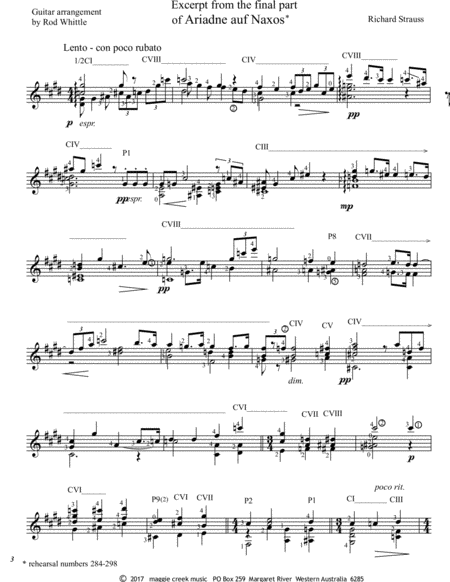
Excerpt from the Last Part of Ariadne Auf Naxos
Guitare

$7.00 6.07 € Guitare PDF SheetMusicPlus

Solo Guitar - Level 4 - Digital Download SKU: A0.899112 Composed by Richard Strauss. Arranged by Rod Whittle. 20th Century. Individual part. 2 pages. Maggie Creek Music #25789. Published by Maggie Creek Music (A0.899112). 2 pages; for solo classical guitar; published by Maggie Creek MusicRichard Strauss (1864 -1949) Strauss's music amounts to a huge body of symphonic and operatic work written over 60 years. Full of vitality, endlessly melodic, brilliantly orchestrated, it begins and ends in the romantic tradition, but for the most part expresses something more modern and individualistic, not without controversy in its time. Variation of style and structure is drawn from the descriptive (literary) nature of compositions, and an extraordinary inventiveness enlivens the scenes, moods and situations. Strauss said once that he produced music the way cows give milk, and indeed his music rarely seems contrived. The opera Strauss wrote 15 operas on a variety of subjects and across the whole spectrum of drama. He acknowledged being enchanted by the soprano voice, and his writing for it highlights many of the works, including Adriane auf Naxos (composed in 1912). The opera has been described as 'sparkling', which sums it up well, and passages influenced by Bach, Mozart, Puccini, and Wagner add to the interest. The storyline is a play within a play, the second part being the mythological 'Opera' staged in the story. The three pieces transcribed* are from this Opera. The guitar arrangements All classical guitar pieces are compromises. The instrument has only six strings, the left hand four fingers able to be used, and with the right hand its rare to use more than three fingers and the thumb. So, despite the amount of noise possible, it's inevitable that passages occur where either harmony, bass or fragments of counterpoint that would be beneficial are left out. In particular, the higher up the neck music is played the simpler it tends to be, if harder to play, and unless the low bass is an open string there wont be any. So I think the main part of attaining a fair transcription (better to be called an arrangement if the original musical structure is not strictly followed, as in this case) is determining how a good compromise can be reached. Melody, counterpoint, bass and main harmonies demand inclusion, and register is important. One may generally assume the original score can't be improved on. However, if the music may sound well on guitar, and the above elements can be incorporated without the playing becoming very difficult, something enjoyable to play and worthwhile listening to should be able to be achieved. Overture; 'A golden time …' Here the Mozart influence, better, inspiration, is wonderfully evident. A gentle waltz time (only the first section of the overture is transcribed) carries the colourful harmonies, strong melodic threads and connecting flourishes that stamp both pieces. The aria is alluded to in the Overture several times, which as you would expect, is intricately woven with the hints themes later to be established in the Opera. It has a kind of 'jazzy' freedom, and it's always miraculous to me that composition so involved can retain its musical line, here done in Strauss's inimitable way. The aria, sung not far into the Opera, has the perfect inevitability of Mozart, but again it is Strauss. As explained, keys have been changed to suit the guitar. Chorus and Aria This selection from the finale has features well worth trying to translate. The device of having a strong chorus, in the style of a Bach chorale, stated and then counterpointed by a solo voice in a restatement, is potent, and that in the opera the chorus (of the three nymphs) isn't immediately followed by the accompanying aria (of Ariadne) means the latter comes as a moment of surprising beauty. Neither parts are complicated, and lovely arpeggios, a feature Strauss's music, often impart the assured progressions. A problem was to capture the distinct register of the so.
'A golden time ...' from Ariadne auf Naxos
Guitare

$7.00 6.07 € Guitare PDF SheetMusicPlus

Solo Guitar - Level 5 - Digital Download SKU: A0.987853 Composed by Robert M. Greenberg. 20th Century. Individual part. 21 pages. Robert M. Greenberg #115407. Published by Robert M. Greenberg (A0.987853). Preferred Contact Information: RMonteverdi@comcast.net Performing Rights Organization: BMI Website: robertgreenbergmusic.com Facebook Band Page: facebook.com/RobertGreenbergMusic Duration: ca. 21 minutes Year of composition: 1996 Program Note: I. Toccata/Hands of Steel II. Strum/Serenade III. O Tanenbaum (Toccata reprise) IV. Two-Part Contention V. John Doe VI. True Pluck A number of years ago, the great English guitarist Julian Bream told David Tanenbaum - the dedicatee of tonight's premiere - not to premiere a guitar work unless he knew for a fact it was the composer's second guitar work. Sage advice. The guitar is an instrument that gives up its secrets to a non-guitar playing composer only reluctantly. Indeed, the timbral, digital and chordal subtleties of this most subtle and intimate instrument are truly understood by the guitarist only. Pity the outlander who composes for the guitar for the first time! With this last thought in mind I had, until last fall, managed to avoid writing a guitar piece. However, even the most abject compositional coward will relent when a musician like David Tanenbaum asks for a piece and offers his assistance and critical judgement in its composition. So it was with PLUCK, composed between November of 1995 and January of 1996. Bream's advice notwithstanding, PLUCK is my first guitar piece. Tanenbaum is brave. The title, PLUCK, thus refers to both the action of plucking strings as well as pluck - bravery, grit, true grit. PLUCK is written in six interrelated movements. The first movement, Toccata/Hands of Steel introduces much of the essential pitch and harmonic material of the piece, as well as Flamenco-style rasgueado strumming which, try as I might, I could not resist using. Movement two, Strum/Serenade, explains itself in its title. Movement three, O Tanenbaum (a designation for which David has forgiven me) reprises the Toccata and describes, well, a sort of musical tree (David has forgiven me for this, too). Two-Part Contention is a combatative, argumentative movement that pits the treble strings of the guitar against the bass. Movement 5, John Doe is a lyric and mysterious moment of rest before the manic finale. Movement 6, True Pluck, is a fast, furious and virtuosic finale. PLUCK is dedicated, with greatest respect and affection, to my friend David Tanenbaum. May he only want to play my second guitar piece.
Pluck for guitar
Guitare

$16.00 13.88 € Guitare PDF SheetMusicPlus

Solo Guitar - Level 4 - Digital Download SKU: A0.914739 Composed by Sol Paul Levy (1881-1920). Arranged by Eric J Roth. 20th Century,Romantic Period. Individual part. 6 pages. Eric J Roth #4593125. Published by Eric J Roth (A0.914739). 6 pages (2 pages of music) formatted for 8.5x11 printing.Sol Paul Levy, born  in Chicago, Illinois in 1881, was a composer, arranger and performer of silent  film music. He attended All Hallows College in Dublin, Ireland and served as  first clarinetist in bands led by John Philip Sousa and Arthur Pryor. Levy led  the foreign orchestrating department for Victor Records – which was the first  music company to produce the disc record – and was a founder of Belwin Music. Levy  compiled a series of photoplay cues for piano that was published in H.S. Gordon’s 1914 Motion Picture Collection. He also wrote songs, the most  famous of which was That Naughty Waltz. Sol Paul Levy died in New York in 1920. During the Silent Film Era (1896-1936), showings usually featured live music, which helped to provide  dramatic and emotional cues for the audience. The first public silent film shown  in 1895 was accompanied by a guitarist. Soon after, films were commonly accompanied  by either a pianist, organist, or chamber orchestra. Accompanists often  improvised or compiled music from the classical, theatrical or popular repertories  using a cue sheet identifying the effects or moods to be conveyed. While some  films produced full scores or detailed cue sheets containing excerpts of music  unique to that film, a repertoire of generic music soon developed to provide accompanists  with music that they could adapt as needed. With titles such as Dramatic  Conflict, Dramatic Tension, Heavy Mysterioso, and Weird Oriental Theme, Sol  Paul Levy’s scores clearly served this purpose. The Vampire: A  Dramatic Theme, composed in 1917, could have been easily adapted to any of the  more than twenty films about vampires that appeared between 1909 and 1930. The  score exists in three versions: one for small orchestra with piano conductor,  one for chamber orchestra without piano, and one for chamber orchestra without  timpani. Instruments included piano, flute, clarinet,  two cornets, trombone, two timpani, two violins, viola, cello, and bass. Despite being composed for small  orchestra, the piece, composed in A minor, is well suited to the guitar once  instrumental and octave doublings are removed. While a solo guitar cannot  produce the power and volume of a chamber orchestra, it certainly can evoke the  intended mood. Except in a few instances owing to the limitations of the guitar,  all original dynamic markings have been retained. All fingerings, of course, are editorial. Please note that some of the fingerings in the score may differ than those used in the linked YouTube Video.
The Vampire: A Dramatic Theme
Guitare

$3.99 3.46 € Guitare PDF SheetMusicPlus


1 16 31 ....61


Partitions Gratuites
Acheter des Partitions Musicales
Acheter des Partitions Digitales à Imprimer
Acheter des Instruments de Musique

© 2000 - 2026

Accueil - Version intégrale





