EUROPE
126 articles
USA
9 articles
DIGITAL
13 articles (à imprimer)
Partitions Digitales
Partitions à imprimer
13 partitions trouvées


Guitar - Intermediate - Digital Download SKU: M0.30906MEB Country. Folk. Ebook and online audio. 41 pages. Mel Bay Publications - Digital Sheet Music #30906MEB. Published by Mel Bay Publications - Digital Sheet Music (M0.30906MEB). ISBN 9781513476667. 8.75X11.75 inches.This solo collection presents 19 iconic melodies from the American traditional song book plus 6 modern original compositions by William Bay, president of Mel Bay Publications; all selections have been arranged in tablature for the 5-string banjo in gDGBD tuning by Catalonian multi-instrumentalist and bluegrass specialist, Llu?s G?mez.Any collection of American ballads would be incomplete without settings of the beautiful melodies penned by Stephen Foster, several of which appear here including Beautiful Dreamer, Darling Nellie Gray, I Dream of Jeanie with the Light Brown Hair, and Hard Times, Come Again No More. Some of these tunes are arranged in uncommon banjo keys, all without retuning the banjo or using a capo. These keys may be challenging at first but will teach you a lot about the banjo fretboard.The authorÆs generous preface offers tips on practice, performance and interpretation rarely found in tablature collections such as these, but this book has it all, including online recordings of each arrangement.
Banjo Picking Tunes - Beautiful American Airs & Ballads
Guitare

$14.99 12.52 € Guitare PDF SheetMusicPlus

Solo Guitar - Level 4 - Digital Download SKU: A0.802998 Composed by LINCOLN BRADY. 20th Century,Concert,Contemporary,World. Individual part. 9 pages. LINCOLN BRADY #1985881. Published by LINCOLN BRADY (A0.802998). Inspired by the true story of the ancient greek statue - 'DANCING SATYR' (in Mazara del Vallo) - discovered by fishermen off the coast of Sicily in 1998 after having lain on the Mediterranean ocean floor for over 2,000 years. Following five years of careful refurbishment in Rome's 'Istituto Centrale per il Restauro' this amazing bronze statue, probably from the school of Praxiteles, was restored almost to its former glory with its head and torso remaining largely intact, incredibly! The 'Dancing Satyr' was then taken on a global tour, including Japan and the Louvre in Paris, where it drew very large crowds capturing the world's imagination. It is now housed in a purpose-built museum in Sicily - 'Museo del Satiro'. The first movement - INTRODUZIONE - begins in a neo-Italian Baroque style , with ancient undertones, in homage to the statue's current home where it has received great care and attention. The music then proceeds in a more modern and programmatic vein conjuring the disastrous sinking of the ship carrying this masterpiece in ancient times and its loss to the inky depths below. The second movement - DANZA - is much lighter in mood celebrating its recovery and conveying the joyous expression of the 'Dancing Satyr' with its arched back and head thrown back in ecstatic abandonment, brilliantly portrayed by its original sculptor. Here the musical language is more influenced by the rhythms of Greek folk music while incorporating modern guitar idioms and harmonic concepts as in the first movement.
IL SATIRO DANZANTE - Solo Guitar
Guitare

$9.99 8.34 € Guitare PDF SheetMusicPlus

Guitar - Level 4 - Digital Download SKU: A0.1135186 By LINCOLN BRADY. By LINCOLN BRADY. Arranged by LINCOLN BRADY. Classical,Multicultural,World. Full Performance. Duration 403. LINCOLN BRADY #735224. Published by LINCOLN BRADY (A0.1135186). Http://www.sheetmusicplus.com/title/il-satiro-danzante-digital-sheet-music/20229001?ac=1&_requestid=2340691 The first movement - INTRODUZIONE - begins in a neo-Italian Baroque style , with ancient undertones, in homage to the statue's current home where it has received great care and attention. The music then proceeds in a more modern and programmatic vein conjuring the disastrous sinking of the ship carrying this masterpiece in ancient times and its loss to the inky depths below. The second movement - DANZA - is much lighter in mood celebrating its recovery and conveying the joyous expression of the 'Dancing Satyr' with its arched back and head thrown back in ecstatic abandonment, brilliantly portrayed by its original sculptor. Here the musical language is more influenced by the rhythms of Greek folk music while incorporating modern guitar idioms and harmonic concepts as in the first movement.
IL SATIRO DANZANTE - Solo Guitar
Guitare
LINCOLN BRADY
$2.99 2.5 € Guitare PDF SheetMusicPlus

Solo Guitar - Level 4 - Digital Download SKU: A0.1328873 By 40s Instrumental Music. By Duke Ellington, Eddie De Lange, and Irving Mills. Arranged by Christopher J. Malin. 20th Century,Jazz,Standards. Individual part. 1 pages. Christopher J. Malin #916882. Published by Christopher J. Malin (A0.1328873). Solo jazz guitar chord/melody arrangement with tablature. Seldom heard standard in this style. Beautiful, instantly recognizable melody. One of Duke Ellington finer pieces. This piece makes you stand out as a solo jazz guitarist of all idioms. Some chords are played as triads or dyads or eliminated, and single notes are used. I draw a line over the note if it's the high note of a chord or I use a dot if it's played as a single note, the chord is then in parentheses. I tend to use a minimalist style that keeps the important parts of the music. Sounds great on acoustic and electric guitars.I tend to play the A section in free time, adding improvisation. Then almost like a modern Power Ballad I play the B' section in a strong swing time. I repeat measures 11 to 14 three times! Then, I pull in the reins and slow her down towards the end and improvise freely at the bitter end. I love this tune! Hope you will too.
Solitude
Guitare
40s Instrumental Music
$7.00 5.85 € Guitare PDF SheetMusicPlus

Guitar - Intermediate - Digital Download SKU: M0.93430EB Solos. Early Music / Renaissance. E-book. 21 pages. Mel Bay Publications - Digital Sheet Music #93430EB. Published by Mel Bay Publications - Digital Sheet Music (M0.93430EB). ISBN 9781513455174. 8.75x11.75 inches.The Renaissance Era covered a span of years from approximately 1450-1600. The lute occupied an important position in the instrumental music of the times because it was one of the first instruments for which any large quantity of music was written. The lute was also the most common yet most highly regarded musical instrument of the 16th century. All the pieces in this volume were originally written for the lute. Each one has been carefully transcribed and edited in modern music notation for the classic guitar which is the ideal instrument for recreating this beautiful polyphonic music of long ago.
Renaissance Lute Music
Guitare

$9.99 8.34 € Guitare PDF SheetMusicPlus

Solo Guitar - Level 4 - Digital Download SKU: A0.899112 Composed by Richard Strauss. Arranged by Rod Whittle. 20th Century. Individual part. 2 pages. Maggie Creek Music #25789. Published by Maggie Creek Music (A0.899112). 2 pages; for solo classical guitar; published by Maggie Creek MusicRichard Strauss (1864 -1949) Strauss's music amounts to a huge body of symphonic and operatic work written over 60 years. Full of vitality, endlessly melodic, brilliantly orchestrated, it begins and ends in the romantic tradition, but for the most part expresses something more modern and individualistic, not without controversy in its time. Variation of style and structure is drawn from the descriptive (literary) nature of compositions, and an extraordinary inventiveness enlivens the scenes, moods and situations. Strauss said once that he produced music the way cows give milk, and indeed his music rarely seems contrived. The opera Strauss wrote 15 operas on a variety of subjects and across the whole spectrum of drama. He acknowledged being enchanted by the soprano voice, and his writing for it highlights many of the works, including Adriane auf Naxos (composed in 1912). The opera has been described as 'sparkling', which sums it up well, and passages influenced by Bach, Mozart, Puccini, and Wagner add to the interest. The storyline is a play within a play, the second part being the mythological 'Opera' staged in the story. The three pieces transcribed* are from this Opera. The guitar arrangements All classical guitar pieces are compromises. The instrument has only six strings, the left hand four fingers able to be used, and with the right hand its rare to use more than three fingers and the thumb. So, despite the amount of noise possible, it's inevitable that passages occur where either harmony, bass or fragments of counterpoint that would be beneficial are left out. In particular, the higher up the neck music is played the simpler it tends to be, if harder to play, and unless the low bass is an open string there wont be any. So I think the main part of attaining a fair transcription (better to be called an arrangement if the original musical structure is not strictly followed, as in this case) is determining how a good compromise can be reached. Melody, counterpoint, bass and main harmonies demand inclusion, and register is important. One may generally assume the original score can't be improved on. However, if the music may sound well on guitar, and the above elements can be incorporated without the playing becoming very difficult, something enjoyable to play and worthwhile listening to should be able to be achieved. Overture; 'A golden time …' Here the Mozart influence, better, inspiration, is wonderfully evident. A gentle waltz time (only the first section of the overture is transcribed) carries the colourful harmonies, strong melodic threads and connecting flourishes that stamp both pieces. The aria is alluded to in the Overture several times, which as you would expect, is intricately woven with the hints themes later to be established in the Opera. It has a kind of 'jazzy' freedom, and it's always miraculous to me that composition so involved can retain its musical line, here done in Strauss's inimitable way. The aria, sung not far into the Opera, has the perfect inevitability of Mozart, but again it is Strauss. As explained, keys have been changed to suit the guitar. Chorus and Aria This selection from the finale has features well worth trying to translate. The device of having a strong chorus, in the style of a Bach chorale, stated and then counterpointed by a solo voice in a restatement, is potent, and that in the opera the chorus (of the three nymphs) isn't immediately followed by the accompanying aria (of Ariadne) means the latter comes as a moment of surprising beauty. Neither parts are complicated, and lovely arpeggios, a feature Strauss's music, often impart the assured progressions. A problem was to capture the distinct register of the so.
'A golden time ...' from Ariadne auf Naxos
Guitare

$7.00 5.85 € Guitare PDF SheetMusicPlus

Solo Guitar - Level 4 - Digital Download SKU: A0.899109 Composed by Richard Strauss. Arranged by Rod Whittle. 20th Century. Individual part. 2 pages. Maggie Creek Music #25787. Published by Maggie Creek Music (A0.899109). 2 pages; for solo classical guitar; published by Maggie Creek MusicRichard Strauss (1864 -1949) Strauss's music amounts to a huge body of symphonic and operatic work written over 60 years. Full of vitality, endlessly melodic, brilliantly orchestrated, it begins and ends in the romantic tradition, but for the most part expresses something more modern and individualistic, not without controversy in its time. Variation of style and structure is drawn from the descriptive (literary) nature of compositions, and an extraordinary inventiveness enlivens the scenes, moods and situations. Strauss said once that he produced music the way cows give milk, and indeed his music rarely seems contrived. The opera Strauss wrote 15 operas on a variety of subjects and across the whole spectrum of drama. He acknowledged being enchanted by the soprano voice, and his writing for it highlights many of the works, including Adriane auf Naxos (composed in 1912). The opera has been described as 'sparkling', which sums it up well, and passages influenced by Bach, Mozart, Puccini, and Wagner add to the interest. The storyline is a play within a play, the second part being the mythological 'Opera' staged in the story. The three pieces transcribed* are from this Opera. The guitar arrangements All classical guitar pieces are compromises. The instrument has only six strings, the left hand four fingers able to be used, and with the right hand its rare to use more than three fingers and the thumb. So, despite the amount of noise possible, it's inevitable that passages occur where either harmony, bass or fragments of counterpoint that would be beneficial are left out. In particular, the higher up the neck music is played the simpler it tends to be, if harder to play, and unless the low bass is an open string there wont be any. So I think the main part of attaining a fair transcription (better to be called an arrangement if the original musical structure is not strictly followed, as in this case) is determining how a good compromise can be reached. Melody, counterpoint, bass and main harmonies demand inclusion, and register is important. One may generally assume the original score can't be improved on. However, if the music may sound well on guitar, and the above elements can be incorporated without the playing becoming very difficult, something enjoyable to play and worthwhile listening to should be able to be achieved. Overture; 'A golden time …' Here the Mozart influence, better, inspiration, is wonderfully evident. A gentle waltz time (only the first section of the overture is transcribed) carries the colourful harmonies, strong melodic threads and connecting flourishes that stamp both pieces. The aria is alluded to in the Overture several times, which as you would expect, is intricately woven with the hints themes later to be established in the Opera. It has a kind of 'jazzy' freedom, and it's always miraculous to me that composition so involved can retain its musical line, here done in Strauss's inimitable way. The aria, sung not far into the Opera, has the perfect inevitability of Mozart, but again it is Strauss. As explained, keys have been changed to suit the guitar. Chorus and Aria This selection from the finale has features well worth trying to translate. The device of having a strong chorus, in the style of a Bach chorale, stated and then counterpointed by a solo voice in a restatement, is potent, and that in the opera the chorus (of the three nymphs) isn't immediately followed by the accompanying aria (of Ariadne) means the latter comes as a moment of surprising beauty. Neither parts are complicated, and lovely arpeggios, a feature Strauss's music, often impart the assured progressions. A problem was to capture the distinct register o.
Chorus and Aria from Ariadne auf Naxos
Guitare

$7.00 5.85 € Guitare PDF SheetMusicPlus

Solo Guitar - Level 4 - Digital Download SKU: A0.899111 Composed by Richard Strauss. Arranged by Rod Whittle. 20th Century. Individual part. 2 pages. Maggie Creek Music #25793. Published by Maggie Creek Music (A0.899111). 2 pages; for solo classical guitar; published by Maggie Creek MusicRichard Strauss (1864 -1949) Strauss's music amounts to a huge body of symphonic and operatic work written over 60 years. Full of vitality, endlessly melodic, brilliantly orchestrated, it begins and ends in the romantic tradition, but for the most part expresses something more modern and individualistic, not without controversy in its time. Variation of style and structure is drawn from the descriptive (literary) nature of compositions, and an extraordinary inventiveness enlivens the scenes, moods and situations. Strauss said once that he produced music the way cows give milk, and indeed his music rarely seems contrived. The opera Strauss wrote 15 operas on a variety of subjects and across the whole spectrum of drama. He acknowledged being enchanted by the soprano voice, and his writing for it highlights many of the works, including Adriane auf Naxos (composed in 1912). The opera has been described as 'sparkling', which sums it up well, and passages influenced by Bach, Mozart, Puccini, and Wagner add to the interest. The storyline is a play within a play, the second part being the mythological 'Opera' staged in the story. The three pieces transcribed* are from this Opera. The guitar arrangements All classical guitar pieces are compromises. The instrument has only six strings, the left hand four fingers able to be used, and with the right hand its rare to use more than three fingers and the thumb. So, despite the amount of noise possible, it's inevitable that passages occur where either harmony, bass or fragments of counterpoint that would be beneficial are left out. In particular, the higher up the neck music is played the simpler it tends to be, if harder to play, and unless the low bass is an open string there wont be any. So I think the main part of attaining a fair transcription (better to be called an arrangement if the original musical structure is not strictly followed, as in this case) is determining how a good compromise can be reached. Melody, counterpoint, bass and main harmonies demand inclusion, and register is important. One may generally assume the original score can't be improved on. However, if the music may sound well on guitar, and the above elements can be incorporated without the playing becoming very difficult, something enjoyable to play and worthwhile listening to should be able to be achieved. Overture; 'A golden time …'Here the Mozart influence, better, inspiration, is wonderfully evident. A gentle waltz time (only the first section of the overture is transcribed) carries the colourful harmonies, strong melodic threads and connecting flourishes that stamp both pieces. The aria is alluded to in the Overture several times, which as you would expect, is intricately woven with the hints themes later to be established in the Opera. It has a kind of 'jazzy' freedom, and it's always miraculous to me that composition so involved can retain its musical line, here done in Strauss's inimitable way. The aria, sung not far into the Opera, has the perfect inevitability of Mozart, but again it is Strauss. As explained, keys have been changed to suit the guitar. Chorus and Aria This selection from the finale has features well worth trying to translate. The device of having a strong chorus, in the style of a Bach chorale, stated and then counterpointed by a solo voice in a restatement, is potent, and that in the opera the chorus (of the three nymphs) isn't immediately followed by the accompanying aria (of Ariadne) means the latter comes as a moment of surprising beauty. Neither parts are complicated, and lovely arpeggios, a feature Strauss's music, often impart the assured progressions. A problem was to capture the distinct register of the sopr.
Overture from Ariadne auf Naxos
Guitare

$7.00 5.85 € Guitare PDF SheetMusicPlus

Solo Guitar - Level 3 - Digital Download SKU: A0.899127 Composed by Richard Strauss. Arranged by Rod Whittle. 20th Century. Individual part. 4 pages. Maggie Creek Music #3037161. Published by Maggie Creek Music (A0.899127). Transcription for solo classical guitar. 4 pages. Richard Strauss (1864 -1949) Strauss's music amounts to a huge body of symphonic and operatic work written over 60 years. Full of vitality, endlessly melodic, brilliantly orchestrated, it begins and ends in the romantic tradition, but for the most part expresses something more modern and individualistic, not without controversy in its time. Variation of style and structure is drawn from the descriptive (literary) nature of compositions, and an extraordinary inventiveness enlivens the scenes, moods and situations. Strauss said once that he produced music the way cows give milk, and indeed his music rarely seems contrived. The opera Strauss wrote 15 operas on a variety of subjects and across the whole spectrum of drama. He acknowledged being enchanted by the soprano voice, and his writing for it highlights many of the works, including Adriane auf Naxos (composed in 1912). The opera has been described as 'sparkling', which sums it up well, and passages influenced by Bach, Mozart, Puccini, and Wagner add to the interest. The storyline is a play within a play, the second part being the mythological 'Opera' staged in the story. The three pieces transcribed* are from this Opera. The guitar arrangements All classical guitar pieces are compromises. The instrument has only six strings, the left hand four fingers able to be used, and with the right hand its rare to use more than three fingers and the thumb. So, despite the amount of noise possible, it's inevitable that passages occur where either harmony, bass or fragments of counterpoint that would be beneficial are left out. In particular, the higher up the neck music is played the simpler it tends to be, if harder to play, and unless the low bass is an open string there wont be any. So I think the main part of attaining a fair transcription (better to be called an arrangement if the original musical structure is not strictly followed, as in this case) is determining how a good compromise can be reached. Melody, counterpoint, bass and main harmonies demand inclusion, and register is important. One may generally assume the original score can't be improved on. However, if the music may sound well on guitar, and the above elements can be incorporated without the playing becoming very difficult, something enjoyable to play and worthwhile listening to should be able to be achieved. Overture; 'A golden time …' Here the Mozart influence, better, inspiration, is wonderfully evident. A gentle waltz time (only the first section of the overture is transcribed) carries the colourful harmonies, strong melodic threads and connecting flourishes that stamp both pieces. The aria is alluded to in the Overture several times, which as you would expect, is intricately woven with the hints themes later to be established in the Opera. It has a kind of 'jazzy' freedom, and it's always miraculous to me that composition so involved can retain its musical line, here done in Strauss's inimitable way. The aria, sung not far into the Opera, has the perfect inevitability of Mozart, but again it is Strauss. As explained, keys have been changed to suit the guitar. Chorus and Aria This selection from the finale has features well worth trying to translate. The device of having a strong chorus, in the style of a Bach chorale, stated and then counterpointed by a solo voice in a restatement, is potent, and that in the opera the chorus (of the three nymphs) isn't immediately followed by the accompanying aria (of Ariadne) means the latter comes as a moment of surprising beauty. Neither parts are complicated, and lovely arpeggios, a feature Strauss's music, often impart the assured progressions. A problem was to capture the distinct register of the soprano voices, som.
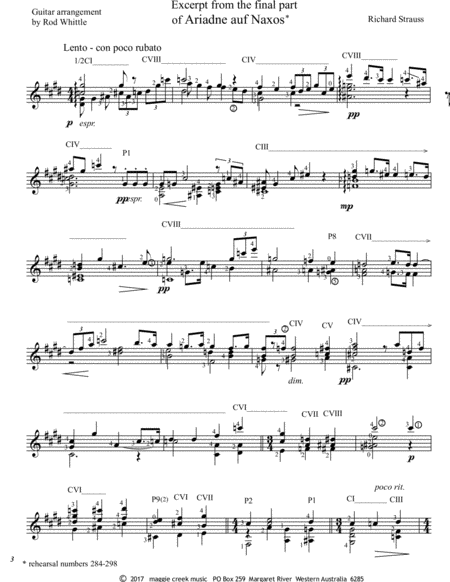
Excerpt from the Last Part of Ariadne Auf Naxos
Guitare

$7.00 5.85 € Guitare PDF SheetMusicPlus


Partitions Gratuites
Acheter des Partitions Musicales
Acheter des Partitions Digitales à Imprimer
Acheter des Instruments de Musique

© 2000 - 2026

Accueil - Version intégrale





