EUROPE
484 articles
USA
0 articles
DIGITAL
118 articles (à imprimer)
Partitions Digitales
Partitions à imprimer
118 partitions trouvées

1 16 31 ....106

Solo Guitar - Level 3 - Digital Download SKU: A0.1441062 By Keith Terrett. By Francisco Tarrega. Arranged by Keith Terrett. 20th Century,Classical,Contest,Festival,Instructional,Multicultural,World. Individual part. 12 pages. Keith Terrett #1021041. Published by Keith Terrett (A0.1441062). Recuerdos de la Alhambra (Memories of the Alhambra) is a classical guitar piece composed in Málaga by Spanish composer and guitarist Francisco Tárrega. It requires the tremolo technique and is often performed by advanced players.The piece was written for and dedicated to Tárrega's patron Concepción Gómez de Jacoby in 1899, commemorating their visit to the Alhambra palace and fortress complex in Granada, Spain. It was originally titled Improvisación ¡A Granada! Cantiga Árabe. It became known through an early 20th-century publication edited by Tárrega and dedicated as an homage to the French guitarist Alfred Cottin.Performance notesThe piece showcases a challenging guitar tremolo, wherein a single melody note is plucked consecutively by the ring, middle and index fingers in such rapid succession that the result is an illusion of one long sustained note. The thumb plays an arpeggio-pattern accompaniment simultaneously. Many who have heard the piece but not seen it performed mistake it for a duet.The A-section of the piece is written in A-minor and the B-section is written in the parallel major (A-major).Arrangements:Ruggiero Ricci arranged this piece for solo violin and often performed it as an encore.Chris Freeman and John Shaw recorded the song for their album Chris Freeman and John Shaw (May 1981, EMI Custom Records YPRX 1828, MAC 126).Nana Mouskouri recorded a vocal version for her 1989 album Classical. Sarah Brightman recorded a re-adapted vocal version for her album Classics.Alex Jacobowitz frequently performs a version of the song on his marimba and xylophone. He recorded it for several of his albums: Spanish Rosewood (1996), The Art of Xylos (2002), and Aria (2010).Luiza Borac arranged this piece for solo piano on her 2014 CD Chants Nostalgiques (Avie AV-2316).Xavi Ganjam made a special arrangement for sitar on his EP Soham (2019, Ganjam Records, Spain).Italian violist Marco Misciagna published the arrangement of this piece for solo viola.Soundtrack use:Recuerdos de la Alhambra has been used as title or incidental music in many films, including the soundtrack for René Clément's Forbidden Games (as played by Narciso Yepes), for The Killing Fields (under the title Étude as performed by Mike Oldfield), and in the films Sideways and Margaret.Performed and arranged by Jonathon Coudrille, it was used as the title music for the British television series Out of Town and a version performed by Pepe Romero was used as incidental music in The Sopranos episode Luxury Lounge. Gideon Coe on BBC Radio 6Music uses this tune as a musical background at approximately the half-way point of his evening weekday show. A sung version appears in the Studio Ghibli film When Marnie Was There.It is also the theme used for Philip II of Spain in the 4X strategy game Civilization VI, with the track progressing from a simple guitar arrangement to an entire orchestral performance as Spain advances through the ages.The theme was part of the soundtrack and storyline for the eponymous 2018 Korean television series Memories of the Alhambra.
Recuerdos de la Alhanbra for Classical Guitar
Guitare
Keith Terrett
$1.99 1.72 € Guitare PDF SheetMusicPlus

Solo Guitar - Level 4 - Digital Download SKU: A0.971659 Composed by Jeffrey Hoover. 20th Century,Contemporary. Individual part. 11 pages. Musicart Publications #5793861. Published by Musicart Publications (A0.971659). Blue Wizard is inspired by American Jazz, Blues, and Flamenco traditions.  For solo classical guitar, it is 6 minutes in length.  The work begins as a Blues, with its familiar twelve-measure form and phrasing, but rapidly moves into a musical fantasy based on five-tone and modal scales heard in jazz.   The music continues to travel through a variety of moods, colors, and textures.  Ideas return and are transformed.  The closing section of Blue Wizard possesses a dancing quality, with a final push to the end.  As with other compositions by Jeffrey Hoover, there is an interpretive painting Blue Wizard, painted by the composer.Jeffrey Hoover's compositions- music ranging from soloist to symphony orchestra -have received recognition through the Universal Edition/SMP Press Contemporary Composition Award, the prestigious Trieste prize, the international Luigi Russolo competition, awards from Mu Phi Epsilon, the Lancaster Fine Arts Festival, grants, publications fellowships, and more than 25 commissions. He is a member of the ACME roster of Mu Phi Epsilon, recognized for distinguished achievement as a composer.   One unique aspect of Hoover’s work is when he combines composition with his paintings, creating synergetic art that intrigues and captivate audiences and performers alike. His paintings are seen in exhibitions and in concerts where his paintings are projected while musicians perform his music. Hoover’s background as a performer includes both classical and jazz music, as saxophonist and conductor. His book The Arts and Society: Making New Worlds is published by Kendall Hunt Publishing.Hoover was born on September 11, 1959, in Anderson, Indiana. He holds a Ph.D. in Fine Arts (Composition and Interdisciplinary Fine Arts) from Texas Tech University, as well as an M.M. and Bch.Sc. from Ball State University. His career in higher education has included both faculty and arts administration appointments.  To learn more about Jeffrey Hoover's work, or for specific inquiries about his music, guest residencies/festivals, and commissions, please visit his website:  https://jeffreyhooverart.wixsite.com/mysite
Blue Wizard (guitar)
Guitare

$9.95 8.61 € Guitare PDF SheetMusicPlus

Guitar - Intermediate - Digital Download SKU: ZY.DO-1522 Composed by Francis Bebey. Arranged by Ingrid Riollot. Score. 5 pages. Les Editions Doberman-Yppan (digital) #DO 1522. Published by Les Editions Doberman-Yppan (digital) (ZY.DO-1522). Francis Bebey est né à Douala en juillet 1929, dans une grande famille où son père, pasteur, luttait pour nourrir ses enfants. Mais Francis a eu l'opportunité d'aller à l'école. Admirant son frère aîné, Marcel Eyidi Bebey, il s'est éduqué, s'est distingué, et a finalement reçu une bourse pour passer son baccalauréat en France.Nous approchions de la fin des années 1950 lorsqu'il est arrivé à La Rochelle. Plus que jamais, dans cette France où les Africains étaient regardés avec curiosité, condescendance ou dédain, Francis s'appuyait sur ses ressources intellectuelles. Travailleur assidu, il a obtenu son baccalauréat, puis s'est installé à Paris où il a commencé des études d'anglais à la Sorbonne. Un jour, il a su ce qui l'attirait vraiment : il voulait faire de la radio. Francis a appris son métier en France et aux Ã?tats-Unis.Après avoir travaillé quelques années comme reporter, il a été embauché en 1961 en tant que fonctionnaire international au Département de l'information de l'UNESCO.Parallèlement, Francis a toujours été attiré par la création musicale. Son activité diurne très sérieuse ne l'empêchait pas de fréquenter les clubs de jazz le soir. Ã? Paris, le jazz, la musique à la mode à cette époque, mais aussi la rumba et la salsa l'attiraient. Il collectionnait les disques et assistait à de nombreux concerts. Avec son complice Manu Dibango, Francis montait sur scène et jouait de la musique.Francis aimait la musique classique depuis son enfance. Il avait grandi en écoutant les cantates et les oratorios de Bach ou Handel que son père chantait au temple. Il s'est passionné pour la guitare, impressionné par les maîtres espagnols et sud-américains, et a décidé d'apprendre à jouer de l'instrument lui-même.Il a commencé à composer des pièces pour guitare, mêlant les diverses influences qui le traversaient avec la musique traditionnelle africaine qu'il portait en lui depuis son enfance. Son approche a captivé le directeur du Centre culturel américain (alors situé dans le quartier de Saint-Germain à Paris), qui lui a offert l'opportunité de se produire devant un public. Francis y a donné son premier récital de guitare (1963) devant un public hypnotisé. Son premier album solo est sorti peu de temps après.Progressivement, Francis est devenu reconnu comme musicien et compositeur. Plusieurs albums de l'ambassadeur africain de la guitare, comme le décrivait la presse, sont sortis. Il a également écrit des livres, au point que sa carrière artistique est devenue difficile à concilier avec sa carrière de fonctionnaire. En 1974, même s'il était devenu le directeur général chargé de la musique à l'UNESCO, il a fait le saut audacieux et a démissionné de cette prestigieuse institution pour se consacrer aux trois activités qui l'intéressaient : la musique, la littérature et le journalisme.Il a exploré le patrimoine musical traditionnel du continent africain, notamment à travers le piano à pouce sanza et la musique polyphonique des pygmées d'Afrique centrale, ou en chantant dans sa langue maternelle et en composant des chansons humoristiques en français !Le succès a suivi. Francis Bebey a parcouru le monde : de la France au Brésil, du Cameroun à la Suède, de l'Allemagne aux Caraïbes, ou du Maroc au Japon... la liste des pays où il a été invité à se produire, à donner des conférences ou à rencontrer des lecteurs est très longue. En plus de la reconnaissance publique, il bénéficiait de la reconnaissance de ses collègues musiciens, tels que le guitariste John Williams ou le Vénézuélien Antonio Lauro, qui l'ont invité à faire partie du jury d'un concours de guitare classique à Caracas.Sa vie était le voyage d'un pionnier africain, un homme enraciné dans son patrimoine culturel et portant un message de partage et d'espoir pour le monde. Son originalité continue de résonner dans le monde entier depuis son décès à la fin du mois de mai 2001.Francis Bebey was born in Douala in July 1929, into a large family where his father, a pastor, struggled to feed his children. But Francis had the opportunity to go to school. Admiring his elder brother, Marcel Eyidi Bebey, he educated himself, distinguished himself, and eventually received a scholarship to go and take his baccalaureate in France.We approached the end of the 1950s when he arrived in La Rochelle. More than ever, in this France where Africans were looked at with curiosity, condescension, or disdain, Francis relied on his intellectual resources. A diligent worker, he obtained his Baccalaureate, then moved to Paris where he started English studies at the Sorbonne. One day, he knew what truly attracted him: he wanted to do radio. Francis learned his craft in France and in the USA.After working for a few years as a reporter, he was hired in 1961 as an international civil servant in the UNESCO Information Department.In parallel, Francis had always been drawn to musical creation. His very serious daytime activity didnâ??t prevent him from frequenting jazz clubs in the evenings. In Paris, the Jazz, the trendy music of that time, but also rumba and salsa attracted him. He collected records and attended numerous concerts. With his accomplice Manu Dibango, Francis took the stage and played music.Francis liked classical music since his childhood. He grew up listening to the cantatas and oratorios of Bach or Handel that his father had sung in the temple. He became passionate about the guitar, impressed by the Spanish and South American masters, and decided to learn to strum the instrument himself.He started composing guitar pieces, blending the various influences that flow through him with the traditional African music he had carried within since childhood. His approach captivated the director of the American Cultural Center (then located in the Saint-Germain neighborhood of Paris), who offered him the opportunity to perform in front of an audience. Francis gave his first guitar recital there (1963) in front of a mesmerized audience. His first solo album was released shortly thereafter.Gradually, Francis became recognized as a musician and composer. Several albums of the African guitar ambassador, as described by the press, were released. He also wrote books, to the point that his artistic career became challenging to reconcile with his career as a civil servant. In 1974, even though he had become the General Manager in charge of music at UNESCO, he took the bold leap and resigned from this prestigious institution to dedicated himself to the three activities that interested him: music, literature, and journalism. He explored the traditional musical heritage of the African continent, notably through the thumb piano sanza, and the polyphonic music of the Central African pygmies, or singing in his native language and composing humoristic songs in French!Success followed. Francis Bebey traveled the world: from France to Brazil, Cameroon to Sweden, Germany to the Carribean, or Morocco to Japan... the list of countries where he was invited to perform, gives lectures, or meets readers is very long. In addition to public recognition, he enjoyed the recognition of his fellow musicians, such as guitarist John Williams or Venezuelan Antonio Lauro, who invited him to be a part of the jury for a classical guitar competition in Caracas.His life was the journey of an African pioneer, a man rooted in his cultural heritage and carrying a message of sharing and hope for the world. His originality continues to vibrate around the world since his passing at the end of May 2001.
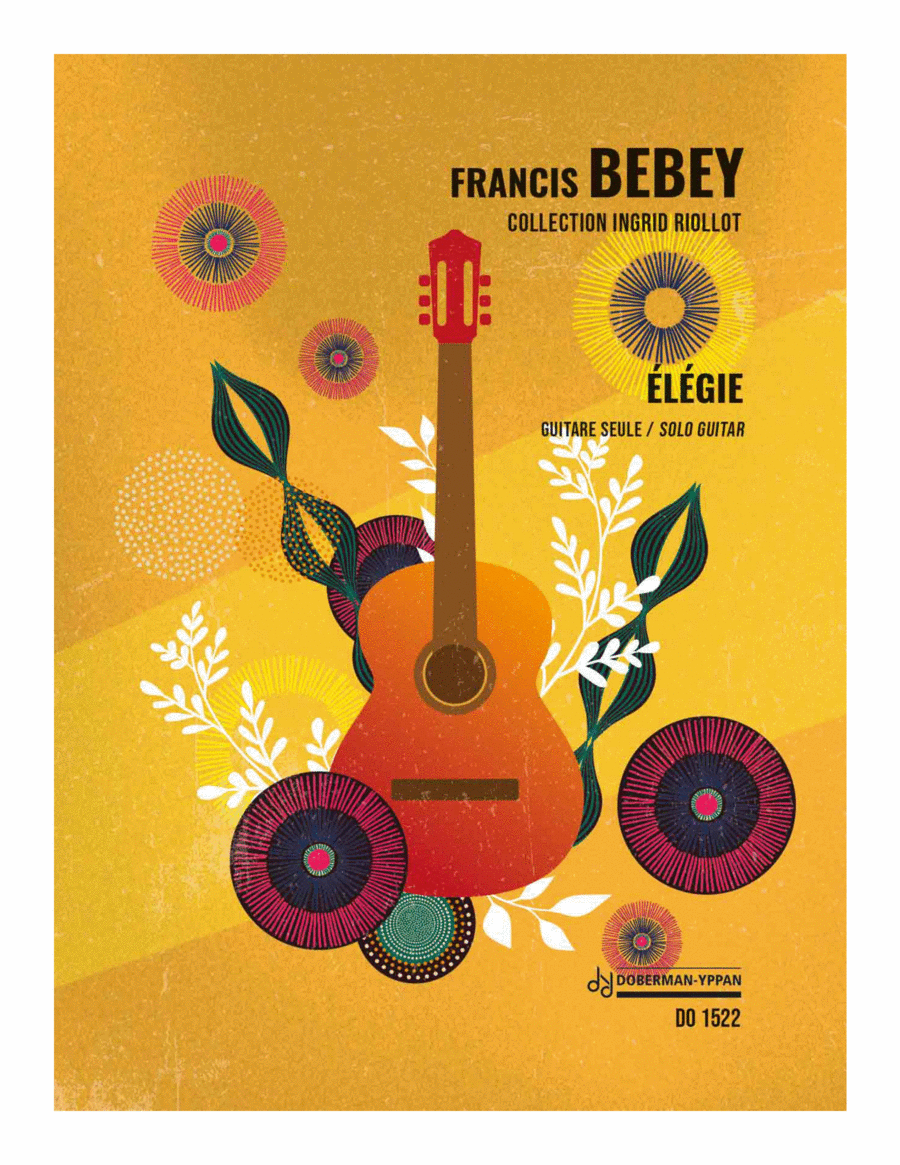
Élégie
Guitare

$3.95 3.42 € Guitare PDF SheetMusicPlus

Solo Guitar - Level 4 - Digital Download SKU: A0.1080715 By The Candlelight Guitarist. By John Philip Sousa. Arranged by Bradley Powell. Classical,Contest,Festival,Holiday,Patriotic,Traditional. Individual part. 6 pages. Geofonica Artistworks #684944. Published by Geofonica Artistworks (A0.1080715). The very popular official march of the United States, composed by John Philip Sousa, arranged for solo classical guitar (in standard notation) by Bradley Powell, aka The Candlelight Guitarist. It is an advanced intermediate to advanced level of finger-style classical guitar. NOTE: This same arrangement is also available in Standard Notation WITH TAB). ABOUT: Bradley Powell (aka The Candlelight Guitarist) began guitar at age ten, inspired by The Beatles. At 15, he became a protégé of jazz guitarist Joe Pass, and later studied classical guitar under Vincent Macaluso and at California State University, Northridge under Ronald Purcell, with a master class under Andrés Segovia. Brad was featured performing Gerald Wilson's Sonata for Guitar and Orchestra at the Hollywood Bowl, with the composer conducting. Brad was mentored in composition by David Rose (composer for Little House on the Prairie). Brad has composed music for TV, including Hill Street Blues and The 'A' Team, working with Mike Post. Brad has ten albums as The Candlelight Guitarist. Brad is also the classical guitarist for Disney's Princess Breakfast Adventure at Disneyland's Grand Californian Resort. When not making music, Brad is often out hiking with his dogs. COMMENTS FROM ESTABLISHED REVIEWERS... Dr. Beth - Amazon.com #1 Hall of Fame reviewer Brad has a knack for putting together gentle, soothing guitar medleys which provide the perfect background or relaxation soundtrack. Bill Binkelman - Music Reviewer for Zone Music Reporter and New Age Retailer The Candlelight Guitarist is your tour guide to a land of easy-going, warm, and inviting instrumentals. Rebecca of Amazon - Amazon.com HALL OF FAME TOP 500 REVIEWER Bradley Powell's flawless playing allows you to completely relax into sleep or relax into an evening of candlelight and romance. I've fallen into a peaceful sleep while listening to this music and have also spent relaxing afternoons reading while The Candlelight Guitarist wove an intricate tapestry of sounds to nurture my heart. ... Bradley Powell's music is infused with natural ambience. As rich sounds renew your spirit, you can relax into a deep sigh of the heart. His style is artistic, heart healing and filled with romantic and cultural influences. Vicki Blizzard (Editor, PaperWorks and Crazy for Cross-Stitch! magazines) in CREATIVITY e-Letter: Music to filter into my dreams. My new favorite to listen to is classical guitar music by Bradley Powell. Jana L. Perskie Ceruleana (New York, NY USA) ~ Amazon.com TOP 50 Reviewer. The talented and creative Bradley Powell is the Candlelight Guitarist. His music is original and some of the most soul soothing I have ever heard. Bob McKillop, founder and publisher, MaineFolkMusic.com Brad Powell is a talented and highly trained California guitarist and composer who calls himself The Candlelight Guitarist, and for good reason. His music is perfect for situations in which candlelight figures prominently. Quiet meditation, romance, intellectual stimulation – the soft, pure tones of his Spanish and classic instrumental style open up your heart and render it more receptive to the spiritual messages that these pursuits engender. Grady Harp - HALL OF FAME TOP 100 REVIEWER music to soothe and calm and enrich the psyche. Would that there were more Brad Powells out there to help us all through these times. The world would be a saner place!.
Stars and Stripes Forever
Guitare
The Candlelight Guitarist
$3.76 3.25 € Guitare PDF SheetMusicPlus

Solo Guitar - Level 3 - Digital Download SKU: A0.971655 Composed by Jeffrey Hoover. 20th Century,Contemporary. Individual part. 10 pages. Musicart Publications #5793563. Published by Musicart Publications (A0.971655). An Unexpected Vista is a work for solo guitar by Jeffrey Hoover. Cinematic in quality, the music possesses an expansiveness. While a contemporary work, this composition has been performed effectively on programs that include Classical, Romantic, or 20th-century works. As with other compositions by Hoover, there is an interpretive painting by Hoover that may be projected during the performance if desired.  The score in this edition is arranged to be printed double-sided, with correct page turns.Jeffrey Hoover's compositions- music ranging from soloist to symphony orchestra -have received recognition through the Universal Edition/SMP Press Contemporary Composition Award, the prestigious Trieste prize, the international Luigi Russolo competition, awards from Mu Phi Epsilon, the Lancaster Fine Arts Festival, grants, publications fellowships and more than 20 commissions. He is a member of the ACME roster of Mu Phi Epsilon, recognized for distinguished achievement as a composer. One unique aspect of Hoover’s work is when he combines composition with his paintings, creating synergetic art that intrigues and captivate audiences and performers alike. His paintings are seen in exhibitions and in concerts where his paintings are projected while musicians perform his music. Hoover’s background as a performer includes both classical and jazz music, as saxophonist and conductor. His book The Arts and Society: Making New Worlds is published by Kendall Hunt Publishing.Hoover was born on September 11, 1959, in Anderson, Indiana. He holds a Ph.D. in Fine Arts (Composition and Interdisciplinary Fine Arts) from Texas Tech University, as well as an M.M and Bch.Sc. from Ball State University. His career in higher education has included both faculty and arts administration appointments. For more information about his compositions, availability for appearance and festivals, and commissions, please contact him through his website.https://jeffreyhooverart.wixsite.com/mysite
An Unexpected Vista (guitar)
Guitare

$9.95 8.61 € Guitare PDF SheetMusicPlus

Solo Guitar - Level 5 - Digital Download SKU: A0.987853 Composed by Robert M. Greenberg. 20th Century. Individual part. 21 pages. Robert M. Greenberg #115407. Published by Robert M. Greenberg (A0.987853). Preferred Contact Information: RMonteverdi@comcast.net Performing Rights Organization: BMI Website: robertgreenbergmusic.com Facebook Band Page: facebook.com/RobertGreenbergMusic Duration: ca. 21 minutes Year of composition: 1996 Program Note: I. Toccata/Hands of Steel II. Strum/Serenade III. O Tanenbaum (Toccata reprise) IV. Two-Part Contention V. John Doe VI. True Pluck A number of years ago, the great English guitarist Julian Bream told David Tanenbaum - the dedicatee of tonight's premiere - not to premiere a guitar work unless he knew for a fact it was the composer's second guitar work. Sage advice. The guitar is an instrument that gives up its secrets to a non-guitar playing composer only reluctantly. Indeed, the timbral, digital and chordal subtleties of this most subtle and intimate instrument are truly understood by the guitarist only. Pity the outlander who composes for the guitar for the first time! With this last thought in mind I had, until last fall, managed to avoid writing a guitar piece. However, even the most abject compositional coward will relent when a musician like David Tanenbaum asks for a piece and offers his assistance and critical judgement in its composition. So it was with PLUCK, composed between November of 1995 and January of 1996. Bream's advice notwithstanding, PLUCK is my first guitar piece. Tanenbaum is brave. The title, PLUCK, thus refers to both the action of plucking strings as well as pluck - bravery, grit, true grit. PLUCK is written in six interrelated movements. The first movement, Toccata/Hands of Steel introduces much of the essential pitch and harmonic material of the piece, as well as Flamenco-style rasgueado strumming which, try as I might, I could not resist using. Movement two, Strum/Serenade, explains itself in its title. Movement three, O Tanenbaum (a designation for which David has forgiven me) reprises the Toccata and describes, well, a sort of musical tree (David has forgiven me for this, too). Two-Part Contention is a combatative, argumentative movement that pits the treble strings of the guitar against the bass. Movement 5, John Doe is a lyric and mysterious moment of rest before the manic finale. Movement 6, True Pluck, is a fast, furious and virtuosic finale. PLUCK is dedicated, with greatest respect and affection, to my friend David Tanenbaum. May he only want to play my second guitar piece.
Pluck for guitar
Guitare

$16.00 13.85 € Guitare PDF SheetMusicPlus

Solo Guitar - Level 4 - Digital Download SKU: A0.914739 Composed by Sol Paul Levy (1881-1920). Arranged by Eric J Roth. 20th Century,Romantic Period. Individual part. 6 pages. Eric J Roth #4593125. Published by Eric J Roth (A0.914739). 6 pages (2 pages of music) formatted for 8.5x11 printing.Sol Paul Levy, born  in Chicago, Illinois in 1881, was a composer, arranger and performer of silent  film music. He attended All Hallows College in Dublin, Ireland and served as  first clarinetist in bands led by John Philip Sousa and Arthur Pryor. Levy led  the foreign orchestrating department for Victor Records – which was the first  music company to produce the disc record – and was a founder of Belwin Music. Levy  compiled a series of photoplay cues for piano that was published in H.S. Gordon’s 1914 Motion Picture Collection. He also wrote songs, the most  famous of which was That Naughty Waltz. Sol Paul Levy died in New York in 1920. During the Silent Film Era (1896-1936), showings usually featured live music, which helped to provide  dramatic and emotional cues for the audience. The first public silent film shown  in 1895 was accompanied by a guitarist. Soon after, films were commonly accompanied  by either a pianist, organist, or chamber orchestra. Accompanists often  improvised or compiled music from the classical, theatrical or popular repertories  using a cue sheet identifying the effects or moods to be conveyed. While some  films produced full scores or detailed cue sheets containing excerpts of music  unique to that film, a repertoire of generic music soon developed to provide accompanists  with music that they could adapt as needed. With titles such as Dramatic  Conflict, Dramatic Tension, Heavy Mysterioso, and Weird Oriental Theme, Sol  Paul Levy’s scores clearly served this purpose. The Vampire: A  Dramatic Theme, composed in 1917, could have been easily adapted to any of the  more than twenty films about vampires that appeared between 1909 and 1930. The  score exists in three versions: one for small orchestra with piano conductor,  one for chamber orchestra without piano, and one for chamber orchestra without  timpani. Instruments included piano, flute, clarinet,  two cornets, trombone, two timpani, two violins, viola, cello, and bass. Despite being composed for small  orchestra, the piece, composed in A minor, is well suited to the guitar once  instrumental and octave doublings are removed. While a solo guitar cannot  produce the power and volume of a chamber orchestra, it certainly can evoke the  intended mood. Except in a few instances owing to the limitations of the guitar,  all original dynamic markings have been retained. All fingerings, of course, are editorial. Please note that some of the fingerings in the score may differ than those used in the linked YouTube Video.
The Vampire: A Dramatic Theme
Guitare

$3.99 3.45 € Guitare PDF SheetMusicPlus

Solo Guitar - Level 4 - Digital Download SKU: A0.1029294 Composed by CÉSAR CANO. Contemporary,World. Individual part. 35 pages. POLYHYMNIA Ediciones musicales #4799751. Published by POLYHYMNIA Ediciones musicales (A0.1029294). In the second century AD, Artemidoro de Daldis (135-200), a very cultured man who had traveled a lot, contemporary of Emperor Marco Aurelio, wrote in Ephesus his work Symbolism of Dreams (Oneirocritica). In it he tried to create a systematic theory for the interpretation of dreams, based on experience. Artemidoro claimed that he had written his work in five volumes by express order of the god Apollo, who had appeared several times in his dreams. In his fascinating book he distinguishes five kinds of dreams: Dream, Vision, Oracle, Appearance and Fantasy. Artemidoro’s book, Op. 63, is a work for guitar in five movements, which take their titles as the kinds of dreams mentioned above: Dream, Vision, Oracle, Appearance and Fantasy. It is an extensive composition, 19 minutes long, and with a great variety of compositional and instrumental techniques: the performer, who is asked for a lot of versatility and imagination, has to play glissandi, harmonics, pizzicati, bells, loops, metric modulations, ordinary and muted strokes, microtones, distortions, various kinds of bumps in the box, etc. The five movements share a special scordature and the same melodic, harmonic and rhythmic material, which is transformed according to the dreamlike atmosphere of the piece, but always maintaining each of the structural elements a recognizable identity. The multiple presences of these essential identities throughout the work articulate the complex form of the Book. I finished the composition of The Book of Artemidoro on April 24, 2006. The work is dedicated to guitarist José Guerola, who premiered it at the Vivanco Palace in Catarroja (Spain), on May 5, 2006.
EL LIBRO DE ARTEMIDORO, Op.63, for guitar
Guitare

$6.99 6.05 € Guitare PDF SheetMusicPlus

Solo Guitar - Level 4 - Digital Download SKU: A0.948712 Composed by Bradley Powell (The Candlelight Guitarist). Concert,Folk,Sacred,Spiritual. Individual part. 5 pages. Geofonica Artistworks #6856481. Published by Geofonica Artistworks (A0.948712). Guitar solo (in standard notation) composed by Bradley Powell (The Candlelight Guitarist), from his CD Beatitude Bridge. Intermediate to advanced level blend of folk-jazz and classical finger-style guitar (a trademark style blend of The Classical Guitarist.) It's a positive, moving, yet reflective guitar instrumental, inspired by the many biblical verses about friendship (incl. Ecclesiastes 4:9-10, John 15:15, John 15:12-15, Job 6:14, Proverbs 18:24, Proverbs 27:10, John 15:13). Wonderful for an offertory or musical interlude in a church service, spiritual gathering, concert or recital.ABOUT: Bradley Powell (aka The Candlelight Guitarist) began guitar at age ten, inspired by The Beatles. At 15, he became a protégé of jazz guitarist Joe Pass, and later studied classical guitar under Vincent Macaluso and at California State University, Northridge under Ronald Purcell, with a master class under Andrés Segovia. Brad was featured performing Gerald Wilson's Sonata for Guitar and Orchestra at the Hollywood Bowl, with the composer conducting. Brad was mentored in composition by David Rose (composer for Little House on the Prairie). Brad has composed music for TV, including Hill Street Blues and The 'A' Team, working with Mike Post. Brad has ten albums as The Candlelight Guitarist. Brad is also the classical guitarist for Disney's Princess Breakfast Adventuire at Disneyland's Grand Californian Resort. When not making music, Brad is often out hiking with his dogs.COMMENTS FROM ESTABLISHED REVIEWERS...Dr. Beth - Amazon.com #1 Hall of Fame reviewerBrad has a knack for putting together gentle, soothing guitar medleys which provide the perfect background or relaxation soundtrack.Bill Binkelman - Music Reviewer for Zone Music Reporter and New Age RetailerThe Candlelight Guitarist is your tour guide to a land of easy-going, warm, and inviting instrumentals.Rebecca of Amazon - Amazon.com HALL OF FAME TOP 500 REVIEWERBradley Powell's flawless playing allows you to completely relax into sleep or relax into an evening of candlelight and romance. I've fallen into a peaceful sleep while listening to this music and have also spent relaxing afternoons reading while The Candlelight Guitarist wove an intricate tapestry of sounds to nurture my heart. ... Bradley Powell's music is infused with natural ambience. As rich sounds renew your spirit, you can relax into a deep sigh of the heart. His style is artistic, heart healing and filled with romantic and cultural influences.Vicki Blizzard (Editor, PaperWorks and Crazy for Cross-Stitch! magazines) in CREATIVITY e-Letter: Music to filter into my dreams. My new favorite to listen to is classical guitar music by Bradley Powell.Jana L. Perskie ceruleana (New York, NY USA) ~ Amazon.com TOP 50 Reviewer.The talented and creative Bradley Powell is the Candlelight Guitarist. His music is original and some of the most soul soothing I have ever heard.Bob McKillop, founder and publisher, MaineFolkMusic.comBrad Powell is a talented and highly trained California guitarist and composer who calls himself The Candlelight Guitarist, and for good reason. His music is perfect for situations in which candlelight figures prominently. Quiet meditation, romance, intellectual stimulation â?? the soft, pure tones of his Spanish and classic instrumental style open up your heart and render it more receptive to the spiritual messages that these pursuits engender.Grady Harp - HALL OF FAME TOP 100 REVIEWERmusic to soothe and calm and enrich the psyche. Would that there were more Brad Powells out there to help us all through these times. The world would be a saner place!
Making Friends
Guitare

$3.99 3.45 € Guitare PDF SheetMusicPlus


1 16 31 ....106


Partitions Gratuites
Acheter des Partitions Musicales
Acheter des Partitions Digitales à Imprimer
Acheter des Instruments de Musique

© 2000 - 2026

Accueil - Version intégrale





