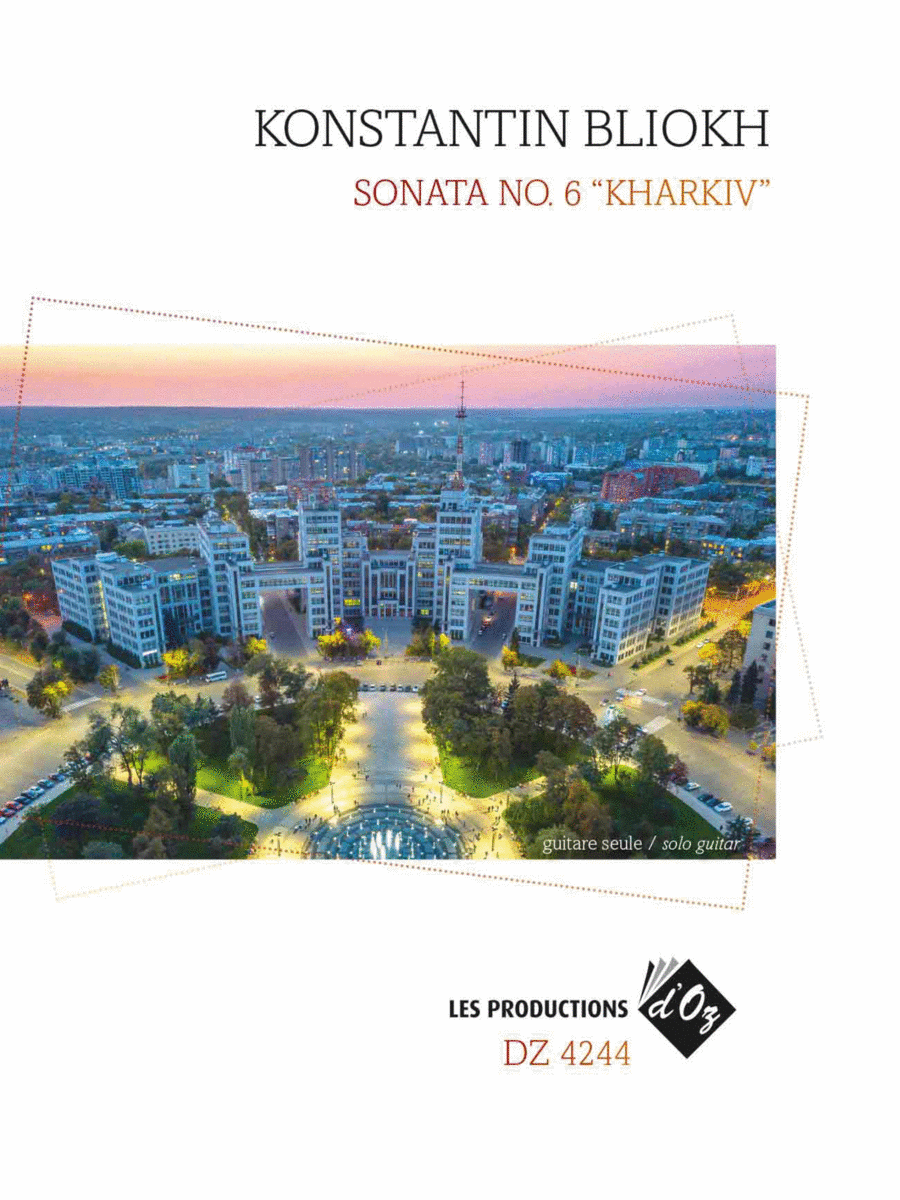
Guitar - Advanced - Digital Download SKU: ZZ.DZ-4244 Composed by Konstantin Bliokh. Score. 13 pages. Les Productions d'OZ - Digital #DZ 4244. Published by Les Productions d'OZ - Digital (ZZ.DZ-4244). La Sonate n° 6 Kharkiv pour guitare solo a été composée en 2021, à la fin du confinement lié au COVID-19. Ã? ce moment-là , ma famille et moi étions restés dans notre ville natale de Kharkiv (également connue sous le nom de Kharkov), en Ukraine, pendant près de deux ans. Nous considérions cette période de pandémie comme un désastre, mais nous avons réalisé plus tard que c'était en fait un moment plutôt heureux, car la guerre est arrivée dans notre pays quelques mois plus tard. Depuis 2022, une fraction considérable des 1,5 million de citoyens de Kharkiv ont quitté leur foyer, ceux qui sont restés vivent sous des attaques incessantes de missiles, et beaucoup ont été tués. Je voudrais dédier cette Sonate à la ville frontalière de Kharkiv et, surtout, à ses citoyens souffrant de la guerre.Pourtant, la musique de la Sonate n'a aucun programme spécifique. Ici, je donnerai un bref aperçu de ses principaux éléments de composition pour faciliter les interprétations futures.Les premier et quatrième mouvements de cette Sonate sont basés sur l'interaction entre le principe dodécaphonique et le centre tonal de sol majeur, naturel pour la guitare. En particulier, le premier mouvement est basé sur l'interaction de la triade de sol majeur Solâ??Siâ??Ré des cordes de guitare à vide 2â??3â??4, le motif ascendant 1 impliquant les notes Miâ??Fa#â??Laâ??Do# (à l'origine sur la première corde), et le motif descendant 2 utilisant les notes Miâ??Doâ??Sibâ??La (à l'origine sur la corde de basse 6). Ces éléments se complètent presque pour former douze tons (à l'exception du Fa manquant), et les motifs alternent avec des fragments ostinato où chaque note de la triade de sol majeur est déplacée pas à pas d'un demi-ton vers le haut ou vers le bas.Le deuxième mouvement est un Scherzo impliquant de nombreux demi-tons dans des accords accentués et des passages rapides, ainsi qu'un mouvement mélodique chromatique dans la voix de basse. Il est presque atonal dans certains fragments, mais a un centre tonal global de la mineur.Le troisième mouvement est un Adagio méditatif basé sur un thème composé dans l'échelle hexatonique Réâ??Miâ??Faâ??Sol#â??Laâ??Si et des accords ostinato impliquant les cordes de basse à vide Miâ??Laâ??Ré et le demi-ton Siâ??Do.Enfin, le quatrième mouvement est basé sur le thème dodécaphonique complet composé de deux phrases comprenant les motifs 1 et 2 du premier mouvement : Solâ??Faâ??Sibâ??Labâ??Doâ??Mibâ??Ré et Miâ??Siâ??Do#â??Laâ??Fa#. Ce thème est présenté dans ses formes prime et rétrograde. Il y a des dialogues entre la première corde, les basses et les cordes médianes à vide, similaires au premier mouvement. Ã? son apogée, le thème dodécaphonique est interprété en utilisant le mouvement parallèle de l'accord de sol majeur standard de la guitare avec les cordes médianes à vide sur douze positions.La Sonate a été créée en première et enregistrée (CD Naxos No. 8.574630) par le célèbre guitariste ukrainien Marko Topchii, qui a également vécu et étudié à Kharkiv. Je lui suis extrêmement reconnaissant pour l'interprétation brillante de cette pièce.Je suis très redevable envers Productions d'Oz d'avoir conservé mes notations originales là où celles-ci ne correspondent pas au style de l'éditeur.Sonata No. 6 Kharkiv for guitar solo was composed in 2021, in the end of the COVID-19 lockdown. At that time my family and I were staying in our home city of Kharkiv (also known as Kharkov), Ukraine for almost two years. We considered that pandemic period as a disaster, but later have realized that it actually was a rather happy time, because a war came to our homeland just a few months later. Since 2022 a considerable fraction of the 1.5 millions of Kharkiv citizens have left their homes, those who stayed have been living under ceaseless missile attacks, and many have been killed. I would like to dedicate this Sonata to the frontier city of Kharkiv and, most of all, to its citizens suffering from the war.Yet, the music of the Sonata does not have any specific program. Here I will give a brief overview of its main composition elements to facilitate future interpretations.The first and fourth movements of this Sonata are based on the interplay between the twelve-tone principle and the G-major tonal center, natural for the guitar. Namely, the first movement is based on the interaction of the G-major triad Gâ??Bâ??D of the open guitar strings 2â??3â??4, ascending motif 1 involving the notes Eâ??F#â??Aâ??C# (originally on the first string), and descending motif 2 using the notes E-â??Câ??Bbâ??A- (originally, on the bass string 6). These elements supplement each other to almost make up twelve tones (apart from the missing F), and the motifs alternate with ostinato fragments where each note in the G major triad is step-by-step moved by a semitone up or down.The second movement is a Scherzo involving numerous semitones in accented chords and fast passages, as well as chromatic melodic motion in the bass voice. It is almost atonal in some fragments, but has an overall tonal center of A-minor.The third movement is a meditative Adagio based on a theme composed within hexatonic scale Dâ??Eâ??Fâ??G#â??Aâ??B and ostinato chords involving open bass strings Eâ??Aâ??D and semitone Bâ??C.Finally, the fourth movement is based on the complete twelve-tone theme consisting of two phrases including motifs 1 and 2 from the first movement: Gâ??Fâ??Bbâ??Abâ??Câ??Ebâ??D and Eâ??Bâ??C#â??Aâ??F#. This theme is presented in its prime and retrograde forms. There are dialogues between the first string, basses and open middle strings, similar to the first movement. In the culmination, the twelve-tone theme is performed using the parallel motion of the standard guitar G-major chord with open middle strings across twelve positions.The Sonata was premiered and recorded (CD Naxos No. 8.574630) by the prominent Ukrainian guitarist Marko Topchii who has also lived and studied in Kharkiv. I am extremely grateful to him for the brilliant performance of this piece.I am greatly indebted to Productions dâ??Oz for keeping my original notations in places where these do not conform to the publisherâ??s style.