EUROPE
3015 articles
USA
227 articles
DIGITAL
429 articles (à imprimer)
Partitions Digitales
Partitions à imprimer
429 partitions trouvées

1 16 31 ....421

Solo Guitar - Level 2 - Digital Download SKU: A0.1139670 Composed by Brian Streckfus. Instructional,Jazz,Singer/Songwriter. Individual part. 12 pages. Brian Streckfus #739941. Published by Brian Streckfus (A0.1139670). This is a 12-page PDF showing 7 guitar chords on each page. Rather than selling each PDF seperately (which is a bit overpriced and too much of a hassle), I decided to combine them and offer a great deal! Learn how to compose chord progressions like a pro while having fun and playing!Objective:Teach yourself the seven chords that belong to each type of scale. Rather than bombard you with a thousand guitar chords (which is easy to happen when browsing the internet or playing random songs), I'd rather show how a select few chords are working well together in common contexts. The hope is that you would then be able to see this happening in all 12 keys. What Scales/Modes are being harmonized? C Major (+jazz version) A (natural) minor (+jazz version) A harmonic minor (+jazz version) B Locrian D Dorian E Phyrigian F Lydian G Mixolydian Features: Slowly increases in physical and theoritcal difficulty at the same time. Many music theory books seem abstract and impractical whereas these chord charts show music theory applied to guitar. These chord progressions are a great composition aid. Guitar chord diagrams Traditional notation with letter names on the note heads Roman numerals color coded Modes included. The Beatles and jazz musicians use modal chord progressions to give their music uniqueness. It's almost as if one note is wrong intentionally.  Practicality and flow on guitar is emphasized more then music theory conciseness. Letter names are not in a perfect order (as that is sometimes impossible for the guitar to do). Sometimes a more complex chord is opted for because it's actually easier to play physically.  Tips: Order = Blue, Yellow, Red, Blue for stereotypical classical style chord progressions. Rock and blues often do more of a chord succession; red going to yellow happens often, even though it is breaking a rule. The professional names for blue, yellow, red: tonic, predominant, dominant respectively. I did not invent this theoretical concept, but I am probably one of the few musician's to color code the categories regularly. The colors explain the situation elegantly; the professional words seem like abstract PhD education, whereas saying blue is relaxing and red is uncomfortable is something a child can understand quickly. One fantastic tip I hardly hear anyone say: it doesn't so much matter that you play the same chord as the other musician in your ensemble (unless you are getting paid to do exactly that). It matters more that you simply play the same color as them. You will have a deeper understanding of how music works if you think like this, and mistakes will no longer be seen as mistakes. What happens when a C Major and A minor chord are played at the same time? Hardly anything! It's just a Am7! Big whoop! It isn't a horrendous sounding mistake. Circle a key on the circle of fifths. Now circle the two keys next to it (-1b, +1#). This leads to six chords that belong diatonically to the first key you circled! Memorizing these will allow you to better predict what composers are about to do, especially if you know ahead of time that the song does not change key. Get away from the echo chamber of common are arugably bad cowboy chords and be able to build your own.
Guitar Chord Progression Generators for Common Scales ~ 12 Pages
Guitare

$1.99 1.67 € Guitare PDF SheetMusicPlus

Guitar (all) - Intermediate - Digital Download SKU: M0.22170EB Composed by Gordon Mizzi. Adult Contemporary. Classic. E-book. Mel Bay Publications - Digital Sheet Music #22170EB. Published by Mel Bay Publications - Digital Sheet Music (M0.22170EB). ISBN 9781619112094. 8.75x11.75 inches.This collection of the work of the Maltese composer, Gordon Mizzi, for solo guitar is being made available to the public for the first time. Saints and Fireworks, The Music of Gordon Mizzi Volume Two is the second of two albums of Gordon Mizzi's music, which are available from Mel Bay Publications. This album takes its title from the  CD, Gordon Mizzi, Saints and Fireworks that has been recorded by Carlos Bonell, one of today's most celebrated guitarists and which is available from Spearhead Music. The individual track recordings are also available as downloads from itunes, amazon.com and other sites.This album contains a diverse collection of original works as well as transcriptions of Renaissance and Maltese folk music by Gordon Mizzi. The Branles de Malte by Jean d'Estr+¬e were originally composed by the French Knights of St. John in Malta in 1551 for the Dauphin of France. Gordon Mizzi has made guitar transcriptions of these five dances and this is the first time that they are being published. The Branles de Malte by Adrian Le Roy are also included. There are a number of original compositions. Saints and Fireworks, a piece in two movements, vividly represents Malta's village festas. Island Scenes are six musical portraits of towns and villages dotting the landscape of Malta.They include Valletta- Barrakka Gardens, San Giljan-After the Feast, Mdina- Citt+á Notabile, the dreamy Comino-The Blue Lagoon, Sliema- The Tower, and the pulsatingly brash Paceville -Sin City. Three Love Poems : Hula, Lahaina and Hana are influences from Hawaii. There are also two cradle songs Child Don't Cry and Ninna Nanna as well as folk inspired melodies such as Night Crossing and il- Maltija. The guitarist will find a veritable pot pourri of scents and sounds in this album.
Saints and Fireworks: The Music of Gordon Mizzi, Volume Two
Guitare

$17.99 15.14 € Guitare PDF SheetMusicPlus

Guitar - Level 3 - Digital Download SKU: A0.1299289 By Queen. By Freddie Mercury. Arranged by Derek Hasted. 20th Century,Film/TV,Pop. 14 pages. Derek Hasted #889151. Published by Derek Hasted (A0.1299289). LOVE OF MY LIFE (Queen) - GUITAR DUETFor Classical or Acoustic Guitar - sometimes it's erroneously listed here as Electric GuitarDerek Hasted writes This delightful melody fits classical guitar like a glove.There are two arrangements in this one edition - one for “solo and accompaniment†and one where the roles swap over at each verse. The versions are otherwise identical. The first of these arrangements is ideal for a duo in which the abilities are slightly unequal.My arrangement is based on Queen’s Official Video and includes all the key changes and phrases except for one little piece of quasi-improvisation I have removed (which would otherwise leave one player looking at the floor in a duet performance!)There is an amount of fingering and slurring which may help to get the smoothest performance, but there are plenty of places where the music needs to breathe, so please don’t rush... I hope you enjoy playing this lovely and moving piece!This is one of a large and growing range of accessible ensembles from experienced arranger Derek Hasted, and is supplied as full score and parts. Derek's website at www.derek-hasted.co.uk/smp lists all his arrangements by title and by number of instruments, with links to soundclips and sample score.
Love Of My Life
Guitare
Queen
$4.99 4.2 € Guitare PDF SheetMusicPlus

Solo Guitar - Level 4 - Digital Download SKU: A0.1189647 Composed by Simon James. Classical,Contemporary,Instructional. Individual part. 5 pages. DML #789280. Published by DML (A0.1189647). These short Preludes for guitar are intended to illustrate a particular technical point or points. It may be either technical or compositional or both and I would have to say that I have been influenced by Tarrega’s Preludes which he wrote mostly for his students and so have called them Preludes rather than Studies. I learnt Tarrega’s pieces such as Adelita and Lagrima early in my study of the guitar and always enjoyed their nature as both technical exercises but also performance pieces. I have tried to emulate that with these pieces. This Prelude is based on the use of thirds and sixths on the guitar. These intervals are the easiest to play on guitar and the sweetest sounding though they can still be used dramatically as in this work. The middle section, or B section if you prefer, uses chords with dissonance built into the chord shape and which are also not too difficult to play.
Prelude No 4 in Em (Fire In The Sky)
Guitare

$2.99 2.52 € Guitare PDF SheetMusicPlus

Solo Guitar - Level 3 - Digital Download SKU: A0.899127 Composed by Richard Strauss. Arranged by Rod Whittle. 20th Century. Individual part. 4 pages. Maggie Creek Music #3037161. Published by Maggie Creek Music (A0.899127). Transcription for solo classical guitar. 4 pages. Richard Strauss (1864 -1949) Strauss's music amounts to a huge body of symphonic and operatic work written over 60 years. Full of vitality, endlessly melodic, brilliantly orchestrated, it begins and ends in the romantic tradition, but for the most part expresses something more modern and individualistic, not without controversy in its time. Variation of style and structure is drawn from the descriptive (literary) nature of compositions, and an extraordinary inventiveness enlivens the scenes, moods and situations. Strauss said once that he produced music the way cows give milk, and indeed his music rarely seems contrived. The opera Strauss wrote 15 operas on a variety of subjects and across the whole spectrum of drama. He acknowledged being enchanted by the soprano voice, and his writing for it highlights many of the works, including Adriane auf Naxos (composed in 1912). The opera has been described as 'sparkling', which sums it up well, and passages influenced by Bach, Mozart, Puccini, and Wagner add to the interest. The storyline is a play within a play, the second part being the mythological 'Opera' staged in the story. The three pieces transcribed* are from this Opera. The guitar arrangements All classical guitar pieces are compromises. The instrument has only six strings, the left hand four fingers able to be used, and with the right hand its rare to use more than three fingers and the thumb. So, despite the amount of noise possible, it's inevitable that passages occur where either harmony, bass or fragments of counterpoint that would be beneficial are left out. In particular, the higher up the neck music is played the simpler it tends to be, if harder to play, and unless the low bass is an open string there wont be any. So I think the main part of attaining a fair transcription (better to be called an arrangement if the original musical structure is not strictly followed, as in this case) is determining how a good compromise can be reached. Melody, counterpoint, bass and main harmonies demand inclusion, and register is important. One may generally assume the original score can't be improved on. However, if the music may sound well on guitar, and the above elements can be incorporated without the playing becoming very difficult, something enjoyable to play and worthwhile listening to should be able to be achieved. Overture; 'A golden time …' Here the Mozart influence, better, inspiration, is wonderfully evident. A gentle waltz time (only the first section of the overture is transcribed) carries the colourful harmonies, strong melodic threads and connecting flourishes that stamp both pieces. The aria is alluded to in the Overture several times, which as you would expect, is intricately woven with the hints themes later to be established in the Opera. It has a kind of 'jazzy' freedom, and it's always miraculous to me that composition so involved can retain its musical line, here done in Strauss's inimitable way. The aria, sung not far into the Opera, has the perfect inevitability of Mozart, but again it is Strauss. As explained, keys have been changed to suit the guitar. Chorus and Aria This selection from the finale has features well worth trying to translate. The device of having a strong chorus, in the style of a Bach chorale, stated and then counterpointed by a solo voice in a restatement, is potent, and that in the opera the chorus (of the three nymphs) isn't immediately followed by the accompanying aria (of Ariadne) means the latter comes as a moment of surprising beauty. Neither parts are complicated, and lovely arpeggios, a feature Strauss's music, often impart the assured progressions. A problem was to capture the distinct register of the soprano voices, som.
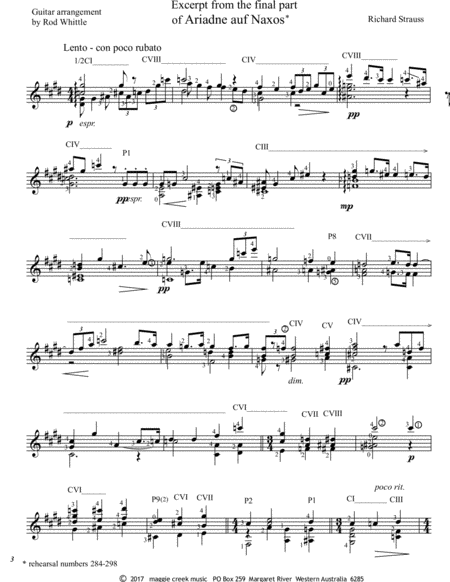
Excerpt from the Last Part of Ariadne Auf Naxos
Guitare

$7.00 5.89 € Guitare PDF SheetMusicPlus

Solo Guitar - Level 5 - Digital Download SKU: A0.1021517 Composed by Victor Rebullida. 20th Century,Concert,Contemporary. Individual part. 14 pages. Victor Rebullida #6055667. Published by Victor Rebullida (A0.1021517). Recorded by Alberto Royo in CD Mistúra. Música para guitarra. Cuatro autores contemporáneos aragoneses. Edited by Delicias Discográficas 2001. Reference DCD-28. More information about the CD: alberto.guitarra@gmail.comGioco is a five part piece: Allegro leggiero; tpo. giusto Triste e intenso; poco rubato Scherzando Adagio meditativo Allegro agitato The author wrote:Gioco, an Italian word meaning game, is the title of this guitar work composed in 1994.Gioco is a work of current aesthetic, atonal, built however on a structure as classic as that of a Sonata, of great conciseness and clarity and brief duration. It consists of five movements in which the former has a simple, school sonata shape, with two well-identifiable themes, one ethereal based on sets of bells and harmonics and another choppy, contrasting, in parallel ninth intervals, which are developed and subsequently reexposed at the end of the movement.The second movement is a slow time when the resonance of arpeggiated sounds is important. As will happen in the fourth half, the music conveys a sense of freedom, almost improvisation resulting from its unsympted writing and the irregularity of the measure. The third is a Scherzo in which humorous character is accentuated by the rapid descending and ascending glissandi. No less grotesque is the contrasting quote of Gaspar Sanz's Spaniard played in a singular way as will be seen in the interpretation, suddenly interrupted by the glissandi. The fourth is another slow movement in which resonances are also the center. Here you resort to obtaining a particular, harmonic sound similar to the sound of a gong, by placing paper clip on the three boards of the guitar. The fifth and final time is live movement in the form of a purr in which the different episodes are quotes from the themes appeared in the previous movements. The player says about this work: Work dated in 1994, virtuoso and contrasting, of resounding accessibility, not intending to reach the audience using easy resources but an admirable capacity for communication, Gioco is divided into five movements in which varied colours and textures occur and almost all the abundant classical and contemporary timbric resources of the guitar are exploited with intelligence, (controlled challenges, blows on the board, metallic vibration of a clip...), In this work one of the outstanding findings of its author is the alternative use in the Scherzando of his contemporary language and two recognizable literal quotations of the Aragonese Baroque guitarist Gaspar Sanz, which appear softly in an ironic and evocative loudness. Justino Losada wrote this review:Gioco, represents a continuous game of sonorities of very rich timbric nuances as well as an exacerbated game of frets (such as in its 3rd movement Scherzando), and abundant contemporary resources such as the microtonal vicinity of the detuned passages or the blows on the box for our interpreter to show of his skills, a task that although complicated he knows how to perform perfectly coming out of all difficulties. Rebullida's language is not simple, but the composer is clearly aware of the difficulties to reach a large audience, and to do so he polishes his language by seeking an exchange between modern and ancient sonorities in a continuous game creating a climate of warm and direct communication. Justino Losada
Gioco. Sonata for guitar
Guitare

$6.00 5.05 € Guitare PDF SheetMusicPlus

Solo Guitar - Level 4 - Digital Download SKU: A0.1202804 Composed by Richard Hirsch. 20th Century,Contemporary,New Age. Individual part. 9 pages. Richard Hirsch #801568. Published by Richard Hirsch (A0.1202804). I offer an original composition for solo acoustic guitar that I have carried with me over several decades and through several changes in living situation. I started working with the piece already back in the 1970s when I was living in Frankfurt/Main, Germany and kept developing it when I moved to Stockholm and from there to Gothenburg, Sweden. A first recording of the composition was made in a private studio just outside Gothenburg in 1987. I have only recently been able to transmit the piece to musical notation in preparation for publication.The piece has a relaxed nature and contains many repetitions of simple themes that are meant to evoke a sense of monotonous spaciousness. One musician who listened to the first recording said he thought it sounded minimalistic, which I thought was a good description, although at the time I was unaware that minimalism was a term used to describe a whole style of music. The piece has a rather meditative character in the first part, turning more rhythmic in the second part. The third part is a swing version of the first part and the piece ends with a return to the meditative straight first part. The piece is meant to be primitive in the sense of primordial and goes in something resembling a pentatonic scale based on A. The rhythmic second part should be played so that the guitar starts to hum an A tone, the humming carrying over into and through the more melodic sections. The composition has an organic development with slight variations in the basic themes as the piece progresses.Depending on the mood of the interpreting performer, the repetitions might be played in a different order or a different number of times. I seldom play the composition exactly the same every time myself. The piece has also worked as a basis for jam sessions with accompaniment of drums and a base, although the guitar had to have some sort of amplification. The piece can be played on either steel string or nylon string acoustic guitars, or electric guitars. I chose the title Big Drum because of the recurring base A that is a dominant feature of the piece, reminding me of the big drums played by people all over the world. The piece has a participatory character, especially in the more rhythmic and swing parts, inviting the listeners to clap, stamp their feet, or drum on whatever is available,As the notation is accompanied by tablature, I refrain from giving left hand fingering. The right hand fingering consists basically of base notes played by the thumb and treble notes played by alternating index and middle fingers in combination with the ring finger.
Big Drum
Guitare

$4.99 4.2 € Guitare PDF SheetMusicPlus

Guitar,Instrumental Duet - Level 3 - Digital Download SKU: A0.1262076 Composed by Traditional. Arranged by Richard Hirsch. Instructional,Multicultural,Traditional,World. 3 pages. Richard Hirsch #855138. Published by Richard Hirsch (A0.1262076). I offer an arrangement in D major of the traditional Flamenco Tanguillo de Cádiz as a second guitar to accompany my arrangement of the Tanguillo for solo guitar. The solo guitar arrangement is written in A major. To work as guitar 1 in the duet, the solo version must be played with the capo at the fifth fret to transpose the score to D major. This is normal practice in Flamenco guitar playing. The guitarist simply plays the score as if the capo were the nut. The tones/notes are then referred to as if they were being played in the first position, but they sound of course different.I created the arrangement in D major to accompany a student I taught to play the solo version so we could play and perform together. It was a lot of fun working on the arrangement and we had a great time playing the Tanguillo as a duet. It was also a big hit with audiences. I particularly recommend this arrangement for instructors teaching the solo version to intermediate students of Flamenco guitar, especially young students who will find it easier to play the Tanguillo at the fifth fret in D major. It is a great inspiration for  students to play along with their instructor, making music together. The arrangement also, of course, works just as well as a duet for two students or two experienced guitarists.The D minor section contains the typical Andalusian cadence found in the more â??jondoâ? styles of Flamenco and serves as a first introduction to these darker more serious â??sonidos negrosâ? as Manuel de Falla referred to them. The many taps or â??golpesâ? found in the score are, as I said in the description of the Tanguillo solo, not absolutely essential, but they definitely add more â??punchâ? to the performance and give the arrangement a more earthy Gitano Andaluz character.
Tanguillo de Cádiz Guitar 2
Guitare

$3.99 3.36 € Guitare PDF SheetMusicPlus


1 16 31 ....421


Partitions Gratuites
Acheter des Partitions Musicales
Acheter des Partitions Digitales à Imprimer
Acheter des Instruments de Musique

© 2000 - 2026

Accueil - Version intégrale





