EUROPE
558 articles
USA
25 articles
DIGITAL
11 articles (à imprimer)
Partitions Digitales
Partitions à imprimer
11 partitions trouvées


Solo Guitar - Level 2 - Digital Download SKU: A0.1103599 Composed by John Powell. Arranged by Davide Bizzarri. Celtic,Film/TV,Irish,March. Individual part. 1 pages. Davide Bizzarri #706870. Published by Davide Bizzarri (A0.1103599). This isn't a stand-alone part, it's a part of a set based on the string quartet arrangement. This arrangement of Coming Back Around aims to restore the epic atmosphere of the original piece, with a reduced staff like the string quartet. You can also use this part together with other detached instrumental parts of the same piece (with the compatible arrangement), for example the percussion, harp, flute or bass parts, which you can find in another collection of the same arranger, in this site. Also the orchestral score is available.
Coming Back Around
Guitare

$4.99 4.22 € Guitare PDF SheetMusicPlus

The Weeknd : I Feel It Coming (niveau très facile, guitare d'accompagnement)
Guitare
Téléchargez la tablature et la partition Guitare I Feel It Coming (niveau très facile, gui…
5.99 € Guitare PDF Tomplay

The Weeknd : I Feel It Coming (niveau facile, guitare d'accompagnement)
Guitare
Téléchargez la tablature et la partition Guitare I Feel It Coming (niveau facile, guitare …
5.99 € Guitare PDF Tomplay

The Weeknd : I Feel It Coming (niveau débutant, guitare d'accompagnement)
Guitare
Téléchargez la tablature et la partition Guitare I Feel It Coming (niveau débutant, guitar…
5.99 € Guitare PDF Tomplay

The Weeknd : I Feel It Coming (niveau intermédiaire, guitare d'accompagnement)
Guitare
Téléchargez la tablature et la partition Guitare I Feel It Coming (niveau intermédiaire, g…
5.99 € Guitare PDF Tomplay

Guitar (all) - Intermediate - Digital Download SKU: M0.22170EB Composed by Gordon Mizzi. Adult Contemporary. Classic. E-book. Mel Bay Publications - Digital Sheet Music #22170EB. Published by Mel Bay Publications - Digital Sheet Music (M0.22170EB). ISBN 9781619112094. 8.75x11.75 inches.This collection of the work of the Maltese composer, Gordon Mizzi, for solo guitar is being made available to the public for the first time. Saints and Fireworks, The Music of Gordon Mizzi Volume Two is the second of two albums of Gordon Mizzi's music, which are available from Mel Bay Publications. This album takes its title from the  CD, Gordon Mizzi, Saints and Fireworks that has been recorded by Carlos Bonell, one of today's most celebrated guitarists and which is available from Spearhead Music. The individual track recordings are also available as downloads from itunes, amazon.com and other sites.This album contains a diverse collection of original works as well as transcriptions of Renaissance and Maltese folk music by Gordon Mizzi. The Branles de Malte by Jean d'Estr+¬e were originally composed by the French Knights of St. John in Malta in 1551 for the Dauphin of France. Gordon Mizzi has made guitar transcriptions of these five dances and this is the first time that they are being published. The Branles de Malte by Adrian Le Roy are also included. There are a number of original compositions. Saints and Fireworks, a piece in two movements, vividly represents Malta's village festas. Island Scenes are six musical portraits of towns and villages dotting the landscape of Malta.They include Valletta- Barrakka Gardens, San Giljan-After the Feast, Mdina- Citt+á Notabile, the dreamy Comino-The Blue Lagoon, Sliema- The Tower, and the pulsatingly brash Paceville -Sin City. Three Love Poems : Hula, Lahaina and Hana are influences from Hawaii. There are also two cradle songs Child Don't Cry and Ninna Nanna as well as folk inspired melodies such as Night Crossing and il- Maltija. The guitarist will find a veritable pot pourri of scents and sounds in this album.
Saints and Fireworks: The Music of Gordon Mizzi, Volume Two
Guitare

$17.99 15.21 € Guitare PDF SheetMusicPlus

Solo Guitar - Level 3 - Digital Download SKU: A0.899127 Composed by Richard Strauss. Arranged by Rod Whittle. 20th Century. Individual part. 4 pages. Maggie Creek Music #3037161. Published by Maggie Creek Music (A0.899127). Transcription for solo classical guitar. 4 pages. Richard Strauss (1864 -1949) Strauss's music amounts to a huge body of symphonic and operatic work written over 60 years. Full of vitality, endlessly melodic, brilliantly orchestrated, it begins and ends in the romantic tradition, but for the most part expresses something more modern and individualistic, not without controversy in its time. Variation of style and structure is drawn from the descriptive (literary) nature of compositions, and an extraordinary inventiveness enlivens the scenes, moods and situations. Strauss said once that he produced music the way cows give milk, and indeed his music rarely seems contrived. The opera Strauss wrote 15 operas on a variety of subjects and across the whole spectrum of drama. He acknowledged being enchanted by the soprano voice, and his writing for it highlights many of the works, including Adriane auf Naxos (composed in 1912). The opera has been described as 'sparkling', which sums it up well, and passages influenced by Bach, Mozart, Puccini, and Wagner add to the interest. The storyline is a play within a play, the second part being the mythological 'Opera' staged in the story. The three pieces transcribed* are from this Opera. The guitar arrangements All classical guitar pieces are compromises. The instrument has only six strings, the left hand four fingers able to be used, and with the right hand its rare to use more than three fingers and the thumb. So, despite the amount of noise possible, it's inevitable that passages occur where either harmony, bass or fragments of counterpoint that would be beneficial are left out. In particular, the higher up the neck music is played the simpler it tends to be, if harder to play, and unless the low bass is an open string there wont be any. So I think the main part of attaining a fair transcription (better to be called an arrangement if the original musical structure is not strictly followed, as in this case) is determining how a good compromise can be reached. Melody, counterpoint, bass and main harmonies demand inclusion, and register is important. One may generally assume the original score can't be improved on. However, if the music may sound well on guitar, and the above elements can be incorporated without the playing becoming very difficult, something enjoyable to play and worthwhile listening to should be able to be achieved. Overture; 'A golden time …' Here the Mozart influence, better, inspiration, is wonderfully evident. A gentle waltz time (only the first section of the overture is transcribed) carries the colourful harmonies, strong melodic threads and connecting flourishes that stamp both pieces. The aria is alluded to in the Overture several times, which as you would expect, is intricately woven with the hints themes later to be established in the Opera. It has a kind of 'jazzy' freedom, and it's always miraculous to me that composition so involved can retain its musical line, here done in Strauss's inimitable way. The aria, sung not far into the Opera, has the perfect inevitability of Mozart, but again it is Strauss. As explained, keys have been changed to suit the guitar. Chorus and Aria This selection from the finale has features well worth trying to translate. The device of having a strong chorus, in the style of a Bach chorale, stated and then counterpointed by a solo voice in a restatement, is potent, and that in the opera the chorus (of the three nymphs) isn't immediately followed by the accompanying aria (of Ariadne) means the latter comes as a moment of surprising beauty. Neither parts are complicated, and lovely arpeggios, a feature Strauss's music, often impart the assured progressions. A problem was to capture the distinct register of the soprano voices, som.
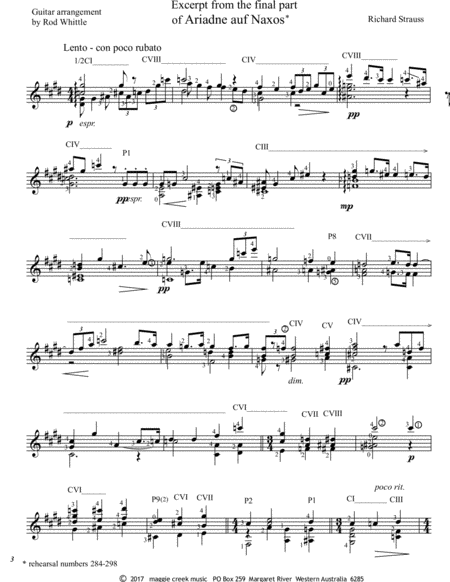
Excerpt from the Last Part of Ariadne Auf Naxos
Guitare

$7.00 5.92 € Guitare PDF SheetMusicPlus

Solo Guitar - Level 4 - Digital Download SKU: A0.899111 Composed by Richard Strauss. Arranged by Rod Whittle. 20th Century. Individual part. 2 pages. Maggie Creek Music #25793. Published by Maggie Creek Music (A0.899111). 2 pages; for solo classical guitar; published by Maggie Creek MusicRichard Strauss (1864 -1949) Strauss's music amounts to a huge body of symphonic and operatic work written over 60 years. Full of vitality, endlessly melodic, brilliantly orchestrated, it begins and ends in the romantic tradition, but for the most part expresses something more modern and individualistic, not without controversy in its time. Variation of style and structure is drawn from the descriptive (literary) nature of compositions, and an extraordinary inventiveness enlivens the scenes, moods and situations. Strauss said once that he produced music the way cows give milk, and indeed his music rarely seems contrived. The opera Strauss wrote 15 operas on a variety of subjects and across the whole spectrum of drama. He acknowledged being enchanted by the soprano voice, and his writing for it highlights many of the works, including Adriane auf Naxos (composed in 1912). The opera has been described as 'sparkling', which sums it up well, and passages influenced by Bach, Mozart, Puccini, and Wagner add to the interest. The storyline is a play within a play, the second part being the mythological 'Opera' staged in the story. The three pieces transcribed* are from this Opera. The guitar arrangements All classical guitar pieces are compromises. The instrument has only six strings, the left hand four fingers able to be used, and with the right hand its rare to use more than three fingers and the thumb. So, despite the amount of noise possible, it's inevitable that passages occur where either harmony, bass or fragments of counterpoint that would be beneficial are left out. In particular, the higher up the neck music is played the simpler it tends to be, if harder to play, and unless the low bass is an open string there wont be any. So I think the main part of attaining a fair transcription (better to be called an arrangement if the original musical structure is not strictly followed, as in this case) is determining how a good compromise can be reached. Melody, counterpoint, bass and main harmonies demand inclusion, and register is important. One may generally assume the original score can't be improved on. However, if the music may sound well on guitar, and the above elements can be incorporated without the playing becoming very difficult, something enjoyable to play and worthwhile listening to should be able to be achieved. Overture; 'A golden time …'Here the Mozart influence, better, inspiration, is wonderfully evident. A gentle waltz time (only the first section of the overture is transcribed) carries the colourful harmonies, strong melodic threads and connecting flourishes that stamp both pieces. The aria is alluded to in the Overture several times, which as you would expect, is intricately woven with the hints themes later to be established in the Opera. It has a kind of 'jazzy' freedom, and it's always miraculous to me that composition so involved can retain its musical line, here done in Strauss's inimitable way. The aria, sung not far into the Opera, has the perfect inevitability of Mozart, but again it is Strauss. As explained, keys have been changed to suit the guitar. Chorus and Aria This selection from the finale has features well worth trying to translate. The device of having a strong chorus, in the style of a Bach chorale, stated and then counterpointed by a solo voice in a restatement, is potent, and that in the opera the chorus (of the three nymphs) isn't immediately followed by the accompanying aria (of Ariadne) means the latter comes as a moment of surprising beauty. Neither parts are complicated, and lovely arpeggios, a feature Strauss's music, often impart the assured progressions. A problem was to capture the distinct register of the sopr.
Overture from Ariadne auf Naxos
Guitare

$7.00 5.92 € Guitare PDF SheetMusicPlus

Solo Guitar - Level 4 - Digital Download SKU: A0.899112 Composed by Richard Strauss. Arranged by Rod Whittle. 20th Century. Individual part. 2 pages. Maggie Creek Music #25789. Published by Maggie Creek Music (A0.899112). 2 pages; for solo classical guitar; published by Maggie Creek MusicRichard Strauss (1864 -1949) Strauss's music amounts to a huge body of symphonic and operatic work written over 60 years. Full of vitality, endlessly melodic, brilliantly orchestrated, it begins and ends in the romantic tradition, but for the most part expresses something more modern and individualistic, not without controversy in its time. Variation of style and structure is drawn from the descriptive (literary) nature of compositions, and an extraordinary inventiveness enlivens the scenes, moods and situations. Strauss said once that he produced music the way cows give milk, and indeed his music rarely seems contrived. The opera Strauss wrote 15 operas on a variety of subjects and across the whole spectrum of drama. He acknowledged being enchanted by the soprano voice, and his writing for it highlights many of the works, including Adriane auf Naxos (composed in 1912). The opera has been described as 'sparkling', which sums it up well, and passages influenced by Bach, Mozart, Puccini, and Wagner add to the interest. The storyline is a play within a play, the second part being the mythological 'Opera' staged in the story. The three pieces transcribed* are from this Opera. The guitar arrangements All classical guitar pieces are compromises. The instrument has only six strings, the left hand four fingers able to be used, and with the right hand its rare to use more than three fingers and the thumb. So, despite the amount of noise possible, it's inevitable that passages occur where either harmony, bass or fragments of counterpoint that would be beneficial are left out. In particular, the higher up the neck music is played the simpler it tends to be, if harder to play, and unless the low bass is an open string there wont be any. So I think the main part of attaining a fair transcription (better to be called an arrangement if the original musical structure is not strictly followed, as in this case) is determining how a good compromise can be reached. Melody, counterpoint, bass and main harmonies demand inclusion, and register is important. One may generally assume the original score can't be improved on. However, if the music may sound well on guitar, and the above elements can be incorporated without the playing becoming very difficult, something enjoyable to play and worthwhile listening to should be able to be achieved. Overture; 'A golden time …' Here the Mozart influence, better, inspiration, is wonderfully evident. A gentle waltz time (only the first section of the overture is transcribed) carries the colourful harmonies, strong melodic threads and connecting flourishes that stamp both pieces. The aria is alluded to in the Overture several times, which as you would expect, is intricately woven with the hints themes later to be established in the Opera. It has a kind of 'jazzy' freedom, and it's always miraculous to me that composition so involved can retain its musical line, here done in Strauss's inimitable way. The aria, sung not far into the Opera, has the perfect inevitability of Mozart, but again it is Strauss. As explained, keys have been changed to suit the guitar. Chorus and Aria This selection from the finale has features well worth trying to translate. The device of having a strong chorus, in the style of a Bach chorale, stated and then counterpointed by a solo voice in a restatement, is potent, and that in the opera the chorus (of the three nymphs) isn't immediately followed by the accompanying aria (of Ariadne) means the latter comes as a moment of surprising beauty. Neither parts are complicated, and lovely arpeggios, a feature Strauss's music, often impart the assured progressions. A problem was to capture the distinct register of the so.
'A golden time ...' from Ariadne auf Naxos
Guitare

$7.00 5.92 € Guitare PDF SheetMusicPlus

Solo Guitar - Level 4 - Digital Download SKU: A0.899109 Composed by Richard Strauss. Arranged by Rod Whittle. 20th Century. Individual part. 2 pages. Maggie Creek Music #25787. Published by Maggie Creek Music (A0.899109). 2 pages; for solo classical guitar; published by Maggie Creek MusicRichard Strauss (1864 -1949) Strauss's music amounts to a huge body of symphonic and operatic work written over 60 years. Full of vitality, endlessly melodic, brilliantly orchestrated, it begins and ends in the romantic tradition, but for the most part expresses something more modern and individualistic, not without controversy in its time. Variation of style and structure is drawn from the descriptive (literary) nature of compositions, and an extraordinary inventiveness enlivens the scenes, moods and situations. Strauss said once that he produced music the way cows give milk, and indeed his music rarely seems contrived. The opera Strauss wrote 15 operas on a variety of subjects and across the whole spectrum of drama. He acknowledged being enchanted by the soprano voice, and his writing for it highlights many of the works, including Adriane auf Naxos (composed in 1912). The opera has been described as 'sparkling', which sums it up well, and passages influenced by Bach, Mozart, Puccini, and Wagner add to the interest. The storyline is a play within a play, the second part being the mythological 'Opera' staged in the story. The three pieces transcribed* are from this Opera. The guitar arrangements All classical guitar pieces are compromises. The instrument has only six strings, the left hand four fingers able to be used, and with the right hand its rare to use more than three fingers and the thumb. So, despite the amount of noise possible, it's inevitable that passages occur where either harmony, bass or fragments of counterpoint that would be beneficial are left out. In particular, the higher up the neck music is played the simpler it tends to be, if harder to play, and unless the low bass is an open string there wont be any. So I think the main part of attaining a fair transcription (better to be called an arrangement if the original musical structure is not strictly followed, as in this case) is determining how a good compromise can be reached. Melody, counterpoint, bass and main harmonies demand inclusion, and register is important. One may generally assume the original score can't be improved on. However, if the music may sound well on guitar, and the above elements can be incorporated without the playing becoming very difficult, something enjoyable to play and worthwhile listening to should be able to be achieved. Overture; 'A golden time …' Here the Mozart influence, better, inspiration, is wonderfully evident. A gentle waltz time (only the first section of the overture is transcribed) carries the colourful harmonies, strong melodic threads and connecting flourishes that stamp both pieces. The aria is alluded to in the Overture several times, which as you would expect, is intricately woven with the hints themes later to be established in the Opera. It has a kind of 'jazzy' freedom, and it's always miraculous to me that composition so involved can retain its musical line, here done in Strauss's inimitable way. The aria, sung not far into the Opera, has the perfect inevitability of Mozart, but again it is Strauss. As explained, keys have been changed to suit the guitar. Chorus and Aria This selection from the finale has features well worth trying to translate. The device of having a strong chorus, in the style of a Bach chorale, stated and then counterpointed by a solo voice in a restatement, is potent, and that in the opera the chorus (of the three nymphs) isn't immediately followed by the accompanying aria (of Ariadne) means the latter comes as a moment of surprising beauty. Neither parts are complicated, and lovely arpeggios, a feature Strauss's music, often impart the assured progressions. A problem was to capture the distinct register o.
Chorus and Aria from Ariadne auf Naxos
Guitare

$7.00 5.92 € Guitare PDF SheetMusicPlus

Solo Guitar - Level 4 - Digital Download SKU: A0.1271506 By Cher. By Burt Bacharach and Hal David. Arranged by John Fries. 20th Century,Film/TV,Jazz,Standards. Individual part. 2 pages. John Fries #863904. Published by John Fries (A0.1271506). Please contact me by email at jfries@ptd.net to make a special request or to find out all that I have to offer and to express your comments or concerns. Thanks, John.  Alfie is a song written by Burt Bacharach and Hal David to promote the 1966 film Alfie. Cilia Black states that, rather than declining outright to record the song, she decided to set conditions: I said I'd only do it if Burt Bacharach himself did the arrangement, never thinking for one moment that he would. When the reply came back from America that he'd be happy to...I said I would only do it if Burt came over to London for the recording session. 'Yes,' came the reply. Next I said that as well as the arrangements and coming over, he had to play piano on the session. To my astonishment it was agreed that Burt would do all three. So by this time, coward that I was, I really couldn't back out. The song was a major hit for Cilla Black (UK) and Dionne Warwick (US).
Alfie
Guitare
Cher
$4.99 4.22 € Guitare PDF SheetMusicPlus


Partitions Gratuites
Acheter des Partitions Musicales
Acheter des Partitions Digitales à Imprimer
Acheter des Instruments de Musique

© 2000 - 2026

Accueil - Version intégrale





