EUROPE
553 articles
USA
0 articles
DIGITAL
12 articles (à imprimer)
Partitions Digitales
Partitions à imprimer
12 partitions trouvées


E-Flat Clarinet,Piano - Level 3 - Digital Download SKU: A0.549379 Composed by George Frideric Handel. Arranged by James M. Guthrie, ASCAP. Baroque,Sacred,Standards,Wedding. Score and part. 9 pages. Jmsgu3 #3492251. Published by jmsgu3 (A0.549379). Duration: 4:55, Score: 6 pages, Solo part: 1 page, piano part: 2 pages. A very famous aria (Ombra mai fu) from XerxesSuitable for any venue requiring meditative music. Excellent choice for a recital encore. Xerxes Xerxes is, in fact, an opera seria in three acts by Handel. Moreover, Handel conducted the premiere performance in London in 1738. Handel casts the opera in Persia in 470 BC. The part of Xerxes was indeed originally sung by a soprano castrato. Nowadays, the part is generally sung by a mezzo-soprano or conversely a counter-tenor. In the first place, Xerxes sings an opening aria, Ombra mai fu to a plane tree. Handel sets this aria to one of his most truly famous melodies. Although many refer to it traditionally as Handel’s Largo, Handel has, on the contrary, clearly marked Larghetto in the score. Handel Background George Frideric Handel (1685 - 1759) was born in Germany but eventually became a British citizen. Nonetheless, he was a famous Baroque composer. In fact, he became famous for his operas, oratorios, anthems, and organ concertos. Handel studied music and, by and large, worked as a composer in Germany and Italy before moving to London. On the whole, Handel was very familiar with the contemporary music of Italy and Germany. Career in England It is essential to realize that Italian opera was all the rage in England at the time. Moreover, Handel was really good at writing them. Therefore, he started not one but three opera companies in England. Alexander's Feast was a huge success in 1736, but Handel began composing English choral works. After success with the Messiah in 1742) he certainly never again wrote an Italian opera. Consequently, he died in 1759, a treasured genius. Accordingly, the English government gave him full state honors at his funeral. Hence, he is buried in Westminster Abbey in London. Legacy Music historians agree that Handel was in general one of the greatest composers of the Baroque era.  To demonstrate, his works such as the Messiah, Water Music, and Music for the Royal Fireworks remain consistently popular up to the present time. He especially composed the coronation anthem, Zadok the Priest for the coronation of George II. Nevertheless, it has specifically been performed at every succeeding British coronation since. His oratorio Solomon has by all means also continued to be prevalent. As a matter of fact, Sinfonia from act 3 was featured in the 2012 London Olympics opening ceremony. Handel was particularly prolific. To enumerate, he wrote over forty operas.  Since the late 1960s, we have expressly experienced a revival of baroque music. Similarly, we have especially seen a pique of interest in historically informed musical performances. Since his death in 1779, interest in Handel's music has all in all, expanded.  
Handel: Largo from Xerxes for Alto Clarinet & Piano
Clarinette

$32.95 28.31 € Clarinette PDF SheetMusicPlus

E-Flat Clarinet,Piano - Level 2 - Digital Download SKU: A0.549849 Composed by Johann Sebastian Bach. Arranged by James M. Guthrie, ASCAP. Baroque,Concert,Easter,Sacred,Standards. Score and part. 12 pages. Jmsgu3 #3555017. Published by jmsgu3 (A0.549849). Wachet auf, ruft uns die Stimme (Awake, the voice is calling us) from Cantata BWV 140. Duration: ca. 4:00, Score: 6 pages, solo part 1 page, piano part: 4 pages. Program this for church services during the Easter season, weddings, or as a recital encore. www.jamesguthrie.comWachet auf, ruft uns die Stimme (Awake, the Voice is calling us) also known as: Sleepers Awake Bach composed his church cantata Wachet auf (BWV 140) as part of his second annual cantata cycle covering the entire annual church calendar. It is based on the hymn of the same name by Philipp Nicolai (1599). The hymn text covers the readings for the 27th Sunday after Trinity. Bach designed the cantata in seven movements, setting the stanzas in various forms. Among these forms are the chorale fantasia, the chorale prelude, and a four-part chorale. He casts the new lyrics as recitatives – in a manner similar to the opera. Fourth Movement Bach writes the fourth movement, Zion hört die Wächter singen (Zion hears the watchmen singing), in the style of a chorale prelude with the chorale phrases performed as a strict cantus firmus. The phrases seem to enter at times erratically against the famous lyrical melody. The violins play this melody in unison as a foil against the cantus phrases. The violin melody is so independent and complete that when the cantus melody appears it catches the listener at times totally off-guard. Bach later transcribed this movement for organ (BWV 645). This transcription became No. 1 of the Six Schübler Chorales. Bach Overview First of all, Johann Sebastian Bach is maybe the greatest composer in music history. Certainly, he was prolific. As a result, everyone has heard of his works. Furthermore, these works number well over a thousand. It seems like people are probably most familiar with the instrumental works such as the Brandenburg Concertos, and the Goldberg Variations. But, similarly famous are such noteworthy works as the Well-Tempered Clavier, the Musical Offering, and certainly the Art of Fugue. Seems like his most famous vocal works include the most noteworthy Mass in B Minor. Also, most noteworthy, though, are the St. John Passion, and certainly the Christmas Oratorio.  History Bach came from a long line of musicians and above all, composers. Consequently, he, first of all, pursued a career as a church organist. So as a result, he gained employment in various Protestant churches in Germany. For a while, he worked as a court musician in Weimar and Köthen. Here he probably developed his organ style and likewise his chamber music style. Eventually, he, therefore, gained an appointment as Cantor of St. Thomas in Leipzig. Here he worked until difficulties with his employer ultimately drove him away. The King of Poland finally appointed him as court composer.  Style It seems like Bach created a fascinating new international style. He synthesized elements of the most noteworthy European music ideas into his new style. Even more, this new style was probably his synthesis of European musical rhythm and form. Furthermore, he demonstrated a complete mastery of counterpoint and motivic development. His sense of harmonic organization probably propelled him to the top. Revival               Mendelssohn conducted a Bach revival in the nineteenth century. His effort probably helped to re-familiarize the public with the magnitude of Bach’s works. During this period, scholars published many noteworthy Bach biographies. Moreover, Wolfgang Schmieder published the BWV (Bach Werke Verzeichnis). As a result, this is now the official catalog of his entire artistic output. The BWV number allows us to locate a work in the catalog. Sometimes scholars will simply use an S (Schmieder) as an abbreviation.
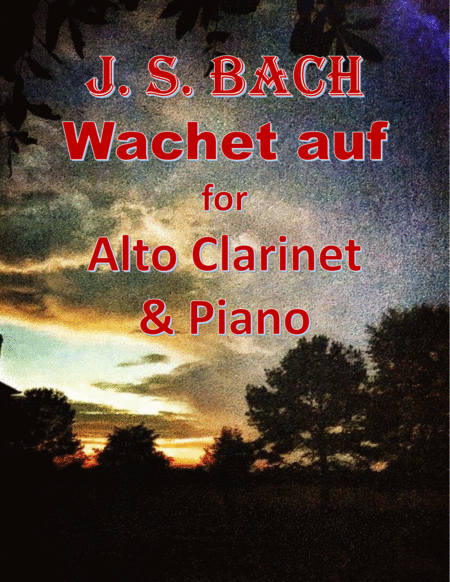
Bach: Wachet auf for Alto Clarinet & Piano
Clarinette

$24.95 21.43 € Clarinette PDF SheetMusicPlus

E-Flat Clarinet,Piano - Level 1 - Digital Download SKU: A0.548683 Composed by Adam. Arranged by James M. Guthrie, ASCAP. Christian,Christmas. Score and part. 10 pages. Jmsgu3 #3410473. Published by jmsgu3 (A0.548683). Duration: 4:56. Score 5 pg. 44 ms. Solo part: 2 pg. Piano part: 3 pg.Cantique de Noël The French composer Adolphe Adam was already famous as a composer of many successful ballets and operas. Then, in the 1840’s he wrote his most famous work - O Holy Night. The original song title was Minuit Chretiens or Cantique de Noël.  Placide Cappeau provided the original song lyrics. The song was first performed in Roquemaure by the opera singer Emily Laurey at midnight mass in 1847. It became very popular among the French, much the way that Silent Night was famous elsewhere. In the 1850’s John S. Dwight, a Unitarian minister and music teacher translated the song into English.   Adolphe Adam In his younger years, Adam studied organ and composition at the Paris Conservatoire. He also played the timpani in the Conservatoire orchestra. Adam used his savings and borrowed money to open a new opera house - the fourth opera house in Paris in 1847. Unfortunately, the Revolution of 1848 forced him to close. He taught composition at the Paris Conservatoire from 1849 until his death in 1856. Placide Cappeau The poet Cappeau was an advocate of the French Enlightenment philosopher Voltaire.  Voltaire was renowned for criticizing the Catholic church, religious intolerance, and dogma in general. Consequently, Cappeau made the Redeemer figure in his song a kind of reformer of injustices, in particular, the problem of original sin. To begin with, people recognized Cappeau’s theology as eccentric, probably even doubtful. Theology In the earlier form of Minuit, the Christ figure descends to intervene with His Father’s plan to punish mankind.  Traditional doctrine pronounces that Christ came from love, not to intervene. This version also declares that Christ appeared to expunge the original sin of Adam. Cappeau removed this part from him poem years later, because he just didn’t believe it.  He preferred to portray Christ as the reformer of disparity and unfairness. Before long, the writer/politician Alphonse de Lamartine referred to the Minuit as the the Marseillaise of religion. Most French churchmen agreed with this idea but certainly did not consider it a tribute.  Register for free lifetime updates and revisions at www.jamesguthrie.com
O Holy Night for Alto Clarinet & Piano
Clarinette

$24.95 21.43 € Clarinette PDF SheetMusicPlus

E-Flat Clarinet,Piano - Level 2 - Digital Download SKU: A0.1050529 Composed by G.Puccini. Arranged by Raymond Fenech. Christmas,Easter,Opera,Romantic Period,Wedding. Score and part. 10 pages. Raymond Fenech #654897. Published by Raymond Fenech (A0.1050529). O mio babbino caro (Oh my dear Papaâ€) is an aria from the opera Gianni Schicchi (1918) by Giacomo Puccini to a libretto by Giovacchino Forzano. It is sung by Lauretta after tensions between her father Schicchi and the family of Rinuccio, the boy she loves, have reached a breaking point that threatens to separate her from Rinuccio. It provides an interlude expressing lyrical simplicity and love in contrast with the atmosphere of hypocrisy, jealousy, double-dealing, and feuding in medieval Florence. It provides the only set-piece in the through-composed opera. This Aria is arranged by Raymond Fenech The duration is 3.21 minutes and it is an Intermediate level piece.
O Mio Babbino Caro - G.Puccini - Eb Clarinet and Piano
Clarinette

$3.99 3.43 € Clarinette PDF SheetMusicPlus

Clarinet Solo - Level 3 - Digital Download SKU: A0.730264 Composed by James Nathaniel Holland. Contemporary,Holiday,Love,Sacred,Wedding. Individual part. 5 pages. James Nathaniel Holland #1910777. Published by James Nathaniel Holland (A0.730264). Arranged for Bb Clarinet solo and Orchestra Reduction Piano Accompaniment (Duration: 5:12) Enjoy playing this beautiful Pas de Deux from James Nathaniel Holland's ballet The Satyricon Meditative and relaxing, a nice addition to cafe music repertoire, weddings and special music for religious services. Originally written for viola, violin and orchestra. Piano full score and part included. Full score is in concert pitch. James Nathaniel Holland is an American classical music composer of operas, symphonies, ballets, songs, and other musical concertworks that incorporate a unique, eclectic, blend of romantic, classical, world and jazz styles. From 2005 he moved to Costa Rica where he organized concerts with visiting guest artists to present his chamber music to the public. Presently he lives in a castle in the central mountains of Costa Rica. Website: http://www.lacoronadelossantos.net/jamesnathanielholland.html YouTube Channel: https://www.youtube.com/user/composerjnholland
Pas de Deux from The Satyricon Ballet Bb Clarinet and Piano
Clarinette

$3.95 3.39 € Clarinette PDF SheetMusicPlus

Clarinet and piano - intermediate to advanced - Digital Download SKU: S9.Q53273 Air favori de l’opéra La muette de Portici de D.F.E. Auber. Composed by Christian Rummel. Edited by Rainer Mohrs and Rudolf Mauz. This edition: Sheet music. (c) 2020 Schott Music GmbH & Co. KG, Mainz. Classical. Downloadable. 12 pages. Schott Music - Digital #Q53273. Published by Schott Music - Digital (S9.Q53273). German • Danish.Christian Rummel (also Chrétien Rummel), music educator, pianist, clarinettist, violinist and composer, was born in Gollachostheim, Franconia (Germany). He received his musical education in Mannheim. Rummel first worked as a military band director. Following his military career, he moved to Wiesbaden as he was offered a position as a music teacher there. Later he directed the court orchestra in Biebrich and following its dissolution, he directed the Wiesbaden theatre orchestra. On the occasion of a visit to Vienna, the publishers Schott recommended him to Ludwig van Beethoven (letter of 19th April 1824), with the request for ‘friendship and good will‘. He is said to have had an ‘urge for perfection through studying composition‘. This Schlummerlied is dedicated to Baron Breidbach-Bürresheim. The melody comes from the opera ‘La muette de Portici (The mute girl of Portici) by the composer Daniel-François-Esprit Auber (1782–1871), which was first performed at the Paris Opera House in 1828. The setting is a fishing village near Naples. The plot revolves around love, marriage, revolt against the Spanish occupying forces and, as if that were not enough, the volcano Vesuvius erupts at the end. The piece was published by Schott in 1832 (plate number 3733).
Schlummerlied
Clarinette

$3.99 3.43 € Clarinette PDF SheetMusicPlus

Clarinet and piano - intermediate to advanced - Digital Download SKU: S9.Q53283 Six Duos de Salon, No. 5. Composed by Jacques Gregoir. Edited by Rainer Mohrs and Rudolf Mauz. Arranged by Hubert Leonard and J. Blaes. This edition: Sheet music. (c) 2020 Schott Music GmbH & Co. KG, Mainz. Classical. Downloadable. 9 pages. Schott Music - Digital #Q53283. Published by Schott Music - Digital (S9.Q53283). German • Danish.Joseph Jacques-Mathieu Gregoir (also Grégoir) was a pianist, conductor and composer. When he was young he went from Antwerp to Paris for piano lessons. He then studied with Christian Rummel in Biebrich near Wiesbaden and worked mainly in Brussels. His work includes compositions for piano, chamber music, symphonies and an opera. This edition is based on the Duos concertantes for violin and piano by J. Gregoir and Hubert Léonard (1819– 1890, violinist and Professor in Brussels) from the 1850s (see Hofmeister, Handbuch der musikalischen Literatur 1852–59). The edition for clarinet is by Joseph Blaes (1814–1892), clarinettist in Brussels. Three pieces have been selected: Chant de Mai (No. 2), Le Bal (No. 3), Sur l’eau (No. 5), all were published in 1858 (plate number 14614).
Sur l’eau
Clarinette

$3.99 3.43 € Clarinette PDF SheetMusicPlus

Clarinet and piano - intermediate to advanced - Digital Download SKU: S9.Q53282 Six Duos de Salon, No. 3. Composed by Jacques Gregoir. Edited by Rainer Mohrs and Rudolf Mauz. Arranged by Hubert Leonard and J. Blaes. This edition: Sheet music. (c) 2020 Schott Music GmbH & Co. KG, Mainz. Classical. Downloadable. 10 pages. Schott Music - Digital #Q53282. Published by Schott Music - Digital (S9.Q53282). German • Danish.Joseph Jacques-Mathieu Gregoir (also Grégoir) was a pianist, conductor and composer. When he was young he went from Antwerp to Paris for piano lessons. He then studied with Christian Rummel in Biebrich near Wiesbaden and worked mainly in Brussels. His work includes compositions for piano, chamber music, symphonies and an opera. This edition is based on the Duos concertantes for violin and piano by J. Gregoir and Hubert Léonard (1819– 1890, violinist and Professor in Brussels) from the 1850s (see Hofmeister, Handbuch der musikalischen Literatur 1852–59). The edition for clarinet is by Joseph Blaes (1814–1892), clarinettist in Brussels. Three pieces have been selected: Chant de Mai (No. 2), Le Bal (No. 3), Sur l’eau (No. 5), all were published in 1858 (plate number 14614).
Le Bal
Clarinette

$3.99 3.43 € Clarinette PDF SheetMusicPlus

Clarinet and piano - intermediate to advanced - Digital Download SKU: S9.Q53281 Six Duos de Salon, No. 2. Composed by Jacques Gregoir. Edited by Rainer Mohrs and Rudolf Mauz. Arranged by Hubert Leonard and J. Blaes. This edition: Sheet music. (c) 2020 Schott Music GmbH & Co. KG, Mainz. Classical. Downloadable. 9 pages. Schott Music - Digital #Q53281. Published by Schott Music - Digital (S9.Q53281). German • Danish.Joseph Jacques-Mathieu Gregoir (also Grégoir) was a pianist, conductor and composer. When he was young he went from Antwerp to Paris for piano lessons. He then studied with Christian Rummel in Biebrich near Wiesbaden and worked mainly in Brussels. His work includes compositions for piano, chamber music, symphonies and an opera. This edition is based on the Duos concertantes for violin and piano by J. Gregoir and Hubert Léonard (1819– 1890, violinist and Professor in Brussels) from the 1850s (see Hofmeister, Handbuch der musikalischen Literatur 1852–59). The edition for clarinet is by Joseph Blaes (1814–1892), clarinettist in Brussels. Three pieces have been selected: Chant de Mai (No. 2), Le Bal (No. 3), Sur l’eau (No. 5), all were published in 1858 (plate number 14614).
Chant de Mai
Clarinette

$3.99 3.43 € Clarinette PDF SheetMusicPlus


Partitions Gratuites
Acheter des Partitions Musicales
Acheter des Partitions Digitales à Imprimer
Acheter des Instruments de Musique

© 2000 - 2026

Accueil - Version intégrale





