EUROPE
57 articles
USA
2 articles
DIGITAL
7 articles (à imprimer)
Partitions Digitales
Partitions à imprimer
7 partitions trouvées


Double bass clarinet or bass clarinet solo - difficult - Digital Download SKU: S9.Q6998 Composed by Benjamin Schweitzer. This edition: Sheet music. Clarinet Library. Downloadable. Duration 9 minutes. Schott Music - Digital #Q6998. Published by Schott Music - Digital (S9.Q6998). Maverick I [noise] is the first piece in a five-part series of solo compositions for double-bass instruments. The subtitle 'noise' points to the fact that the composition is pervaded by numerous noise-like elements - from extremely low windage noise to distorted multiphonics. However, the piece is not only noise-like, it rather contains musical elements, such as multiphonics, repetitions and stationary tones, that gradually develop from the 'overloaded' beginning, with hard cuts and harsh sounds still determining the uncompromising character of the piece.
maverick I (noise)
Clarinette

$11.99 10.14 € Clarinette PDF SheetMusicPlus

E-Flat Clarinet,Piano - Level 3 - Digital Download SKU: A0.549712 Composed by Peter Ilyich Tchaikovsky. Arranged by James M. Guthrie, ASCAP. Children,Christmas,Romantic Period,Standards. Score and part. 15 pages. Jmsgu3 #3530309. Published by jmsgu3 (A0.549712). Duration: ca. 58, score: 9 pages, solo part: 2 pages, piano part: 3 pages.This piece would be a perfect recital encore - short, energetic - leave your audience wanting more. Also, program this for your Christmas pageant. Pyotr Ilyich Tchaikovsky Tchaikovsky is probably the most popular of the great composers in America. His music certainly appeals to musicians. Likewise, it appeals even to folks who don’t normally listen to serious music. This is probably because of his most noteworthy melodies. Above all, he writes with great emotion. This certainly makes a most noteworthy if not an unforgettable impact. Education First of all, He attended classes at the Russian Musical Society. Even more, He also attended the St. Petersburg Conservatory. There he studied music theory with Nikolai Zaremba. He also consequently studied composition with Anton Rubenstein. It seems like Rubenstein came under criticism from a group of Russian composers known as the Five. The Five The Five certainly rejected Western musical influences. They rather sought to use elements from Russian music. They furthermore wanted to use more exotic musical materials. Western Techniques More than other Russian composers, Tchaikovsky studied modern Western music. He certainly develops his music like the European masters. So, rather than repeating a motive, he moves to a new key. He then introduces a different theme in the new key. Hence, he maintained his independence from the Five. Even more, he became the first Russian composer of international stature. Influences Tchaikovsky was probably influenced in his ballet scoring by Léo Delibes. Richard Wagner influenced his symphonic writing. Tchaikovsky’s most famous works include the 1812 Overture, The Nutcracker Suite, and Swan Lake. Also famous are the Violin Concerto in D and the six symphonies. The greatest of the six symphonies may be No. 6, the Pathétique. Nutcracker Suite, Op. 71a The Nutcracker Suite is a ballet that was performed for the first time in December 1892 in St. Petersburg. To begin with, the original ballet failed to attract a positive reception. However, the ballet suite became probably one of the most popular of all of Tchaikovsky’s works. The ballet suite became even more famous in the 1960s. It is now performed all over the world, particularly during the Christmas season.
Tchaikovsky: Russian Dance from Nutcracker Suite for Alto Clarinet & Piano
Clarinette

$32.95 27.86 € Clarinette PDF SheetMusicPlus

E-Flat Clarinet,Piano - Level 3 - Digital Download SKU: A0.549690 Composed by Peter Ilyich Tchaikovsky. Arranged by James M. Guthrie, ASCAP. Children,Christmas,Romantic Period,Standards. Score and part. 14 pages. Jmsgu3 #3520445. Published by jmsgu3 (A0.549690). Duration: ca. 1:42, 52 measures, Score: 7 pages, solo part: 2 pages, piano part: 4 pages. A popular Christmas favorite from Tchaikovsky's Nutcracker Suite. Pyotr Ilyich Tchaikovsky Tchaikovsky is probably the most popular of the great composers in America. His music certainly appeals to musicians. Likewise, it appeals even to folks who don’t normally listen to serious music. This is probably because of his most noteworthy melodies. Above all, he writes with great emotion. This certainly makes a most noteworthy if not an unforgettable impact. Education First of all, He attended classes at the Russian Musical Society. Even more, He also attended the St. Petersburg Conservatory. There he studied music theory with Nikolai Zaremba. He also consequently studied composition with Anton Rubenstein. It seems like Rubenstein came under criticism from a group of Russian composers known as the Five. The Five The Five certainly rejected Western musical influences. They rather sought to use elements from Russian music. They furthermore wanted to use more exotic musical materials. Western Techniques More than other Russian composers, Tchaikovsky studied modern Western music. He certainly develops his music like the European masters. So, rather than repeating a motive, he moves to a new key. He then introduces a different theme in the new key. Hence, he maintained his independence from the Five. Even more, he became the first Russian composer of international stature. Influences Tchaikovsky was probably influenced in his ballet scoring by Léo Delibes. Richard Wagner influenced his symphonic writing. Tchaikovsky’s most famous works include the 1812 Overture, The Nutcracker Suite, and Swan Lake. Also famous are the Violin Concerto in D and the six symphonies. The greatest of the six symphonies may be No. 6, the Pathétique. Nutcracker Suite, Op. 71a The Nutcracker Suite is a ballet that was performed for the first time in December 1892 in St. Petersburg. To begin with, the original ballet failed to attract a positive reception. However, the ballet suite became probably one of the most popular of all of Tchaikovsky’s works. The ballet suite became even more famous in the 1960s. It is now performed all over the world, particularly during the Christmas season.
Tchaikovsky: Dance of the Sugar-Plum Fairy from Nutcracker Suite for Alto Clarinet & Piano
Clarinette

$32.95 27.86 € Clarinette PDF SheetMusicPlus

E-Flat Clarinet,Piano - Level 3 - Digital Download SKU: A0.549758 Composed by Peter Ilyich Tchaikovsky. Arranged by James M. Guthrie, ASCAP. Children,Christmas,Romantic Period,Standards. Score and part. 17 pages. Jmsgu3 #3533255. Published by jmsgu3 (A0.549758). Duration: ca. 3:15 Score: 10 pages, solo part: 2 pages, piano part: 4 pages. Tchaikovsky paints a very mysterious mood in this favorite masterpiece from the Nutcracker Suite. It is also a traditional Christmas favorite. Pyotr Ilyich Tchaikovsky Tchaikovsky is probably the most popular of the great composers in America. His music certainly appeals to musicians. Likewise, it appeals even to folks who don’t normally listen to serious music. This is probably because of his most noteworthy melodies. Above all, he writes with great emotion. This certainly makes a most noteworthy if not an unforgettable impact. Education First of all, He attended classes at the Russian Musical Society. Even more, He also attended the St. Petersburg Conservatory. There he studied music theory with Nikolai Zaremba. He also consequently studied composition with Anton Rubenstein. It seems like Rubenstein came under criticism from a group of Russian composers known as the Five. The Five The Five certainly rejected Western musical influences. They rather sought to use elements from Russian music. They furthermore wanted to use more exotic musical materials. Western Techniques More than other Russian composers, Tchaikovsky studied modern Western music. He certainly develops his music like the European masters. So, rather than repeating a motive, he moves to a new key. He then introduces a different theme in the new key. Hence, he maintained his independence from the Five. Even more, he became the first Russian composer of international stature. Influences Tchaikovsky was probably influenced in his ballet scoring by Léo Delibes. Richard Wagner influenced his symphonic writing. Tchaikovsky’s most famous works include the 1812 Overture, The Nutcracker Suite, and Swan Lake. Also famous are the Violin Concerto in D and the six symphonies. The greatest of the six symphonies may be No. 6, the Pathétique. Nutcracker Suite, Op. 71a The Nutcracker Suite is a ballet that was performed for the first time in December 1892 in St. Petersburg. To begin with, the original ballet failed to attract a positive reception. However, the ballet suite became probably one of the most popular of all of Tchaikovsky’s works. The ballet suite became even more famous in the 1960s. It is now performed all over the world, particularly during the Christmas season.
Tchaikovsky: Arabian Dance from Nutcracker Suite for Alto Clarinet & Piano
Clarinette

$32.95 27.86 € Clarinette PDF SheetMusicPlus

A Clarinet Solo,B-Flat Clarinet Solo - Digital Download SKU: A0.1309185 Composed by Jason Alder. 20th Century,21st Century,Instructional. Individual part. 18 pages. AMA Editions #898359. Published by AMA Editions (A0.1309185). This is the newly updated 3rd Edition of the most comprehensive fingering chart for clarinet. The 2nd Edition became widely popular and used by clarinetists around the world, and this new 3rd Edition adds 127 fingerings for a total offering of over 300 fingerings through four and a half octaves in quarter-tones for clarinet, from written E3 to A7.Author's Notes:Ten years have passed since releasing the 2nd Edition of my Bass Clarinet Quarter-Tone Fingering Charts, which coincided with the first release of a chart for soprano clarinet. I’m now already on the 3rd Edition of both the clarinet and bass clarinet charts, which are being released simultaneously, following the recent release of a compilation of three separate charts for Leblanc, Selmer, and Eppelsheim contrabass clarinets.The first obvious change in the 3rd Edition is to the title. I have added Altissimo to better reflect that these charts are not only useful for their quarter-tones, but also for their stratospheric range. The charts have also had a formatting revision and are now being published through AMA Editions, available in print as well as digital forms.The next big change is the addition of 127 quarter-tone and altissimo fingerings, and some corrections and revisions to the existing ones. With these revisions come some new notations of the diagrams. One of these is the use of grey-colored keys, first used in the contrabass clarinet charts, to indicate keys which may be added to help tuning, response, and/or resonance. Rather than creating a new diagram for every possible combination, I thought it would be more effective to show the fundamental fingering in black, with the grey keys as possible additions dependent on what works best for a player and their instrument.
Clarinet Quarter-Tone & Altissimo Fingering Chart
Clarinette

$9.00 7.61 € Clarinette PDF SheetMusicPlus

Clarinet Solo - Level 4 - Digital Download SKU: A0.1018946 Composed by Benjamin Harry Sajo. 20th Century,Contemporary. Individual part. 1 pages. Benjamin Sajo #6078675. Published by Benjamin Sajo (A0.1018946). Programme Notes: This composition was written to be considered for pairing alongside Ludwig van Beethoven’s Symphony #3, the Eroica, but can stand on its own virtues as an intense and slow meditation on heroism. The music is like a boiling pot on the stove that’s just began to overflow its bubbles. The first part of the title, kommos, is a Classical Greek term from Attic dramaturgy, literally meaning striking but specifically referring to beating oneself up during lamentation--ripping at the hair, gouging out the eyes--like Oedipus--slapping the forehead, and other acts amid moments of extreme emotional turmoil. For example, from Aeschylus's play Agamemnon, a character bewails: Apollo, Apollo! God of the Ways, my destroyer! For you have destroyed me-and utterly [...]What is this fresh woe [...]what monstrous, monstrous horror, beyond love's enduring, beyond all remedy? And help stands far away! We can easily imagine physical accompaniment to the script; rather than bottling up the pain, the hero lets it all explosively come out.  â€ƒThe second part of the title, When the world moved on, is an epigraph taken from American author Stephen King’s The Dark Tower epic. The primary setting of the novel, a world similar in many ways to our own, is experiencing a dark age where the glorious past is all but a distant memory and all good things are referred to wistfully as occurring, When the world moved on. Yet, the main protagonist, Roland, the last gunslinger, emphasizes that it is not just a figure of speech, but the literal distances between destinations have increased, the positions of the stars have changed, as well as the occurrence of other unnatural phenomena. The world has become a gulf of isolation from all corners. Taken together, this piece is a lamentation for when the world moved on. Truly completed on Yom Kippur during the Covid-19 Pandemic, being unable to fast or go to synagogue, this is my atonement.About the Composer: Benjamin Sajo (b. 1988) is a Canadian composer of contemporary classical music, as well as an educator. Since developing a fiercely independent creative voice upon the completion of his studies at Western (2010) and McGill Universities (2013), he continues to find inspiration from the intersection of mythology, art, and nature upon the contemporary human experience. In 2019, he released his premiere album of original music, The Great War Sextet: Canadian War Poetry with Trombone & Strings, with support from the Ontario Arts Council. He is a member of SOCAN and the League of Canadian Composers.
Kommos (Lamentation) / "When the World Moved On" - Clarinet 1 in Bb
Clarinette

$3.50 2.96 € Clarinette PDF SheetMusicPlus

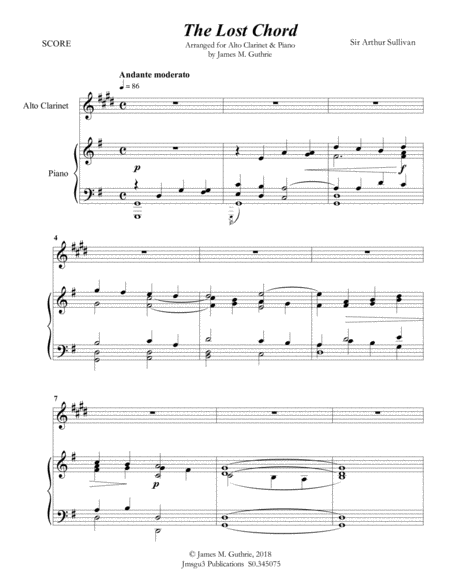
E-Flat Clarinet,Piano - Level 4 - Digital Download SKU: A0.549450 Composed by Sir Arthur Seymour Sullivan. Arranged by James M. Guthrie, ASCAP. Instructional,Romantic Period,Sacred,Standards. Score and part. 15 pages. Jmsgu3 #3497161. Published by jmsgu3 (A0.549450). Score: 10 pages, solo part: 2 pages, piano part: 3 pages. Duration: 4:25. Not difficult, but requires sensitivity & dynamic control. Suitable for recitals, church meditations, or school programs.  School Years First of all, Sullivan attended music school at the Royal Academy of Music. Because Sullivan was so talented, the Academy awarded him the Mendelssohn Scholarship for two years in a row. He, therefore, studied with John Goss, who studied with Thomas Atwood, who in turn studied with Mozart. Sullivan similarly studied the piano at the Academy with Arthur O’Leary. Study Abroad During his first year, he also earned money by singing solos in the Chapel Royal. At the end of his second year, the Academy consequently continued his scholarship and sent him to study at the Leipzig Conservatoire. He certainly studied composition, and likewise counterpoint and piano. Hence, during his final year in Leipzig, Sullivan finally completed his graduation composition project: Incidental Music for Shakespeare’s The Tempest. Association with Gilbert It seems like Sullivan built the bulk of his composing career largely in the 1860s. As a result, he became famous for his incidental music for the Tempest and his Irish Symphony. He, therefore, began collaborating with the poet W. S. Gilbert in the 1870s. Rather than focus on serious opera, Gilbert and Sullivan, in contrast, concentrated on comic opera such as H. M. S. Pinafore, the Pirates of Penzance, and the Mikado. Therefore, certainly as a result of his education and experience, Sullivan composed a total of 24 operas, 11 symphonic works, 10 choral pieces. Even more, he wrote a large number of noteworthy hymns such as Onward Christian Soldiers. The general style of his music is maybe similar to Mendelssohn, Schumann, and perhaps Liszt. It seems like Sullivan was fond of writing distinct melodies for each character in his operettas. His melodies combine together as the characters did. Furthermore, he was a master orchestrator, and therefore played the flute, clarinet, trumpet, and trombone fluently. The Lost Chord Sullivan wrote his most noteworthy song the Lost Chord in 1877. As a result, it was a great success and was certainly performed all over the world by a variety of singers such as Enrico Caruso. Because Sullivan was the most famous composer in England, the Lost Chord became the most famous of all British or American songs of the 1870s and 1890s. Consequently, in 1888 Thomas Edison recorded The Lost Chord for the phonograph. It was one of the first songs ever recorded. Furthermore, Queen Victoria knighted Sullivan in 1883.  
Sullivan: The Lost Chord for Alto Clarinet & Piano
Clarinette

$26.95 22.79 € Clarinette PDF SheetMusicPlus


Partitions Gratuites
Acheter des Partitions Musicales
Acheter des Partitions Digitales à Imprimer
Acheter des Instruments de Musique

© 2000 - 2026

Accueil - Version intégrale