EUROPE
11 articles
USA
0 articles
DIGITAL
188 articles (à imprimer)
Partitions Digitales
Partitions à imprimer
188 partitions trouvées

1 16 31 ....181

Concert Band - Digital Download SKU: A0.1270296 By David Catherwood. By Traditional English tunes. Arranged by David Catherwood. Christmas,Holiday. Score and Parts. 55 pages. Opus 3 Music #862730. Published by Opus 3 Music (A0.1270296). Suite - 3 Lyrical English Christmas Carols1) God Rest Ye Merry Gentlemen2) O Little Town of Bethlehem3) The First NowellThese 3 traditional English carols may be performed separately, used to accompany singing or put together as above to form an effective concert item  Perfect for Holiday concerts, Christmas carol services or Community concerts!The generous set of parts contains parts for varying combinations and ensembles , including Concert band, Brass band and Orchestra. The download includes a full score in C and the follwing parts (with permission to copy to suit your own requirements)Part 1 in C (Oboe, Flute, Violin 1)Part 1 in Bb (Clarinet 1 in Bb, Trumpet/Cornet 1 in Bb) *Part 2 in C (Violin 2)Part 2 in Bb (Clarinet 2 in Bb, Trumpet/Cornet 2 in Bb) *Part 2 in Eb (Alto Saxophone, Eb Horn 1) *Part 2 in F (French Horn)Part 3 in C (Bassoon 1, Trombone)Part 3 in Eb (Alto Saxophone, Eb Horn 2) *Part 3 in alto clef (Viola)Part 3 in F (French Horn)Part 3 in Bb (Tenor Saxophone, Bb Trombone/Baritone (treble clef) *Part 4 in C (Cello, Double Bass, Bassoon 2, Bass Trombone) *Part 4 in Eb (Baritone Saxophone, Eb Bass Tuba (treble clef) *Part 4 in Bb (Bb Bass Tuba/Euphonium (treble clef) *Percussion *Also, for some movements there are separate Flute and Bb Euphonium * parts where appropriate* Brass band parts(Each of these three carol arrangements is also available separately on Sheet music plus and Sheet music direct however there is a considerable saving buying all three together in this bundle).
3 Lyrical English Christmas Carols for Flexible ensemble inc. small Brass band arr. by D Catherwood
Orchestre d'harmonie
David Catherwood
$19.50 16.75 € Orchestre d'harmonie PDF SheetMusicPlus

Concert Band - Level 3 - Digital Download SKU: A0.549215 Composed by Gabrieli. Arranged by James M. Guthrie, ASCAP. Renaissance,Standards. Score and Parts. 47 pages. Jmsgu3 #3467666. Published by jmsgu3 (A0.549215). A musical monument: the first known composition in history to employ dynamics. Instrumentation: Medium-sized Concert Band. 1 PiccoloAt least 2 flutes, clarinets, alto & tenor saxesAt least 1 bass clarinetAt least  2 trumpets, horns, trombones & tubas4 timpaniScore: 20 pg. 81 measures. Duration: 3:45 at half-note = 86. Innovations First of all, Gabrieli preferred sacred vocal and certainly instrumental music. Hence, he concentrated on music that consequently took advantage of resonance and likewise reverberation for maximum effect. Seems like Gabrieli may have invented dynamics – or was rather the first to indicate them such as in his Sonata Pian’ e Forte. Consequently, he was also a pioneer in spatial techniques. He, therefore, developed and used very specific notation to indicate instrumentation. Gabrieli experimented with assembling massive instrumental forces into isolated groups separated by space. In this way, he consequently contributed heavily to the Baroque Concertato style. Polychoral Works Gabrieli probably used the layout of the San Marco church for his experiments. This is because he worked there as a musician and composer. Furthermore, the church had two choir lofts facing each other. He certainly used these to create striking spatial effects between instrumental forces. Certainly, many of his works are composed such that a choir or instrumental group could first be heard on one side, then consequently followed by a response from the group on the other side. Sometimes there was probably a third group positioned near the main altar as well. Spatial Music Above all, Gabrieli studied carefully detailed groups of instruments and singers. Furthermore, it seems like he created precise directions for instrumentation in rather than two groups. The instruments, because they could be appropriately situated, could consequently be heard with perfect clearness at distant locations. As a result, arrangements that seem bizarre on paper, can in contrast sound perfectly in balance. First Works Finally, Gabrieli published his first motets along with his uncle Andrea's compositions in Concerti (1587). These compositions furthermore indicate considerable usage of dialogue and echo effects. Consequently, here we see low and high choirs with the variance between their ranges indicated by instrumental accompaniment. Seems like Gabrieli’s later motets Sacrae Symphoniae (1597) move away from close antiphony. In contrast, he moves towards not simply echoing the material, but developing it through sequential choral entrances. Even more, he takes this procedure to the extreme in the Motet Omnes Gentes. Unlike earlier works, here the instruments are certainly an essential part of the presentation. Also, only parts marked: Capella are supposed to be sung. Homophony Hence, after 1605, Gabrieli moves to a much more homophonic style. He writes sections purely for instruments – which calls Sinfonia – and smaller sections for vocal soloists, accompanied by a basso continuo.  
Gabrieli: Sonata Pian e Forte Ch. 175 for Concert Band
Orchestre d'harmonie

$47.95 41.19 € Orchestre d'harmonie PDF SheetMusicPlus

Concert Band - Level 4 - Digital Download SKU: A0.742741 Composed by Various. Arranged by Randy Calistri-Yeh. Folk,Holiday,Patriotic,Traditional. Score and parts. 401 pages. Custom Chamber Music #350874. Published by Custom Chamber Music (A0.742741). 2nd edition - new and improved.Volume 1 of our Patriotic collection contains four classic patriotic tunes and three complete Sousa marches. Altogether this has seven songs and over 14 minutes of music that both you and your audience are sure to love. Each song is also available separately from the publisher link above.These arrangements can be played with anywhere from 3 to 7 parts, with a great deal of flexibility in instrumentation. This makes it ideal for bands of all types (school, community, or professional). This is one of the most versatile collections you'll ever use!The songs included in Volume 1 are:The Star-Spangled Banner (US National Anthem), by John Stafford Smith.America the Beautiful, by Samuel Ward.Battle Hymn of the Republic (Mine Eyes Have Seen the Glory).My Country, 'Tis of Thee (America, known as God Save the King/Queen in England).Stars and Stripes Forever, by John Philip Sousa.Washington Post March, by John Philip Sousa.Semper Fidelis, by John Philip Sousa.Each song is in its original key, so it is easy to combine these with your own choir or piano/organ parts. The difficulty level ranges from medium-easy to medium-advanced. The arrangements respect the original style of the composers while greatly expanding the instrument flexibility.This collection contains a full score, as well as individual parts in all the appropriate clefs and transpositions to support the following ensembles:Brass trio, quartet, quintet, and sextet.Woodwind trio, quartet, quintet, and sextet.String trio, quartet, quintet, and sextet.Clarinet trio, quartet, quintet, and sextet.Saxophone trio, quartet, and quintet.Mixed trio, quartet, quintet, and sextet (all with optional percussion).Wind ensemble, brass ensemble, string orchestra, full orchestra, and full band.The parts are described as follows:Part 1: Main melody. Piccolo, Flute, Oboe, Bb Clarinet, Soprano Saxophone, Bb Trumpet, Violin, Viola.Part 2: Main harmony, possibly some B-section melody. Bb Clarinet, Alto Clarinet, Alto Saxophone, Bb Trumpet, Violin, Viola.Part 3: Other harmony. Bb Clarinet, Alto/Bass Clarinet, Alto/Tenor Saxophone, French Horn, Bb Trumpet, Trombone, C/Bb Euphonium, Violin, Viola, Cello.Part 4: Main bass line. Bass Clarinet, Baritone Saxophone, Bassoon, Trombone, Bass Trombone, C/Bb Euphonium, Tuba, Cello, Bass.Part 5: Other harmony. Bass Clarinet, Baritone Saxophone, Bassoon, Trombone, Bass Trombone, C/Bb Euphonium, Tuba, Cello, Bass.Part 6: Main melody down an octave, with some additional notes. Bass Clarinet, Bassoon, French Horn, Trombone, C/Bb Euphonium, Cello, Bass.Part 7: Optional percussion (snare drum, bass drum, cymbal) that can be added to any of the above combinations, or skipped entirely.We recommend the following combinations:Trio: Parts 1, 2, 4 (#4 works better than #3 for trio).Quartet: Parts 1, 2, 3, 4.Quintet: Parts 1, 2, 3, 4, 5.Sextet: Parts 1, 2, 3, 4, 5, 6.Septet: Part 1, 2, 3, 4, 5, 6, 7.Be sure to also check out our three volumes of Christmas Carols for All!
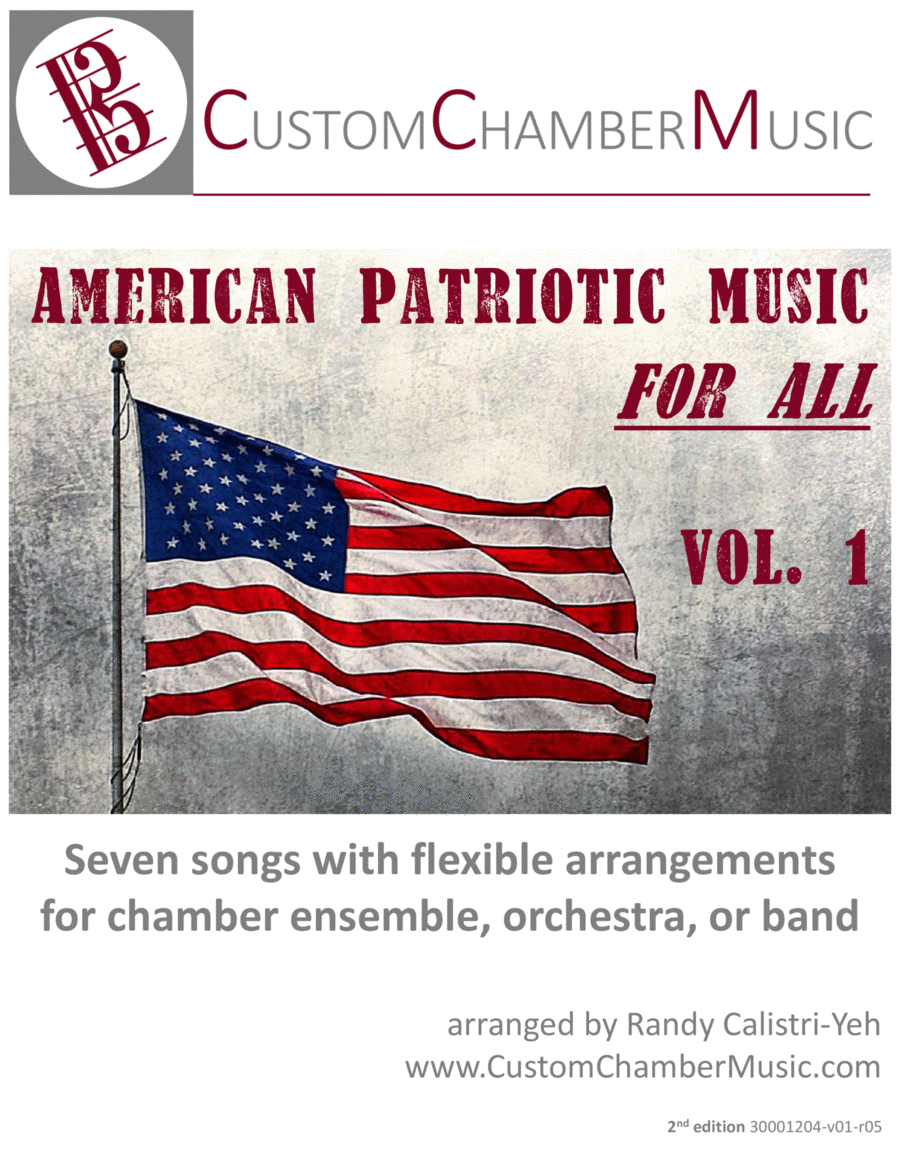
American Patriotic Music for All, Volume 1 (Flexible Band)
Orchestre d'harmonie

$45.00 38.65 € Orchestre d'harmonie PDF SheetMusicPlus

Concert Band - Level 3 - Digital Download SKU: A0.549206 Composed by Gabrieli. Arranged by James M. Guthrie, ASCAP. Renaissance,Standards. Score and Parts. 29 pages. Jmsgu3 #3461981. Published by jmsgu3 (A0.549206). Duration 3:00. Score 9 pg. Parts 2 pg. ea. Instrumentation: small wind band, no percussion. Innovations First of all, Gabrieli preferred sacred vocal and certainly instrumental music. Hence, he concentrated on music that consequently took advantage of resonance and likewise reverberation for maximum effect. Seems like Gabrieli may have invented dynamics – or was rather the first to indicate them such as in his Sonata Pian’ e Forte. Consequently, he was also a pioneer in spatial techniques. He therefore developed and used very specific notation to indicate instrumentation. Gabrieli experimented with assembling massive instrumental forces into isolated groups separated by space. In this way, he consequently contributed heavily to the Baroque Concertato style. Polychoral Works Gabrieli probably used the layout of the San Marco church for his experiments. This is because he worked there as a musician and composer. Furthermore, the church had two choir lofts facing each other. He certainly used these to create striking spatial effects between instrumental forces. Certainly, many of his works are composed such that a choir or instrumental group could first be heard on one side, then consequently followed by a response from the group on the other side. Sometimes there was probably a third group positioned near the main altar as well. Spatial Music Above all, Gabrieli studied carefully detailed groups of instruments and singers. Furthermore, it seems like he created precise directions for instrumentation in rather more than two groups. The instruments, because they could be appropriately situated, could consequently be heard with perfect clearness at distant locations. As a result, arrangements which seem bizarre on paper, can in contrast sound perfectly in-balance. First Works Finally, Gabrieli published his first motets along with his uncle Andrea's compositions in Concerti (1587). These compositions furthermore indicate considerable usage of dialogue and echo effects. Consequently, here we see low and high choirs with the variance between their ranges indicated by instrumental accompaniment. Seems like Gabrieli’s later motets Sacrae Symphoniae (1597) move away from close antiphony. In contrast, he moves towards not simply echoing the material, but developing it by sequential choral entrances. Even more, he takes this procedure to the extreme in the Motet Omnes Gentes. Unlike earlier works, here the instruments are certainly an essential part of the presentation. Also, only parts marked: Capella are supposed to be sung. Homophony Hence, after 1605, Gabrieli moves to a much more homophonic style. He writes sections purely for instruments – which calls Sinfonia – and smaller sections for vocal soloists, accompanied by a basso continuo.
Gabrieli: Canzon Septimi Toni Ch 172 for Concert Band
Orchestre d'harmonie

$47.95 41.19 € Orchestre d'harmonie PDF SheetMusicPlus

Concert Band - Level 2 - Digital Download SKU: A0.549200 Composed by Giovanni Gabrieli. Arranged by James M. Guthrie. Easter,Renaissance,Standards. 27 pages. Jmsgu3 #3458689. Published by jmsgu3 (A0.549200). Giovanni Gabrieli: Jubilate Deo (Ch. 136). Instrumentation: small concert band, no percussion. Here is a stunningly beautiful example of Renaissance polyphony and a mesmerizing fast-paced recital number. Program this initially to set an exciting mood or as an encore to leave the listeners in a jubilant afterglow. The parts are not tricky, but plan to rehearse the many subtleties of dynamic contrast between the various sub-groups and the overall articulations. Innovations First of all, Gabrieli preferred sacred vocal and, indeed, instrumental music. Hence, he concentrated on music that consequently took advantage of resonance and reverberation for maximum effect. Gabrieli may have invented dynamics – or was the first to indicate them, such as in his Sonata Pian’ e Forte. Consequently, he was also a pioneer in spatial techniques. He, therefore, developed and used very specific notation to indicate instrumentation. Gabrieli experimented with assembling massive instrumental forces into isolated groups separated by space. In this way, he consequently contributed heavily to the Baroque Concertato style. Polychoral Works Gabrieli probably used the layout of the San Marco church for his experiments. This is because he worked there as a musician and composer. Furthermore, the church had two choir lofts facing each other. He indeed used these to create striking spatial effects between instrumental forces. Indeed, many of his works are composed such that a choir or instrumental group could first be heard on one side, followed by a group response. Sometimes there was probably a third group near the main altar as well. Spatial Music Above all, Gabrieli studied carefully detailed groups of instruments and singers. Furthermore, it seems like he created precise directions for instrumentation in rather more than two groups. Because they could be appropriately situated, the instruments could consequently be heard with perfect clearness at distant locations. As a result, arrangements that seem bizarre on paper can, in contrast, sound perfectly in balance. First Works Finally, Gabrieli published his first motets and his uncle Andrea's compositions in Concerti (1587). These compositions furthermore indicate considerable usage of dialogue and echo effects. Consequently, here we see low and high choirs with the variance between their ranges indicated by instrumental accompaniment. Gabrieli’s later motets Sacrae Symphoniae (1597) seem to move away from close antiphony. In contrast, he moves towards not simply echoing the material but developing it by sequential choral entrances. Even more, he takes this procedure to the extreme in the Motet Omnes Gentes. Unlike earlier works, the instruments are an essential part of the presentation, only parts marked: Capella are supposed to be sung. Homophony Hence, after 1605, Gabrieli moves to a much more homophonic style. He writes sections purely for instruments – called Sinfonia – and smaller sections for vocal soloists, accompanied by a basso continuo.
Gabrieli: Jubilate Deo Ch. 136 for Concert Band
Orchestre d'harmonie

$47.95 41.19 € Orchestre d'harmonie PDF SheetMusicPlus

Concert Band - Level 2 - Digital Download SKU: A0.522171 Composed by Various. Arranged by Colin Kirkpatrick. Praise & Worship,Sacred. Score and parts. 123 pages. Colin Kirkpatrick Publications #5726781. Published by Colin Kirkpatrick Publications (A0.522171). Here’s a terrific collection of sixty of the best-loved hymns ever composed. The hymns are scored in four parts and could be used with virtually any combination of conventional wind instruments. They are presented in a set of three books and include full four-part instrumental scores plus separate parts in a variety of useful transpositions. Parts 1 and 2 (soprano and alto) are provided in B flat, E flat and C (8ve higher than concert); Part 3 (tenor) in B flat (9th above concert), E flat, F and C (bass clef) and Part 4 (bass) in B flat, E flat and C. There’s also an optional but useful simplified keyboard part intended for less experienced keyboard players. The left hand plays only the bass part most of the time, with the right hand part kept as simple as possible. It could be used as the basis of an accompaniment and means that you can use the arrangements as solos, duets or trios. The piano part too means that you can use the arrangements as solos, duets or trios. These arrangements are intended either as stand-alone pieces that could be used as interludes in a service, or they could be used to accompany solo, choral or congregational singing. This is essential music for schools and many churches and contains probably all the hymns you’ll ever need. The entire collection of scores and parts is presented in a single 123-page PDF file for instant download. Book 2 contains the following twenty popular hymns: A Mighty Fortress is our God (Ein Feste Burg); Awake my Soul (Morning Hymn); All Creatures of our God and King (Lasst uns Erfreuen); All People that on Earth do Dwell (Old Hundredth); Angels we have Heard on High (Gloria); Be thou my Vision (Slane); Come Thou Font of Every Blessing (Nettleton); Eternal Father, Strong to Save (Melita); God moves in a Mysterious Way (London New); Glory to Thee, My God, This Night (Tallis Canon); How Sweet the Name of Jesus Sounds (St. Peter); Immortal, Invisible, God Only Wise (St. Denio); Onward, Christian Soldiers (St. Gertrude); Let us with a Gladsome Mind (Monkland) Love Divine, All Loves Excelling (Beecher); Praise my Soul, the King of Heaven (Lauda Anima); The Day Thou Gavest (St. Clement); The King of Love my Shepherd is (St. Columba); We Plough the Fields and Scatter (Wir pflügen); Lead Us, Heavenly Father, Lead Us (Mannheim). The music has been set in wind-friendly keys and the arrangements are compatible with the brass collection of the same name. They are not compatible with the string collection of the same name.   
The Best Hymns of All Time (for Wind Instruments) Book 2
Orchestre d'harmonie

$31.99 27.48 € Orchestre d'harmonie PDF SheetMusicPlus

Concert Band - Digital Download SKU: A0.745475 Composed by John Philip Sousa. Arranged by Randy Calistri-Yeh. Holiday,Patriotic,Traditional. Score and parts. 77 pages. Custom Chamber Music #353404. Published by Custom Chamber Music (A0.745475). Semper Fidelis is one of John Philip Sousa's most popular marches. This extremely flexible arrangement can be played with anywhere from 3 to 7 parts, suitable for bands of all types (school, community, or professional).This song is also available as part of the collection American Patriotic Music for All, Volume 1, a package of four classic patriotic tunes and three complete Sousa marches (click the publisher link above).To demonstrate the flexibility of this arrangement, the audio clip has an excerpt performed as a full concert band, a string orchestra, and a woodwind trio.This song is in its original key, so it is easy to combine with your own choir or piano/organ parts.Your purchase contains a full score, as well as individual parts in all the appropriate clef and transposition to support the following ensembles:Brass trio, quartet, quintet, and sextet.Woodwind trio, quartet, quintet, and sextet.String trio, quartet, quintet, and sextet.Clarinet trio, quartet, quintet, and sextet.Saxophone trio, quartet, and quintet.Mixed trio, quartet, quintet, and sextet, with optional percussion.Wind ensemble, brass ensemble, string orchestra, full orchestra, and full band.The parts are described as follows:Part 1: Main melody. Piccolo, Flute, Oboe, Bb Clarinet, Soprano Saxophone, Bb Trumpet, Violin, Viola.Part 2: Main harmony, possibly some B-section melody. Bb Clarinet, Alto Clarinet, Alto Saxophone, Bb Trumpet, Violin, Viola.Part 3: Other harmony. Bb Clarinet, Alto/Bass Clarinet, Alto/Tenor Saxophone, French Horn, Bb Trumpet, Trombone, C/Bb Euphonium, Violin, Viola, Cello.Part 4: Main bass line. Bass Clarinet, Baritone Saxophone, Bassoon, Trombone, Bass Trombone, C/Bb Euphonium, Tuba, Cello, Bass.Part 5: Other harmony. Bass Clarinet, Baritone Saxophone, Bassoon, Trombone, Bass Trombone, C/Bb Euphonium, Tuba, Cello, Bass.Part 6: Main melody down an octave, with some additional notes. Bass Clarinet, Bassoon, French Horn, Trombone, C/Bb Euphonium, Cello, Bass.Part 7: Optional percussion (snare drum, bass drum, cymbal) that can be added to any of the above combinations, or skipped entirely.We recommend the following combinations:Trio: Parts 1, 2, 4 (#4 works better than #3 for trio).Quartet: Parts 1, 2, 3, 4.Quintet: Parts 1, 2, 3, 4, 5.Sextet: Parts 1, 2, 3, 4, 5, 6.Septet: Part 1, 2, 3, 4, 5, 6, 7.
Sousa Semper Fidelis (Flexible Band)
Orchestre d'harmonie

$15.00 12.88 € Orchestre d'harmonie PDF SheetMusicPlus

Concert Band - Digital Download SKU: AX.00-PC-0017035_TMP Timpani. Composed by Gary Fagan. Instructional. Part. 1 pages. Alfred Music - Digital Sheet Music #00-PC-0017035_TMP. Published by Alfred Music - Digital Sheet Music (AX.00-PC-0017035_TMP). UPC: 038081506104.This spirited composition for concert band is inspired by Mill Mountain, which is located on the outskirts of Roanoke, VA and provides a wonderful elevated view of both the city of Roanoke and the beautiful Shenandoah Valley. Of particular interest, the mountaintop contains a structure known as the Mill Mountain Star, the world's largest freestanding illuminated man-made star, visible for 60 miles from the air and 1,045 feet above the city of Roanoke. (3:00)Concert/Contest; Festival.
Mill Mountain Vistas: Timpani
Orchestre d'harmonie

$3.00 2.58 € Orchestre d'harmonie PDF SheetMusicPlus

Concert Band - Digital Download SKU: AX.00-PC-0017035_O1 Oboe. Composed by Gary Fagan. Instructional. Part. 1 pages. Alfred Music - Digital Sheet Music #00-PC-0017035_O1. Published by Alfred Music - Digital Sheet Music (AX.00-PC-0017035_O1). UPC: 038081506104.This spirited composition for concert band is inspired by Mill Mountain, which is located on the outskirts of Roanoke, VA and provides a wonderful elevated view of both the city of Roanoke and the beautiful Shenandoah Valley. Of particular interest, the mountaintop contains a structure known as the Mill Mountain Star, the world's largest freestanding illuminated man-made star, visible for 60 miles from the air and 1,045 feet above the city of Roanoke. (3:00)Concert/Contest; Festival.
Mill Mountain Vistas: Oboe
Orchestre d'harmonie

$3.00 2.58 € Orchestre d'harmonie PDF SheetMusicPlus

Concert Band - Digital Download SKU: AX.00-PC-0017035_TN2 2nd Trombone. Composed by Gary Fagan. Instructional. Part. 1 pages. Alfred Music - Digital Sheet Music #00-PC-0017035_TN2. Published by Alfred Music - Digital Sheet Music (AX.00-PC-0017035_TN2). UPC: 038081506104.This spirited composition for concert band is inspired by Mill Mountain, which is located on the outskirts of Roanoke, VA and provides a wonderful elevated view of both the city of Roanoke and the beautiful Shenandoah Valley. Of particular interest, the mountaintop contains a structure known as the Mill Mountain Star, the world's largest freestanding illuminated man-made star, visible for 60 miles from the air and 1,045 feet above the city of Roanoke. (3:00)Concert/Contest; Festival.
Mill Mountain Vistas: 2nd Trombone
Orchestre d'harmonie

$3.00 2.58 € Orchestre d'harmonie PDF SheetMusicPlus


1 16 31 ....181


Partitions Gratuites
Acheter des Partitions Musicales
Acheter des Partitions Digitales à Imprimer
Acheter des Instruments de Musique

© 2000 - 2026

Accueil - Version intégrale





