EUROPE
0 articles
USA
26 articles
DIGITAL
19 articles (à imprimer)
Partitions Digitales
Partitions à imprimer
19 partitions trouvées


Full Orchestra - Level 4 - Digital Download SKU: A0.730401 Composed by James Nathaniel Holland. Contemporary,Musical/Show,Opera. Score and parts. 37 pages. James Nathaniel Holland #3142471. Published by James Nathaniel Holland (A0.730401). Tenor Aria From the Hillside from the 21st Century Opera ON THE WINGS OF THE SCARLET MESSENGER (Based on the Henry James novel, On the Wings of a Dove) here with full orchestral accompaniment. (Full score in concert pitch, voice, and individual parts included)  This accompaniment can also be used with the solo and male ensemble that is contained in the full vocal score.Instrumentation:  pic, fl12,ob12,eh,cl12,bcl,tenor sax, bsn12,hrn1234, trpt 12, trmb, btrm, timp, hand cym/egg shaker, hrp, voice, stringsDuration: 4:00 minutes  (Sample here begins with extra measure)  Video presentation at: https://www.youtube.com/watch?v=u47yb4kiE0Y Curious? Listen to the complete opera playlist en demo at: http://www.youtube.com/watch?v=Rr5x_aXnUMM&list=PLEcbVsA36MCvHG_MTBdv7x2UNjwG27sMa Adaptation, Libretto, and Music by James Nathaniel Holland Performance: James Nathaniel Holland, Tenor Orchestra: CH Symphony Group (Complete Duration: 2 hours) BRIEF SYNOPSIS: In the urban capital of Soon Rafa, lovers Mariana (Soprano) and Kai (Bass) cannot be together because of Mariana's disapproving wealthy Aunt (Mezzo-Soprano). Torn between love and financial security, an unlikely opportunity arises when a dying rich Occidental, Justin (Tenor) reveals his romantic interest in Kai. The couple plot a pretense to inherit Justin's money and be free to marry and live together. This aria occurs in Act I, Scene 2. Justin (tenor) has just hired a group of porters, including Kai (bass), to guide him through the jungles of the island to photograph the mythical bird, the Scarlet Messenger. Although the men insist it is a legend, Justin inspires them to persevere with him. Aria Libretto, Justin (tenor singing): From the hillside, something breaks free. Is it real? Or just illusion? Oh how I have to see you, feel that beauty. Upon your wings our souls must one day fly to heaven. Never doubt that you can find him, hiding among your dreams. For when you feel all hope is gone, that's when you spot his red wings, fiery bright. (to the group of porters) So come with me, all's not in vain. It is real, just not illusion. The day is fading fast, oh, so quickly. We'll be the first to see that blazing path of fire. The Scarlet Messenger! Oh how that would be the greatest gift of my life.  Composer website: http://lacoronadelossantos.net/jamesnathanielholland.html  Music, Lyrics, Performance Copyright 2017 James Nathaniel Holland.
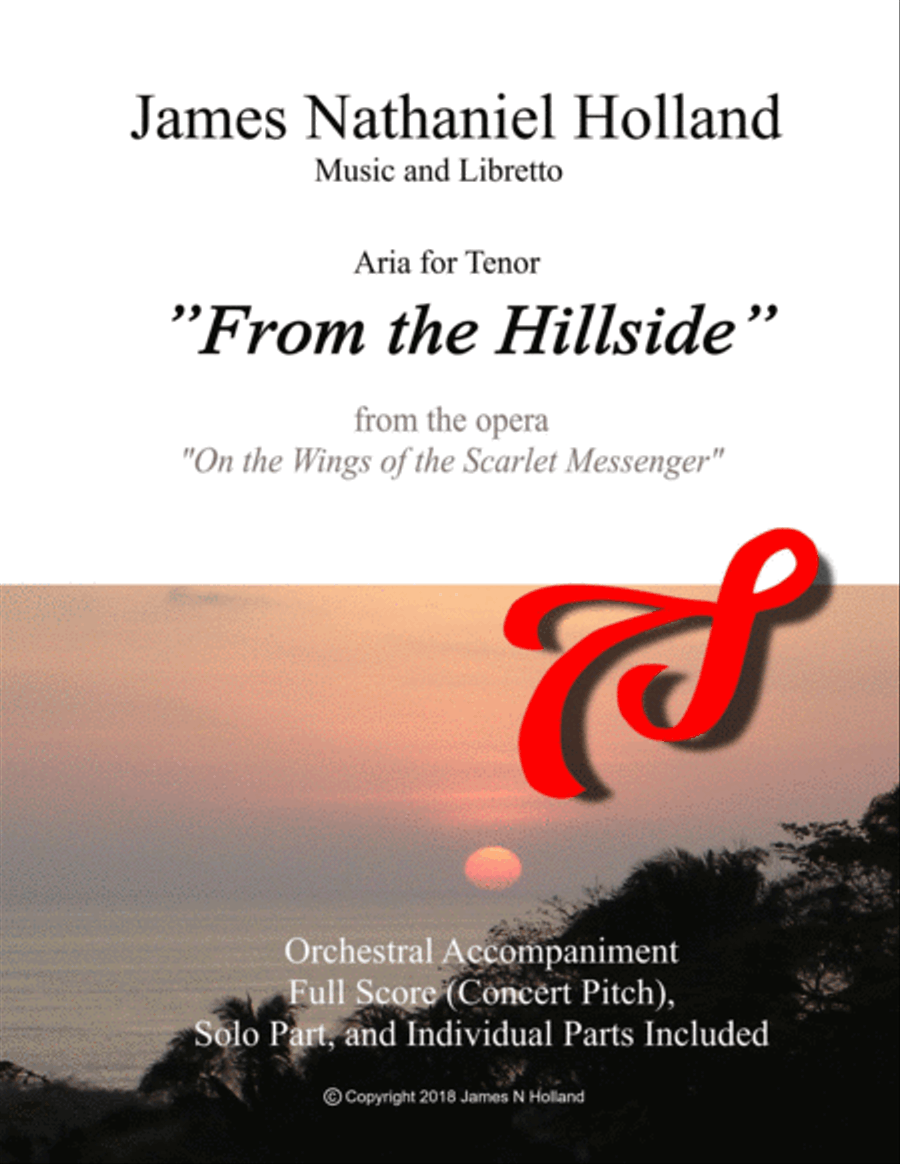
From the Hillside, Aria for Tenor with Orchestral Accompaniment from On the Wings of the Scarlet Mes
Orchestre

$15.95 13.33 € Orchestre PDF SheetMusicPlus

Full Orchestra - Level 3 - Digital Download SKU: A0.1322866 Composed by Malcolm D Robertson. 21st Century,Classical. 29 pages. Mr Malcolm D Robertson #911133. Published by Mr Malcolm D Robertson (A0.1322866). This simple straightfoward work for orchestra originated in a work for the local Youth Orchestra, of which I was a member, back in 1985. Of the original work only the melody, heard first on oboe along with some of the accompaniment, remains along with parts of the opening & closing of the work. I've kept the original scoring, 2 Flutes, Oboe, 2 Clarinets, 2 Bassoons, 2 Horns, Harp & Strings. The title comes from an artwork by British born artist Tim White (who is particularly known for his science fiction & fantasy works), which inspired the original composition & is also the first name of my father to whose memory this work is dedicated.Orchestral can be supplied upon request.
Waiting to hear from William - Score Only
Orchestre

$7.99 6.68 € Orchestre PDF SheetMusicPlus

Full Orchestra - Level 3 - Digital Download SKU: A0.798380 Composed by Peitro Yon (public domain). Arranged by Paul Hemmer. Christmas. Score and parts. 50 pages. PJMS MUSIC #6566139. Published by PJMS MUSIC (A0.798380). Gesù bambino is an Italian Christmas carol composed by Pietro Yon in 1917. The melody was used by Frederick H. Martens in his English language carol When Blossoms Flowered 'mid the Snows. The melody and lyrics of the chorus are derived from the chorus of Adeste Fideles (O Come All Ye Faithful).The music historian Salvatore Basile notes: The song would achieve the near-impossible feat of surviving in the standard holiday repertoire, with important performances, innumerable recordings, and every kind of vocal and instrumental arrangement. This orchestration features solo Soprano or Tenor, SATB Chorus and orchestra accompaniment
Gesu Bambino - Solo Soprano or tenor with SATB and Orchestra accompaniment
Orchestre

$50.00 41.78 € Orchestre PDF SheetMusicPlus

Full Orchestra - Level 5 - Digital Download SKU: A0.1356636 Composed by Adrian Gagiu. 20th Century,Classical,Contemporary. 215 pages. Adrian Gagiu #941262. Published by Adrian Gagiu (A0.1356636). The score, parts and vocal score of the Third Symphony (2000, revised 2023), an ambitious, modernist/neoclassical composition for orchestra and chorus with four vocal soloists. It may represent a search for harmony within and/or without and is a huge, subtle variations form on a theme that appears clearly and in full only in the Finale. The chromatic, first movement (Andante maestoso) begins mysteriously with A's in the unaccompanied violins, like a tuning or a seed of what is to come. These A's are adorned with oscillations which gradually become wider leaps until they reach the fifth (as in the beginning of the future full theme), and the other instruments join gradually. The mood is dark, tragic, pensive, and somehow abstract, as the music wanders in an almost improvisatory manner through chromatic modes and goes crescendo-decrescendo back again to the bare, cryptic A's. The energetic second movement (Allegro) is an enormous scherzo toying with the second melodic cell of the full theme, a descending tetrachord. This vital, Dionysian frenzy (in strong contrast to the Apollonian, severe contemplation in the first movement) leads only to its exhaustion and to the disorientated, slow Trio: first, an almost atonal tenor monologue accompanied by harp (on verses from Dante's Purgatory), then a quotation from Beethoven's sketches for a planned overture on the B-A-C-H motif, followed by a fugal section on the same archetypal motif and again a tenor monologue (on verses from Eminescu's Satire No. 4), this time with organ accompaniment and more and more tortured until the choral exclamations and the final cymbal clash. The search seemed in vain, so the rhythmic fury of the scherzo returns, but in mirror, as minor modes replaced the major ones on the same material. The Finale (Larghetto-Allegro-Larghetto) was inspired by the last scene in Goethe's Faust, part 2. After a cryptic variation for choir a cappella, the full theme appears at last in the orchestra, setting a lyric, appeased mood and more diatonic harmonies, while it reconciles the introspection of the first movement and the emotional and vital aspects of the second, although occasional attempts are made to escape, striving more and more towards the ending (with four vocal soloists and chorus). The parenthetic structure of the finale is a holographic reflection of the general form of the whole symphony, alternating gentle, contemplative episodes with exuberant or majestic fugatos. Towards the ending, ecstatic, big, complex quartal chords suggest the limits of perception and language (on the final stanzas from Dante's Paradise), until the sonority becomes again more and more rarefied and the journey returns to its starting point from the first movement: the 'tuning' A's in the violins. Total duration: 54 min. Performing Rights Organization: SOCAN. The mp3 audio clip is the second movement.
Symphony No. 3 in A minor, op. 17
Orchestre

$210.00 175.47 € Orchestre PDF SheetMusicPlus

Full Orchestra - Level 5 - Digital Download SKU: A0.1357497 Composed by Adrian Gagiu. 20th Century,Classical,Contemporary. 291 pages. Adrian Gagiu #942043. Published by Adrian Gagiu (A0.1357497). The orchestral parts of the Third Symphony (2000, revised 2023), an ambitious, modernist/neoclassical composition for orchestra and chorus with four vocal soloists. It may represent a search for harmony within and/or without and is a huge, subtle variations form on a theme that appears clearly and in full only in the Finale.The chromatic, first movement (Andante maestoso) begins mysteriously with A's in the unaccompanied violins, like a tuning or a seed of what is to come. These A's are adorned with oscillations which gradually become wider leaps until they reach the fifth (as in the beginning of the future full theme), and the other instruments join gradually. The mood is dark, tragic, pensive, and somehow abstract, as the music wanders in an almost improvisatory manner through chromatic modes and goes crescendo-decrescendo back again to the bare, cryptic A's.The energetic second movement (Allegro) is an enormous scherzo toying with the second melodic cell of the full theme, a descending tetrachord. This vital, Dionysian frenzy (in strong contrast to the Apollonian, severe contemplation in the first movement) leads only to its exhaustion and to the disorientated, slow Trio: first, an almost atonal tenor monologue accompanied by harp (on verses from Dante's Purgatory), then a quotation from Beethoven's sketches for a planned overture on the B-A-C-H motif, followed by a fugal section on the same archetypal motif and again a tenor monologue (on verses from Eminescu's Satire No. 4), this time with organ accompaniment and more and more tortured until the choral exclamations and the final cymbal clash. The search seemed in vain, so the rhythmic fury of the scherzo returns, but in mirror, as minor modes replaced the major ones on the same material.The Finale (Larghetto-Allegro-Larghetto) was inspired by the last scene in Goethe's Faust, part 2. After a cryptic variation for choir a cappella, the full theme appears at last in the orchestra, setting a lyric, appeased mood and more diatonic harmonies, while it reconciles the introspection of the first movement and the emotional and vital aspects of the second, although occasional attempts are made to escape, striving more and more towards the ending (with four vocal soloists and chorus). The parenthetic structure of the finale is a holographic reflection of the general form of the whole symphony, alternating gentle, contemplative episodes with exuberant or majestic fugatos. Towards the ending, ecstatic, big, complex quartal chords suggest the limits of perception and language (on the final stanzas from Dante's Paradise), until the sonority becomes again more and more rarefied and the journey returns to its starting point from the first movement: the 'tuning' A's in the violins.Total duration: 54 min. Performing Rights Organization: SOCAN. The mp3 audio clip is the second movement.
Symphony No. 3 in A minor, op. 17 (parts)
Orchestre

$210.00 175.47 € Orchestre PDF SheetMusicPlus

Full Orchestra - Level 4 - Digital Download SKU: A0.1018940 Composed by Benjamin Harry Sajo. 20th Century,Contemporary. Score and parts. 13 pages. Benjamin Sajo #6078661. Published by Benjamin Sajo (A0.1018940). Programme Notes: This composition was written to be considered for pairing alongside Ludwig van Beethoven’s Symphony #3, the Eroica, but can stand on its own virtues as an intense and slow meditation on heroism. The music is like a boiling pot on the stove that’s just began to overflow its bubbles. The first part of the title, kommos, is a Classical Greek term from Attic dramaturgy, literally meaning striking but specifically referring to beating oneself up during lamentation--ripping at the hair, gouging out the eyes--like Oedipus--slapping the forehead, and other acts amid moments of extreme emotional turmoil. For example, from Aeschylus's play Agamemnon, a character bewails: Apollo, Apollo! God of the Ways, my destroyer! For you have destroyed me-and utterly [...]What is this fresh woe [...]what monstrous, monstrous horror, beyond love's enduring, beyond all remedy? And help stands far away! We can easily imagine physical accompaniment to the script; rather than bottling up the pain, the hero lets it all explosively come out.  â€ƒThe second part of the title, When the world moved on, is an epigraph taken from American author Stephen King’s The Dark Tower epic. The primary setting of the novel, a world similar in many ways to our own, is experiencing a dark age where the glorious past is all but a distant memory and all good things are referred to wistfully as occurring, When the world moved on. Yet, the main protagonist, Roland, the last gunslinger, emphasizes that it is not just a figure of speech, but the literal distances between destinations have increased, the positions of the stars have changed, as well as the occurrence of other unnatural phenomena. The world has become a gulf of isolation from all corners. Taken together, this piece is a lamentation for when the world moved on. Truly completed on Yom Kippur during the Covid-19 Pandemic, being unable to fast or go to synagogue, this is my atonement.About the Composer: Benjamin Sajo (b. 1988) is a Canadian composer of contemporary classical music, as well as an educator. Since developing a fiercely independent creative voice upon the completion of his studies at Western (2010) and McGill Universities (2013), he continues to find inspiration from the intersection of mythology, art, and nature upon the contemporary human experience. In 2019, he released his premiere album of original music, The Great War Sextet: Canadian War Poetry with Trombone & Strings, with support from the Ontario Arts Council. He is a member of SOCAN and the League of Canadian Composers.
Kommos (Lamentation) / "When the World Moved On" - Conductor's Score
Orchestre

$20.00 16.71 € Orchestre PDF SheetMusicPlus

Full Orchestra - Level 4 - Digital Download SKU: A0.1018959 Composed by Benjamin Harry Sajo. 20th Century,Contemporary. Score and parts. 34 pages. Benjamin Sajo #6078723. Published by Benjamin Sajo (A0.1018959). Programme Notes: This composition was written to be considered for pairing alongside Ludwig van Beethoven’s Symphony #3, the Eroica, but can stand on its own virtues as an intense and slow meditation on heroism. The music is like a boiling pot on the stove that’s just began to overflow its bubbles.  The first part of the title, kommos, is a Classical Greek term from Attic dramaturgy, literally meaning striking but specifically referring to beating oneself up during lamentation--ripping at the hair, gouging out the eyes--like Oedipus--slapping the forehead, and other acts amid moments of extreme emotional turmoil. For example, from Aeschylus's play Agamemnon, a character bewails: Apollo, Apollo! God of the Ways, my destroyer! For you have destroyed me-and utterly [...]What is this fresh woe [...]what monstrous, monstrous horror, beyond love's enduring, beyond all remedy? And help stands far away! We can easily imagine physical accompaniment to the script; rather than bottling up the pain, the hero lets it all explosively come out.    The second part of the title, When the world moved on, is an epigraph taken from American author Stephen King’s The Dark Tower epic. The primary setting of the novel, a world similar in many ways to our own, is experiencing a dark age where the glorious past is all but a distant memory and all good things are referred to wistfully as occurring, When the world moved on. Yet, the main protagonist, Roland, the last gunslinger, emphasizes that it is not just a figure of speech, but the literal distances between destinations have increased, the positions of the stars have changed, as well as the occurrence of other unnatural phenomena. The world has become a gulf of isolation from all corners.  Taken together, this piece is a lamentation for when the world moved on. Truly completed on Yom Kippur during the Covid-19 Pandemic, being unable to fast or go to synagogue, this is my atonement.About the Composer:  Benjamin Sajo (b. 1988) is a Canadian composer of contemporary classical music, as well as an educator. Since developing a fiercely independent creative voice upon the completion of his studies at Western (2010) and McGill Universities (2013), he continues to find inspiration from the intersection of mythology, art, and nature upon the contemporary human experience. In 2019, he released his premiere album of original music, The Great War Sextet: Canadian War Poetry with Trombone & Strings, with support from the Ontario Arts Council. He is a member of SOCAN and the League of Canadian Composers.
Kommos (Lamentation) / "When the World Moved On" - Extracted Parts
Orchestre

$31.50 26.32 € Orchestre PDF SheetMusicPlus

Orchestra - Digital Download SKU: LX.30-2371L Composed by Lloyd Larson. Sacred Anthem, Christmas. Orchestral Score and Parts. 55 pages. Lorenz Publishing - Digital Sheet Music #e30/2371L. Published by Lorenz Publishing - Digital Sheet Music (LX.30-2371L). Exciting opening and closing fanfares herald the glad Christmas tidings in this regal carol medley by celebrated composer, Lloyd Larson. Following the opening acclamation, the choir sings in unison the pastoral strains of â??While Shepherds Watched Their Flocks.â? Next, â??He Is Born, the Divine Christ Childâ? increases the joyous celebration. Then, this carol partners with â??Hark! the Herald Angels Singâ? as the choral texture builds to the festive closing! In two voicings with optional orchestral accompaniment, this medley is filled with the spirit of Christmas. (From the cantata â??And Glory Shone Around;â? SATB â?? 65/1993L, SAB â?? 65/1994L.) Instrumentation: 2 Fl, Ob, 2 Cl, Bsn, 2 Hn, 3 Tpt, 2 Tbn, Tuba, Timp, 2 Perc, Harp, Vln 1 and 2, Vla, Cello, Bass.
Gloria! To God Sing Gloria! - Orchestral Score and Parts
Orchestre

$69.95 58.45 € Orchestre PDF SheetMusicPlus

Full Orchestra - Level 3 - Digital Download SKU: A0.742589 By The Beatles. By John Lennon and Paul McCartney. Arranged by Javier Martínez Maya. Contemporary. Score and parts. 54 pages. Arte Nova Music Lab #6431891. Published by Arte Nova Music Lab (A0.742589). You've Got to Hide Your Love Away is a song by the English rock band the Beatles. It was written and sung by John Lennon (though credited to Lennon–McCartney) and released on the album Help! in August 1965.Lennon said of the song, That's me in my Dylan period again. I am like a chameleon, influenced by whatever is going on. If Elvis can do it, I can do it. If the Everly Brothers can do it, me and Paul can. Same with Dylan. The song is an early example of John self-reflecting in his writing, which had begun with songs such as I'm a Loser in the summer of 1964. Lennon wrote the song at home, wanting another song for the film Help!. The song is just basically John doing Dylan, Paul McCartney confirmed.The song is similar to a folkish strophic form and uses a Dylanesque acoustic guitar figure in compound duple time, chiefly acoustic accompaniment, no backing voices and light percussion from brushed snare, tambourine and maraca. A flute, however, replaces the harmonica that Dylan typically used. Taken from https://en.wikipedia.org/wiki/You%27ve_Got_to_Hide_Your_Love_Away
You've Got To Hide Your Love Away
Orchestre
The Beatles
$60.00 50.13 € Orchestre PDF SheetMusicPlus

Full Orchestra - Level 3 - Digital Download SKU: A0.957733 Composed by Stephen Lines. Contemporary. Score and parts. 99 pages. Stephen Lines #26285. Published by Stephen Lines (A0.957733). Bramshill was written to commemorate the 50th anniversary of the police staff college and was premiered by the British Police Symphony Orchestra in 2008. In 2011 it undertook some quite serious revision. Bramshill House was until recently the home of the Police Staff College. In 1953 the Home Office purchased Bramshill from Lord Brocket. There is evidence that the site has been inhabited since the time of Domesday and the Norman Conquest. The present building was constructed principally by Edward Zouche, 11th Baron Zouche of Harringworth, between c. 1605-1625. The music is written in large ternary form as a concert rondo. There are features within which depict and draw together various facets of the early history of Bramshill House as a Jacobean structure with that of its current role as the police staff college. After a declamatory eighteen bar opening in the key of C minor the piece leads towards the principal theme - it is introduced by the horn, quietly accompanied by chords from the clarinets dipping in and out of the chalumeau register - a haunting, ethereal theme that depicts the mystery of the ancient building and its numerous reported wraiths. The theme develops and is pronounced giacoso in the strings with light accompaniment in the higher woodwinds. A restatement of the main theme is followed by a section, fugato; this depicts a police officer on the beat in the early hours of a cold, wet, winter’s night. This theme transmutes into a quasi-stately dance such as may have been performed in Bramshill’s great withdrawing room or the long gallery in the 1600’s. A series of 6/3 chords then develop into what sounds akin to a police siren; the section culminates in a wash of sound with police theme, stately dance and siren sounding simultaneously. In the final section, the principal theme is reiterated in various guises and sub-themes are further explored.
Bramshill Concert Rondo
Orchestre

$22.50 18.8 € Orchestre PDF SheetMusicPlus

Full Orchestra - Digital Download SKU: AX.00-PC-0016219_TMP Timpani. Composed by Angela Souders and Michael Souders. Arranged by Jerry Brubaker. Instructional. Part. 1 pages. Alfred Music - Digital Sheet Music #00-PC-0016219_TMP. Published by Alfred Music - Digital Sheet Music (AX.00-PC-0016219_TMP). UPC: 038081429014.Patriotism and gratitude prevail in this moving tribute to the men and women of our armed forces. The combined concert band, string orchestra, and full orchestra accompaniment for choir performance of the Internet sensation, Thank You, Soldiers, is scored to provide maximum flexibility. Use the instrumentalists available and rest assured that the arrangement will work. Playable and easy to learn, even when in keys new to the string or wind player. As a special touch, project animated images from the optional VideoTrax DVD during performance. Available in three different choral voicings, again for maximum flexibility.
Thank You, Soldiers: Timpani
Orchestre

$3.00 2.51 € Orchestre PDF SheetMusicPlus

Full Orchestra - Digital Download SKU: AX.00-PR-0004513 Score. Composed by Angela Souders and Michael Souders. Arranged by Jerry Brubaker. Instructional. Score. 12 pages. Alfred Music - Digital Sheet Music #00-PR-0004513. Published by Alfred Music - Digital Sheet Music (AX.00-PR-0004513). UPC: 038081429014.Patriotism and gratitude prevail in this moving tribute to the men and women of our armed forces. The combined concert band, string orchestra, and full orchestra accompaniment for choir performance of the Internet sensation, Thank You, Soldiers, is scored to provide maximum flexibility. Use the instrumentalists available and rest assured that the arrangement will work. Playable and easy to learn, even when in keys new to the string or wind player. As a special touch, project animated images from the optional VideoTrax DVD during performance. Available in three different choral voicings, again for maximum flexibility.
Thank You, Soldiers: Score
Orchestre

$9.00 7.52 € Orchestre PDF SheetMusicPlus

Full Orchestra - Digital Download SKU: AX.00-PC-0016219_BTC1 Baritone T.C.. Composed by Angela Souders and Michael Souders. Arranged by Jerry Brubaker. Instructional. Part. 1 pages. Alfred Music - Digital Sheet Music #00-PC-0016219_BTC1. Published by Alfred Music - Digital Sheet Music (AX.00-PC-0016219_BTC1). UPC: 038081429014.Patriotism and gratitude prevail in this moving tribute to the men and women of our armed forces. The combined concert band, string orchestra, and full orchestra accompaniment for choir performance of the Internet sensation, Thank You, Soldiers, is scored to provide maximum flexibility. Use the instrumentalists available and rest assured that the arrangement will work. Playable and easy to learn, even when in keys new to the string or wind player. As a special touch, project animated images from the optional VideoTrax DVD during performance. Available in three different choral voicings, again for maximum flexibility.
Thank You, Soldiers: Baritone T.C.
Orchestre

$3.00 2.51 € Orchestre PDF SheetMusicPlus

Full Orchestra - Digital Download SKU: AX.00-PC-0016219_M1 Mallets. Composed by Angela Souders and Michael Souders. Arranged by Jerry Brubaker. Instructional. Part. 1 pages. Alfred Music - Digital Sheet Music #00-PC-0016219_M1. Published by Alfred Music - Digital Sheet Music (AX.00-PC-0016219_M1). UPC: 038081429014.Patriotism and gratitude prevail in this moving tribute to the men and women of our armed forces. The combined concert band, string orchestra, and full orchestra accompaniment for choir performance of the Internet sensation, Thank You, Soldiers, is scored to provide maximum flexibility. Use the instrumentalists available and rest assured that the arrangement will work. Playable and easy to learn, even when in keys new to the string or wind player. As a special touch, project animated images from the optional VideoTrax DVD during performance. Available in three different choral voicings, again for maximum flexibility.
Thank You, Soldiers: Mallets
Orchestre

$3.00 2.51 € Orchestre PDF SheetMusicPlus


Partitions Gratuites
Acheter des Partitions Musicales
Acheter des Partitions Digitales à Imprimer
Acheter des Instruments de Musique

© 2000 - 2026

Accueil - Version intégrale





