EUROPE
211 articles
USA
5 articles
DIGITAL
9 articles (à imprimer)
Partitions Digitales
Partitions à imprimer
9 partitions trouvées


Full Orchestra - Level 5 - Digital Download SKU: A0.1040096 Composed by An-lun Huang. 20th Century,Contemporary,Multicultural,Traditional,World. Score and parts. 424 pages. DoReMi Edition #644919. Published by DoReMi Edition (A0.1040096). One of the Masterpieces of Chinese Music of 20th Century The magnificent cave art at Dunhuang, in Western China sets the stage for the ballet, “Dream of Dunhuangâ€. In the middle of the vast wastes of Western China, lies the oasis of Dunhuang, situated in today‘s Gansu Province. Since the Western Han Dynasty(202BC-8AC), Dunhuang was an important trading and cultural center on the famous “Silk Road’, the ribbon of communication which fostered the historic ties between East and West. In the East was China, source of treasured trading articles such as silk; in the West, the â€road“ branched to Venice, and north to what is today‘s Russia. The mural led caves at Dunhuang, which were begun the Northern Wei dynasty(336AD), and developed over one thousand years into the Qing Dynasty, re presents one of the world‘s richest cultural treasures. Drawing on bothn Western(Indian and Persian) as well as Chinese tradition, the caves, of which 492 remain intact, were decorated as a mines of religious devotion, with the initiation of Buddhism into China. The subjects of the murals, such as devise, demons, apsaras and bodhisattvas, represent the entire pantheon of Buddhist mythology, yet are also significant in their representation of muti-racial and muti-cultural influences, standing as an important testament to the age old exchange between East and West. A fabricated fantasia, the story of the ballet was inspirited by the famous artist, maestro Chang Shu-hong, who dedicated his whole life to Dunhuang. One of the Huang An-lun‘s major compositions with the play written by Xu Qing-dong, the score of “Dream of Dunhuang†was completed in mid-1979. The ballet has been dedicated to the composer‘s closest friends, Canadian writers John Fraser and Elizabeth MacCallun. Up to the date this CD being released, the ballet has never got a chance to performed in mainland China. Nevertheless, its music has been wildly performed and warmly received around the world. The Singapore premiere of its suite No.1 was performed by the SSO, conducted by Maestro Lim Yao. It has been also chosen as one of the “Master Piece of Chinese Music in 20th Century†in 1993. The world premiere of the complete ballet was performed successfully by the Russian State Ballet of Moscow, directed by its artist director, Vyatcheslav Godeyev, in 1994. Choreographed by Chen Min, it was took place in Taiwan with the Taiwan Symphony Orchestra, conducted by maestro David C.H.Chen. In 2002, ROI of Hong Kong has released the CD of the whole ballet, performed by the Russian Philharmonic Orchestra of Moscow. This is also the audio file attached. Before this recording conducted by the composer himself, the entire score was also performed by the Bolshoi Symphony Orchestra of Moscow in1995. The YouTube video was the World Premiere in Taiwan by the Russia National Ballet with the Taiwan symphony Orchestra, conducted by David Chen in 1994. The ballet, “ Dream of Dunhuang†depicts two young artists seeking the ultimate experience in love and expression. This two lovers arrived at desert and with the guidance of the celestial maiden, they discover the miracles of Dunhuang. It‘s divided into three acts: Act I: Desert, Act II: Cave, and Act III: Mogao cave.
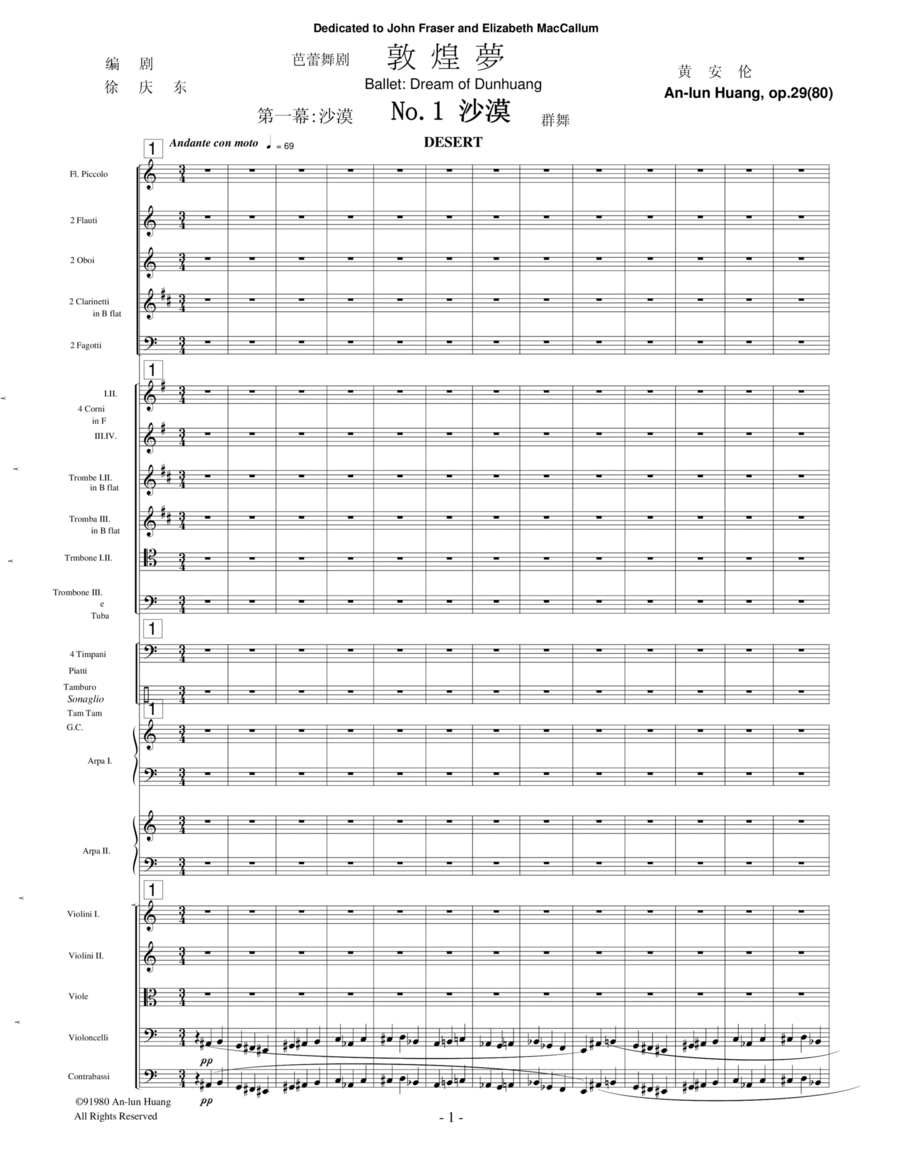
Dream of Dunhuang - Ballet in 3 Acts, O,p.29 (1979 - 80) - Score Only
Orchestre

$29.99 25.82 € Orchestre PDF SheetMusicPlus

Full Orchestra - Level 3 - Digital Download SKU: A0.742596 Composed by Sebastian Yradier and Shan Zhang. Arranged by Javier Martínez Maya. Contemporary. Score and parts. 59 pages. Arte Nova Music Lab #6432131. Published by Arte Nova Music Lab (A0.742596). La Paloma, The Dove in English, is a popular Spanish song that has been produced and reinterpreted in diverse cultures, settings, arrangements, and recordings over the last 140 years. The song was composed and written by the Spanish composer from the Basque region Sebastián Iradier (later Yradier) in the 1850s. In 1879, it was registered at the copyright office in Madrid as a Canción Americana con acompañamiento de Piano. Iradier was to die in obscurity within few years, never to learn how popular his song would become.Very quickly, La Paloma became popular outside of Spain, particularly in Mexico, and soon spread around the world. In many places, including Afghanistan, Cuba, Colombia, Hawaii, the Philippines, Germany, Romania, Venezuela, Zanzibar, and Goa it gained the status of a quasi-folk song. Over the years, the popularity of La Paloma has surged and receded periodically, but never subsided. It may be considered one of the first universal popular hits and has appealed to artists of diverse musical backgrounds. There are more than one thousand versions of this song, and together with Yesterday by The Beatles, is one of the most-recorded songs in the history of music; it is certainly the most-recorded Spanish song.Taken from https://en.wikipedia.org/wiki/La_Paloma
Dove
Orchestre

$60.00 51.65 € Orchestre PDF SheetMusicPlus

Full Orchestra - Level 2 - Digital Download SKU: A0.1194600 By Hanka Ordonowna. By Henry Vars. Arranged by Marek Czekala. 20th Century,Film/TV. Score and parts. 29 pages. Marek Czekala #793907. Published by Marek Czekala (A0.1194600). Love will forgive you everything - the song was written in 1933, the music was composed by Henryk Wars, and the words were written by Julian Tuwim (under the pseudonym Oldlen). The song was a hit in interwar Poland and remains so to this day. The song was written especially for the film The Spy in the Mask, which enjoyed a record attendance in cinemas. It was sung by Hanka Ordonówna and soon the song became her artistic showcase. Later, Ordonówna often resembled a song in the MaÅ‚e Qui Pro Quo theater. The piece performed by Ordonówna was recorded on the Syrena-Electro label, which was very popular at the time. The publisher's circulation reached tens of thousands of copies, and the discs with this recording were pressed for almost six years due to the constant interest in the song.MiÅ‚ość ci wszystko wybaczy – piosenka powstaÅ‚a w 1933 roku, do której muzykÄ™ skomponowaÅ‚ Henryk Wars, a sÅ‚owa napisaÅ‚ Julian Tuwim (pod ps. „Oldlenâ€). Piosenka byÅ‚a przebojem w miÄ™dzywojennej Polsce i pozostaje nim do dziÅ›. Utwór zostaÅ‚ napisany specjalnie na potrzeby filmu Szpieg w masce, cieszÄ…cego siÄ™ rekordowÄ… frekwencjÄ… w kinach. ZaÅ›piewaÅ‚a go w nim Hanka Ordonówna i wkrótce piosenka staÅ‚a siÄ™ jej artystycznÄ… wizytówkÄ…. W późniejszym czasie Ordonówna czÄ™sto przypominaÅ‚a piosenkÄ™ w teatrzyku MaÅ‚e Qui Pro Quo. Utwór w wykonaniu Ordonówny nagrany zostaÅ‚ na pÅ‚ytach bardzo popularnej wówczas wytwórni Syrena-Electro. NakÅ‚ad wydawnictwa osiÄ…gnÄ…Å‚ kilkadziesiÄ…t tysiÄ™cy egzemplarzy, a pÅ‚yty z tym nagraniem tÅ‚oczono przez blisko sześć lat z uwagi na niezmienne zainteresowanie piosenkÄ….Wikipedia.
Love Will Forgive You Everything
Orchestre
Hanka Ordonowna
$50.00 43.04 € Orchestre PDF SheetMusicPlus

Full Orchestra - Level 3 - Digital Download SKU: A0.1022807 Composed by Yoonjee Kim. Contemporary,World. Score and parts. 4 pages. Yoonjee Kim #3417623. Published by Yoonjee Kim (A0.1022807). Lily Park consists of three movements entitled Wind Bell, Goblin Lights, and Rock of Ages. The three movements are based on my personal impression of the cemetery, Lily Park, where all my grandparents are buried. The first movement, the shortest in duration, is slow and calm. It is introductory in quality, and expresses the pictorial impression of the cemetery by using various tone colors. This movement utilizes mixed instrumental consorts to project the concept of moderation and serenity. There is a close connection between the first movement and the last movement, as both features a wind-bell sound, a variety of percussion instruments, and slow tempi. The first movement focuses on the external appearance of the cemetery such as the quiet atmosphere, the wind, and the sound of bell ringing. The third movement represents the mental and emotional aspects of grief, memory of the funerals and reminiscent of my grandparents. The second movement is an imaginary night scene. For thousands of years, Korean have believed that goblins roam the tombs at night and are visible as blue and red lights. The movement is fast, busy and somewhat bizarre and whimsical, depicting the motion of the goblin lights. This contrasts with other two movements, thus the overall form becomes an arch shape. In addition, only the second movement is sectionalized by three different musical ideas while the first and the last movements are through composed with a single idea.I. Wind BellThe first movement expresses the general images of the cemetery; calm atmosphere, blowing wind, clean air, and a wide green field. The place is so quiet that the only the wind-bell ringing as the wind blows can be heard. In order to depict the wind-bell sound along with other optic and aural images, I create various tone colors by using various instrumental combinations in different transpositions and registrations.
Lily Park - I. Wind Bell
Orchestre

$17.00 14.63 € Orchestre PDF SheetMusicPlus

Full Orchestra - Digital Download SKU: A0.1022809 Composed by Yoonjee Kim. Contemporary,World. Score and parts. 16 pages. Yoonjee Kim #3417625. Published by Yoonjee Kim (A0.1022809). Lily Park consists of three movements entitled Wind Bell, Goblin Lights, and Rock of Ages. The three movements are based on my personal impression of the cemetery, Lily Park, where all my grandparents are buried. The first movement, the shortest in duration, is slow and calm. It is introductory in quality, and expresses the pictorial impression of the cemetery by using various tone colors. This movement utilizes mixed instrumental consorts to project the concept of moderation and serenity. There is a close connection between the first movement and the last movement, as both features a wind-bell sound, a variety of percussion instruments, and slow tempi. The first movement focuses on the external appearance of the cemetery such as the quiet atmosphere, the wind, and the sound of bell ringing. The third movement represents the mental and emotional aspects of grief, memory of the funerals and reminiscent of my grandparents. The second movement is an imaginary night scene. For thousands of years, Korean have believed that goblins roam the tombs at night and are visible as blue and red lights. The movement is fast, busy and somewhat bizarre and whimsical, depicting the motion of the goblin lights. This contrasts with other two movements, thus the overall form becomes an arch shape. In addition, only the second movement is sectionalized by three different musical ideas while the first and the last movements are through composed with a single idea.II. Goblin Lights
Lily Park - II. Goblin Lights
Orchestre

$17.00 14.63 € Orchestre PDF SheetMusicPlus


Partitions Gratuites
Acheter des Partitions Musicales
Acheter des Partitions Digitales à Imprimer
Acheter des Instruments de Musique

© 2000 - 2026

Accueil - Version intégrale





