EUROPE
11487 articles
USA
0 articles
DIGITAL
46 articles (à imprimer)
Partitions Digitales
Partitions à imprimer
46 partitions trouvées


2 Pianos,4 Hands,Piano Duet - Level 5 - Digital Download SKU: A0.1288884 By Richard Simm. By George Butterworth. Arranged by Richard Simm. 20th Century,Chamber,Classical,Folk,Multicultural,World. Score. 11 pages. Richard Simm #879723. Published by Richard Simm (A0.1288884). George Butterworth was a uniquely gifted composer and arranger of English folk songs, who was tragically killed in action during WW1 at the age of only 31.His small output included the song cycle, A Shropshire Lad, from which he expanded the first song, Loveliest of Trees into a wonderful orchestral rhapsody.The music is full of passion, but also the most delicate sensitivity, capturing the romantic essence of the English countryside from bygone days.This arrangement by Richard Simm for two pianos now gives pianists access to this beautiful music.
A Shropshire Lad - Rhapsody
2 Pianos, 4 mains
Richard Simm
$7.95 6.89 € 2 Pianos, 4 mains PDF SheetMusicPlus

Instrumental Duet,Keyboard - Digital Download SKU: A0.1497843 Composed by Jenni Roditi. 21st Century,Classical,Contemporary. 12 pages. Jenni Roditi #1074255. Published by Jenni Roditi (A0.1497843). Piano Duo - 2 pianos, 4 hands. Surrender, Between the Octaves was the piece that was composed first in the suite. It exposes a simple call to return to the beginning, to return to a pure act of listening. This note..ah, now that note.. oh. This is how the piece was written - one note at a time. Listening from within a space (its original title) of resonance, of edges and meetings, of disappearances and repetitions that reflect on this gentle body of notes. There is a slow hearing that may, or may not create a tone-journey.Names of all the movements in the suite Between the Octaves in the right order are Initiate, Surrender, Thread, Curve, Encircle, Ritualise, Ignite. The whole suite follows a long line from movement 1 to movement 7. However, individual pieces are well suited to be played alone too. Piano Duo is ideally two Steinway grands, otherwise, whatever is available. An enjoyment of the tensions and relationships generated between the two instruments: grand-upright, upright-electronic keyboard is to be explored as a positive. Each piece creates its own world in the suite and can be part of smaller subgroups taken from the suite, in any combination, but the order of the pieces needs to be maintained if more than one is played. Here is a taste of the background to the musical world of this 53 minute compositional suite. During a reflective time I read the following: The whole philosophy of dharma art (Buddhist art) is that you don't try to be artistic, but you just approach objects as they are, and the message comes through automatically. (Chogyam Trungpa Rinpoche, from 'True Perception The Path of Dharma Art.' Shambhala 2008, p.133.) The 'objects as they are' became the 'octaves as they are'. As the pieces were composed the octaves had a centring and clarifying role that allowed other material to circulate around or play against them. They acted as pivots, repetitions, drones, ostinati, pointillist nodes, pedals, melodic features, struts, harmonic turnpikes, breathing spaces, bass lines: musical imperatives. The octaves called the musical shots most of the time. When the music pulled a semitone up or down and away from the octaves (as it did quite often) it was especially telling in the context of the ringing spaces the octaves were creating. I became interested in the subtle dislocation that two pianos could provide. By dislocation I mean a degree of tension between the natural acoustics of the two instruments in the room and the players idiosyncrasies as musicians.  The whole point of this work was to examine the nature of my syntax, grammar, and compositional thinking. The title demanded one thing above all: what notes am I going to use between these octaves?? My choice of notes was derived in most instances from the tempo, pitch, and rhythm of the initial octaves at the beginning of each piece alongside the individual word titles that I set out to explore as musical images. The audio was developed from Sibelius software, via MIDI to Logic samples of a Steinway grand piano.
SURRENDER, Between the Octaves, A Piano Duo Suite (Movement 2 of 7)
2 Pianos, 4 mains
dislocation I mean a degree of tension between the natural acoustics of the two instruments in the room and the players idiosyncrasies as musicians  The whole point of this work was to examine the nature of my syntax, grammar, and compositional thinking
$20.00 17.34 € 2 Pianos, 4 mains PDF SheetMusicPlus

Instrumental Duet,Keyboard - Level 4 - Digital Download SKU: A0.1497861 Composed by Jenni Roditi. 21st Century,Classical,Contemporary. 26 pages. Jenni Roditi #1074273. Published by Jenni Roditi (A0.1497861). Piano Duo 2 pianos/4 hands. Ritualise, Between the Octaves finally found its identity with the word ritualise. It began as announce, became pronounce, then declare and went as far a pontificate for a title. At that point I realised I was mocking my own music and needed to take it more seriously. Ritualise brought out a meaning to the music that I hadn’t wanted to admit to. It is quite folk-like, in a primal and entrancing kind of way. I can imagine a communal dance for some ceremonial purpose in this music with both public and private elements.Names of all the movements in the suite Between the Octaves in the right order are Initiate, Surrender, Thread, Curve, Encircle, Ritualise, Ignite. The whole suite follows a long line from movement 1 to movement 7. However, individual pieces are well suited to be played alone too. Piano Duo is ideally two Steinway grands, otherwise, whatever is available. An enjoyment of the tensions and relationships generated between the two instruments: grand-upright, upright-electronic keyboard is to be explored as a positive. Each piece creates its own world in the suite and can be part of smaller subgroups taken from the suite, in any combination, but the order of the pieces needs to be maintained if more than one is played. Here is a taste of the background to the musical world of this 53 minute compositional suite. During a reflective time I read the following: The whole philosophy of dharma art (Buddhist art) is that you don't try to be artistic, but you just approach objects as they are, and the message comes through automatically. (Chogyam Trungpa Rinpoche, from 'True Perception The Path of Dharma Art.' Shambhala 2008, p.133.) The 'objects as they are' became the 'octaves as they are'. As the pieces were composed the octaves had a centring and clarifying role that allowed other material to circulate around or play against them. They acted as pivots, repetitions, drones, ostinati, pointillist nodes, pedals, melodic features, struts, harmonic turnpikes, breathing spaces, bass lines: musical imperatives. The octaves called the musical shots most of the time. When the music pulled a semitone up or down and away from the octaves (as it did quite often) it was especially telling in the context of the ringing spaces the octaves were creating. I became interested in the subtle dislocation that two pianos could provide. By dislocation I mean a degree of tension between the natural acoustics of the two instruments in the room and the players idiosyncrasies as musicians.  The whole point of this work was to examine the nature of my syntax, grammar, and compositional thinking. The title demanded one thing above all: what notes am I going to use between these octaves?? My choice of notes was derived in most instances from the tempo, pitch, and rhythm of the initial octaves at the beginning of each piece alongside the individual word titles that I set out to explore as musical images. The audio was developed from Sibelius software, via MIDI to Logic samples of a Steinway grand piano.
RITUALISE, Between the Octaves - A Piano Duo Suite (Movement 6 of 7)
2 Pianos, 4 mains
dislocation I mean a degree of tension between the natural acoustics of the two instruments in the room and the players idiosyncrasies as musicians  The whole point of this work was to examine the nature of my syntax, grammar, and compositional thinking
$20.00 17.34 € 2 Pianos, 4 mains PDF SheetMusicPlus

Instrumental Duet,Keyboard - Digital Download SKU: A0.1497847 Composed by Jenni Roditi. 21st Century,Classical,Contemporary. 11 pages. Jenni Roditi #1074259. Published by Jenni Roditi (A0.1497847). Piano Duo 2 pianos/4 hands. Thread, Between the Octaves grew out of the call the make a single line weave between the octaves. Line was the original title. Thread, as a word, brings more texture to the title and describes what the line is actually doing, threading around the harmony. A secondary thread is heard after a while, echoing and shading the primary line, with its own treble weave. It was like going back to the beginning of making melody again.Names of all the movements in the suite Between the Octaves in the right order are Initiate, Surrender, Thread, Curve, Encircle, Ritualise, Ignite. The whole suite follows a long line from movement 1 to movement 7. However, individual pieces are well suited to be played alone too. Piano Duo is ideally two Steinway grands, otherwise, whatever is available. An enjoyment of the tensions and relationships generated between the two instruments: grand-upright, upright-electronic keyboard is to be explored as a positive. Each piece creates its own world in the suite and can be part of smaller subgroups taken from the suite, in any combination, but the order of the pieces needs to be maintained if more than one is played. Here is a taste of the background to the musical world of this 53 minute compositional suite. During a reflective time I read the following: The whole philosophy of dharma art (Buddhist art) is that you don't try to be artistic, but you just approach objects as they are, and the message comes through automatically. (Chogyam Trungpa Rinpoche, from 'True Perception The Path of Dharma Art.' Shambhala 2008, p.133.) The 'objects as they are' became the 'octaves as they are'. As the pieces were composed the octaves had a centring and clarifying role that allowed other material to circulate around or play against them. They acted as pivots, repetitions, drones, ostinati, pointillist nodes, pedals, melodic features, struts, harmonic turnpikes, breathing spaces, bass lines: musical imperatives. The octaves called the musical shots most of the time. When the music pulled a semitone up or down and away from the octaves (as it did quite often) it was especially telling in the context of the ringing spaces the octaves were creating. I became interested in the subtle dislocation that two pianos could provide. By dislocation I mean a degree of tension between the natural acoustics of the two instruments in the room and the players idiosyncrasies as musicians.  The whole point of this work was to examine the nature of my syntax, grammar, and compositional thinking. The title demanded one thing above all: what notes am I going to use between these octaves?? My choice of notes was derived in most instances from the tempo, pitch, and rhythm of the initial octaves at the beginning of each piece alongside the individual word titles that I set out to explore as musical images. The audio was developed from Sibelius software, via MIDI to Logic samples of a Steinway grand piano.    

THREAD, Between the Octaves A Piano Duo Suite (Movement 3 of 7)
2 Pianos, 4 mains
dislocation I mean a degree of tension between the natural acoustics of the two instruments in the room and the players idiosyncrasies as musicians  The whole point of this work was to examine the nature of my syntax, grammar, and compositional thinking
$20.00 17.34 € 2 Pianos, 4 mains PDF SheetMusicPlus

Instrumental Duet,Keyboard - Level 4 - Digital Download SKU: A0.1497866 Composed by Jenni Roditi. 21st Century,Classical,Contemporary. 24 pages. Jenni Roditi #1074279. Published by Jenni Roditi (A0.1497866). Piano Duo - 2 pianos/4 hands. Ignite, Between the Octaves began with the impetus of static ‘pulsation’ (its original title) on repeated octaves. The piece is a fizzing dash of nodal vortices, small, then larger, spinning and tumbling and all the way to the finish line. This piece brings the complete suite of 7 pieces to a dynamic close, with a sense of ignition to new beginnings. The music echoes the opening F octaves of Initiate (movement 1). Names of all the movements in the suite Between the Octaves in the right order are Initiate, Surrender, Thread, Curve, Encircle, Ritualise, Ignite. The whole suite follows a long line from movement 1 to movement 7. However, individual pieces are well suited to be played alone too. Piano Duo is ideally two Steinway grands, otherwise, whatever is available. An enjoyment of the tensions and relationships generated between the two instruments: grand-upright, upright-electronic keyboard is to be explored as a positive. Each piece creates its own world in the suite and can be part of smaller subgroups taken from the suite, in any combination, but the order of the pieces needs to be maintained if more than one is played. Here is a taste of the background to the musical world of this 53 minute compositional suite. During a reflective time I read the following: The whole philosophy of dharma art (Buddhist art) is that you don't try to be artistic, but you just approach objects as they are, and the message comes through automatically. (Chogyam Trungpa Rinpoche, from 'True Perception The Path of Dharma Art.' Shambhala 2008, p.133.) The 'objects as they are' became the 'octaves as they are'. As the pieces were composed the octaves had a centring and clarifying role that allowed other material to circulate around or play against them. They acted as pivots, repetitions, drones, ostinati, pointillist nodes, pedals, melodic features, struts, harmonic turnpikes, breathing spaces, bass lines: musical imperatives. The octaves called the musical shots most of the time. When the music pulled a semitone up or down and away from the octaves (as it did quite often) it was especially telling in the context of the ringing spaces the octaves were creating. I became interested in the subtle dislocation that two pianos could provide. By dislocation I mean a degree of tension between the natural acoustics of the two instruments in the room and the players idiosyncrasies as musicians.  The whole point of this work was to examine the nature of my syntax, grammar, and compositional thinking. The title demanded one thing above all: what notes am I going to use between these octaves?? My choice of notes was derived in most instances from the tempo, pitch, and rhythm of the initial octaves at the beginning of each piece alongside the individual word titles that I set out to explore as musical images. The audio was developed from Sibelius software, via MIDI to Logic samples of a Steinway grand piano. 

IGNITE, Between the Octaves - A Piano Duo Suite (Movement 7 of 7)
2 Pianos, 4 mains
dislocation I mean a degree of tension between the natural acoustics of the two instruments in the room and the players idiosyncrasies as musicians  The whole point of this work was to examine the nature of my syntax, grammar, and compositional thinking
$20.00 17.34 € 2 Pianos, 4 mains PDF SheetMusicPlus

Instrumental Duet,Keyboard - Level 5 - Digital Download SKU: A0.1497831 Composed by Jenni Roditi. 21st Century,Classical,Contemporary. 24 pages. Jenni Roditi #1074235. Published by Jenni Roditi (A0.1497831). For Piano Duo - 2 pianos/4hands. Initiate, Between the Octaves, the opening piece in the suite, is a sparky, rhythmic and post-modern hoquet, of some wit and almost perpetual bounciness. A ricocheting of quickly contrasting dynamics with occasional switches to distant moments. Three big plunges into legato emotional flow, release the popping bubbles of the fiery staccato material. A short final chorale settles and grounds the quick cuts, swoops and build ups that have propelled the whole piece. Names of all the movements in the suite Between the Octaves in the right order are Initiate, Surrender, Thread, Curve, Encircle, Ritualise, Ignite. The whole suite follows a long line from movement 1 to movement 7. However, individual pieces are well suited to be played alone too. Piano Duo is ideally two Steinway grands, otherwise, whatever is available. An enjoyment of the tensions and relationships generated between the two instruments: grand-upright, upright-electronic keyboard is to be explored as a positive. Each piece creates its own world in the suite and can be part of smaller subgroups taken from the suite, in any combination, but the order of the pieces needs to be maintained if more than one is played. Here is a taste of the background to the musical world of this 53 minute compositional suite. During a reflective time I read the following: The whole philosophy of dharma art (Buddhist art) is that you don't try to be artistic, but you just approach objects as they are, and the message comes through automatically. (Chogyam Trungpa Rinpoche, from 'True Perception The Path of Dharma Art.' Shambhala 2008, p.133.) The 'objects as they are' became the 'octaves as they are'. As the pieces were composed the octaves had a centring and clarifying role that allowed other material to circulate around or play against them. They acted as pivots, repetitions, drones, ostinati, pointillist nodes, pedals, melodic features, struts, harmonic turnpikes, breathing spaces, bass lines: musical imperatives. The octaves called the musical shots most of the time. When the music pulled a semitone up or down and away from the octaves (as it did quite often) it was especially telling in the context of the ringing spaces the octaves were creating. I became interested in the subtle dislocation that two pianos could provide. By dislocation I mean a degree of tension between the natural acoustics of the two instruments in the room and the players idiosyncrasies as musicians.  The whole point of this work was to examine the nature of my syntax, grammar, and compositional thinking. The title demanded one thing above all: what notes am I going to use between these octaves?? My choice of notes was derived in most instances from the tempo, pitch, and rhythm of the initial octaves at the beginning of each piece alongside the individual word titles that I set out to explore as musical images. The audio was developed from Sibelius software, via MIDI to Logic samples of a Steinway grand piano.

INITIATE, Between the Octaves - A Piano Duo Suite (Movement 1 of 7)
2 Pianos, 4 mains
dislocation I mean a degree of tension between the natural acoustics of the two instruments in the room and the players idiosyncrasies as musicians  The whole point of this work was to examine the nature of my syntax, grammar, and compositional thinking
$20.00 17.34 € 2 Pianos, 4 mains PDF SheetMusicPlus

Instrumental Duet,Keyboard - Level 4 - Digital Download SKU: A0.1497857 Composed by Jenni Roditi. 21st Century,Classical,Contemporary. 19 pages. Jenni Roditi #1074269. Published by Jenni Roditi (A0.1497857). Piano Duo 2 pianos/4 hands. Encircle, Between the Octaves, originally called rotate as its impetus was to generate a steadily rotating music. Encircle was later chosen as a more evocative word. The harmony surprised me as it suggested shifts and colourations that I would not have expected to conjure. Two upper rotating parts with melodic narrative are supported by bass and baritone lower parts. The final section adds a dance-like short form to end what could otherwise have run and run and run.  Names of all the movements in the suite Between the Octaves in the right order are Initiate, Surrender, Thread, Curve, Encircle, Ritualise, Ignite. The whole suite follows a long line from movement 1 to movement 7. However, individual pieces are well suited to be played alone too. Piano Duo is ideally two Steinway grands, otherwise, whatever is available. An enjoyment of the tensions and relationships generated between the two instruments: grand-upright, upright-electronic keyboard is to be explored as a positive. Each piece creates its own world in the suite and can be part of smaller subgroups taken from the suite, in any combination, but the order of the pieces needs to be maintained if more than one is played. Here is a taste of the background to the musical world of this 53 minute compositional suite. During a reflective time I read the following: The whole philosophy of dharma art (Buddhist art) is that you don't try to be artistic, but you just approach objects as they are, and the message comes through automatically. (Chogyam Trungpa Rinpoche, from 'True Perception The Path of Dharma Art.' Shambhala 2008, p.133.) The 'objects as they are' became the 'octaves as they are'. As the pieces were composed the octaves had a centring and clarifying role that allowed other material to circulate around or play against them. They acted as pivots, repetitions, drones, ostinati, pointillist nodes, pedals, melodic features, struts, harmonic turnpikes, breathing spaces, bass lines: musical imperatives. The octaves called the musical shots most of the time. When the music pulled a semitone up or down and away from the octaves (as it did quite often) it was especially telling in the context of the ringing spaces the octaves were creating. I became interested in the subtle dislocation that two pianos could provide. By dislocation I mean a degree of tension between the natural acoustics of the two instruments in the room and the players idiosyncrasies as musicians.  The whole point of this work was to examine the nature of my syntax, grammar, and compositional thinking. The title demanded one thing above all: what notes am I going to use between these octaves?? My choice of notes was derived in most instances from the tempo, pitch, and rhythm of the initial octaves at the beginning of each piece alongside the individual word titles that I set out to explore as musical images. The audio was developed from Sibelius software, via MIDI to Logic samples of a Steinway grand piano. 

ENCIRCLE, Between the Octaves - A Piano Duo Suite (Movement 5 of 7)
2 Pianos, 4 mains
dislocation I mean a degree of tension between the natural acoustics of the two instruments in the room and the players idiosyncrasies as musicians  The whole point of this work was to examine the nature of my syntax, grammar, and compositional thinking
$20.00 17.34 € 2 Pianos, 4 mains PDF SheetMusicPlus

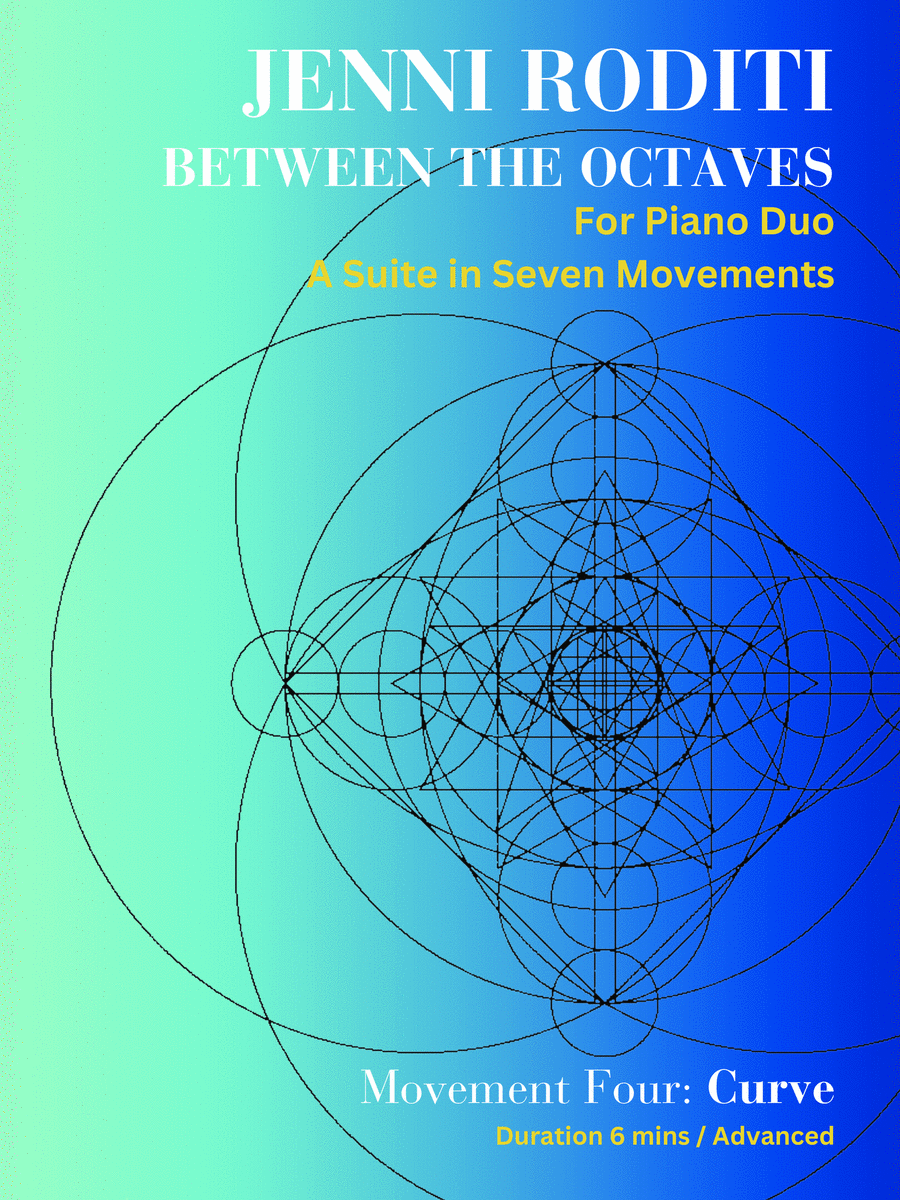
Instrumental Duet,Keyboard - Digital Download SKU: A0.1497852 Composed by Jenni Roditi. 21st Century,Classical,Contemporary. 17 pages. Jenni Roditi #1074264. Published by Jenni Roditi (A0.1497852). Piano Duo 2 pianos/4 hands. Curve, Between the Octaves points to a fugal past, where lines enter and build in stately flow. It invites lines to intermingle, without assuming they will all arrive somewhere, or at the same time. A certain intensity builds, then scales, both up and down, free themselves from the discussion of the interleaving lines. The chromaticism suggests curving between harmonies, and is nearly always ambivalent. An assertive chordal climax intervenes to shake off the tensions, yet this peels away into further curvatures that twist and twirl, until a final resting point agrees to present itself.  Names of all the movements in the suite Between the Octaves in the right order are Initiate, Surrender, Thread, Curve, Encircle, Ritualise, Ignite. The whole suite follows a long line from movement 1 to movement 7. However, individual pieces are well suited to be played alone too. Piano Duo is ideally two Steinway grands, otherwise, whatever is available. An enjoyment of the tensions and relationships generated between the two instruments: grand-upright, upright-electronic keyboard is to be explored as a positive. Each piece creates its own world in the suite and can be part of smaller subgroups taken from the suite, in any combination, but the order of the pieces needs to be maintained if more than one is played. Here is a taste of the background to the musical world of this 53 minute compositional suite. During a reflective time I read the following: The whole philosophy of dharma art (Buddhist art) is that you don't try to be artistic, but you just approach objects as they are, and the message comes through automatically. (Chogyam Trungpa Rinpoche, from 'True Perception The Path of Dharma Art.' Shambhala 2008, p.133.) The 'objects as they are' became the 'octaves as they are'. As the pieces were composed the octaves had a centring and clarifying role that allowed other material to circulate around or play against them. They acted as pivots, repetitions, drones, ostinati, pointillist nodes, pedals, melodic features, struts, harmonic turnpikes, breathing spaces, bass lines: musical imperatives. The octaves called the musical shots most of the time. When the music pulled a semitone up or down and away from the octaves (as it did quite often) it was especially telling in the context of the ringing spaces the octaves were creating. I became interested in the subtle dislocation that two pianos could provide. By dislocation I mean a degree of tension between the natural acoustics of the two instruments in the room and the players idiosyncrasies as musicians.  The whole point of this work was to examine the nature of my syntax, grammar, and compositional thinking. The title demanded one thing above all: what notes am I going to use between these octaves?? My choice of notes was derived in most instances from the tempo, pitch, and rhythm of the initial octaves at the beginning of each piece alongside the individual word titles that I set out to explore as musical images. The audio was developed from Sibelius software, via MIDI to Logic samples of a Steinway grand piano.

CURVE, Between the Octaves - A Piano Duo Suite (Movement 4 of 7)
2 Pianos, 4 mains
dislocation I mean a degree of tension between the natural acoustics of the two instruments in the room and the players idiosyncrasies as musicians  The whole point of this work was to examine the nature of my syntax, grammar, and compositional thinking
$20.00 17.34 € 2 Pianos, 4 mains PDF SheetMusicPlus

2 Pianos,4 Hands,Piano Duet - Level 3 - Digital Download SKU: A0.1460130 By Sharon Wilson. By Elisha Albright Hoffman, George Job Elvey, Lewis E. Jones, Matthew Bridges, and Robert Lowry. Arranged by Sharon Wilson. 19th Century,Christian,Easter,Lent,Sacred. Score. 72 pages. Sharon Wilson #1039070. Published by Sharon Wilson (A0.1460130). This collection contains 5 uplifting worship hymns arranged as PIANO DUETS (for 2 Pianos, 4 Hands). These arrangements are straight-forward and suitable for intermediate pianists. These bright and festive arrangements are a welcome addition to the piano repertoire for intermediate students and suitable for performances in a church setting (prelude, offertory, postlude). Though frequently associated with the Easter and Lent season, these arrangements can be performed any time of year as a celebration of Jesus' love for us.PIANO 1 and PIANO 2 alternate leading with the melody throughout each song, making these arrangements fun and equally challenging for both players while adding variety for the listeners. For each song there is a combined score (Grand Staff) with both piano parts on each page plus an alternate format with each piano part on separate pages (PIANO 1 and PIANO 2). Each song is also available separately with accompanying preview pages and audio samples. The audio sample plays Are You Washed in theBlood? and the YouTube video features Christ Arose.Song titles included in this collection: Are You Washed in the Blood?Christ Arose (Low in the Grave He Lay)Crown Him with Many CrownsNothing but the BloodPower in the BloodVisit Sharon Wilson's website: https://www.SharonWilsonMusic.com/Subscribe to her YouTube Channel: https://youtube.com/@SharonWilsonMusic
Easter Hymns for Two Pianos (A Collection of 5 Piano Duets for 2 Pianos, 4 Hands)
2 Pianos, 4 mains
Sharon Wilson
$15.00 13.01 € 2 Pianos, 4 mains PDF SheetMusicPlus

2 Pianos,4 Hands,Piano Duet - Level 3 - Digital Download SKU: A0.991619 Composed by Antonis Koundourakis. Concert,Contemporary,Instructional,Standards. Score. 11 pages. ANTONIOS KOUNDOURAKIS #3471903. Published by ANTONIOS KOUNDOURAKIS (A0.991619). In this piece Antonis explores the polyphonic and the homophonic style of composition with the added benefit and freedom of having 2 extra hands on the keyboard. Therefore there is a wide range being used simultaneously and in many cases the piece requires good coordination of the performers while in other cases independence of dynamics and phrasing. There is an extended period of stretto immitations, normally found in the style of the Fugue, and a 7 voice homophonic section resembling choral music. The different styles are juxtaposed in the form of a conversation, hence the title of the piece.This piece is ideal for live performance but can also be played by teacher and student while interchanging the parts they play for added benefit of learing coordination and understanding the challenges of the other performer when playing together.   In case you buy and perform the piece don't hesitate to contact Antonis at midnightnotesband@gmail.com to give him any feedback on the score legibility/playability and the experience of playing his composition! Videos are also very welcome! 
"Conversations" A piece for Piano Four (4) Hands
2 Pianos, 4 mains

$6.00 5.2 € 2 Pianos, 4 mains PDF SheetMusicPlus

2 Pianos,4 Hands,Piano Duet - Level 5 - Digital Download SKU: A0.1464123 By Richard Simm. By Bedrich Smetana. Arranged by Richard Simm. 19th Century,Classical,Folk,Multicultural,Romantic Period,World. Score. 9 pages. Richard Simm #1042836. Published by Richard Simm (A0.1464123). Smetana struggled hard for recognition in his life as a composer, but in his later years his major contribution to a Czech national style in music was acknowledged. Vltava is a marvellous orchestral depiction of the river that flows through Prague, reflecting the aspect of realism which was part of his romantic inspiration.This 2-piano arrangement by Richard Simm is pianistically advanced in order to retain as much as possible of the original's rich orchestral texture, but the focus is on the beautiful main theme of the work, concluding with Smetana's rather Wagnerian coda. Polished pianists will enjoy taking part in the powerful, surging flow of this descriptive work.
Vltava (Moldau)
2 Pianos, 4 mains
Richard Simm
$8.95 7.76 € 2 Pianos, 4 mains PDF SheetMusicPlus


Partitions Gratuites
Acheter des Partitions Musicales
Acheter des Partitions Digitales à Imprimer
Acheter des Instruments de Musique

© 2000 - 2026

Accueil - Version intégrale
