EUROPE
2603 articles
USA
0 articles
DIGITAL
39 articles (à imprimer)
Partitions Digitales
Partitions à imprimer
39 partitions trouvées


Instrumental Duet,Keyboard - Digital Download SKU: A0.1497852 Composed by Jenni Roditi. 21st Century,Classical,Contemporary. 17 pages. Jenni Roditi #1074264. Published by Jenni Roditi (A0.1497852). Piano Duo 2 pianos/4 hands. Curve, Between the Octaves points to a fugal past, where lines enter and build in stately flow. It invites lines to intermingle, without assuming they will all arrive somewhere, or at the same time. A certain intensity builds, then scales, both up and down, free themselves from the discussion of the interleaving lines. The chromaticism suggests curving between harmonies, and is nearly always ambivalent. An assertive chordal climax intervenes to shake off the tensions, yet this peels away into further curvatures that twist and twirl, until a final resting point agrees to present itself.  Names of all the movements in the suite Between the Octaves in the right order are Initiate, Surrender, Thread, Curve, Encircle, Ritualise, Ignite. The whole suite follows a long line from movement 1 to movement 7. However, individual pieces are well suited to be played alone too. Piano Duo is ideally two Steinway grands, otherwise, whatever is available. An enjoyment of the tensions and relationships generated between the two instruments: grand-upright, upright-electronic keyboard is to be explored as a positive. Each piece creates its own world in the suite and can be part of smaller subgroups taken from the suite, in any combination, but the order of the pieces needs to be maintained if more than one is played. Here is a taste of the background to the musical world of this 53 minute compositional suite. During a reflective time I read the following: The whole philosophy of dharma art (Buddhist art) is that you don't try to be artistic, but you just approach objects as they are, and the message comes through automatically. (Chogyam Trungpa Rinpoche, from 'True Perception The Path of Dharma Art.' Shambhala 2008, p.133.) The 'objects as they are' became the 'octaves as they are'. As the pieces were composed the octaves had a centring and clarifying role that allowed other material to circulate around or play against them. They acted as pivots, repetitions, drones, ostinati, pointillist nodes, pedals, melodic features, struts, harmonic turnpikes, breathing spaces, bass lines: musical imperatives. The octaves called the musical shots most of the time. When the music pulled a semitone up or down and away from the octaves (as it did quite often) it was especially telling in the context of the ringing spaces the octaves were creating. I became interested in the subtle dislocation that two pianos could provide. By dislocation I mean a degree of tension between the natural acoustics of the two instruments in the room and the players idiosyncrasies as musicians.  The whole point of this work was to examine the nature of my syntax, grammar, and compositional thinking. The title demanded one thing above all: what notes am I going to use between these octaves?? My choice of notes was derived in most instances from the tempo, pitch, and rhythm of the initial octaves at the beginning of each piece alongside the individual word titles that I set out to explore as musical images. The audio was developed from Sibelius software, via MIDI to Logic samples of a Steinway grand piano.
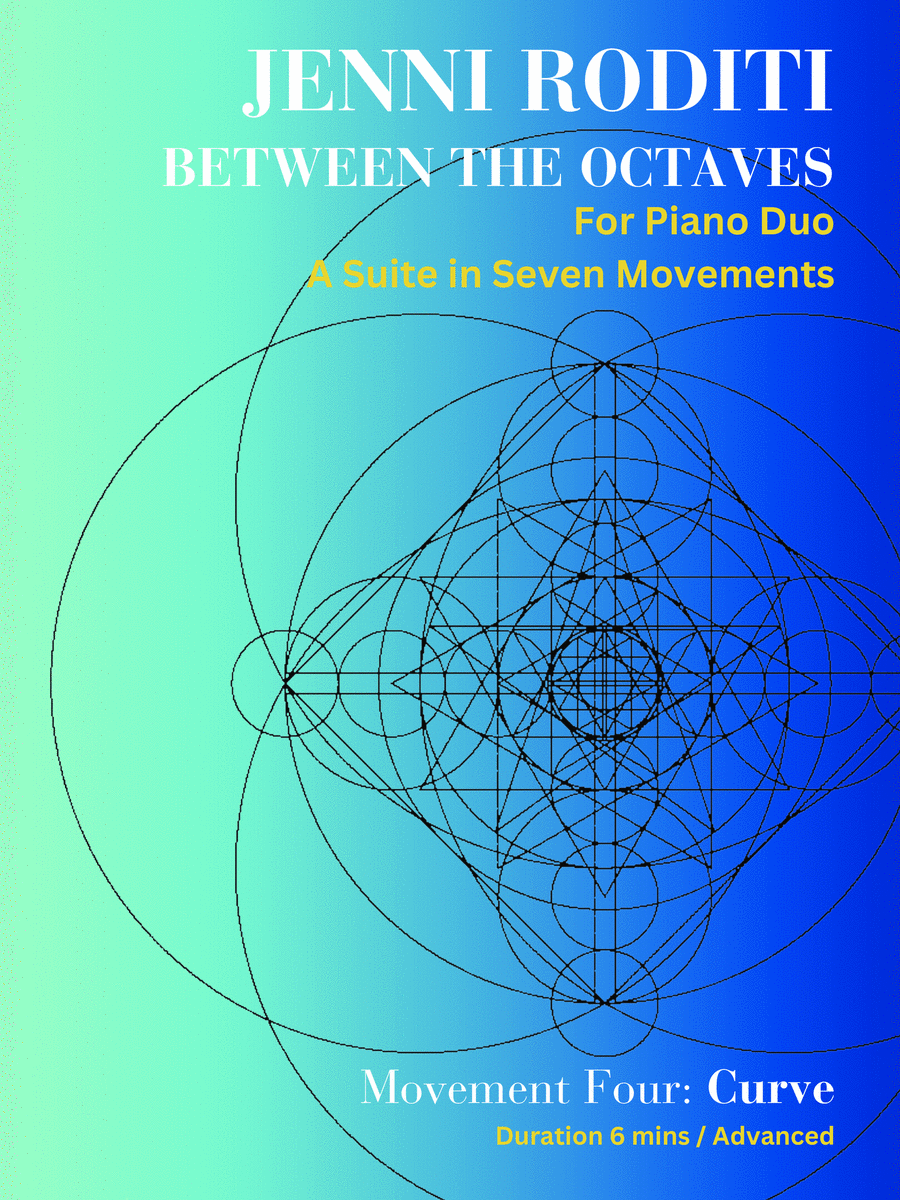
CURVE, Between the Octaves - A Piano Duo Suite (Movement 4 of 7)
2 Pianos, 4 mains
dislocation I mean a degree of tension between the natural acoustics of the two instruments in the room and the players idiosyncrasies as musicians  The whole point of this work was to examine the nature of my syntax, grammar, and compositional thinking
$20.00 17.43 € 2 Pianos, 4 mains PDF SheetMusicPlus

Instrumental Duet,Keyboard - Level 4 - Digital Download SKU: A0.1497857 Composed by Jenni Roditi. 21st Century,Classical,Contemporary. 19 pages. Jenni Roditi #1074269. Published by Jenni Roditi (A0.1497857). Piano Duo 2 pianos/4 hands. Encircle, Between the Octaves, originally called rotate as its impetus was to generate a steadily rotating music. Encircle was later chosen as a more evocative word. The harmony surprised me as it suggested shifts and colourations that I would not have expected to conjure. Two upper rotating parts with melodic narrative are supported by bass and baritone lower parts. The final section adds a dance-like short form to end what could otherwise have run and run and run.  Names of all the movements in the suite Between the Octaves in the right order are Initiate, Surrender, Thread, Curve, Encircle, Ritualise, Ignite. The whole suite follows a long line from movement 1 to movement 7. However, individual pieces are well suited to be played alone too. Piano Duo is ideally two Steinway grands, otherwise, whatever is available. An enjoyment of the tensions and relationships generated between the two instruments: grand-upright, upright-electronic keyboard is to be explored as a positive. Each piece creates its own world in the suite and can be part of smaller subgroups taken from the suite, in any combination, but the order of the pieces needs to be maintained if more than one is played. Here is a taste of the background to the musical world of this 53 minute compositional suite. During a reflective time I read the following: The whole philosophy of dharma art (Buddhist art) is that you don't try to be artistic, but you just approach objects as they are, and the message comes through automatically. (Chogyam Trungpa Rinpoche, from 'True Perception The Path of Dharma Art.' Shambhala 2008, p.133.) The 'objects as they are' became the 'octaves as they are'. As the pieces were composed the octaves had a centring and clarifying role that allowed other material to circulate around or play against them. They acted as pivots, repetitions, drones, ostinati, pointillist nodes, pedals, melodic features, struts, harmonic turnpikes, breathing spaces, bass lines: musical imperatives. The octaves called the musical shots most of the time. When the music pulled a semitone up or down and away from the octaves (as it did quite often) it was especially telling in the context of the ringing spaces the octaves were creating. I became interested in the subtle dislocation that two pianos could provide. By dislocation I mean a degree of tension between the natural acoustics of the two instruments in the room and the players idiosyncrasies as musicians.  The whole point of this work was to examine the nature of my syntax, grammar, and compositional thinking. The title demanded one thing above all: what notes am I going to use between these octaves?? My choice of notes was derived in most instances from the tempo, pitch, and rhythm of the initial octaves at the beginning of each piece alongside the individual word titles that I set out to explore as musical images. The audio was developed from Sibelius software, via MIDI to Logic samples of a Steinway grand piano. 
ENCIRCLE, Between the Octaves - A Piano Duo Suite (Movement 5 of 7)
2 Pianos, 4 mains
dislocation I mean a degree of tension between the natural acoustics of the two instruments in the room and the players idiosyncrasies as musicians  The whole point of this work was to examine the nature of my syntax, grammar, and compositional thinking
$20.00 17.43 € 2 Pianos, 4 mains PDF SheetMusicPlus

Instrumental Duet,Keyboard - Digital Download SKU: A0.1497843 Composed by Jenni Roditi. 21st Century,Classical,Contemporary. 12 pages. Jenni Roditi #1074255. Published by Jenni Roditi (A0.1497843). Piano Duo - 2 pianos, 4 hands. Surrender, Between the Octaves was the piece that was composed first in the suite. It exposes a simple call to return to the beginning, to return to a pure act of listening. This note..ah, now that note.. oh. This is how the piece was written - one note at a time. Listening from within a space (its original title) of resonance, of edges and meetings, of disappearances and repetitions that reflect on this gentle body of notes. There is a slow hearing that may, or may not create a tone-journey.Names of all the movements in the suite Between the Octaves in the right order are Initiate, Surrender, Thread, Curve, Encircle, Ritualise, Ignite. The whole suite follows a long line from movement 1 to movement 7. However, individual pieces are well suited to be played alone too. Piano Duo is ideally two Steinway grands, otherwise, whatever is available. An enjoyment of the tensions and relationships generated between the two instruments: grand-upright, upright-electronic keyboard is to be explored as a positive. Each piece creates its own world in the suite and can be part of smaller subgroups taken from the suite, in any combination, but the order of the pieces needs to be maintained if more than one is played. Here is a taste of the background to the musical world of this 53 minute compositional suite. During a reflective time I read the following: The whole philosophy of dharma art (Buddhist art) is that you don't try to be artistic, but you just approach objects as they are, and the message comes through automatically. (Chogyam Trungpa Rinpoche, from 'True Perception The Path of Dharma Art.' Shambhala 2008, p.133.) The 'objects as they are' became the 'octaves as they are'. As the pieces were composed the octaves had a centring and clarifying role that allowed other material to circulate around or play against them. They acted as pivots, repetitions, drones, ostinati, pointillist nodes, pedals, melodic features, struts, harmonic turnpikes, breathing spaces, bass lines: musical imperatives. The octaves called the musical shots most of the time. When the music pulled a semitone up or down and away from the octaves (as it did quite often) it was especially telling in the context of the ringing spaces the octaves were creating. I became interested in the subtle dislocation that two pianos could provide. By dislocation I mean a degree of tension between the natural acoustics of the two instruments in the room and the players idiosyncrasies as musicians.  The whole point of this work was to examine the nature of my syntax, grammar, and compositional thinking. The title demanded one thing above all: what notes am I going to use between these octaves?? My choice of notes was derived in most instances from the tempo, pitch, and rhythm of the initial octaves at the beginning of each piece alongside the individual word titles that I set out to explore as musical images. The audio was developed from Sibelius software, via MIDI to Logic samples of a Steinway grand piano.

SURRENDER, Between the Octaves, A Piano Duo Suite (Movement 2 of 7)
2 Pianos, 4 mains
dislocation I mean a degree of tension between the natural acoustics of the two instruments in the room and the players idiosyncrasies as musicians  The whole point of this work was to examine the nature of my syntax, grammar, and compositional thinking
$20.00 17.43 € 2 Pianos, 4 mains PDF SheetMusicPlus

Instrumental Duet,Keyboard - Level 4 - Digital Download SKU: A0.1497866 Composed by Jenni Roditi. 21st Century,Classical,Contemporary. 24 pages. Jenni Roditi #1074279. Published by Jenni Roditi (A0.1497866). Piano Duo - 2 pianos/4 hands. Ignite, Between the Octaves began with the impetus of static ‘pulsation’ (its original title) on repeated octaves. The piece is a fizzing dash of nodal vortices, small, then larger, spinning and tumbling and all the way to the finish line. This piece brings the complete suite of 7 pieces to a dynamic close, with a sense of ignition to new beginnings. The music echoes the opening F octaves of Initiate (movement 1). Names of all the movements in the suite Between the Octaves in the right order are Initiate, Surrender, Thread, Curve, Encircle, Ritualise, Ignite. The whole suite follows a long line from movement 1 to movement 7. However, individual pieces are well suited to be played alone too. Piano Duo is ideally two Steinway grands, otherwise, whatever is available. An enjoyment of the tensions and relationships generated between the two instruments: grand-upright, upright-electronic keyboard is to be explored as a positive. Each piece creates its own world in the suite and can be part of smaller subgroups taken from the suite, in any combination, but the order of the pieces needs to be maintained if more than one is played. Here is a taste of the background to the musical world of this 53 minute compositional suite. During a reflective time I read the following: The whole philosophy of dharma art (Buddhist art) is that you don't try to be artistic, but you just approach objects as they are, and the message comes through automatically. (Chogyam Trungpa Rinpoche, from 'True Perception The Path of Dharma Art.' Shambhala 2008, p.133.) The 'objects as they are' became the 'octaves as they are'. As the pieces were composed the octaves had a centring and clarifying role that allowed other material to circulate around or play against them. They acted as pivots, repetitions, drones, ostinati, pointillist nodes, pedals, melodic features, struts, harmonic turnpikes, breathing spaces, bass lines: musical imperatives. The octaves called the musical shots most of the time. When the music pulled a semitone up or down and away from the octaves (as it did quite often) it was especially telling in the context of the ringing spaces the octaves were creating. I became interested in the subtle dislocation that two pianos could provide. By dislocation I mean a degree of tension between the natural acoustics of the two instruments in the room and the players idiosyncrasies as musicians.  The whole point of this work was to examine the nature of my syntax, grammar, and compositional thinking. The title demanded one thing above all: what notes am I going to use between these octaves?? My choice of notes was derived in most instances from the tempo, pitch, and rhythm of the initial octaves at the beginning of each piece alongside the individual word titles that I set out to explore as musical images. The audio was developed from Sibelius software, via MIDI to Logic samples of a Steinway grand piano. 

IGNITE, Between the Octaves - A Piano Duo Suite (Movement 7 of 7)
2 Pianos, 4 mains
dislocation I mean a degree of tension between the natural acoustics of the two instruments in the room and the players idiosyncrasies as musicians  The whole point of this work was to examine the nature of my syntax, grammar, and compositional thinking
$20.00 17.43 € 2 Pianos, 4 mains PDF SheetMusicPlus

Instrumental Duet,Keyboard - Level 4 - Digital Download SKU: A0.1497861 Composed by Jenni Roditi. 21st Century,Classical,Contemporary. 26 pages. Jenni Roditi #1074273. Published by Jenni Roditi (A0.1497861). Piano Duo 2 pianos/4 hands. Ritualise, Between the Octaves finally found its identity with the word ritualise. It began as announce, became pronounce, then declare and went as far a pontificate for a title. At that point I realised I was mocking my own music and needed to take it more seriously. Ritualise brought out a meaning to the music that I hadn’t wanted to admit to. It is quite folk-like, in a primal and entrancing kind of way. I can imagine a communal dance for some ceremonial purpose in this music with both public and private elements.Names of all the movements in the suite Between the Octaves in the right order are Initiate, Surrender, Thread, Curve, Encircle, Ritualise, Ignite. The whole suite follows a long line from movement 1 to movement 7. However, individual pieces are well suited to be played alone too. Piano Duo is ideally two Steinway grands, otherwise, whatever is available. An enjoyment of the tensions and relationships generated between the two instruments: grand-upright, upright-electronic keyboard is to be explored as a positive. Each piece creates its own world in the suite and can be part of smaller subgroups taken from the suite, in any combination, but the order of the pieces needs to be maintained if more than one is played. Here is a taste of the background to the musical world of this 53 minute compositional suite. During a reflective time I read the following: The whole philosophy of dharma art (Buddhist art) is that you don't try to be artistic, but you just approach objects as they are, and the message comes through automatically. (Chogyam Trungpa Rinpoche, from 'True Perception The Path of Dharma Art.' Shambhala 2008, p.133.) The 'objects as they are' became the 'octaves as they are'. As the pieces were composed the octaves had a centring and clarifying role that allowed other material to circulate around or play against them. They acted as pivots, repetitions, drones, ostinati, pointillist nodes, pedals, melodic features, struts, harmonic turnpikes, breathing spaces, bass lines: musical imperatives. The octaves called the musical shots most of the time. When the music pulled a semitone up or down and away from the octaves (as it did quite often) it was especially telling in the context of the ringing spaces the octaves were creating. I became interested in the subtle dislocation that two pianos could provide. By dislocation I mean a degree of tension between the natural acoustics of the two instruments in the room and the players idiosyncrasies as musicians.  The whole point of this work was to examine the nature of my syntax, grammar, and compositional thinking. The title demanded one thing above all: what notes am I going to use between these octaves?? My choice of notes was derived in most instances from the tempo, pitch, and rhythm of the initial octaves at the beginning of each piece alongside the individual word titles that I set out to explore as musical images. The audio was developed from Sibelius software, via MIDI to Logic samples of a Steinway grand piano.

RITUALISE, Between the Octaves - A Piano Duo Suite (Movement 6 of 7)
2 Pianos, 4 mains
dislocation I mean a degree of tension between the natural acoustics of the two instruments in the room and the players idiosyncrasies as musicians  The whole point of this work was to examine the nature of my syntax, grammar, and compositional thinking
$20.00 17.43 € 2 Pianos, 4 mains PDF SheetMusicPlus

Instrumental Duet,Keyboard - Level 5 - Digital Download SKU: A0.1497831 Composed by Jenni Roditi. 21st Century,Classical,Contemporary. 24 pages. Jenni Roditi #1074235. Published by Jenni Roditi (A0.1497831). For Piano Duo - 2 pianos/4hands. Initiate, Between the Octaves, the opening piece in the suite, is a sparky, rhythmic and post-modern hoquet, of some wit and almost perpetual bounciness. A ricocheting of quickly contrasting dynamics with occasional switches to distant moments. Three big plunges into legato emotional flow, release the popping bubbles of the fiery staccato material. A short final chorale settles and grounds the quick cuts, swoops and build ups that have propelled the whole piece. Names of all the movements in the suite Between the Octaves in the right order are Initiate, Surrender, Thread, Curve, Encircle, Ritualise, Ignite. The whole suite follows a long line from movement 1 to movement 7. However, individual pieces are well suited to be played alone too. Piano Duo is ideally two Steinway grands, otherwise, whatever is available. An enjoyment of the tensions and relationships generated between the two instruments: grand-upright, upright-electronic keyboard is to be explored as a positive. Each piece creates its own world in the suite and can be part of smaller subgroups taken from the suite, in any combination, but the order of the pieces needs to be maintained if more than one is played. Here is a taste of the background to the musical world of this 53 minute compositional suite. During a reflective time I read the following: The whole philosophy of dharma art (Buddhist art) is that you don't try to be artistic, but you just approach objects as they are, and the message comes through automatically. (Chogyam Trungpa Rinpoche, from 'True Perception The Path of Dharma Art.' Shambhala 2008, p.133.) The 'objects as they are' became the 'octaves as they are'. As the pieces were composed the octaves had a centring and clarifying role that allowed other material to circulate around or play against them. They acted as pivots, repetitions, drones, ostinati, pointillist nodes, pedals, melodic features, struts, harmonic turnpikes, breathing spaces, bass lines: musical imperatives. The octaves called the musical shots most of the time. When the music pulled a semitone up or down and away from the octaves (as it did quite often) it was especially telling in the context of the ringing spaces the octaves were creating. I became interested in the subtle dislocation that two pianos could provide. By dislocation I mean a degree of tension between the natural acoustics of the two instruments in the room and the players idiosyncrasies as musicians.  The whole point of this work was to examine the nature of my syntax, grammar, and compositional thinking. The title demanded one thing above all: what notes am I going to use between these octaves?? My choice of notes was derived in most instances from the tempo, pitch, and rhythm of the initial octaves at the beginning of each piece alongside the individual word titles that I set out to explore as musical images. The audio was developed from Sibelius software, via MIDI to Logic samples of a Steinway grand piano.

INITIATE, Between the Octaves - A Piano Duo Suite (Movement 1 of 7)
2 Pianos, 4 mains
dislocation I mean a degree of tension between the natural acoustics of the two instruments in the room and the players idiosyncrasies as musicians  The whole point of this work was to examine the nature of my syntax, grammar, and compositional thinking
$20.00 17.43 € 2 Pianos, 4 mains PDF SheetMusicPlus

Instrumental Duet,Keyboard - Digital Download SKU: A0.1497847 Composed by Jenni Roditi. 21st Century,Classical,Contemporary. 11 pages. Jenni Roditi #1074259. Published by Jenni Roditi (A0.1497847). Piano Duo 2 pianos/4 hands. Thread, Between the Octaves grew out of the call the make a single line weave between the octaves. Line was the original title. Thread, as a word, brings more texture to the title and describes what the line is actually doing, threading around the harmony. A secondary thread is heard after a while, echoing and shading the primary line, with its own treble weave. It was like going back to the beginning of making melody again.Names of all the movements in the suite Between the Octaves in the right order are Initiate, Surrender, Thread, Curve, Encircle, Ritualise, Ignite. The whole suite follows a long line from movement 1 to movement 7. However, individual pieces are well suited to be played alone too. Piano Duo is ideally two Steinway grands, otherwise, whatever is available. An enjoyment of the tensions and relationships generated between the two instruments: grand-upright, upright-electronic keyboard is to be explored as a positive. Each piece creates its own world in the suite and can be part of smaller subgroups taken from the suite, in any combination, but the order of the pieces needs to be maintained if more than one is played. Here is a taste of the background to the musical world of this 53 minute compositional suite. During a reflective time I read the following: The whole philosophy of dharma art (Buddhist art) is that you don't try to be artistic, but you just approach objects as they are, and the message comes through automatically. (Chogyam Trungpa Rinpoche, from 'True Perception The Path of Dharma Art.' Shambhala 2008, p.133.) The 'objects as they are' became the 'octaves as they are'. As the pieces were composed the octaves had a centring and clarifying role that allowed other material to circulate around or play against them. They acted as pivots, repetitions, drones, ostinati, pointillist nodes, pedals, melodic features, struts, harmonic turnpikes, breathing spaces, bass lines: musical imperatives. The octaves called the musical shots most of the time. When the music pulled a semitone up or down and away from the octaves (as it did quite often) it was especially telling in the context of the ringing spaces the octaves were creating. I became interested in the subtle dislocation that two pianos could provide. By dislocation I mean a degree of tension between the natural acoustics of the two instruments in the room and the players idiosyncrasies as musicians.  The whole point of this work was to examine the nature of my syntax, grammar, and compositional thinking. The title demanded one thing above all: what notes am I going to use between these octaves?? My choice of notes was derived in most instances from the tempo, pitch, and rhythm of the initial octaves at the beginning of each piece alongside the individual word titles that I set out to explore as musical images. The audio was developed from Sibelius software, via MIDI to Logic samples of a Steinway grand piano.    

THREAD, Between the Octaves A Piano Duo Suite (Movement 3 of 7)
2 Pianos, 4 mains
dislocation I mean a degree of tension between the natural acoustics of the two instruments in the room and the players idiosyncrasies as musicians  The whole point of this work was to examine the nature of my syntax, grammar, and compositional thinking
$20.00 17.43 € 2 Pianos, 4 mains PDF SheetMusicPlus

2 Pianos,4 Hands,Piano Duet - Level 4 - Digital Download SKU: A0.972673 Composed by James Siddons. Contemporary,Folk,Jazz,Spiritual. Score. 25 pages. James Siddons Music and Writings #6698569. Published by James Siddons Music and Writings (A0.972673). Performance NoteSonata Hymnica No. 6 is scored for two pianos and three performers. One  performer (or player) sits at Piano I and may also serve as the conductor. At Piano II, Performer 1 plays from the treble  staff and Performer 2 plays from the bass staff. There are possible variations in this, such as having four pianos (two pianos  doubling the other two), or having two performers at Piano I, with Performer 2 playing only the bass-staff rhythmic pattern that  begins in measure 37. A standing conductor (not playing piano) may be desired.  Although repetitive, the music in this sonata rarely repeats itself  exactly; hence, further minor improvisations by the performers are appropriate, keeping with the improvisatory nature of oral  tradition. Program Note (for use in concert programs) by James Siddons  The Sonata Hymnica series by James Siddons consists of piano solos that explore the world of American hymns and  vernacular religious songs in the 1880-1920 era, when rural and small-town churches relied on pianos for music, and, in an age before microphones and amplification, the acoustics of wooden floors, walls, and high ceilings. These sonatas are not hymn arrangements but explorations of the sounds that can be created by a piano in a reverberant environment, all the while keeping in mind the essential message of the familiar words  sung to the various hymn tunes. Sonata Hymnica No. 6 is the first in the series to be for piano ensemble, and the second (after No. 3) to be based on the worship music of the 19th-century African American church. This sixth sonata also explores the singing world of the black congregation and choir as well as the piano. Their singing was shaped  by the sounds and intonations of the piano and the heritage of European music behind it, as well as the contours and cadences of the religious folk songs known as Spirituals. But the black congregations also sang hymns and choruses from the Classical tradition, and the Spirituals became the basis of many adaptations by white arrangers. Thus, we may speak  of  standardized adaptations of Spirituals as white black music, and black performance styles of Classical works as black white music. Piano ragtime music is a non-religious example of white music (the military march) made into black white music by the blending in of the syncopated rag rhythm. Sonata Hymnica No. 6 explores the intermingling of these two strains of American music as heard in the 19th-century black church. In his classic book The Souls of Black Folk (Chicago, 1903), W. E. B. Du Bois confesses to not being a musician but nonetheless finding himself enthralled by the music of the Southern 19th-century African Americans. He refers to their singing as the Frenzy or ‘Shouting,’ when the Spirit of the Lord passed by, and seizing the  devotee, made him mad with supernatural joy . . . stamping, shrieking, and shouting, the rushing to and fro and waving of arms,  the weeping and laughing, the vision and the trance (p. 116). On another page, Du Bois speaks of . . . the songs of my fathers . . . swelling with song, instinct for life, tremendous treble and darkening bass (p. 163). Sonata Hymnica No. 6 uses the African call and response form as well  as percussive polyrhythms.
Sonata Hymnica No. 6
2 Pianos, 4 mains

$10.00 8.71 € 2 Pianos, 4 mains PDF SheetMusicPlus

2 Pianos,4 Hands,Piano Duet - Level 4 - Digital Download SKU: A0.1183755 By Richard Simm. By Irish Folk Tune. Arranged by Richard Simm. Folk,Multicultural,Traditional,World. Score. 3 pages. Richard Simm #783447. Published by Richard Simm (A0.1183755). Probably one of the loveliest folk melodies that have ever existed, this mysterious, key-elusive tune tells the story of a lover whose sweetheart has received permission from her family to marry him. He sees her move away from him at the fair, as she tells him, It will not be long, love, till our wedding day. But their love is ill-fated, as the sad ending of the story has her returning to him that night as a ghost, repeating the same words...
She Moved Through the Fair - arr. for 2 pianos
2 Pianos, 4 mains
Richard Simm
$6.95 6.06 € 2 Pianos, 4 mains PDF SheetMusicPlus

2 Pianos,4 Hands,Piano Duet - Level 4 - Digital Download SKU: A0.944075 Composed by Ofer Ben-Amots. 20th Century,Contemporary,Latin,World. Score. 28 pages. The Composer's Own Press #5041193. Published by The Composer's Own Press (A0.944075). Composer's notes: I have always been fascinated by music that lives on the boundary between popular and highbrow, and Argentinian Tango falls right into this category. I wrote Tango for the Road in the summer of 2015, following an earlier tango in my Odessa Trio, titled Tango Dorfman. The genre has a number of well-defined musical characteristics, often opposing one another: it is rhythmically strict and precise, yet warm and sentimental; it carries melodious tunes accompanied by soft chromaticism and elegance, yet it conceals tremendous spark and inner-power; being a partner dance, it sometimes displays a Leader/Follower relationship and other times an equal vigor and energy between the partners.
Tango for the Road - for two pianos
2 Pianos, 4 mains

$18.00 15.68 € 2 Pianos, 4 mains PDF SheetMusicPlus

Instrumental Duet Instrumental Duet,Piano - Digital Download SKU: A0.869334 Composed by Thomas Oboe Lee. 20th Century,Classical,Contemporary,Latin,Romantic Period. Score and parts. 4 pages. Thomas Oboe Lee #2033629. Published by Thomas Oboe Lee (A0.869334). YouTube link: https://www.youtube.com/user/thomasoboelee/videosWhen the Reed sisters, Elizabeth & Lydia, asked me to write a new work for two pianos, I wasn't quite sure where or how to begin. Then I came upon a book on numerology by Annemarie Schimmel, The Mystery of Numbers. In it I discovered a lot of fascinating things, mystical and magical, associated with each number from one to 10,000. Since I would be writing a piece for a duo, double digits would do the trick. Number 22 stood out. It has two important associations: the Hebrew alphabet has 22 letters, and there are 22 major arcana cards or allegories of the Tarot. Perfect! I could write 22 pieces, each a musical rendering of a card.  And, coincidentally, this work will opus 66.For pictorial inspiration, I bought a Pierpont Morgan Library copy of the Visconti-Sforza Tarot Cards from 15th century Italy. For musical inspiration, I listened to the wonderful salon music of the Polish composer Frederic Chopin, the American composer Louis Moreau Gottschalk, and the Brazilian composer Ernesto Nazareth.The 22 pieces in the Visconti-Sforza Tarot Cards are: Zero Il Matto The Fool entertains the gathered guests with a tarantella. I. Il Saltimbanco The Mountebank shuffles his cards and does a samba. II. La Papessa The High Priestess concocts a magic potion. III. L'Imperatrice The Empress dances all night. IV. L'Imperatore The Emperor promenades into the Great Hall and inspects the courtiers. V. Il Papa The Pope makes a proclamation that all sinners will be pardoned. VI. L'Amore Love in a tropical paradise. VII. Il Carro Triumphant in battle, the gladiators ride into town on chariots. VIII. La Giustizia Justice is swift and unrelenting. IX. Il Vecchio The Old Man reminisces. X. La Ruota della Fortuna Fortunes rise and fall unpredictably. XI. La Fortezza Strength and fortitude will prevail. XII. Il Penduto Lamentation for the Hanged Man. XIII. Il Morte Death lurks around the corner. XIV. La Temperanza Temperance in A major. XV. Il Diavolo The Devil seduces with his charm and wit. XVI. La Torre The tower topples and crashes onto the populace gathered below. XVII. La Stella Twinkle, twinkle, little star ... XVIII. La Luna Minuet for moonstruck lovers. XIX Il Sole Sunshine, margaritas and salsa cubana. XX Il Giudizio On the Day of Judgment, the angels blow their trumpets ... XXI. Il Mondo The world would be a happier place if we all dance together. Performance option: Shuffle the 22 allegory cards from the Tarot deck to determine the order of performance.
Visconti Sforza Tarot Cards, opus 66 ... Twenty Two Salon Pieces For Two Pianos (1996) 12 La Fortezz
2 Pianos, 4 mains

$9.99 8.71 € 2 Pianos, 4 mains PDF SheetMusicPlus

Instrumental Duet Instrumental Duet,Piano - Digital Download SKU: A0.869318 Composed by Thomas Oboe Lee. 20th Century,Baroque,Classical,Contemporary,Romantic Period. Score and parts. 3 pages. Thomas Oboe Lee #2032475. Published by Thomas Oboe Lee (A0.869318). YouTube link: https://www.youtube.com/user/thomasoboelee/videosWhen the Reed sisters, Elizabeth & Lydia, asked me to write a new work for two pianos, I wasn't quite sure where or how to begin. Then I came upon a book on numerology by Annemarie Schimmel, The Mystery of Numbers. In it I discovered a lot of fascinating things, mystical and magical, associated with each number from one to 10,000. Since I would be writing a piece for a duo, double digits would do the trick. Number 22 stood out. It has two important associations: the Hebrew alphabet has 22 letters, and there are 22 major arcana cards or allegories of the Tarot. Perfect! I could write 22 pieces, each a musical rendering of a card.  And, coincidentally, this work will opus 66.For pictorial inspiration, I bought a Pierpont Morgan Library copy of the Visconti-Sforza Tarot Cards from 15th century Italy. For musical inspiration, I listened to the wonderful salon music of the Polish composer Frederic Chopin, the American composer Louis Moreau Gottschalk, and the Brazilian composer Ernesto Nazareth.The 22 pieces in the Visconti-Sforza Tarot Cards are: Zero Il Matto The Fool entertains the gathered guests with a tarantella. I. Il Saltimbanco The Mountebank shuffles his cards and does a samba. II. La Papessa The High Priestess concocts a magic potion. III. L'Imperatrice The Empress dances all night. IV. L'Imperatore The Emperor promenades into the Great Hall and inspects the courtiers. V. Il Papa The Pope makes a proclamation that all sinners will be pardoned. VI. L'Amore Love in a tropical paradise. VII. Il Carro Triumphant in battle, the gladiators ride into town on chariots. VIII. La Giustizia Justice is swift and unrelenting. IX. Il Vecchio The Old Man reminisces. X. La Ruota della Fortuna Fortunes rise and fall unpredictably. XI. La Fortezza Strength and fortitude will prevail. XII. Il Penduto Lamentation for the Hanged Man. XIII. Il Morte Death lurks around the corner. XIV. La Temperanza Temperance in A major. XV. Il Diavolo The Devil seduces with his charm and wit. XVI. La Torre The tower topples and crashes onto the populace gathered below. XVII. La Stella Twinkle, twinkle, little star ... XVIII. La Luna Minuet for moonstruck lovers. XIX Il Sole Sunshine, margaritas and salsa cubana. XX Il Giudizio On the Day of Judgment, the angels blow their trumpets ... XXI. Il Mondo The world would be a happier place if we all dance together. Performance option: Shuffle the 22 allegory cards from the Tarot deck to determine the order of performance.
Visconti Sforza Tarot Cards, opus 66 ... Twenty Two Salon Pieces For Two Pianos (1996) 05 L'Imperato
2 Pianos, 4 mains

$9.99 8.71 € 2 Pianos, 4 mains PDF SheetMusicPlus

Instrumental Duet Instrumental Duet,Piano - Digital Download SKU: A0.869325 Composed by Thomas Oboe Lee. 20th Century,Baroque,Classical,Contemporary,Romantic Period. Score and parts. 3 pages. Thomas Oboe Lee #2032491. Published by Thomas Oboe Lee (A0.869325). YouTube link: https://www.youtube.com/user/thomasoboelee/videosWhen the Reed sisters, Elizabeth & Lydia, asked me to write a new work for two pianos, I wasn't quite sure where or how to begin. Then I came upon a book on numerology by Annemarie Schimmel, The Mystery of Numbers. In it I discovered a lot of fascinating things, mystical and magical, associated with each number from one to 10,000. Since I would be writing a piece for a duo, double digits would do the trick. Number 22 stood out. It has two important associations: the Hebrew alphabet has 22 letters, and there are 22 major arcana cards or allegories of the Tarot. Perfect! I could write 22 pieces, each a musical rendering of a card.  And, coincidentally, this work will opus 66.For pictorial inspiration, I bought a Pierpont Morgan Library copy of the Visconti-Sforza Tarot Cards from 15th century Italy. For musical inspiration, I listened to the wonderful salon music of the Polish composer Frederic Chopin, the American composer Louis Moreau Gottschalk, and the Brazilian composer Ernesto Nazareth.The 22 pieces in the Visconti-Sforza Tarot Cards are: Zero Il Matto The Fool entertains the gathered guests with a tarantella. I. Il Saltimbanco The Mountebank shuffles his cards and does a samba. II. La Papessa The High Priestess concocts a magic potion. III. L'Imperatrice The Empress dances all night. IV. L'Imperatore The Emperor promenades into the Great Hall and inspects the courtiers. V. Il Papa The Pope makes a proclamation that all sinners will be pardoned. VI. L'Amore Love in a tropical paradise. VII. Il Carro Triumphant in battle, the gladiators ride into town on chariots. VIII. La Giustizia Justice is swift and unrelenting. IX. Il Vecchio The Old Man reminisces. X. La Ruota della Fortuna Fortunes rise and fall unpredictably. XI. La Fortezza Strength and fortitude will prevail. XII. Il Penduto Lamentation for the Hanged Man. XIII. Il Morte Death lurks around the corner. XIV. La Temperanza Temperance in A major. XV. Il Diavolo The Devil seduces with his charm and wit. XVI. La Torre The tower topples and crashes onto the populace gathered below. XVII. La Stella Twinkle, twinkle, little star ... XVIII. La Luna Minuet for moonstruck lovers. XIX Il Sole Sunshine, margaritas and salsa cubana. XX Il Giudizio On the Day of Judgment, the angels blow their trumpets ... XXI. Il Mondo The world would be a happier place if we all dance together. Performance option: Shuffle the 22 allegory cards from the Tarot deck to determine the order of performance.
Visconti Sforza Tarot Cards, opus 66 ... Twenty Two Salon Pieces For Two Pianos (1996) 15 La Tempera
2 Pianos, 4 mains

$9.99 8.71 € 2 Pianos, 4 mains PDF SheetMusicPlus

Instrumental Duet Instrumental Duet,Piano - Digital Download SKU: A0.869330 Composed by Thomas Oboe Lee. 20th Century,Classical,Contemporary,Latin,Romantic Period. Score and parts. 4 pages. Thomas Oboe Lee #2032509. Published by Thomas Oboe Lee (A0.869330). YouTube link: https://www.youtube.com/user/thomasoboelee/videosWhen the Reed sisters, Elizabeth & Lydia, asked me to write a new work for two pianos, I wasn't quite sure where or how to begin. Then I came upon a book on numerology by Annemarie Schimmel, The Mystery of Numbers. In it I discovered a lot of fascinating things, mystical and magical, associated with each number from one to 10,000. Since I would be writing a piece for a duo, double digits would do the trick. Number 22 stood out. It has two important associations: the Hebrew alphabet has 22 letters, and there are 22 major arcana cards or allegories of the Tarot. Perfect! I could write 22 pieces, each a musical rendering of a card.  And, coincidentally, this work will opus 66.For pictorial inspiration, I bought a Pierpont Morgan Library copy of the Visconti-Sforza Tarot Cards from 15th century Italy. For musical inspiration, I listened to the wonderful salon music of the Polish composer Frederic Chopin, the American composer Louis Moreau Gottschalk, and the Brazilian composer Ernesto Nazareth.The 22 pieces in the Visconti-Sforza Tarot Cards are: Zero Il Matto The Fool entertains the gathered guests with a tarantella. I. Il Saltimbanco The Mountebank shuffles his cards and does a samba. II. La Papessa The High Priestess concocts a magic potion. III. L'Imperatrice The Empress dances all night. IV. L'Imperatore The Emperor promenades into the Great Hall and inspects the courtiers. V. Il Papa The Pope makes a proclamation that all sinners will be pardoned. VI. L'Amore Love in a tropical paradise. VII. Il Carro Triumphant in battle, the gladiators ride into town on chariots. VIII. La Giustizia Justice is swift and unrelenting. IX. Il Vecchio The Old Man reminisces. X. La Ruota della Fortuna Fortunes rise and fall unpredictably. XI. La Fortezza Strength and fortitude will prevail. XII. Il Penduto Lamentation for the Hanged Man. XIII. Il Morte Death lurks around the corner. XIV. La Temperanza Temperance in A major. XV. Il Diavolo The Devil seduces with his charm and wit. XVI. La Torre The tower topples and crashes onto the populace gathered below. XVII. La Stella Twinkle, twinkle, little star ... XVIII. La Luna Minuet for moonstruck lovers. XIX Il Sole Sunshine, margaritas and salsa cubana. XX Il Giudizio On the Day of Judgment, the angels blow their trumpets ... XXI. Il Mondo The world would be a happier place if we all dance together. Performance option: Shuffle the 22 allegory cards from the Tarot deck to determine the order of performance.
Visconti Sforza Tarot Cards, opus 66 ... Twenty Two Salon Pieces For Two Pianos (1996) 22 Il Mondo
2 Pianos, 4 mains

$9.99 8.71 € 2 Pianos, 4 mains PDF SheetMusicPlus

Instrumental Duet Instrumental Duet,Piano - Digital Download SKU: A0.869341 Composed by Thomas Oboe Lee. Contemporary. Score and parts. 6 pages. Thomas Oboe Lee #32741. Published by Thomas Oboe Lee (A0.869341). YouTube link: https://www.youtube.com/user/thomasoboelee/videosWhen the Reed sisters, Elizabeth & Lydia, asked me to write a new work for two pianos, I wasn't quite sure where or how to begin. Then I came upon a book on numerology by Annemarie Schimmel, The Mystery of Numbers. In it I discovered a lot of fascinating things, mystical and magical, associated with each number from one to 10,000. Since I would be writing a piece for a duo, double digits would do the trick. Number 22 stood out. It has two important associations: the Hebrew alphabet has 22 letters, and there are 22 major arcana cards or allegories of the Tarot. Perfect! I could write 22 pieces, each a musical rendering of a card.  And, coincidentally, this work will opus 66.For pictorial inspiration, I bought a Pierpont Morgan Library copy of the Visconti-Sforza Tarot Cards from 15th century Italy. For musical inspiration, I listened to the wonderful salon music of the Polish composer Frederic Chopin, the American composer Louis Moreau Gottschalk, and the Brazilian composer Ernesto Nazareth.The 22 pieces in the Visconti-Sforza Tarot Cards are: Zero Il Matto The Fool entertains the gathered guests with a tarantella. I. Il Saltimbanco The Mountebank shuffles his cards and does a samba. II. La Papessa The High Priestess concocts a magic potion. III. L'Imperatrice The Empress dances all night. IV. L'Imperatore The Emperor promenades into the Great Hall and inspects the courtiers. V. Il Papa The Pope makes a proclamation that all sinners will be pardoned. VI. L'Amore Love in a tropical paradise. VII. Il Carro Triumphant in battle, the gladiators ride into town on chariots. VIII. La Giustizia Justice is swift and unrelenting. IX. Il Vecchio The Old Man reminisces. X. La Ruota della Fortuna Fortunes rise and fall unpredictably. XI. La Fortezza Strength and fortitude will prevail. XII. Il Penduto Lamentation for the Hanged Man. XIII. Il Morte Death lurks around the corner. XIV. La Temperanza Temperance in A major. XV. Il Diavolo The Devil seduces with his charm and wit. XVI. La Torre The tower topples and crashes onto the populace gathered below. XVII. La Stella Twinkle, twinkle, little star ... XVIII. La Luna Minuet for moonstruck lovers. XIX Il Sole Sunshine, margaritas and salsa cubana. XX Il Giudizio On the Day of Judgment, the angels blow their trumpets ... XXI. Il Mondo The world would be a happier place if we all dance together. Performance option: Shuffle the 22 allegory cards from the Tarot deck to determine the order of performance.
Visconti Sforza Tarot Cards, opus 66 ... Twenty Two Salon Pieces For Two Pianos (1996) 10 Il Vecchio
2 Pianos, 4 mains

$9.99 8.71 € 2 Pianos, 4 mains PDF SheetMusicPlus


Partitions Gratuites
Acheter des Partitions Musicales
Acheter des Partitions Digitales à Imprimer
Acheter des Instruments de Musique

© 2000 - 2026

Accueil - Version intégrale
