EUROPE
6478 articles
USA
0 articles
DIGITAL
25 articles (à imprimer)
Partitions Digitales
Partitions à imprimer
25 partitions trouvées


2 Pianos,4 Hands,Piano Duet - Level 2 - Digital Download SKU: A0.1108425 Composed by Scottish Folk Song. Arranged by Richard Simm. Folk,Traditional. Score. 3 pages. Richard Simm #711067. Published by Richard Simm (A0.1108425). This beautiful ancient melody is treated with great respect by Scottish bagpipers, who play it only on serious ceremonial occasions, and not for mere entertainment. It marks a terrible defeat at the Battle of Flodden, and the text describes the grief of those left at home to mourn. The Flowers in the title are the slain men, and the accompaniment in this 2-piano arrangement by Richard Simm retains the haunting character of distant bagpipe music. The Piano I part is easy, intended for relative beginners, while the second part is for teachers and more advanced pianists.
The Flowers of the Forest
2 Pianos, 4 mains

$7.95 6.89 € 2 Pianos, 4 mains PDF SheetMusicPlus

2 Pianos,4 Hands,Piano Duet - Level 5 - Digital Download SKU: A0.977034 Composed by Paul SanGregory. Contemporary. Score. 29 pages. Distant Engraver Music #3536815. Published by Distant Engraver Music (A0.977034). Each of these four short pieces has its own character, color and rhythmic flow. Because the interplay between parts is sometimes complex and challenging, they can provide wonderful ensemble workouts for performers as well as fun and exciting musical experiences for audiences. The title Harmonic Spaces refers to both the idea that they are musical spaces filled with colors and characters as well as to the widely-spaced harmonic intervals upon which those aspects are built. Each movement is based on one or two wide intervals that mimic the spacing of overtones (or partials) in the harmonic series. This approach allowed the composer to produce unique harmonies, colors and atmospheres. For listeners, of course, knowledge of these intervals isn't important, even though the colors, characters and atmospheres they produce is. Each movement is described briefly below: I - Simply and gracefully moving forward. (9th and 3rd partials)This gently flowing movement is a slow progression of widely-spaced chords with gracefully rising and falling strings of notes woven in and around them. The chords often appear in groups of two, with the second being quieter, like an echo of the first. That creates a sense of harmonic space within which the delicate lines move in and out of agreement with the chords.II - With a steady, even flow (or groove). (7th and 5th partials)The harmonic partials of this movement are what give dominant 7th chords their characteristic sound and function. Furthermore, because 7th chords are an important part of jazz harmony, jazz influences enter into this piece. Listeners may notice the outlines of gliding 7th chords, swinging meters and syncopated rhtyhms reminiscent of jazz.III - Gentle, flexible, but rhythmically accurate. (11th Partial)This movement unfolds slowly like a quiet summer afternoon under a shade tree watching lazy clouds. Because the 11th partial is a note that falls between the cracks of the piano keyboard, both the perfect 4th and augmented 4th (in very wide spacing) are used to approximate it. Although this creates some non-traditional harmonies and non-chord tone effects, the piece is tranquil, peaceful and beautiful. IV - With precision, energy and excitement. (13th Partial)This energetic finale uses much syncopation and rhythmic interplay as well as wide-ranging arpeggios that get shared between the two players. The primary interval often appears as widely spaced parallel motion, which adds a special color or flavor to the rhythms. The result is a joyful romp in a playground of rhythm, color, motion and contrast. (duration of all four pieces is ca. 12 minutes) This work was funded by the National Culture and Arts Foundation of Taiwan (ROC)
Harmonic Spaces (four-hands piano)
2 Pianos, 4 mains

$10.00 8.67 € 2 Pianos, 4 mains PDF SheetMusicPlus

2 Pianos,4 Hands,Piano Duet - Level 5 - Digital Download SKU: A0.1464123 By Richard Simm. By Bedrich Smetana. Arranged by Richard Simm. 19th Century,Classical,Folk,Multicultural,Romantic Period,World. Score. 9 pages. Richard Simm #1042836. Published by Richard Simm (A0.1464123). Smetana struggled hard for recognition in his life as a composer, but in his later years his major contribution to a Czech national style in music was acknowledged. Vltava is a marvellous orchestral depiction of the river that flows through Prague, reflecting the aspect of realism which was part of his romantic inspiration.This 2-piano arrangement by Richard Simm is pianistically advanced in order to retain as much as possible of the original's rich orchestral texture, but the focus is on the beautiful main theme of the work, concluding with Smetana's rather Wagnerian coda. Polished pianists will enjoy taking part in the powerful, surging flow of this descriptive work.
Vltava (Moldau)
2 Pianos, 4 mains
Richard Simm
$8.95 7.76 € 2 Pianos, 4 mains PDF SheetMusicPlus

2 Pianos,4 Hands,Piano Duet - Level 3 - Digital Download SKU: A0.1458066 By Sharon Wilson. By Frances R. Havergal, Henri A. C. Malan, and Lowell Mason. Arranged by Sharon Wilson. 19th Century,Christian,Lent,Romantic Period,Sacred. Score. 13 pages. Sharon Wilson #1037036. Published by Sharon Wilson (A0.1458066). The classic hymn tune HENDON by Henri A. Malan has been arranged as a dual piano duet (for 2 pianos, 4 hands). Both parts carry the melody at times making it fun and equally challenging for both players while adding variety for the listeners. The song begins in the key of G major and then transitions to the key of C major for the second verse.This slightly rhythmic, yet flowing arrangement will encourage reflection as the listeners are reminded of the lyrics penned by Frances R. Havergal: Take my life, and let it be Consecrated, Lord, to Thee; Take my moments and my days, Let them flow in ceaseless praise.The purchase price includes a 7-page score with combined PIANO 1 and PIANO 2 parts on each page (Grand Staff) plus an alternate format with the PIANO 1 and PIANO 2 parts on separate pages (2 pages each). This arrangement is one of the 5 hymns in the collection Hymns of Reflection for Two Pianos.Visit Sharon Wilson's website: https://www.SharonWilsonMusic.com/Subscribe to her YouTube Channel: https://youtube.com/@SharonWilsonMusic
Take My Life and Let It Be (2 Pianos, 4 Hands Duet)
2 Pianos, 4 mains
Sharon Wilson
$5.99 5.19 € 2 Pianos, 4 mains PDF SheetMusicPlus

2 Pianos,4 Hands,Piano Duet - Level 5 - Digital Download SKU: A0.1440150 Composed by Florence B. Price (1887-1953). Arranged by Mena Williams (b. 2002). 20th Century,Classical. Score. 90 pages. Mena C. Williams | The Unfinished Symphony #1020099. Published by Mena C. Williams | The Unfinished Symphony (A0.1440150). In 1903, Florence B. Price (1887-1953) attended the New England Conservatory for piano, organ, and composition. When Price graduated from NEC in 1910, she returned to Arkansas, bringing music education to her hometown. Unfortunately, due to increased racially charged hostility within Little Rock, Arkansas, Florence Price and many other families who participated in the Great Migration moved to Chicago in 1927, where she found new musical studies and performance opportunities. The opportunity that launched Price’s musical career as a composer was when she won the Wanamaker Prize in 1932 for her Symphony in e minor and became the first Black woman composer to have a major orchestral work performed by an American orchestra. Four years later, Price composed Quintet in a minor for Piano and Strings. Within the Quintet, there are four movements, the “Allegro non troppo”, the “Andante con moto”, the “Juba”, and the “Scherzo”. Quintet in A Minor for Piano and Strings utilizes many of Florence Price’s trademark stylistic ideas, imbuing her music with harmonic freshness and a creative and organic structural approach as well as melodies that reflect her spiritual and cultural heritage, all stemming from how Price’s music brings together the European-classical tradition and African American spirituals and folk tunes. Florence Price was a deeply religious person who brought the music of the African American church and the influences of Romantic composers such as Dvo?ák and Tchaikovsky. Thus further resulting in the overall appeal of Price’s music. The captivating lyricism and juba (a dance that originated from plantation enslaved people in the Southern US) rhythmic devices.
Piano Quintet in A minor
2 Pianos, 4 mains

$4.99 4.33 € 2 Pianos, 4 mains PDF SheetMusicPlus

2 Pianos,4 Hands,Piano Duet - Level 1 - Digital Download SKU: A0.1265430 Composed by Alison Mathews. Children,Contemporary,Instructional. Score. 8 pages. Alison Mathews #858248. Published by Alison Mathews (A0.1265430). This is short lively piece for 4 hands that reinforces the landmark Cs, both on the stave and on the keyboard. Level one uses C3, C4, C5 and level two uses C2 to C6 with a final flourish using all 8 Cs! Originally written to be played at 2 pianos I’ve included a duet version which involves some extra moving around the keyboard for both players to ensure your pupil always plays at the correct octave. It’s easy to fit into lesson time alongside flashcard games or to supplement your method book. You can even extend it further by getting your student to create their own part, deciding on the order of Cs and rhythm!
C it, Play it!
2 Pianos, 4 mains

$4.99 4.33 € 2 Pianos, 4 mains PDF SheetMusicPlus

Instrumental Duet,Keyboard - Level 5 - Digital Download SKU: A0.1497831 Composed by Jenni Roditi. 21st Century,Classical,Contemporary. 24 pages. Jenni Roditi #1074235. Published by Jenni Roditi (A0.1497831). For Piano Duo - 2 pianos/4hands. Initiate, Between the Octaves, the opening piece in the suite, is a sparky, rhythmic and post-modern hoquet, of some wit and almost perpetual bounciness. A ricocheting of quickly contrasting dynamics with occasional switches to distant moments. Three big plunges into legato emotional flow, release the popping bubbles of the fiery staccato material. A short final chorale settles and grounds the quick cuts, swoops and build ups that have propelled the whole piece. Names of all the movements in the suite Between the Octaves in the right order are Initiate, Surrender, Thread, Curve, Encircle, Ritualise, Ignite. The whole suite follows a long line from movement 1 to movement 7. However, individual pieces are well suited to be played alone too. Piano Duo is ideally two Steinway grands, otherwise, whatever is available. An enjoyment of the tensions and relationships generated between the two instruments: grand-upright, upright-electronic keyboard is to be explored as a positive. Each piece creates its own world in the suite and can be part of smaller subgroups taken from the suite, in any combination, but the order of the pieces needs to be maintained if more than one is played. Here is a taste of the background to the musical world of this 53 minute compositional suite. During a reflective time I read the following: The whole philosophy of dharma art (Buddhist art) is that you don't try to be artistic, but you just approach objects as they are, and the message comes through automatically. (Chogyam Trungpa Rinpoche, from 'True Perception The Path of Dharma Art.' Shambhala 2008, p.133.) The 'objects as they are' became the 'octaves as they are'. As the pieces were composed the octaves had a centring and clarifying role that allowed other material to circulate around or play against them. They acted as pivots, repetitions, drones, ostinati, pointillist nodes, pedals, melodic features, struts, harmonic turnpikes, breathing spaces, bass lines: musical imperatives. The octaves called the musical shots most of the time. When the music pulled a semitone up or down and away from the octaves (as it did quite often) it was especially telling in the context of the ringing spaces the octaves were creating. I became interested in the subtle dislocation that two pianos could provide. By dislocation I mean a degree of tension between the natural acoustics of the two instruments in the room and the players idiosyncrasies as musicians.  The whole point of this work was to examine the nature of my syntax, grammar, and compositional thinking. The title demanded one thing above all: what notes am I going to use between these octaves?? My choice of notes was derived in most instances from the tempo, pitch, and rhythm of the initial octaves at the beginning of each piece alongside the individual word titles that I set out to explore as musical images. The audio was developed from Sibelius software, via MIDI to Logic samples of a Steinway grand piano.
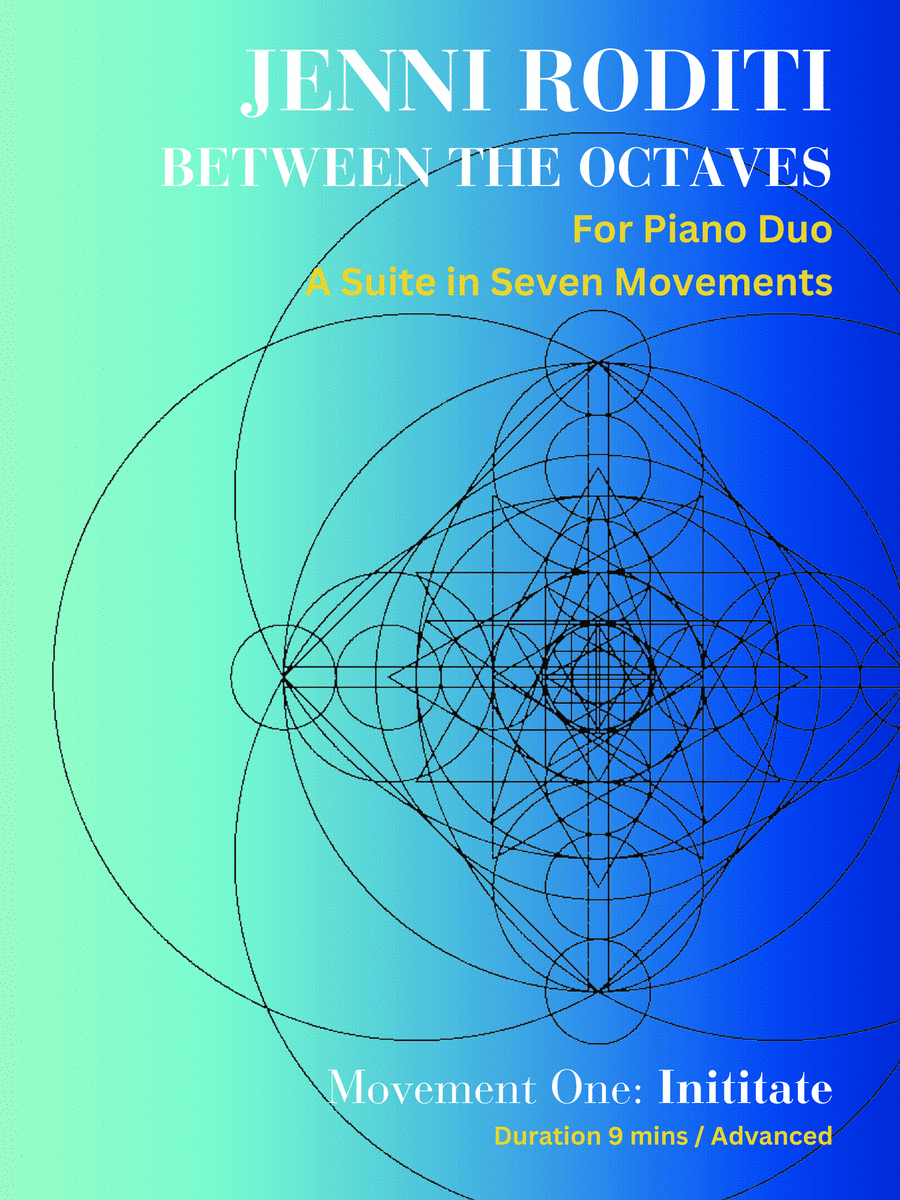
INITIATE, Between the Octaves - A Piano Duo Suite (Movement 1 of 7)
2 Pianos, 4 mains
dislocation I mean a degree of tension between the natural acoustics of the two instruments in the room and the players idiosyncrasies as musicians  The whole point of this work was to examine the nature of my syntax, grammar, and compositional thinking
$20.00 17.34 € 2 Pianos, 4 mains PDF SheetMusicPlus


Partitions Gratuites
Acheter des Partitions Musicales
Acheter des Partitions Digitales à Imprimer
Acheter des Instruments de Musique

© 2000 - 2026

Accueil - Version intégrale





