EUROPE
3397 articles
USA
62 articles
DIGITAL
21 articles (à imprimer)
Partitions Digitales
Partitions à imprimer
21 partitions trouvées


Instrumental Duet,Keyboard - Level 4 - Digital Download SKU: A0.1497861 Composed by Jenni Roditi. 21st Century,Classical,Contemporary. 26 pages. Jenni Roditi #1074273. Published by Jenni Roditi (A0.1497861). Piano Duo 2 pianos/4 hands. Ritualise, Between the Octaves finally found its identity with the word ritualise. It began as announce, became pronounce, then declare and went as far a pontificate for a title. At that point I realised I was mocking my own music and needed to take it more seriously. Ritualise brought out a meaning to the music that I hadn’t wanted to admit to. It is quite folk-like, in a primal and entrancing kind of way. I can imagine a communal dance for some ceremonial purpose in this music with both public and private elements.Names of all the movements in the suite Between the Octaves in the right order are Initiate, Surrender, Thread, Curve, Encircle, Ritualise, Ignite. The whole suite follows a long line from movement 1 to movement 7. However, individual pieces are well suited to be played alone too. Piano Duo is ideally two Steinway grands, otherwise, whatever is available. An enjoyment of the tensions and relationships generated between the two instruments: grand-upright, upright-electronic keyboard is to be explored as a positive. Each piece creates its own world in the suite and can be part of smaller subgroups taken from the suite, in any combination, but the order of the pieces needs to be maintained if more than one is played. Here is a taste of the background to the musical world of this 53 minute compositional suite. During a reflective time I read the following: The whole philosophy of dharma art (Buddhist art) is that you don't try to be artistic, but you just approach objects as they are, and the message comes through automatically. (Chogyam Trungpa Rinpoche, from 'True Perception The Path of Dharma Art.' Shambhala 2008, p.133.) The 'objects as they are' became the 'octaves as they are'. As the pieces were composed the octaves had a centring and clarifying role that allowed other material to circulate around or play against them. They acted as pivots, repetitions, drones, ostinati, pointillist nodes, pedals, melodic features, struts, harmonic turnpikes, breathing spaces, bass lines: musical imperatives. The octaves called the musical shots most of the time. When the music pulled a semitone up or down and away from the octaves (as it did quite often) it was especially telling in the context of the ringing spaces the octaves were creating. I became interested in the subtle dislocation that two pianos could provide. By dislocation I mean a degree of tension between the natural acoustics of the two instruments in the room and the players idiosyncrasies as musicians.  The whole point of this work was to examine the nature of my syntax, grammar, and compositional thinking. The title demanded one thing above all: what notes am I going to use between these octaves?? My choice of notes was derived in most instances from the tempo, pitch, and rhythm of the initial octaves at the beginning of each piece alongside the individual word titles that I set out to explore as musical images. The audio was developed from Sibelius software, via MIDI to Logic samples of a Steinway grand piano.
RITUALISE, Between the Octaves - A Piano Duo Suite (Movement 6 of 7)
2 Pianos, 4 mains
dislocation I mean a degree of tension between the natural acoustics of the two instruments in the room and the players idiosyncrasies as musicians  The whole point of this work was to examine the nature of my syntax, grammar, and compositional thinking
$20.00 16.81 € 2 Pianos, 4 mains PDF SheetMusicPlus

2 Pianos,4 Hands,Piano Duet - Level 3 - Digital Download SKU: A0.1187941 By Richard Simm. By Richard Simm. Arranged by Richard Simm. Folk,Multicultural,Traditional,World. Score. 2 pages. Richard Simm #787548. Published by Richard Simm (A0.1187941). This suite is based upon Richard Simm's Five Irish Melodies, which were originally composed for beginner students to play as piano duets with their teachers or with advanced students. In their new guise for two pianos, they are technically more challenging, but they have the advantage of allowing each performer total control over the subtle pedalling which is sometimes needed here. The lyrics tell of a girl who knows which man she loves, but heaven only knows which one she'll marry...
I Know Where I'm Going
2 Pianos, 4 mains
Richard Simm
$6.95 5.84 € 2 Pianos, 4 mains PDF SheetMusicPlus

Percussion Quartet Marimba - Level 5 - Digital Download SKU: A0.1214857 Composed by Wolfgang Amadeus Mozart. Arranged by Owen Meldon. Classical. 37 pages. Owen Meldon #811788. Published by Owen Meldon (A0.1214857). I was a freshman in high school and just figured out how to use MuseScore. With a holiday concert on the horizon, I wanted to put together a fun arrangement of a classical piece for four percussionists. I settled on Mozart’s Sonata for Two Pianos in D Major (fun fact: this piece has been studied extensively and has proven epilepsy-combatting power!*) and broke down the four piano hands into four marimba parts. In December 2016, I premiered the first iteration of this arrangement with the help of three of my peers; years later, I revisited this arrangement and gave it some much-needed revisions. I also finished arranging the second half of the original, which I couldn’t do in 2016 as the first arrangement had to be fairly short. This is the arrangement in its new finished version, which definitely looks and sounds a lot better than the first. We all start somewhere… *Lin, Lung-Chang, et al. “The Long-Term Effect of Listening to MOZART K.448 Decreases Epileptiform Discharges in Children with Epilepsy.†Instrumentation:Marimba I (4.3 octave marimba minimum)Marimba II (4.3 octave marimba minimum)Marimba III (5.0 octave marimba)Marimba IV (5.0 octave marimba)Duration: c. 6'
Sonata for Two Pianos, I. Allegro con Spirito, K.448 (arr. Owen Meldon)
2 Pianos, 4 mains

$29.99 25.2 € 2 Pianos, 4 mains PDF SheetMusicPlus

2 Pianos,4 Hands,Piano Duet - Level 3 - Digital Download SKU: A0.1182892 By AJR. By Adam Metzger, Jack Metzger, and Ryan Metzger. Arranged by JRN Piano Duo. Contemporary,Pop,Singer/Songwriter. Score. 29 pages. JRN Piano Duo #782641. Published by JRN Piano Duo (A0.1182892). The popular song 'World's Smallest Violin' by AJR arranged and performed by the JRN Piano Duo on two digital pianos (with the help of some digital equipment). You will need a way to loop other instruments and percussion while playing and you need to be able to change your instruments while playing. In the video, a Maschine Mikro MK2 is used. The score includes a compact condensed score and a full orchestral score. Both conatin the same information but differently presented.
World S Smallest Violin
2 Pianos, 4 mains
AJR
$5.99 5.03 € 2 Pianos, 4 mains PDF SheetMusicPlus

Instrumental Duet,Keyboard - Digital Download SKU: A0.1497847 Composed by Jenni Roditi. 21st Century,Classical,Contemporary. 11 pages. Jenni Roditi #1074259. Published by Jenni Roditi (A0.1497847). Piano Duo 2 pianos/4 hands. Thread, Between the Octaves grew out of the call the make a single line weave between the octaves. Line was the original title. Thread, as a word, brings more texture to the title and describes what the line is actually doing, threading around the harmony. A secondary thread is heard after a while, echoing and shading the primary line, with its own treble weave. It was like going back to the beginning of making melody again.Names of all the movements in the suite Between the Octaves in the right order are Initiate, Surrender, Thread, Curve, Encircle, Ritualise, Ignite. The whole suite follows a long line from movement 1 to movement 7. However, individual pieces are well suited to be played alone too. Piano Duo is ideally two Steinway grands, otherwise, whatever is available. An enjoyment of the tensions and relationships generated between the two instruments: grand-upright, upright-electronic keyboard is to be explored as a positive. Each piece creates its own world in the suite and can be part of smaller subgroups taken from the suite, in any combination, but the order of the pieces needs to be maintained if more than one is played. Here is a taste of the background to the musical world of this 53 minute compositional suite. During a reflective time I read the following: The whole philosophy of dharma art (Buddhist art) is that you don't try to be artistic, but you just approach objects as they are, and the message comes through automatically. (Chogyam Trungpa Rinpoche, from 'True Perception The Path of Dharma Art.' Shambhala 2008, p.133.) The 'objects as they are' became the 'octaves as they are'. As the pieces were composed the octaves had a centring and clarifying role that allowed other material to circulate around or play against them. They acted as pivots, repetitions, drones, ostinati, pointillist nodes, pedals, melodic features, struts, harmonic turnpikes, breathing spaces, bass lines: musical imperatives. The octaves called the musical shots most of the time. When the music pulled a semitone up or down and away from the octaves (as it did quite often) it was especially telling in the context of the ringing spaces the octaves were creating. I became interested in the subtle dislocation that two pianos could provide. By dislocation I mean a degree of tension between the natural acoustics of the two instruments in the room and the players idiosyncrasies as musicians.  The whole point of this work was to examine the nature of my syntax, grammar, and compositional thinking. The title demanded one thing above all: what notes am I going to use between these octaves?? My choice of notes was derived in most instances from the tempo, pitch, and rhythm of the initial octaves at the beginning of each piece alongside the individual word titles that I set out to explore as musical images. The audio was developed from Sibelius software, via MIDI to Logic samples of a Steinway grand piano.    
THREAD, Between the Octaves A Piano Duo Suite (Movement 3 of 7)
2 Pianos, 4 mains
dislocation I mean a degree of tension between the natural acoustics of the two instruments in the room and the players idiosyncrasies as musicians  The whole point of this work was to examine the nature of my syntax, grammar, and compositional thinking
$20.00 16.81 € 2 Pianos, 4 mains PDF SheetMusicPlus

Instrumental Duet,Keyboard - Level 5 - Digital Download SKU: A0.1497831 Composed by Jenni Roditi. 21st Century,Classical,Contemporary. 24 pages. Jenni Roditi #1074235. Published by Jenni Roditi (A0.1497831). For Piano Duo - 2 pianos/4hands. Initiate, Between the Octaves, the opening piece in the suite, is a sparky, rhythmic and post-modern hoquet, of some wit and almost perpetual bounciness. A ricocheting of quickly contrasting dynamics with occasional switches to distant moments. Three big plunges into legato emotional flow, release the popping bubbles of the fiery staccato material. A short final chorale settles and grounds the quick cuts, swoops and build ups that have propelled the whole piece. Names of all the movements in the suite Between the Octaves in the right order are Initiate, Surrender, Thread, Curve, Encircle, Ritualise, Ignite. The whole suite follows a long line from movement 1 to movement 7. However, individual pieces are well suited to be played alone too. Piano Duo is ideally two Steinway grands, otherwise, whatever is available. An enjoyment of the tensions and relationships generated between the two instruments: grand-upright, upright-electronic keyboard is to be explored as a positive. Each piece creates its own world in the suite and can be part of smaller subgroups taken from the suite, in any combination, but the order of the pieces needs to be maintained if more than one is played. Here is a taste of the background to the musical world of this 53 minute compositional suite. During a reflective time I read the following: The whole philosophy of dharma art (Buddhist art) is that you don't try to be artistic, but you just approach objects as they are, and the message comes through automatically. (Chogyam Trungpa Rinpoche, from 'True Perception The Path of Dharma Art.' Shambhala 2008, p.133.) The 'objects as they are' became the 'octaves as they are'. As the pieces were composed the octaves had a centring and clarifying role that allowed other material to circulate around or play against them. They acted as pivots, repetitions, drones, ostinati, pointillist nodes, pedals, melodic features, struts, harmonic turnpikes, breathing spaces, bass lines: musical imperatives. The octaves called the musical shots most of the time. When the music pulled a semitone up or down and away from the octaves (as it did quite often) it was especially telling in the context of the ringing spaces the octaves were creating. I became interested in the subtle dislocation that two pianos could provide. By dislocation I mean a degree of tension between the natural acoustics of the two instruments in the room and the players idiosyncrasies as musicians.  The whole point of this work was to examine the nature of my syntax, grammar, and compositional thinking. The title demanded one thing above all: what notes am I going to use between these octaves?? My choice of notes was derived in most instances from the tempo, pitch, and rhythm of the initial octaves at the beginning of each piece alongside the individual word titles that I set out to explore as musical images. The audio was developed from Sibelius software, via MIDI to Logic samples of a Steinway grand piano.

INITIATE, Between the Octaves - A Piano Duo Suite (Movement 1 of 7)
2 Pianos, 4 mains
dislocation I mean a degree of tension between the natural acoustics of the two instruments in the room and the players idiosyncrasies as musicians  The whole point of this work was to examine the nature of my syntax, grammar, and compositional thinking
$20.00 16.81 € 2 Pianos, 4 mains PDF SheetMusicPlus

Instrumental Duet,Keyboard - Digital Download SKU: A0.1497843 Composed by Jenni Roditi. 21st Century,Classical,Contemporary. 12 pages. Jenni Roditi #1074255. Published by Jenni Roditi (A0.1497843). Piano Duo - 2 pianos, 4 hands. Surrender, Between the Octaves was the piece that was composed first in the suite. It exposes a simple call to return to the beginning, to return to a pure act of listening. This note..ah, now that note.. oh. This is how the piece was written - one note at a time. Listening from within a space (its original title) of resonance, of edges and meetings, of disappearances and repetitions that reflect on this gentle body of notes. There is a slow hearing that may, or may not create a tone-journey.Names of all the movements in the suite Between the Octaves in the right order are Initiate, Surrender, Thread, Curve, Encircle, Ritualise, Ignite. The whole suite follows a long line from movement 1 to movement 7. However, individual pieces are well suited to be played alone too. Piano Duo is ideally two Steinway grands, otherwise, whatever is available. An enjoyment of the tensions and relationships generated between the two instruments: grand-upright, upright-electronic keyboard is to be explored as a positive. Each piece creates its own world in the suite and can be part of smaller subgroups taken from the suite, in any combination, but the order of the pieces needs to be maintained if more than one is played. Here is a taste of the background to the musical world of this 53 minute compositional suite. During a reflective time I read the following: The whole philosophy of dharma art (Buddhist art) is that you don't try to be artistic, but you just approach objects as they are, and the message comes through automatically. (Chogyam Trungpa Rinpoche, from 'True Perception The Path of Dharma Art.' Shambhala 2008, p.133.) The 'objects as they are' became the 'octaves as they are'. As the pieces were composed the octaves had a centring and clarifying role that allowed other material to circulate around or play against them. They acted as pivots, repetitions, drones, ostinati, pointillist nodes, pedals, melodic features, struts, harmonic turnpikes, breathing spaces, bass lines: musical imperatives. The octaves called the musical shots most of the time. When the music pulled a semitone up or down and away from the octaves (as it did quite often) it was especially telling in the context of the ringing spaces the octaves were creating. I became interested in the subtle dislocation that two pianos could provide. By dislocation I mean a degree of tension between the natural acoustics of the two instruments in the room and the players idiosyncrasies as musicians.  The whole point of this work was to examine the nature of my syntax, grammar, and compositional thinking. The title demanded one thing above all: what notes am I going to use between these octaves?? My choice of notes was derived in most instances from the tempo, pitch, and rhythm of the initial octaves at the beginning of each piece alongside the individual word titles that I set out to explore as musical images. The audio was developed from Sibelius software, via MIDI to Logic samples of a Steinway grand piano.

SURRENDER, Between the Octaves, A Piano Duo Suite (Movement 2 of 7)
2 Pianos, 4 mains
dislocation I mean a degree of tension between the natural acoustics of the two instruments in the room and the players idiosyncrasies as musicians  The whole point of this work was to examine the nature of my syntax, grammar, and compositional thinking
$20.00 16.81 € 2 Pianos, 4 mains PDF SheetMusicPlus

2 Pianos,4 Hands,Piano Duet - Level 2 - Digital Download SKU: A0.1119510 Composed by Sibylle Kuder. Classical,Contest,Festival,Instructional. Score. 6 pages. Sibylle Kuder #720922. Published by Sibylle Kuder (A0.1119510). I frequently make changes to my compositions. If you would like to make sure that you have the latest edition, please send an email to sibyllekuder@gmail.com ~ If there is a newer edition I will gladly send you the updated PDF file! ~ Early Intermediate. ~ Cheerful, light-hearted, needs very energetic staccato. ~ The PDF file has two versions: a 6-page practice version with lots of white space for adding comments, and a performance version condensed onto four pages, to fit the average music stand.
Concertino in C major I. Allegretto for Early Intermediate Piano
2 Pianos, 4 mains

$3.99 3.35 € 2 Pianos, 4 mains PDF SheetMusicPlus

Instrumental Duet,Keyboard - Level 4 - Digital Download SKU: A0.1497857 Composed by Jenni Roditi. 21st Century,Classical,Contemporary. 19 pages. Jenni Roditi #1074269. Published by Jenni Roditi (A0.1497857). Piano Duo 2 pianos/4 hands. Encircle, Between the Octaves, originally called rotate as its impetus was to generate a steadily rotating music. Encircle was later chosen as a more evocative word. The harmony surprised me as it suggested shifts and colourations that I would not have expected to conjure. Two upper rotating parts with melodic narrative are supported by bass and baritone lower parts. The final section adds a dance-like short form to end what could otherwise have run and run and run.  Names of all the movements in the suite Between the Octaves in the right order are Initiate, Surrender, Thread, Curve, Encircle, Ritualise, Ignite. The whole suite follows a long line from movement 1 to movement 7. However, individual pieces are well suited to be played alone too. Piano Duo is ideally two Steinway grands, otherwise, whatever is available. An enjoyment of the tensions and relationships generated between the two instruments: grand-upright, upright-electronic keyboard is to be explored as a positive. Each piece creates its own world in the suite and can be part of smaller subgroups taken from the suite, in any combination, but the order of the pieces needs to be maintained if more than one is played. Here is a taste of the background to the musical world of this 53 minute compositional suite. During a reflective time I read the following: The whole philosophy of dharma art (Buddhist art) is that you don't try to be artistic, but you just approach objects as they are, and the message comes through automatically. (Chogyam Trungpa Rinpoche, from 'True Perception The Path of Dharma Art.' Shambhala 2008, p.133.) The 'objects as they are' became the 'octaves as they are'. As the pieces were composed the octaves had a centring and clarifying role that allowed other material to circulate around or play against them. They acted as pivots, repetitions, drones, ostinati, pointillist nodes, pedals, melodic features, struts, harmonic turnpikes, breathing spaces, bass lines: musical imperatives. The octaves called the musical shots most of the time. When the music pulled a semitone up or down and away from the octaves (as it did quite often) it was especially telling in the context of the ringing spaces the octaves were creating. I became interested in the subtle dislocation that two pianos could provide. By dislocation I mean a degree of tension between the natural acoustics of the two instruments in the room and the players idiosyncrasies as musicians.  The whole point of this work was to examine the nature of my syntax, grammar, and compositional thinking. The title demanded one thing above all: what notes am I going to use between these octaves?? My choice of notes was derived in most instances from the tempo, pitch, and rhythm of the initial octaves at the beginning of each piece alongside the individual word titles that I set out to explore as musical images. The audio was developed from Sibelius software, via MIDI to Logic samples of a Steinway grand piano. 

ENCIRCLE, Between the Octaves - A Piano Duo Suite (Movement 5 of 7)
2 Pianos, 4 mains
dislocation I mean a degree of tension between the natural acoustics of the two instruments in the room and the players idiosyncrasies as musicians  The whole point of this work was to examine the nature of my syntax, grammar, and compositional thinking
$20.00 16.81 € 2 Pianos, 4 mains PDF SheetMusicPlus

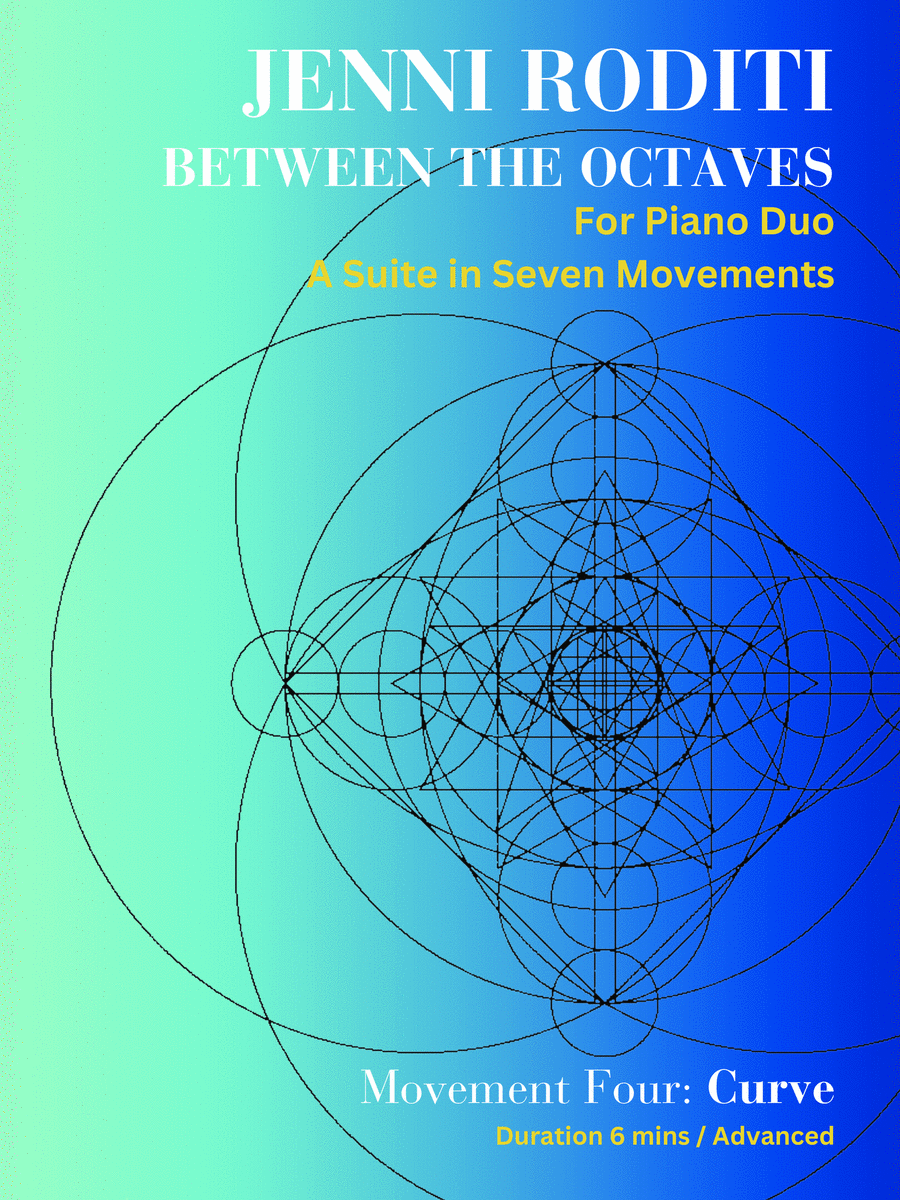
Instrumental Duet,Keyboard - Digital Download SKU: A0.1497852 Composed by Jenni Roditi. 21st Century,Classical,Contemporary. 17 pages. Jenni Roditi #1074264. Published by Jenni Roditi (A0.1497852). Piano Duo 2 pianos/4 hands. Curve, Between the Octaves points to a fugal past, where lines enter and build in stately flow. It invites lines to intermingle, without assuming they will all arrive somewhere, or at the same time. A certain intensity builds, then scales, both up and down, free themselves from the discussion of the interleaving lines. The chromaticism suggests curving between harmonies, and is nearly always ambivalent. An assertive chordal climax intervenes to shake off the tensions, yet this peels away into further curvatures that twist and twirl, until a final resting point agrees to present itself.  Names of all the movements in the suite Between the Octaves in the right order are Initiate, Surrender, Thread, Curve, Encircle, Ritualise, Ignite. The whole suite follows a long line from movement 1 to movement 7. However, individual pieces are well suited to be played alone too. Piano Duo is ideally two Steinway grands, otherwise, whatever is available. An enjoyment of the tensions and relationships generated between the two instruments: grand-upright, upright-electronic keyboard is to be explored as a positive. Each piece creates its own world in the suite and can be part of smaller subgroups taken from the suite, in any combination, but the order of the pieces needs to be maintained if more than one is played. Here is a taste of the background to the musical world of this 53 minute compositional suite. During a reflective time I read the following: The whole philosophy of dharma art (Buddhist art) is that you don't try to be artistic, but you just approach objects as they are, and the message comes through automatically. (Chogyam Trungpa Rinpoche, from 'True Perception The Path of Dharma Art.' Shambhala 2008, p.133.) The 'objects as they are' became the 'octaves as they are'. As the pieces were composed the octaves had a centring and clarifying role that allowed other material to circulate around or play against them. They acted as pivots, repetitions, drones, ostinati, pointillist nodes, pedals, melodic features, struts, harmonic turnpikes, breathing spaces, bass lines: musical imperatives. The octaves called the musical shots most of the time. When the music pulled a semitone up or down and away from the octaves (as it did quite often) it was especially telling in the context of the ringing spaces the octaves were creating. I became interested in the subtle dislocation that two pianos could provide. By dislocation I mean a degree of tension between the natural acoustics of the two instruments in the room and the players idiosyncrasies as musicians.  The whole point of this work was to examine the nature of my syntax, grammar, and compositional thinking. The title demanded one thing above all: what notes am I going to use between these octaves?? My choice of notes was derived in most instances from the tempo, pitch, and rhythm of the initial octaves at the beginning of each piece alongside the individual word titles that I set out to explore as musical images. The audio was developed from Sibelius software, via MIDI to Logic samples of a Steinway grand piano.

CURVE, Between the Octaves - A Piano Duo Suite (Movement 4 of 7)
2 Pianos, 4 mains
dislocation I mean a degree of tension between the natural acoustics of the two instruments in the room and the players idiosyncrasies as musicians  The whole point of this work was to examine the nature of my syntax, grammar, and compositional thinking
$20.00 16.81 € 2 Pianos, 4 mains PDF SheetMusicPlus

Instrumental Duet,Keyboard - Level 4 - Digital Download SKU: A0.1497866 Composed by Jenni Roditi. 21st Century,Classical,Contemporary. 24 pages. Jenni Roditi #1074279. Published by Jenni Roditi (A0.1497866). Piano Duo - 2 pianos/4 hands. Ignite, Between the Octaves began with the impetus of static ‘pulsation’ (its original title) on repeated octaves. The piece is a fizzing dash of nodal vortices, small, then larger, spinning and tumbling and all the way to the finish line. This piece brings the complete suite of 7 pieces to a dynamic close, with a sense of ignition to new beginnings. The music echoes the opening F octaves of Initiate (movement 1). Names of all the movements in the suite Between the Octaves in the right order are Initiate, Surrender, Thread, Curve, Encircle, Ritualise, Ignite. The whole suite follows a long line from movement 1 to movement 7. However, individual pieces are well suited to be played alone too. Piano Duo is ideally two Steinway grands, otherwise, whatever is available. An enjoyment of the tensions and relationships generated between the two instruments: grand-upright, upright-electronic keyboard is to be explored as a positive. Each piece creates its own world in the suite and can be part of smaller subgroups taken from the suite, in any combination, but the order of the pieces needs to be maintained if more than one is played. Here is a taste of the background to the musical world of this 53 minute compositional suite. During a reflective time I read the following: The whole philosophy of dharma art (Buddhist art) is that you don't try to be artistic, but you just approach objects as they are, and the message comes through automatically. (Chogyam Trungpa Rinpoche, from 'True Perception The Path of Dharma Art.' Shambhala 2008, p.133.) The 'objects as they are' became the 'octaves as they are'. As the pieces were composed the octaves had a centring and clarifying role that allowed other material to circulate around or play against them. They acted as pivots, repetitions, drones, ostinati, pointillist nodes, pedals, melodic features, struts, harmonic turnpikes, breathing spaces, bass lines: musical imperatives. The octaves called the musical shots most of the time. When the music pulled a semitone up or down and away from the octaves (as it did quite often) it was especially telling in the context of the ringing spaces the octaves were creating. I became interested in the subtle dislocation that two pianos could provide. By dislocation I mean a degree of tension between the natural acoustics of the two instruments in the room and the players idiosyncrasies as musicians.  The whole point of this work was to examine the nature of my syntax, grammar, and compositional thinking. The title demanded one thing above all: what notes am I going to use between these octaves?? My choice of notes was derived in most instances from the tempo, pitch, and rhythm of the initial octaves at the beginning of each piece alongside the individual word titles that I set out to explore as musical images. The audio was developed from Sibelius software, via MIDI to Logic samples of a Steinway grand piano. 

IGNITE, Between the Octaves - A Piano Duo Suite (Movement 7 of 7)
2 Pianos, 4 mains
dislocation I mean a degree of tension between the natural acoustics of the two instruments in the room and the players idiosyncrasies as musicians  The whole point of this work was to examine the nature of my syntax, grammar, and compositional thinking
$20.00 16.81 € 2 Pianos, 4 mains PDF SheetMusicPlus

2 Pianos,4 Hands,Piano Duet - Level 2 - Digital Download SKU: A0.1359564 Composed by Classical, Americana, and Jamaican Traditionals. Arranged by Amy O'Grady. Classical,Comedy,Traditional. Score. 13 pages. Life at the Speed of Music #944027. Published by Life at the Speed of Music (A0.1359564). With Part I as playful as Part II, school, private studio, adult education, and recreational center teachers need only leave the pages on a piano or iPad for students to spring into action! Parts are just one page, so players can easily practice together, then coordinate over counting and performance. Includes Banana Boat Song, Circus Time Can-Can, Chopsticks Ole!, Good Night, Ladies, The Entertainer, and Waltz Time.
6 Good Time Gems for Early Intermediate Piano Duos
2 Pianos, 4 mains

$7.99 6.71 € 2 Pianos, 4 mains PDF SheetMusicPlus


Partitions Gratuites
Acheter des Partitions Musicales
Acheter des Partitions Digitales à Imprimer
Acheter des Instruments de Musique

© 2000 - 2026

Accueil - Version intégrale
