EUROPE
2494 articles
USA
0 articles
DIGITAL
22 articles (à imprimer)
Partitions Digitales
Partitions à imprimer
22 partitions trouvées


Instrumental Duet Instrumental Duet,Piano - Level 5 - Digital Download SKU: A0.534483 Composed by Germaine Tailleferre. 20th Century,Concert,Standards. Score and parts. 65 pages. Musik Fabrik Music Publishing #3534799. Published by Musik Fabrik Music Publishing (A0.534483). This work was written in the first months of 1942 while Tailleferre was living in Grasse, in the socolled« Free Zone » of occupied France during the Second World War and was completed just asTailleferre was forced to flee France with her daughter. As the wife of Jean Lageat, who had been thesecretary of the French socialist Léon Blum during the « Front Populaire » period just before the Warand who was at that time in the US working against the Vichy Government, and as someone who wasnot unvocal about her political views, this could not have been a comfortable situation. Tailleferre left arecord of what she experienced during this period in an article written for the American music journal «Modern Music » which she wrote shortly after arriving in America in the Spring of 1942 :« Notwithstanding their staunch spirit of resistence, the people under German rule today areincreasingly bowed down under their burdens. By achieving the physical decline of the French, theNazis hope that spiritual collapse will ensue. However, after two years of quasi-famine, France remainspround and great, although the necessity of liberation grows daily more urgent.....For an artist to workunder these conditions is almost impossible. The mere effort of subsisting wastes time and absorbsenergy ; The means to work are also lacking.....Musical composition is made practically impossiblethrough lack of music paper. For more than a year, I sought in vain to find paper in Lyon, Marseillesand Nice on which to copy an orchestral score...Two years of experience under German rule havetaught me that all expressions of pride, dignity, spirit , aspiration of the human will can be made onlyclaudestinely. It is a historical truth that the human mind makes its greatest progress under freedom ».Under such circumstances, it is a miracle that this work exists at all. The three movement work wasdedicated to the famous Marguerite Long, for whom Tailleferre had already written several short worksfor piano solo, and François Lang, a pianist who was closely linked with the Group des Six and whohad performed in the première of the 1934 Concerto Grosso for Two Pianos, 8 Solo Voices, SaxophoneQuartet and Orchestra and for whom Tailleferre wrote two cadenzas for concerti by Mozart and Haydn.The work opens with sunny, optimistism in a mood similar to the opening movement of the ConcertoGrosso, but quickly the mood changes to more dramatic themes. The second movement seems tosubjectively express a rupture with the past and a tragic melancholy. The final third movement isextremely dramatic and almost frightening with it’s force.When Tailleferre left France in the Spring of 1942, having been warned by a neighbor that she wasgoing to be arrested if she didn’t leave immediately, she left the score in a two-piano version, probablydue to the fact that there was no music paper to be had to copy the score. When she returned to Francein 1946, she learned that François Lang had been deported to Auschwitz where he died. Musical life inFrance had been completely changed by the War years. Tailleferre put the work aside and forgot aboutit, perhaps wanting to forget the hardships that she had lived through and the loss of many of her friendsassociated with these years.Tailleferre's version for two pianos is published by Musik Fabrik and the work may be performed inthat version. It is clear however, that the work was intended to be orchestrated and the editors hope thatthe present orchestration will allow the work to finally be presented as Tailleferre conceived duringsome of the darkest years of the Twentieth century.
Germaine Tailleferre: Trois Études for two pianos
2 Pianos, 4 mains
achieving the physical decline of the French, the
Nazis hope that spiritual collapse will ensue
However, after two years of quasi-famine, France remains
pround and great, although the necessity of liberation grows daily more urgent

$32.95 28.59 € 2 Pianos, 4 mains PDF SheetMusicPlus

Percussion Quartet Marimba - Level 5 - Digital Download SKU: A0.1214857 Composed by Wolfgang Amadeus Mozart. Arranged by Owen Meldon. Classical. 37 pages. Owen Meldon #811788. Published by Owen Meldon (A0.1214857). I was a freshman in high school and just figured out how to use MuseScore. With a holiday concert on the horizon, I wanted to put together a fun arrangement of a classical piece for four percussionists. I settled on Mozart’s Sonata for Two Pianos in D Major (fun fact: this piece has been studied extensively and has proven epilepsy-combatting power!*) and broke down the four piano hands into four marimba parts. In December 2016, I premiered the first iteration of this arrangement with the help of three of my peers; years later, I revisited this arrangement and gave it some much-needed revisions. I also finished arranging the second half of the original, which I couldn’t do in 2016 as the first arrangement had to be fairly short. This is the arrangement in its new finished version, which definitely looks and sounds a lot better than the first. We all start somewhere… *Lin, Lung-Chang, et al. “The Long-Term Effect of Listening to MOZART K.448 Decreases Epileptiform Discharges in Children with Epilepsy.†Instrumentation:Marimba I (4.3 octave marimba minimum)Marimba II (4.3 octave marimba minimum)Marimba III (5.0 octave marimba)Marimba IV (5.0 octave marimba)Duration: c. 6'
Sonata for Two Pianos, I. Allegro con Spirito, K.448 (arr. Owen Meldon)
2 Pianos, 4 mains

$29.99 26.02 € 2 Pianos, 4 mains PDF SheetMusicPlus

2 Pianos,4 Hands,Piano Duet - Level 5 - Digital Download SKU: A0.977034 Composed by Paul SanGregory. Contemporary. Score. 29 pages. Distant Engraver Music #3536815. Published by Distant Engraver Music (A0.977034). Each of these four short pieces has its own character, color and rhythmic flow. Because the interplay between parts is sometimes complex and challenging, they can provide wonderful ensemble workouts for performers as well as fun and exciting musical experiences for audiences. The title Harmonic Spaces refers to both the idea that they are musical spaces filled with colors and characters as well as to the widely-spaced harmonic intervals upon which those aspects are built. Each movement is based on one or two wide intervals that mimic the spacing of overtones (or partials) in the harmonic series. This approach allowed the composer to produce unique harmonies, colors and atmospheres. For listeners, of course, knowledge of these intervals isn't important, even though the colors, characters and atmospheres they produce is. Each movement is described briefly below: I - Simply and gracefully moving forward. (9th and 3rd partials)This gently flowing movement is a slow progression of widely-spaced chords with gracefully rising and falling strings of notes woven in and around them. The chords often appear in groups of two, with the second being quieter, like an echo of the first. That creates a sense of harmonic space within which the delicate lines move in and out of agreement with the chords.II - With a steady, even flow (or groove). (7th and 5th partials)The harmonic partials of this movement are what give dominant 7th chords their characteristic sound and function. Furthermore, because 7th chords are an important part of jazz harmony, jazz influences enter into this piece. Listeners may notice the outlines of gliding 7th chords, swinging meters and syncopated rhtyhms reminiscent of jazz.III - Gentle, flexible, but rhythmically accurate. (11th Partial)This movement unfolds slowly like a quiet summer afternoon under a shade tree watching lazy clouds. Because the 11th partial is a note that falls between the cracks of the piano keyboard, both the perfect 4th and augmented 4th (in very wide spacing) are used to approximate it. Although this creates some non-traditional harmonies and non-chord tone effects, the piece is tranquil, peaceful and beautiful. IV - With precision, energy and excitement. (13th Partial)This energetic finale uses much syncopation and rhythmic interplay as well as wide-ranging arpeggios that get shared between the two players. The primary interval often appears as widely spaced parallel motion, which adds a special color or flavor to the rhythms. The result is a joyful romp in a playground of rhythm, color, motion and contrast. (duration of all four pieces is ca. 12 minutes) This work was funded by the National Culture and Arts Foundation of Taiwan (ROC)
Harmonic Spaces (four-hands piano)
2 Pianos, 4 mains

$10.00 8.68 € 2 Pianos, 4 mains PDF SheetMusicPlus

2 Pianos,4 Hands,Piano Duet - Level 3 - Digital Download SKU: A0.1126731 Composed by Richard Simm. Arranged by Richard Simm. Chamber,Classical,Folk,Multicultural,Traditional,World. Score. 4 pages. Richard Simm #727380. Published by Richard Simm (A0.1126731). The first item in this suite of Icelandic tunes by Richard Simm is a hair-raising ghost story! These Icelandic melodies were originally arranged by Simm for beginner students to play as piano duets with their teachers or with advanced students. In their new form for two pianos, they are more embellished and technically challenging than the originals, but are short enough not to present too much of a hurdle. Four of the five songs are known to every Icelander, and their original texts often have stark, dramatic undertones.
"Ghost Story" from An Icelandic Suite
2 Pianos, 4 mains

$4.95 4.3 € 2 Pianos, 4 mains PDF SheetMusicPlus

2 Pianos,4 Hands,Piano Duet - Level 3 - Digital Download SKU: A0.1137117 Composed by Lahkang Myu Awng. Classical,Contemporary,Folk. Score. 16 pages. Myu A Shingni #737224. Published by Myu A Shingni (A0.1137117). “Dumba†is a piano four-hand composition of Lahkang Myu Awng (Myo Aung), and it is required two pianos. The composer employs Kachin's traditional folk tune and which is part of completely pentatonic. Dumba is the name of the wind instrument of the Kachin people, and it always uses in traditional Manau dance. It is one of the necessary instruments. It makes with a Buffalo horn, and it has a few holes. Those holes generate some unique pitches when the fingering alternately moves. The timbre of Dumba is mellow, and the melodic materials are a unique cadence. In this piece, the composer deliberately inserts a short melodic material from Dumba, especially in the cadence of each passage. Instrumentation: Pianos Four-hand Duration: 3:43.
Dumba
2 Pianos, 4 mains

$4.99 4.33 € 2 Pianos, 4 mains PDF SheetMusicPlus

2 Pianos,4 Hands,Piano Duet - Level 5 - Digital Download SKU: A0.1175185 By Paul Posnak & Anita Castiglione. By George Gershwin. Arranged by Paul Posnak. 20th Century,Classical,Jazz,Standards. Score. 10 pages. Paul Posnak #775326. Published by Paul Posnak (A0.1175185). Arrangement for 2 pianos, 4 hands of Swanee by George Gershwin.Foreword by the arranger:George Gershwin, since his days as a teenage song-plugger in Tin Pan Alley, loved the medium of two pianos. A consummate improviser with a harmonically sophisticated, jazz-influenced,orchestral approach to the treatment of melody, he was born into the great age of touring duo piano teams, such as Bauer and Gabrilowitsch, Josef and Rhosina Levine, Luboshutz and Nemenoff, and Gershwin's favorite team, Arden and Ohman. Gershwin loved the multi-voiced orchestral color, power and range of two pianists playing and improvising together. In his first major show written with brother Ira, the 1924 Lady Be Good, he incorporated the renowned team of Phil Ohman and Victor Arden into the musical theater pit orchestra, not only to add to the orchestra's sound and rhythmic drive, but also to play during breaks in the action and during Intermission. They even played encores! This successful formula was repeated for the 1926 show, Oh, Kay, and for the 1927 show, Funny Face.Gershwin's own bravura improvisations on his songs sound, even to the trained ear, like two pianos. I have transcribed (and digitally re-recorded) a number of these improvisations note-for-note from the old LP-remastered 78 rpm records and radio broadcasts. I have tried to capture his own two-fisted orchestral keyboard style: his love of inner voices, contrapuntal runs, jazz figurations, sophisticated chordal textures, and swing.These arrangements resulted from my appearance in 2003 as one of two soloists in several all-Gershwin concerts with The National Symphony Orchestra under the direction of Marvin Hamlisch. Marvin suggested that I also play a couple of my Gershwin improvisation transcriptions, and we thought it would be a perfect touch for Lorin Hollander, the other soloist, and me to play a short two-piano piece. I was surprised to find very few two-piano arrangements of Gershwin's songs. I became inspired to fill this void in the duo piano repertoire. It is my hope that these settings will offer a worthy challenge and musical reward for intermediate and advanced piano students and amateurs, and a unique addition to the duo piano literature for professional pianists and duo piano teams the world over.Paul Posnak.
Swanee
2 Pianos, 4 mains
Paul Posnak & Anita Castiglione
$12.00 10.41 € 2 Pianos, 4 mains PDF SheetMusicPlus

2 Pianos,4 Hands,Piano Duet - Level 2 - Digital Download SKU: A0.1455798 By Sharon Wilson. By John Bacchus Dykes and Reginald Heber. Arranged by Sharon Wilson. 19th Century,Christian,Easter,Romantic Period,Sacred. Score. 10 pages. Sharon Wilson #1034895. Published by Sharon Wilson (A0.1455798). This arrangement of the beloved hymn tune NICAEA by John B. Dykes is written as a dual piano duet (for 2 pianos, 4 hands). Both parts carry the melody at times making it fun and equally challenging for both players while adding variety for the listeners. An optional repeat is provided in case a longer selection is desired. Bold and energetic throughout, this piano duet is ideal for a prelude, postlude, offertory, or whenever an upbeat, short musical interlude is desired. The purchase price includes a 4-page score with combined PIANO 1 and PIANO 2 parts on each page (Grand Staff) plus an alternate format with the PIANO 1 and PIANO 2 parts on separate pages (2 pages each). This arrangement is one of the 5 songs in the collection Hymns of Praise for Two Pianos.Visit Sharon Wilson's website: https://www.SharonWilsonMusic.com/Subscribe to her YouTube Channel: https://youtube.com/@SharonWilsonMusic
Holy, Holy, Holy (2 Pianos, 4 Hands Duet)
2 Pianos, 4 mains
Sharon Wilson
$5.99 5.2 € 2 Pianos, 4 mains PDF SheetMusicPlus

2 Pianos,4 Hands,Piano Duet - Level 3 - Digital Download SKU: A0.565569 By Philip P. Bliss. By Horatio G. Spafford and Philip P. Bliss. Arranged by Sharon Wilson Music. Christian,Easter,Praise & Worship,Romantic Period,Sacred. Score. 18 pages. Sharon Wilson #4793639. Published by Sharon Wilson (A0.565569). The beloved hymn When Peace Like a River by Phil P. Bliss is presented here as a flowing, peaceful intermediate 2 pianos, 4-hands duet (hymn tune VILLE DU HAVRE). Both PIANO 1 and PIANO 2 get to lead with the melody at times making this a fun and equally challenging piece for both players while adding variety for the listeners.PIANO1 plays the melody for the first verse and chorus. After a short interlude PIANO 2 then leads with the melody for the second verse and chorus. This beautiful, uplifting piano duo arrangement is an ideal selection for a church setting and a valuable addition to your sacred repertoire. Duration 3:15.The purchase price includes a 9-page score with both piano parts on each page plus an alternate format with the two piano parts on separate pages (4 pages each).
It Is Well with My Soul (2 Pianos, 4 Hands Duet)
2 Pianos, 4 mains
Philip P Bliss
$5.99 5.2 € 2 Pianos, 4 mains PDF SheetMusicPlus

2 Pianos,4 Hands,Piano Duet - Level 1 - Digital Download SKU: A0.1265430 Composed by Alison Mathews. Children,Contemporary,Instructional. Score. 8 pages. Alison Mathews #858248. Published by Alison Mathews (A0.1265430). This is short lively piece for 4 hands that reinforces the landmark Cs, both on the stave and on the keyboard. Level one uses C3, C4, C5 and level two uses C2 to C6 with a final flourish using all 8 Cs! Originally written to be played at 2 pianos I’ve included a duet version which involves some extra moving around the keyboard for both players to ensure your pupil always plays at the correct octave. It’s easy to fit into lesson time alongside flashcard games or to supplement your method book. You can even extend it further by getting your student to create their own part, deciding on the order of Cs and rhythm!
C it, Play it!
2 Pianos, 4 mains

$4.99 4.33 € 2 Pianos, 4 mains PDF SheetMusicPlus

Instrumental Duet,Keyboard - Level 4 - Digital Download SKU: A0.1497857 Composed by Jenni Roditi. 21st Century,Classical,Contemporary. 19 pages. Jenni Roditi #1074269. Published by Jenni Roditi (A0.1497857). Piano Duo 2 pianos/4 hands. Encircle, Between the Octaves, originally called rotate as its impetus was to generate a steadily rotating music. Encircle was later chosen as a more evocative word. The harmony surprised me as it suggested shifts and colourations that I would not have expected to conjure. Two upper rotating parts with melodic narrative are supported by bass and baritone lower parts. The final section adds a dance-like short form to end what could otherwise have run and run and run.  Names of all the movements in the suite Between the Octaves in the right order are Initiate, Surrender, Thread, Curve, Encircle, Ritualise, Ignite. The whole suite follows a long line from movement 1 to movement 7. However, individual pieces are well suited to be played alone too. Piano Duo is ideally two Steinway grands, otherwise, whatever is available. An enjoyment of the tensions and relationships generated between the two instruments: grand-upright, upright-electronic keyboard is to be explored as a positive. Each piece creates its own world in the suite and can be part of smaller subgroups taken from the suite, in any combination, but the order of the pieces needs to be maintained if more than one is played. Here is a taste of the background to the musical world of this 53 minute compositional suite. During a reflective time I read the following: The whole philosophy of dharma art (Buddhist art) is that you don't try to be artistic, but you just approach objects as they are, and the message comes through automatically. (Chogyam Trungpa Rinpoche, from 'True Perception The Path of Dharma Art.' Shambhala 2008, p.133.) The 'objects as they are' became the 'octaves as they are'. As the pieces were composed the octaves had a centring and clarifying role that allowed other material to circulate around or play against them. They acted as pivots, repetitions, drones, ostinati, pointillist nodes, pedals, melodic features, struts, harmonic turnpikes, breathing spaces, bass lines: musical imperatives. The octaves called the musical shots most of the time. When the music pulled a semitone up or down and away from the octaves (as it did quite often) it was especially telling in the context of the ringing spaces the octaves were creating. I became interested in the subtle dislocation that two pianos could provide. By dislocation I mean a degree of tension between the natural acoustics of the two instruments in the room and the players idiosyncrasies as musicians.  The whole point of this work was to examine the nature of my syntax, grammar, and compositional thinking. The title demanded one thing above all: what notes am I going to use between these octaves?? My choice of notes was derived in most instances from the tempo, pitch, and rhythm of the initial octaves at the beginning of each piece alongside the individual word titles that I set out to explore as musical images. The audio was developed from Sibelius software, via MIDI to Logic samples of a Steinway grand piano. 
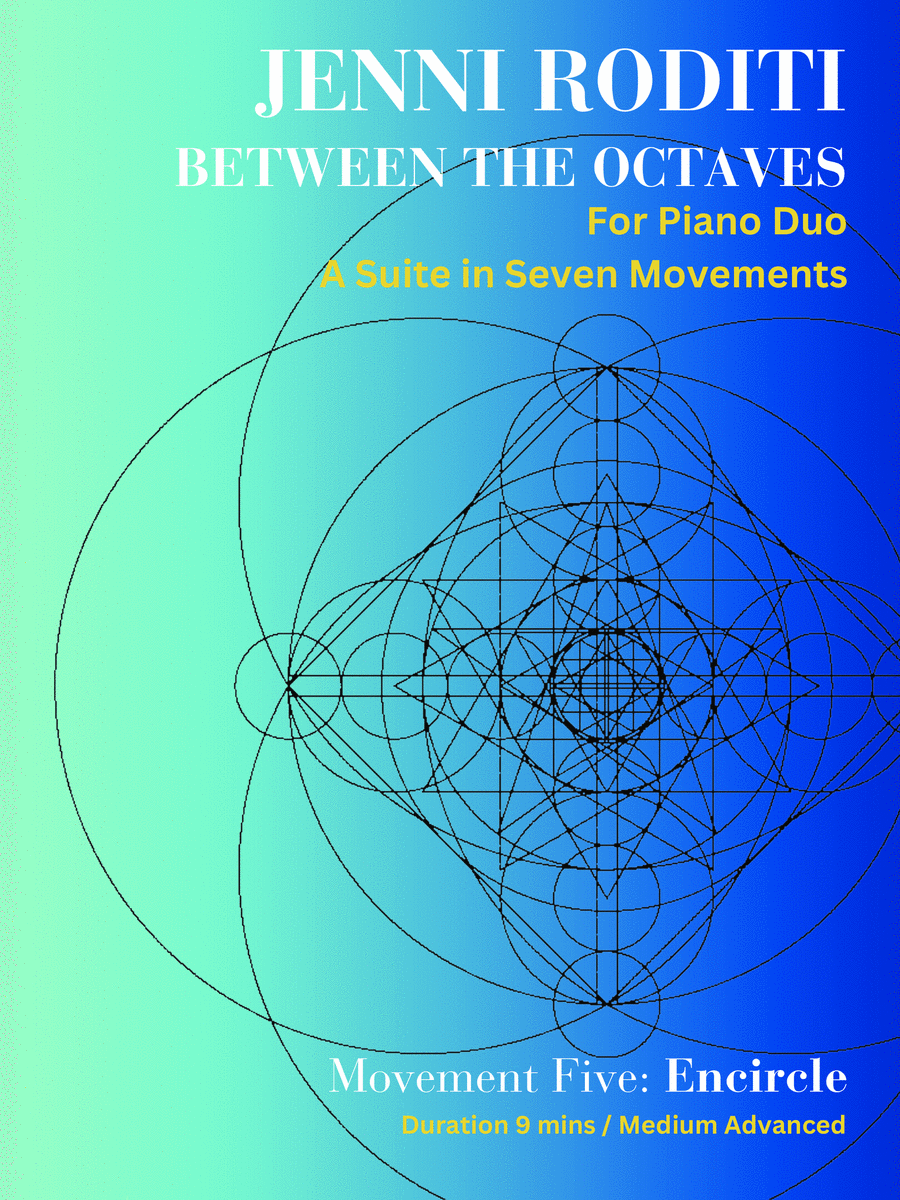
ENCIRCLE, Between the Octaves - A Piano Duo Suite (Movement 5 of 7)
2 Pianos, 4 mains
dislocation I mean a degree of tension between the natural acoustics of the two instruments in the room and the players idiosyncrasies as musicians  The whole point of this work was to examine the nature of my syntax, grammar, and compositional thinking
$20.00 17.35 € 2 Pianos, 4 mains PDF SheetMusicPlus

2 Pianos,4 Hands,Piano Duet - Level 2 - Digital Download SKU: A0.887970 Composed by Graham Yates. Children,Contemporary,Standards. Score. 23 pages. Graham Yates #4995081. Published by Graham Yates (A0.887970). Nine short, silly pieces for piano students. The pieces include piano solos, teacher-student duets, student-student duets (or trio), and a piece with optional auxiliary percussion parts suitable for students. Skill levels range from beginner to intermediate. This work makes a great focal point for a student recital that enlists the participation of the whole studio!Contents:1. The Gnat (beginner piano solo)2. Worm Boogie (late elementary solo or elementary duet)3. Roly-Poly Polonaise (beginner-intermediate duet or beginner trio)4. The Irritated Fungus (beginner solo)5. The Newt That Jumped Over the Moon (beginner solo)6. Spider Aria (intermediate solo or teacher-beginner duet)7. Fire Ants on Parade (intermediate solo)8. Song of the Oysters (intermediate solo)9. Treefrog Invention (intermediate solo with opt. aux. percussion).
The Carnival of the Miniature Animals
2 Pianos, 4 mains

$7.99 6.93 € 2 Pianos, 4 mains PDF SheetMusicPlus


Partitions Gratuites
Acheter des Partitions Musicales
Acheter des Partitions Digitales à Imprimer
Acheter des Instruments de Musique

© 2000 - 2026

Accueil - Version intégrale





