EUROPE
2384 articles
USA
6 articles
DIGITAL
17 articles (à imprimer)
Partitions Digitales
Partitions à imprimer
17 partitions trouvées


2 Pianos,4 Hands,Piano Duet - Level 4 - Digital Download SKU: A0.972673 Composed by James Siddons. Contemporary,Folk,Jazz,Spiritual. Score. 25 pages. James Siddons Music and Writings #6698569. Published by James Siddons Music and Writings (A0.972673). Performance NoteSonata Hymnica No. 6 is scored for two pianos and three performers. One  performer (or player) sits at Piano I and may also serve as the conductor. At Piano II, Performer 1 plays from the treble  staff and Performer 2 plays from the bass staff. There are possible variations in this, such as having four pianos (two pianos  doubling the other two), or having two performers at Piano I, with Performer 2 playing only the bass-staff rhythmic pattern that  begins in measure 37. A standing conductor (not playing piano) may be desired.  Although repetitive, the music in this sonata rarely repeats itself  exactly; hence, further minor improvisations by the performers are appropriate, keeping with the improvisatory nature of oral  tradition. Program Note (for use in concert programs) by James Siddons  The Sonata Hymnica series by James Siddons consists of piano solos that explore the world of American hymns and  vernacular religious songs in the 1880-1920 era, when rural and small-town churches relied on pianos for music, and, in an age before microphones and amplification, the acoustics of wooden floors, walls, and high ceilings. These sonatas are not hymn arrangements but explorations of the sounds that can be created by a piano in a reverberant environment, all the while keeping in mind the essential message of the familiar words  sung to the various hymn tunes. Sonata Hymnica No. 6 is the first in the series to be for piano ensemble, and the second (after No. 3) to be based on the worship music of the 19th-century African American church. This sixth sonata also explores the singing world of the black congregation and choir as well as the piano. Their singing was shaped  by the sounds and intonations of the piano and the heritage of European music behind it, as well as the contours and cadences of the religious folk songs known as Spirituals. But the black congregations also sang hymns and choruses from the Classical tradition, and the Spirituals became the basis of many adaptations by white arrangers. Thus, we may speak  of  standardized adaptations of Spirituals as white black music, and black performance styles of Classical works as black white music. Piano ragtime music is a non-religious example of white music (the military march) made into black white music by the blending in of the syncopated rag rhythm. Sonata Hymnica No. 6 explores the intermingling of these two strains of American music as heard in the 19th-century black church. In his classic book The Souls of Black Folk (Chicago, 1903), W. E. B. Du Bois confesses to not being a musician but nonetheless finding himself enthralled by the music of the Southern 19th-century African Americans. He refers to their singing as the Frenzy or ‘Shouting,’ when the Spirit of the Lord passed by, and seizing the  devotee, made him mad with supernatural joy . . . stamping, shrieking, and shouting, the rushing to and fro and waving of arms,  the weeping and laughing, the vision and the trance (p. 116). On another page, Du Bois speaks of . . . the songs of my fathers . . . swelling with song, instinct for life, tremendous treble and darkening bass (p. 163). Sonata Hymnica No. 6 uses the African call and response form as well  as percussive polyrhythms.
Sonata Hymnica No. 6
2 Pianos, 4 mains

$10.00 8.4 € 2 Pianos, 4 mains PDF SheetMusicPlus

Piano (2- and 4-hands) - easy to intermediate - Digital Download SKU: S9.Q19483 Additional material for piano solo and duet. This edition: Sheet music. Schott Sight-Reading Series. Downloadable. Op. 2. Schott Music - Digital #Q19483. Published by Schott Music - Digital (S9.Q19483). English â?¢ French â?¢ German.This collection of original tunes is an ideal extension of Piano Sight-Reading 2 (ED 12791), or a continuation of Piano Sight-Reading 1 (ED 12736), which presents 144 carefully graded sight-reading pieces and exercises in a range of musical styles. Taking an approach based on self-learning, the 7 sections of the book focus on developing different key technical skills as well as introducing the student to a plethora of musical terms. Each section of the book contains solos, as well as piano duets for practising ensemble sight-reading. Suitable for preliminary, to advanced level students. Part of the comprehensive Sight-Reading series published by Schott and edited by John Kember. PIANO SIGHT-READING and MORE PIANO SIGHT-READING - press reviews The books have a classy presentation, with notation nicely engraved and well spaced ... For those looking for an authoritative and well structured approach to learning real-world sight-reading skills, John Kemberâ??s â??Piano Sight-Reading Seriesâ?? jumps to the top of my list of recommendations. - PIANODAO.COM.
More Piano Sight-Reading 2
2 Pianos, 4 mains

$13.99 11.76 € 2 Pianos, 4 mains PDF SheetMusicPlus

2 Pianos,4 Hands,Piano Duet - Level 2 - Digital Download SKU: A0.565178 By Sharon Wilson. By African-American Spiritual. Arranged by Sharon Wilson Music. Children,Folk,Jazz,Sacred,Spiritual. Score. 12 pages. Sharon Wilson #3519273. Published by Sharon Wilson (A0.565178). This arrangement of the traditional spiritual When the Saints Go Marching In is presented here as a mixed level duet for two pianos, four hands. The PIANO 1 is the easier part (early-intermediate) and the PIANO 2 is slightly more challenging, though still only at the intermediate level. Both PIANO parts carry the melody at times beginning with PIANO 1 for the verse. Quick-paced and bright, this dual piano duet is an ideal selection for a church setting.The purchase price includes a 5-page score with combined PIANO 1 and PIANO 2 parts on each page (the grand staff) plus an alternate format with the PIANO 1 and PIANO 2 parts on separate pages (3 pages each). Duration is just under 1-1/2 minutes. This arrangement is one of the 5 spirituals in the collection Five Joyful Tunes for Two Pianos.This song has numerous verses and varying lyrics, most of which reference the joy of marching into heaven at Jesus' second coming. Bible verses from which the lyrics were gleaned include the following: . . .Yahweh's ransomed ones will return, and come with singing to Zion; and everlasting joy will be on their heads. They will obtain gladness and joy, and sorrow and sighing will flee away. Isaiah 35:10 WEBFor the Lord himself will descend from heaven with a shout, with the voice of the archangel, and with God's trumpet. The dead in Christ will rise first, then we who are alive, who are left, will be caught up together with them in the clouds, to meet the Lord in the air. So we will be with the Lord forever. Therefore comfort one another with these words. 1 Thessalonians 4:16-18 WEBBlessed are those who do his commandments, that they may have the right to the tree of life, and may enter in by the gates into the city. Revelation 22:14 WEBLyrics for my favorite 3 verses:O when the saints go marching in,O when the saints go marching in,O Lord I want to be in that number,When the saints go marching in.O when the trumpet sounds its call,O when the trumpet sounds its call,O Lord I want to be in that number,When the trumpet sounds its call.O when they crown him Lord of all,O when they crown him Lord of all,O Lord I want to be in that numberWhen they crown him Lord of all.
When the Saints Go Marching In (Mixed Level, 2 Pianos, 4 Hands Duet)
2 Pianos, 4 mains
Sharon Wilson
$5.99 5.03 € 2 Pianos, 4 mains PDF SheetMusicPlus

2 Pianos,4 Hands,Piano Duet - Level 5 - Digital Download SKU: A0.800639 Composed by Maurice Ravel. Arranged by Richard Simm. 20th Century. Score. 29 pages. Richard Simm #6719265. Published by Richard Simm (A0.800639). This awesome depiction of a boat on a vast ocean was originally scored, like the composer's Alborada del Gracioso, for solo piano, and is also fearsomely difficult. Ravel later orchestrated both works, and his amazing gifts in this field give us extremely valuable insight into his imaginative conception of this watery scenario. Richard Simm was inspired by the magnificent orchestration to build upon it by arranging it for two pianos instead of one - a combination which Ravel himself often enjoyed using.
"Une barque sur l'océan", for 2 pianos
2 Pianos, 4 mains

$15.95 13.4 € 2 Pianos, 4 mains PDF SheetMusicPlus

2 Pianos,4 Hands,Piano Duet - Level 4 - Digital Download SKU: A0.800632 Composed by Sergei Rachmaninoff. Arranged by Richard Simm. Romantic Period. Score. 4 pages. Richard Simm #5888483. Published by Richard Simm (A0.800632). This arrangement by Richard Simm for two pianos is based upon Rachmaninoff's orchestral version in E minor. The work was originally part of a set of 14 Romances for voice and piano, but its popularity has led to it being arranged for many combinations of instruments. The composer himself orchestrated the accompaniment both in its original key, with a singer as soloist, and in this higher key, scored for violin soloists. Its haunting beauty is best captured by playing softly, as if in the distance.
Vocalise
2 Pianos, 4 mains

$7.95 6.68 € 2 Pianos, 4 mains PDF SheetMusicPlus

Instrumental Duet,Keyboard - Digital Download SKU: A0.1497852 Composed by Jenni Roditi. 21st Century,Classical,Contemporary. 17 pages. Jenni Roditi #1074264. Published by Jenni Roditi (A0.1497852). Piano Duo 2 pianos/4 hands. Curve, Between the Octaves points to a fugal past, where lines enter and build in stately flow. It invites lines to intermingle, without assuming they will all arrive somewhere, or at the same time. A certain intensity builds, then scales, both up and down, free themselves from the discussion of the interleaving lines. The chromaticism suggests curving between harmonies, and is nearly always ambivalent. An assertive chordal climax intervenes to shake off the tensions, yet this peels away into further curvatures that twist and twirl, until a final resting point agrees to present itself.  Names of all the movements in the suite Between the Octaves in the right order are Initiate, Surrender, Thread, Curve, Encircle, Ritualise, Ignite. The whole suite follows a long line from movement 1 to movement 7. However, individual pieces are well suited to be played alone too. Piano Duo is ideally two Steinway grands, otherwise, whatever is available. An enjoyment of the tensions and relationships generated between the two instruments: grand-upright, upright-electronic keyboard is to be explored as a positive. Each piece creates its own world in the suite and can be part of smaller subgroups taken from the suite, in any combination, but the order of the pieces needs to be maintained if more than one is played. Here is a taste of the background to the musical world of this 53 minute compositional suite. During a reflective time I read the following: The whole philosophy of dharma art (Buddhist art) is that you don't try to be artistic, but you just approach objects as they are, and the message comes through automatically. (Chogyam Trungpa Rinpoche, from 'True Perception The Path of Dharma Art.' Shambhala 2008, p.133.) The 'objects as they are' became the 'octaves as they are'. As the pieces were composed the octaves had a centring and clarifying role that allowed other material to circulate around or play against them. They acted as pivots, repetitions, drones, ostinati, pointillist nodes, pedals, melodic features, struts, harmonic turnpikes, breathing spaces, bass lines: musical imperatives. The octaves called the musical shots most of the time. When the music pulled a semitone up or down and away from the octaves (as it did quite often) it was especially telling in the context of the ringing spaces the octaves were creating. I became interested in the subtle dislocation that two pianos could provide. By dislocation I mean a degree of tension between the natural acoustics of the two instruments in the room and the players idiosyncrasies as musicians.  The whole point of this work was to examine the nature of my syntax, grammar, and compositional thinking. The title demanded one thing above all: what notes am I going to use between these octaves?? My choice of notes was derived in most instances from the tempo, pitch, and rhythm of the initial octaves at the beginning of each piece alongside the individual word titles that I set out to explore as musical images. The audio was developed from Sibelius software, via MIDI to Logic samples of a Steinway grand piano.
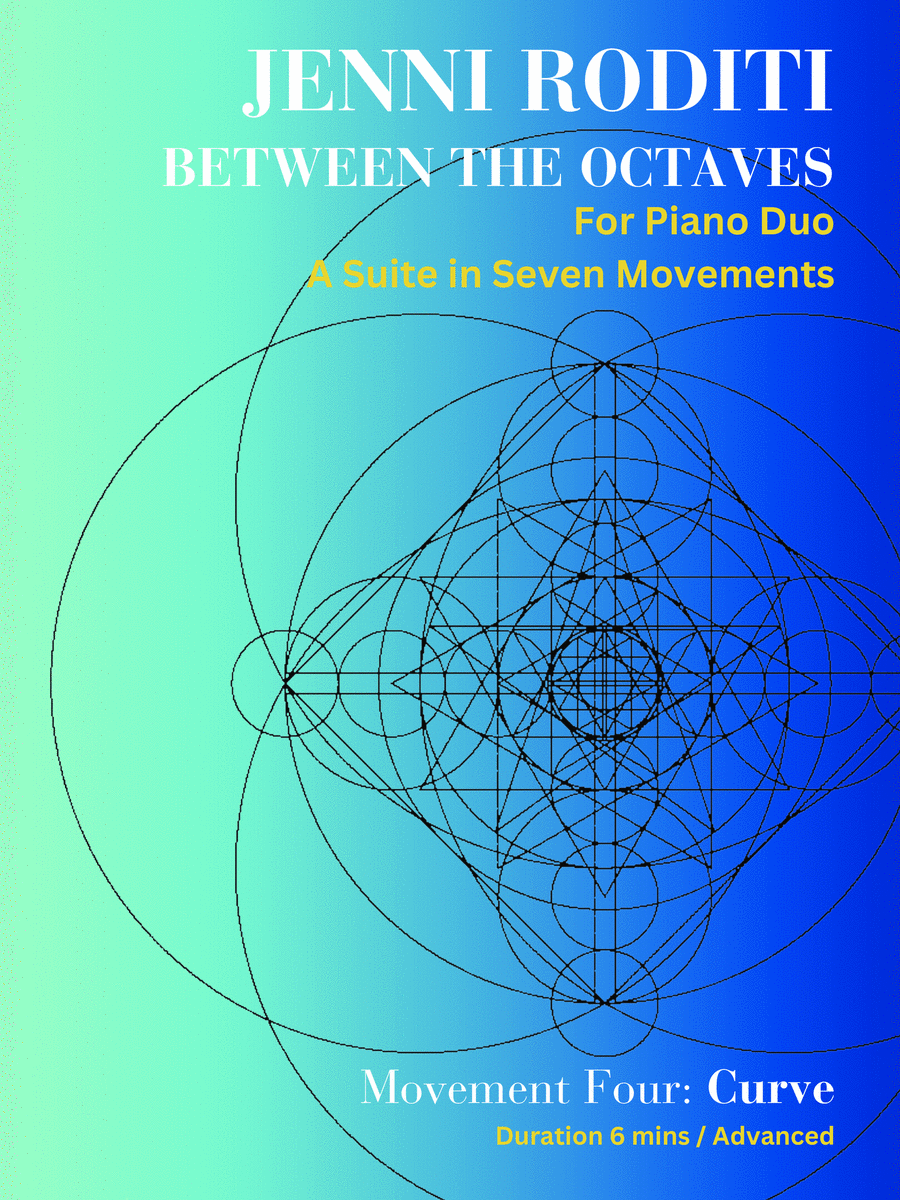
CURVE, Between the Octaves - A Piano Duo Suite (Movement 4 of 7)
2 Pianos, 4 mains
dislocation I mean a degree of tension between the natural acoustics of the two instruments in the room and the players idiosyncrasies as musicians  The whole point of this work was to examine the nature of my syntax, grammar, and compositional thinking
$20.00 16.81 € 2 Pianos, 4 mains PDF SheetMusicPlus

2 Pianos,4 Hands,Piano Duet - Level 3 - Digital Download SKU: A0.1461609 Composed by Yuka Kitamura. Arranged by Jefferson Sequeira. 21st Century,Film/TV,Medieval,Video Game. Score. 9 pages. Jeff Sequeira #1040353. Published by Jeff Sequeira (A0.1461609). Immerse yourself in the majesty and intensity of this iconic musical piece from the original Dark Souls game. This two-piano arrangement captures all the grandeur and drama of battling the Lords of Cinder, transporting you directly to the dark and immersive landscapes of Lordran.Meticulously designed for pianists and game enthusiasts alike, this arrangement showcases both the technical skill and emotional depth required to master its performance. From its powerful opening chords to its evocative and moving melodies, each note is carefully chosen to capture the essence of combat against formidable foes.Perfect for live performances, studio recordings, or simply enjoying at home, this two-piano arrangement of Lord of Cinder is a musical masterpiece that transcends the boundaries of classical interpretation and the gaming universe. Prepare to explore and rediscover the emotional intensity and narrative of Dark Souls through this exceptionally powerful and moving interpretation.Discover why Lord of Cinder from the original Dark Souls remains a benchmark in video game music and delve into this unique musical experience that blends the best of classical artistry with gaming culture.
Gwyn, Lord of Cinder
2 Pianos, 4 mains

$10.00 8.4 € 2 Pianos, 4 mains PDF SheetMusicPlus

2 Pianos,4 Hands,Piano Duet - Level 5 - Digital Download SKU: A0.1401526 Composed by Franz Liszt. Arranged by Roy R. Davila Gomez (R.Music). Classical,Historic,Multicultural,Romantic Period,World. Score. 18 pages. R.Music #984709. Published by R.Music (A0.1401526). The score of La Campanella for two pianos is a gem of the piano repertoire that captures the magic and virtuosity of Franz Liszt's musical genius. has been adapted for two pianos, offering performers a unique experience of musical collaboration.The score presents exciting technical challenges for both pianists, from dizzying arpeggios to dazzling melodic passages. Liszt's ability to create an enchanting atmosphere is reflected in every note, transporting the listener to a world of beauty and passion.This edition for two pianos allows you to explore the harmonic richness and structural complexity of the piece in a new and exciting way. The two pianists immerse themselves in a fluid musical dialogue, creating a unique and captivating performance that will delight both performers and audiences.Get this musical masterpiece today and let yourself be carried away by the magic of Franz Liszt's La Campanella in the privacy of two pianos!
The campanella for two pianos
2 Pianos, 4 mains

$9.99 8.39 € 2 Pianos, 4 mains PDF SheetMusicPlus


Partitions Gratuites
Acheter des Partitions Musicales
Acheter des Partitions Digitales à Imprimer
Acheter des Instruments de Musique

© 2000 - 2026

Accueil - Version intégrale





