EUROPE
80 articles
USA
2 articles
DIGITAL
25 articles (à imprimer)
Partitions Digitales
Partitions à imprimer
25 partitions trouvées


2 Pianos,4 Hands,Piano Duet - Level 3 - Digital Download SKU: A0.991619 Composed by Antonis Koundourakis. Concert,Contemporary,Instructional,Standards. Score. 11 pages. ANTONIOS KOUNDOURAKIS #3471903. Published by ANTONIOS KOUNDOURAKIS (A0.991619). In this piece Antonis explores the polyphonic and the homophonic style of composition with the added benefit and freedom of having 2 extra hands on the keyboard. Therefore there is a wide range being used simultaneously and in many cases the piece requires good coordination of the performers while in other cases independence of dynamics and phrasing. There is an extended period of stretto immitations, normally found in the style of the Fugue, and a 7 voice homophonic section resembling choral music. The different styles are juxtaposed in the form of a conversation, hence the title of the piece.This piece is ideal for live performance but can also be played by teacher and student while interchanging the parts they play for added benefit of learing coordination and understanding the challenges of the other performer when playing together.   In case you buy and perform the piece don't hesitate to contact Antonis at midnightnotesband@gmail.com to give him any feedback on the score legibility/playability and the experience of playing his composition! Videos are also very welcome! 
"Conversations" A piece for Piano Four (4) Hands
2 Pianos, 4 mains

$6.00 5.1 € 2 Pianos, 4 mains PDF SheetMusicPlus

2 Pianos,4 Hands,Piano Duet - Level 4 - Digital Download SKU: A0.945464 Composed by Carl Philipp Emanuel Bach, Giovanni Battista Pescetti. Arranged by Kiyoshi Tamagawa. Baroque. Score. 12 pages. Mastery for Strings Press #5999147. Published by Mastery for Strings Press (A0.945464). The practice of adding an accompaniment to a composition originally created for a solo instrument is a time-honored tradition in Western art music, whether the additional music be for one or a few instruments or an entire ensemble. In the latter case a concerto movement can be fabricated from a solo work. The Concertino Barocco (Little Baroque Concerto) takes as its basis two pieces of the Baroque era that have long been popular repertoire for advancing students of the keyboard: the Solfeggio (or Solfeggietto) by C.P.E. Bach, and the third movement, Presto, from the Sonata in C minor by Giovanni Battista Pescetti. These works are transformed into two miniature concerto movements by adding and interpolating short tutti passages at various points in the form, rather in the style of Antonio Vivaldi. Not a note has been added or subtracted from the original keyboard solos, so that a student who has mastered the originals may play this Concertino simply by memorizing the exact points in the original pieces where additional music for the orchestra has been added and they must wait to continue.
Concertino Barocco (after C.P.E. Bach and G.B. Pescetti)
2 Pianos, 4 mains

$9.99 8.49 € 2 Pianos, 4 mains PDF SheetMusicPlus

2 Pianos,4 Hands,Piano Duet - Level 3 - Digital Download SKU: A0.1407365 By Sharon Wilson. By Sharon Wilson. Arranged by Sharon Wilson. 20th Century,Christian,Contemporary,Instructional,New Age. Score. 87 pages. Sharon Wilson #990042. Published by Sharon Wilson (A0.1407365). Take a walk in the woods, along a sandy beach, or beside a rushing river. Listen to the sounds of nature: birds warbling, frogs croaking, leaves rustling, streams splashing, waves crashing -- sounds abound; some soothing, some startling.  This collection features 7 piano duets inspired by the sounds of nature. Filled with simple melodies, repeating themes, and echoing harmonies, these dual keyboard arrangements (for 2 Pianos, 4 Hands) are as inspirational to play as they are to listen to. These duets sounds equally pleasing whether played on two acoustic pianos or played on two keyboards with unique sounds. For each song there is a grand staff with both piano parts on each page plus the alternate format with each piano part on separate pages. Each duet is also available separately with accompanying preview pages and audio samples. Titles included in this collection: PreludePastoralSerenadeIntermezzoNocturneFantasiaFinale Visit Sharon Wilson's website: https://www.SharonWilsonMusic.com/Subscribe to her YouTube Channel: https://youtube.com/@SharonWilsonMusic
Sounds of Creation (A Collection of 7 Keyboard Duets, for 2 Pianos, 4 Hands)
2 Pianos, 4 mains
Sharon Wilson
$17.99 15.29 € 2 Pianos, 4 mains PDF SheetMusicPlus

2 Pianos,4 Hands,Piano Duet - Level 2 - Digital Download SKU: A0.565178 By Sharon Wilson. By African-American Spiritual. Arranged by Sharon Wilson Music. Children,Folk,Jazz,Sacred,Spiritual. Score. 12 pages. Sharon Wilson #3519273. Published by Sharon Wilson (A0.565178). This arrangement of the traditional spiritual When the Saints Go Marching In is presented here as a mixed level duet for two pianos, four hands. The PIANO 1 is the easier part (early-intermediate) and the PIANO 2 is slightly more challenging, though still only at the intermediate level. Both PIANO parts carry the melody at times beginning with PIANO 1 for the verse. Quick-paced and bright, this dual piano duet is an ideal selection for a church setting.The purchase price includes a 5-page score with combined PIANO 1 and PIANO 2 parts on each page (the grand staff) plus an alternate format with the PIANO 1 and PIANO 2 parts on separate pages (3 pages each). Duration is just under 1-1/2 minutes. This arrangement is one of the 5 spirituals in the collection Five Joyful Tunes for Two Pianos.This song has numerous verses and varying lyrics, most of which reference the joy of marching into heaven at Jesus' second coming. Bible verses from which the lyrics were gleaned include the following: . . .Yahweh's ransomed ones will return, and come with singing to Zion; and everlasting joy will be on their heads. They will obtain gladness and joy, and sorrow and sighing will flee away. Isaiah 35:10 WEBFor the Lord himself will descend from heaven with a shout, with the voice of the archangel, and with God's trumpet. The dead in Christ will rise first, then we who are alive, who are left, will be caught up together with them in the clouds, to meet the Lord in the air. So we will be with the Lord forever. Therefore comfort one another with these words. 1 Thessalonians 4:16-18 WEBBlessed are those who do his commandments, that they may have the right to the tree of life, and may enter in by the gates into the city. Revelation 22:14 WEBLyrics for my favorite 3 verses:O when the saints go marching in,O when the saints go marching in,O Lord I want to be in that number,When the saints go marching in.O when the trumpet sounds its call,O when the trumpet sounds its call,O Lord I want to be in that number,When the trumpet sounds its call.O when they crown him Lord of all,O when they crown him Lord of all,O Lord I want to be in that numberWhen they crown him Lord of all.
When the Saints Go Marching In (Mixed Level, 2 Pianos, 4 Hands Duet)
2 Pianos, 4 mains
Sharon Wilson
$5.99 5.09 € 2 Pianos, 4 mains PDF SheetMusicPlus

2 Pianos,4 Hands,Piano Duet - Level 5 - Digital Download SKU: A0.730240 Composed by James Nathaniel Holland. Contemporary,Folk,Holiday,Jazz,Patriotic. Score. 56 pages. James Nathaniel Holland #442965. Published by James Nathaniel Holland (A0.730240). (Duration: 25 minutes) 2 Pianos, 4 Hands (Revised 2018)James Nathaniel Holland is an American classical music composer of operas, symphonies, ballets, songs, and other musical concertworks that incorporate a unique, eclectic, blend of romantic, classical, world and jazz styles. In this second of his piano concerto, he blends jazz with sensitivity, rhythmic to lyrical. This concerto is entitled New York Tour because like the city that inspired it, it travels throughout times, musical neighborhoods and cultures. Great compliment in programming with Mozart piano concertos or Gershwin's Rhapsody in Blue to feature American classical composers. Newly revised (2018) with measure numbers and rehearsal letters that match the full score.YouTube presentation: https://www.youtube.com/watch?v=eAKDrGPLa3g Born and raised in Indiana, James Nathaniel Holland studied music at DePauw University, Vienna Austria, Interlochen National Music Camp and Indiana University (Bloomington, IN). At these schools many of his early pieces were premiered and performed, with one work being selected for main-stage production in the season. Moving to Los Angeles and then settling in New York, he performed professionally sometimes as a singer, sometimes as a pianist, sometimes as choral conductor. He composed incidental music for the stage. In 2002 he founded a composers collective where they showcased their work. He was one of the first composers to participate in the American Music Center's initial on-line library. The New Jersey Concert Opera and the Gay Men's Chorus of New Jersey also featured his comic operas and art songs. From 2005 he moved to Costa Rica where he organized concerts with visiting guest artists to present his chamber music to the public. Presently he lives in a castle in the central mountains of Costa Rica. Website: https://facebook.com/jamesnathanielholland/ YouTube Channel: https://www.youtube.com/user/composerjnholland
Jazz Piano Concerto No 2 in Ab New York Tour by James Nathaniel Holland
2 Pianos, 4 mains

$9.95 8.46 € 2 Pianos, 4 mains PDF SheetMusicPlus

2 Pianos,4 Hands,Piano Duet - Level 5 - Digital Download SKU: A0.977034 Composed by Paul SanGregory. Contemporary. Score. 29 pages. Distant Engraver Music #3536815. Published by Distant Engraver Music (A0.977034). Each of these four short pieces has its own character, color and rhythmic flow. Because the interplay between parts is sometimes complex and challenging, they can provide wonderful ensemble workouts for performers as well as fun and exciting musical experiences for audiences. The title Harmonic Spaces refers to both the idea that they are musical spaces filled with colors and characters as well as to the widely-spaced harmonic intervals upon which those aspects are built. Each movement is based on one or two wide intervals that mimic the spacing of overtones (or partials) in the harmonic series. This approach allowed the composer to produce unique harmonies, colors and atmospheres. For listeners, of course, knowledge of these intervals isn't important, even though the colors, characters and atmospheres they produce is. Each movement is described briefly below: I - Simply and gracefully moving forward. (9th and 3rd partials)This gently flowing movement is a slow progression of widely-spaced chords with gracefully rising and falling strings of notes woven in and around them. The chords often appear in groups of two, with the second being quieter, like an echo of the first. That creates a sense of harmonic space within which the delicate lines move in and out of agreement with the chords.II - With a steady, even flow (or groove). (7th and 5th partials)The harmonic partials of this movement are what give dominant 7th chords their characteristic sound and function. Furthermore, because 7th chords are an important part of jazz harmony, jazz influences enter into this piece. Listeners may notice the outlines of gliding 7th chords, swinging meters and syncopated rhtyhms reminiscent of jazz.III - Gentle, flexible, but rhythmically accurate. (11th Partial)This movement unfolds slowly like a quiet summer afternoon under a shade tree watching lazy clouds. Because the 11th partial is a note that falls between the cracks of the piano keyboard, both the perfect 4th and augmented 4th (in very wide spacing) are used to approximate it. Although this creates some non-traditional harmonies and non-chord tone effects, the piece is tranquil, peaceful and beautiful. IV - With precision, energy and excitement. (13th Partial)This energetic finale uses much syncopation and rhythmic interplay as well as wide-ranging arpeggios that get shared between the two players. The primary interval often appears as widely spaced parallel motion, which adds a special color or flavor to the rhythms. The result is a joyful romp in a playground of rhythm, color, motion and contrast. (duration of all four pieces is ca. 12 minutes) This work was funded by the National Culture and Arts Foundation of Taiwan (ROC)
Harmonic Spaces (four-hands piano)
2 Pianos, 4 mains

$10.00 8.5 € 2 Pianos, 4 mains PDF SheetMusicPlus

2 Pianos,4 Hands,Piano Duet - Digital Download SKU: A0.497957 Composed by Johann Sebastian Bach. Arranged by Pietro Prugna. Baroque,Christmas,Classical,Wedding. Score. 27 pages. Published by Pietro Prugna (A0.497957). JS Bach's Fugue in G minor (BWV 542) (from Fantasia and Fugue) was originally written for the Organ. It has 4 parts: 1st part is played by the right hand; 2nd part by right and left hands (at different parts); 3rd part on left hand; 4th part on Pedals. As the range of notes is wide, it is impossible to play on solo piano. In this arrangement, the 1st and 3rd parts are played by Piano 1 (right and left hands respectively) while the 2nd and 4th parts are played by Piano 2 (right and left hands respectively). This allows a piano duo to play the Fugue together. For beginners, 4 pianists can play 1 part each on 2 pianos too. This will allow the pianists to appreciate the beauty of the different parts of the Fugue and how they intriguingly blend together.
Fugue in G minor (BWV 542) (from "Fantasia and Fugue") by JS Bach - Arranged for 2 pianos
2 Pianos, 4 mains

$1.99 1.69 € 2 Pianos, 4 mains PDF SheetMusicPlus

2 Pianos,4 Hands,Piano Duet - Digital Download SKU: A0.497959 Composed by Johann Sebastian Bach. Arranged by Pietro Prugna. Baroque,Christmas,Classical,Easter,Wedding. Score. 15 pages. Published by Pietro Prugna (A0.497959). JS Bach's Little Organ Fugue in G minor (BWV 578) was originally written for the Organ. It has 4 parts. The 1st part is played by the right hand, 2nd part by right and left hands (at different parts), 3rd part on left hand; 4th part on Pedals. As the range of notes is wide, it is impossible to play on solo piano. In this arrangement the 1st and 3rd parts are played by Piano 1 (right and left hands respectively), while the 2nd and 4th parts are played by Piano 2 (right and left hands respectively). This allows a piano duo to play the Fugue together. For beginners, 4 pianists can play 1 part each on 2 pianos. This will allow the pianists to appreciate the beauty of the different parts of the Fugue and how they intriguingly blend together.
Fugue in G minor (BWV 578) ("Little Organ Fugue") by JS Bach - Arranged for 2 pianos
2 Pianos, 4 mains

$1.99 1.69 € 2 Pianos, 4 mains PDF SheetMusicPlus

Instrumental Duet,Keyboard - Level 4 - Digital Download SKU: A0.1497857 Composed by Jenni Roditi. 21st Century,Classical,Contemporary. 19 pages. Jenni Roditi #1074269. Published by Jenni Roditi (A0.1497857). Piano Duo 2 pianos/4 hands. Encircle, Between the Octaves, originally called rotate as its impetus was to generate a steadily rotating music. Encircle was later chosen as a more evocative word. The harmony surprised me as it suggested shifts and colourations that I would not have expected to conjure. Two upper rotating parts with melodic narrative are supported by bass and baritone lower parts. The final section adds a dance-like short form to end what could otherwise have run and run and run.  Names of all the movements in the suite Between the Octaves in the right order are Initiate, Surrender, Thread, Curve, Encircle, Ritualise, Ignite. The whole suite follows a long line from movement 1 to movement 7. However, individual pieces are well suited to be played alone too. Piano Duo is ideally two Steinway grands, otherwise, whatever is available. An enjoyment of the tensions and relationships generated between the two instruments: grand-upright, upright-electronic keyboard is to be explored as a positive. Each piece creates its own world in the suite and can be part of smaller subgroups taken from the suite, in any combination, but the order of the pieces needs to be maintained if more than one is played. Here is a taste of the background to the musical world of this 53 minute compositional suite. During a reflective time I read the following: The whole philosophy of dharma art (Buddhist art) is that you don't try to be artistic, but you just approach objects as they are, and the message comes through automatically. (Chogyam Trungpa Rinpoche, from 'True Perception The Path of Dharma Art.' Shambhala 2008, p.133.) The 'objects as they are' became the 'octaves as they are'. As the pieces were composed the octaves had a centring and clarifying role that allowed other material to circulate around or play against them. They acted as pivots, repetitions, drones, ostinati, pointillist nodes, pedals, melodic features, struts, harmonic turnpikes, breathing spaces, bass lines: musical imperatives. The octaves called the musical shots most of the time. When the music pulled a semitone up or down and away from the octaves (as it did quite often) it was especially telling in the context of the ringing spaces the octaves were creating. I became interested in the subtle dislocation that two pianos could provide. By dislocation I mean a degree of tension between the natural acoustics of the two instruments in the room and the players idiosyncrasies as musicians.  The whole point of this work was to examine the nature of my syntax, grammar, and compositional thinking. The title demanded one thing above all: what notes am I going to use between these octaves?? My choice of notes was derived in most instances from the tempo, pitch, and rhythm of the initial octaves at the beginning of each piece alongside the individual word titles that I set out to explore as musical images. The audio was developed from Sibelius software, via MIDI to Logic samples of a Steinway grand piano. 
ENCIRCLE, Between the Octaves - A Piano Duo Suite (Movement 5 of 7)
2 Pianos, 4 mains
dislocation I mean a degree of tension between the natural acoustics of the two instruments in the room and the players idiosyncrasies as musicians  The whole point of this work was to examine the nature of my syntax, grammar, and compositional thinking
$20.00 17 € 2 Pianos, 4 mains PDF SheetMusicPlus

2 Pianos,4 Hands,Piano Duet - Level 5 - Digital Download SKU: A0.1175185 By Paul Posnak & Anita Castiglione. By George Gershwin. Arranged by Paul Posnak. 20th Century,Classical,Jazz,Standards. Score. 10 pages. Paul Posnak #775326. Published by Paul Posnak (A0.1175185). Arrangement for 2 pianos, 4 hands of Swanee by George Gershwin.Foreword by the arranger:George Gershwin, since his days as a teenage song-plugger in Tin Pan Alley, loved the medium of two pianos. A consummate improviser with a harmonically sophisticated, jazz-influenced,orchestral approach to the treatment of melody, he was born into the great age of touring duo piano teams, such as Bauer and Gabrilowitsch, Josef and Rhosina Levine, Luboshutz and Nemenoff, and Gershwin's favorite team, Arden and Ohman. Gershwin loved the multi-voiced orchestral color, power and range of two pianists playing and improvising together. In his first major show written with brother Ira, the 1924 Lady Be Good, he incorporated the renowned team of Phil Ohman and Victor Arden into the musical theater pit orchestra, not only to add to the orchestra's sound and rhythmic drive, but also to play during breaks in the action and during Intermission. They even played encores! This successful formula was repeated for the 1926 show, Oh, Kay, and for the 1927 show, Funny Face.Gershwin's own bravura improvisations on his songs sound, even to the trained ear, like two pianos. I have transcribed (and digitally re-recorded) a number of these improvisations note-for-note from the old LP-remastered 78 rpm records and radio broadcasts. I have tried to capture his own two-fisted orchestral keyboard style: his love of inner voices, contrapuntal runs, jazz figurations, sophisticated chordal textures, and swing.These arrangements resulted from my appearance in 2003 as one of two soloists in several all-Gershwin concerts with The National Symphony Orchestra under the direction of Marvin Hamlisch. Marvin suggested that I also play a couple of my Gershwin improvisation transcriptions, and we thought it would be a perfect touch for Lorin Hollander, the other soloist, and me to play a short two-piano piece. I was surprised to find very few two-piano arrangements of Gershwin's songs. I became inspired to fill this void in the duo piano repertoire. It is my hope that these settings will offer a worthy challenge and musical reward for intermediate and advanced piano students and amateurs, and a unique addition to the duo piano literature for professional pianists and duo piano teams the world over.Paul Posnak.
Swanee
2 Pianos, 4 mains
Paul Posnak & Anita Castiglione
$12.00 10.2 € 2 Pianos, 4 mains PDF SheetMusicPlus

2 Pianos,4 Hands,Piano Duet - Level 3 - Digital Download SKU: A0.564490 By Sharon Wilson. By Sharon Wilson. Arranged by Sharon Wilson. 20th Century,Contemporary,New Age,Praise & Worship,Sacred. Score. 11 pages. Sharon Wilson #1776277. Published by Sharon Wilson (A0.564490). Take a walk in the woods, along a sandy beach, or beside a rushing river. Listen to the sounds of nature: birds warbling, frogs croaking, leaves rustling, streams splashing, waves crashing -- sounds abound; some soothing, some startling. This piece is one of seven in a series of keyboard duets inspired by the sounds of nature.Filled with simple melodies, repeating themes, and echoing harmonies, these dual keyboard arrangements are as inspirational to play as they are to listen to. This piece sounds equally pleasing whether played on two acoustic pianos or played on two keyboards with unique sounds. The purchase price includes a combined score with both parts on each page plus a separate score for each part. Titles in the Sounds of Creation†series: Prelude, Pastoral, Serenade, Intermezzo, Nocturne, Fantasia, FinaleVisit Sharon Wilson’s website: www.SharonWilsonMusic.comSubscribe to her YouTube Channel: www.youtube.com/user/SharonWilsonMusic
Sounds of Creation - Pastoral (Keyboard Duet; 2 Pianos, 4 Hands)
2 Pianos, 4 mains
Sharon Wilson
$4.99 4.24 € 2 Pianos, 4 mains PDF SheetMusicPlus

Instrumental Duet,Keyboard - Level 4 - Digital Download SKU: A0.1497861 Composed by Jenni Roditi. 21st Century,Classical,Contemporary. 26 pages. Jenni Roditi #1074273. Published by Jenni Roditi (A0.1497861). Piano Duo 2 pianos/4 hands. Ritualise, Between the Octaves finally found its identity with the word ritualise. It began as announce, became pronounce, then declare and went as far a pontificate for a title. At that point I realised I was mocking my own music and needed to take it more seriously. Ritualise brought out a meaning to the music that I hadn’t wanted to admit to. It is quite folk-like, in a primal and entrancing kind of way. I can imagine a communal dance for some ceremonial purpose in this music with both public and private elements.Names of all the movements in the suite Between the Octaves in the right order are Initiate, Surrender, Thread, Curve, Encircle, Ritualise, Ignite. The whole suite follows a long line from movement 1 to movement 7. However, individual pieces are well suited to be played alone too. Piano Duo is ideally two Steinway grands, otherwise, whatever is available. An enjoyment of the tensions and relationships generated between the two instruments: grand-upright, upright-electronic keyboard is to be explored as a positive. Each piece creates its own world in the suite and can be part of smaller subgroups taken from the suite, in any combination, but the order of the pieces needs to be maintained if more than one is played. Here is a taste of the background to the musical world of this 53 minute compositional suite. During a reflective time I read the following: The whole philosophy of dharma art (Buddhist art) is that you don't try to be artistic, but you just approach objects as they are, and the message comes through automatically. (Chogyam Trungpa Rinpoche, from 'True Perception The Path of Dharma Art.' Shambhala 2008, p.133.) The 'objects as they are' became the 'octaves as they are'. As the pieces were composed the octaves had a centring and clarifying role that allowed other material to circulate around or play against them. They acted as pivots, repetitions, drones, ostinati, pointillist nodes, pedals, melodic features, struts, harmonic turnpikes, breathing spaces, bass lines: musical imperatives. The octaves called the musical shots most of the time. When the music pulled a semitone up or down and away from the octaves (as it did quite often) it was especially telling in the context of the ringing spaces the octaves were creating. I became interested in the subtle dislocation that two pianos could provide. By dislocation I mean a degree of tension between the natural acoustics of the two instruments in the room and the players idiosyncrasies as musicians.  The whole point of this work was to examine the nature of my syntax, grammar, and compositional thinking. The title demanded one thing above all: what notes am I going to use between these octaves?? My choice of notes was derived in most instances from the tempo, pitch, and rhythm of the initial octaves at the beginning of each piece alongside the individual word titles that I set out to explore as musical images. The audio was developed from Sibelius software, via MIDI to Logic samples of a Steinway grand piano.
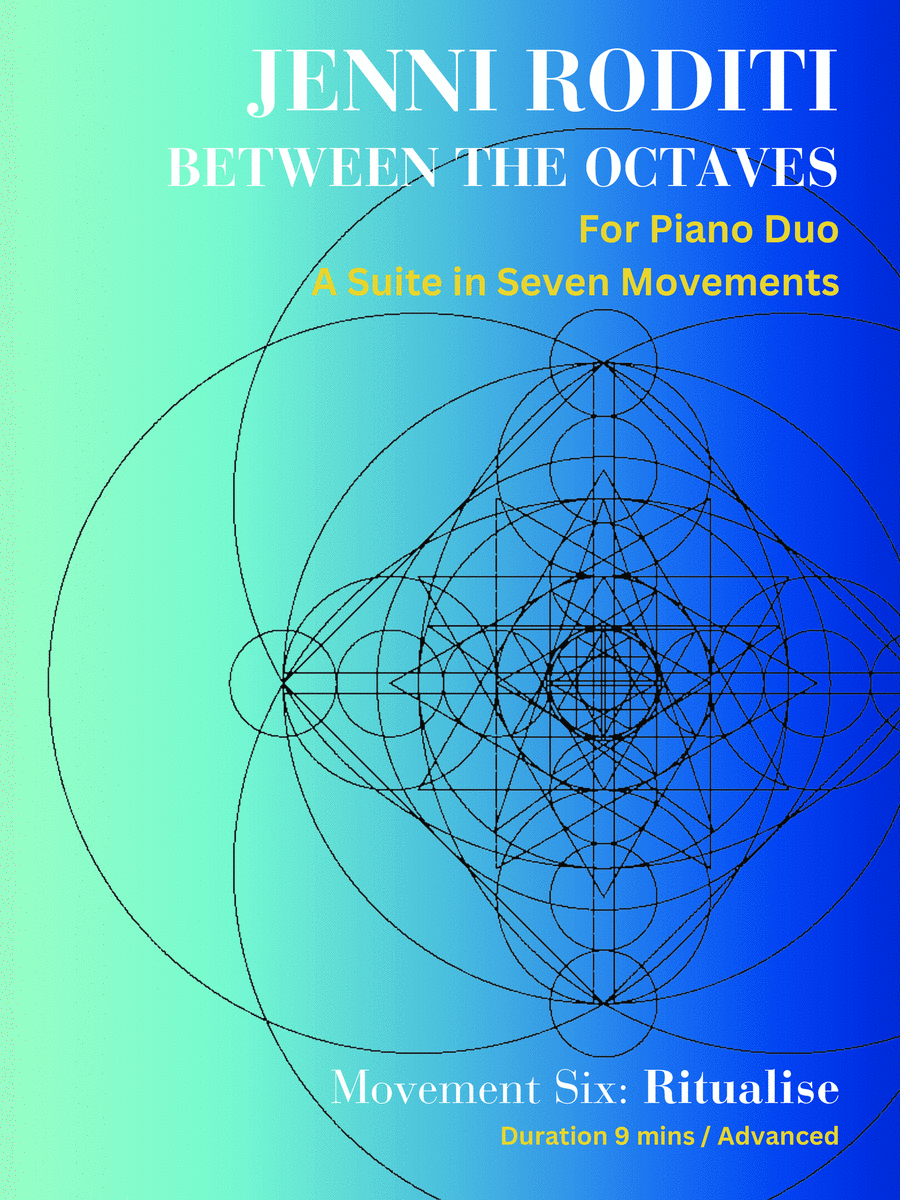
RITUALISE, Between the Octaves - A Piano Duo Suite (Movement 6 of 7)
2 Pianos, 4 mains
dislocation I mean a degree of tension between the natural acoustics of the two instruments in the room and the players idiosyncrasies as musicians  The whole point of this work was to examine the nature of my syntax, grammar, and compositional thinking
$20.00 17 € 2 Pianos, 4 mains PDF SheetMusicPlus


Partitions Gratuites
Acheter des Partitions Musicales
Acheter des Partitions Digitales à Imprimer
Acheter des Instruments de Musique

© 2000 - 2026

Accueil - Version intégrale





