EUROPE
4645 articles
USA
0 articles
DIGITAL
51 articles (à imprimer)
Partitions Digitales
Partitions à imprimer
51 partitions trouvées


Instrumental Duet Instrumental Duet,Piano - Level 5 - Digital Download SKU: A0.534483 Composed by Germaine Tailleferre. 20th Century,Concert,Standards. Score and parts. 65 pages. Musik Fabrik Music Publishing #3534799. Published by Musik Fabrik Music Publishing (A0.534483). This work was written in the first months of 1942 while Tailleferre was living in Grasse, in the socolled« Free Zone » of occupied France during the Second World War and was completed just asTailleferre was forced to flee France with her daughter. As the wife of Jean Lageat, who had been thesecretary of the French socialist Léon Blum during the « Front Populaire » period just before the Warand who was at that time in the US working against the Vichy Government, and as someone who wasnot unvocal about her political views, this could not have been a comfortable situation. Tailleferre left arecord of what she experienced during this period in an article written for the American music journal «Modern Music » which she wrote shortly after arriving in America in the Spring of 1942 :« Notwithstanding their staunch spirit of resistence, the people under German rule today areincreasingly bowed down under their burdens. By achieving the physical decline of the French, theNazis hope that spiritual collapse will ensue. However, after two years of quasi-famine, France remainspround and great, although the necessity of liberation grows daily more urgent.....For an artist to workunder these conditions is almost impossible. The mere effort of subsisting wastes time and absorbsenergy ; The means to work are also lacking.....Musical composition is made practically impossiblethrough lack of music paper. For more than a year, I sought in vain to find paper in Lyon, Marseillesand Nice on which to copy an orchestral score...Two years of experience under German rule havetaught me that all expressions of pride, dignity, spirit , aspiration of the human will can be made onlyclaudestinely. It is a historical truth that the human mind makes its greatest progress under freedom ».Under such circumstances, it is a miracle that this work exists at all. The three movement work wasdedicated to the famous Marguerite Long, for whom Tailleferre had already written several short worksfor piano solo, and François Lang, a pianist who was closely linked with the Group des Six and whohad performed in the première of the 1934 Concerto Grosso for Two Pianos, 8 Solo Voices, SaxophoneQuartet and Orchestra and for whom Tailleferre wrote two cadenzas for concerti by Mozart and Haydn.The work opens with sunny, optimistism in a mood similar to the opening movement of the ConcertoGrosso, but quickly the mood changes to more dramatic themes. The second movement seems tosubjectively express a rupture with the past and a tragic melancholy. The final third movement isextremely dramatic and almost frightening with it’s force.When Tailleferre left France in the Spring of 1942, having been warned by a neighbor that she wasgoing to be arrested if she didn’t leave immediately, she left the score in a two-piano version, probablydue to the fact that there was no music paper to be had to copy the score. When she returned to Francein 1946, she learned that François Lang had been deported to Auschwitz where he died. Musical life inFrance had been completely changed by the War years. Tailleferre put the work aside and forgot aboutit, perhaps wanting to forget the hardships that she had lived through and the loss of many of her friendsassociated with these years.Tailleferre's version for two pianos is published by Musik Fabrik and the work may be performed inthat version. It is clear however, that the work was intended to be orchestrated and the editors hope thatthe present orchestration will allow the work to finally be presented as Tailleferre conceived duringsome of the darkest years of the Twentieth century.
Germaine Tailleferre: Trois Études for two pianos
2 Pianos, 4 mains
achieving the physical decline of the French, the
Nazis hope that spiritual collapse will ensue
However, after two years of quasi-famine, France remains
pround and great, although the necessity of liberation grows daily more urgent

$32.95 28.54 € 2 Pianos, 4 mains PDF SheetMusicPlus

2 Pianos,4 Hands,Piano Duet - Level 4 - Digital Download SKU: A0.1120657 Composed by George Gershwin. Arranged by Daryl McKenzie. 20th Century,Film/TV. Score. 14 pages. Daryl McKenzie #721905. Published by Daryl McKenzie (A0.1120657). Arranged as a Piano Duet. Duration 1:06 French Ballet Class is a six-minute piece written by George Gershwin in 1937 for two pianos for the movie Shall We Dance. This sequence was meant to accompany a scene of dozens of ballet dancers practicing their positions. It is written in the style of the galop. Only two minutes of this music was used in the final film. This arrangement is just over 1 minute long. Same arrangement for single Piano and String Orchestra available.: https://bit.ly/3MKmYbo More arrangements by Daryl McKenzie: https://bit.ly/2VKpOXF Contact: www.mckenziemusicproductions.comYoutube Playlist: https://bit.ly/3m0oUkH
French Ballet Class
2 Pianos, 4 mains

$19.99 17.31 € 2 Pianos, 4 mains PDF SheetMusicPlus

2 Pianos,4 Hands,Piano Duet - Level 3 - Digital Download SKU: A0.1455801 By Sharon Wilson. By Charles Wesley and Thomas Campbell. Arranged by Sharon Wilson. 19th Century,Christian,Lent,Religious,Sacred. Score. 15 pages. Sharon Wilson #1034900. Published by Sharon Wilson (A0.1455801). This arrangement of the familiar hymn tune SAGINA by Thomas Campbell is written as a dual piano duet (for 2 pianos, 4 hands). Both parts carry the melody at times making it fun and equally challenging for both players while adding variety for the listeners. An optional repeat is provided in case a longer selection is desired. Bright and cheerful throughout, this piano duet is ideal for a prelude, postlude, offertory, or whenever an upbeat musical interlude is desired. The purchase price includes a 7-page score with combined PIANO 1 and PIANO 2 parts on each page (Grand Staff) plus an alternate format with the PIANO 1 and PIANO 2 parts on separate pages (3 pages each). This arrangement is one of the 5 songs in the collection Hymns of Praise for Two Pianos.Visit Sharon Wilson's website: https://www.SharonWilsonMusic.com/Subscribe to her YouTube Channel: https://youtube.com/@SharonWilsonMusic
And Can It Be? (2 Pianos, 4 Hands Duet)
2 Pianos, 4 mains
Sharon Wilson
$5.99 5.19 € 2 Pianos, 4 mains PDF SheetMusicPlus

2 Pianos,4 Hands,Piano Duet - Level 3 - Digital Download SKU: A0.1141638 By Carter Larsen. By Carter Larsen. Arranged by Carter Larsen. 20th Century,Classical. Score. 1 pages. Edition Isolde #741977. Published by Edition Isolde (A0.1141638). Divination Vol. XIIa Urtext edition. Composed by Carter Larsen. Two Pianos Collection (hard bound.) With standard notation, introductory text. Published by Edition Isolde. 9x12 inches. 107 pgs. Fantasia Suite is a XXI century musical concept for piano, two pianos and orchestra, a group of composition that represents a continuous cycle of romantic, yet classically written music, in a bold, new contemporary idiom. Divination Vol. XIIa is the XIIa of Carter Larsen Fantasia Suite.
Divination Vol. XIIa
2 Pianos, 4 mains
Carter Larsen
$71.90 62.27 € 2 Pianos, 4 mains PDF SheetMusicPlus

Instrumental Duet,Keyboard - Digital Download SKU: A0.1497843 Composed by Jenni Roditi. 21st Century,Classical,Contemporary. 12 pages. Jenni Roditi #1074255. Published by Jenni Roditi (A0.1497843). Piano Duo - 2 pianos, 4 hands. Surrender, Between the Octaves was the piece that was composed first in the suite. It exposes a simple call to return to the beginning, to return to a pure act of listening. This note..ah, now that note.. oh. This is how the piece was written - one note at a time. Listening from within a space (its original title) of resonance, of edges and meetings, of disappearances and repetitions that reflect on this gentle body of notes. There is a slow hearing that may, or may not create a tone-journey.Names of all the movements in the suite Between the Octaves in the right order are Initiate, Surrender, Thread, Curve, Encircle, Ritualise, Ignite. The whole suite follows a long line from movement 1 to movement 7. However, individual pieces are well suited to be played alone too. Piano Duo is ideally two Steinway grands, otherwise, whatever is available. An enjoyment of the tensions and relationships generated between the two instruments: grand-upright, upright-electronic keyboard is to be explored as a positive. Each piece creates its own world in the suite and can be part of smaller subgroups taken from the suite, in any combination, but the order of the pieces needs to be maintained if more than one is played. Here is a taste of the background to the musical world of this 53 minute compositional suite. During a reflective time I read the following: The whole philosophy of dharma art (Buddhist art) is that you don't try to be artistic, but you just approach objects as they are, and the message comes through automatically. (Chogyam Trungpa Rinpoche, from 'True Perception The Path of Dharma Art.' Shambhala 2008, p.133.) The 'objects as they are' became the 'octaves as they are'. As the pieces were composed the octaves had a centring and clarifying role that allowed other material to circulate around or play against them. They acted as pivots, repetitions, drones, ostinati, pointillist nodes, pedals, melodic features, struts, harmonic turnpikes, breathing spaces, bass lines: musical imperatives. The octaves called the musical shots most of the time. When the music pulled a semitone up or down and away from the octaves (as it did quite often) it was especially telling in the context of the ringing spaces the octaves were creating. I became interested in the subtle dislocation that two pianos could provide. By dislocation I mean a degree of tension between the natural acoustics of the two instruments in the room and the players idiosyncrasies as musicians.  The whole point of this work was to examine the nature of my syntax, grammar, and compositional thinking. The title demanded one thing above all: what notes am I going to use between these octaves?? My choice of notes was derived in most instances from the tempo, pitch, and rhythm of the initial octaves at the beginning of each piece alongside the individual word titles that I set out to explore as musical images. The audio was developed from Sibelius software, via MIDI to Logic samples of a Steinway grand piano.
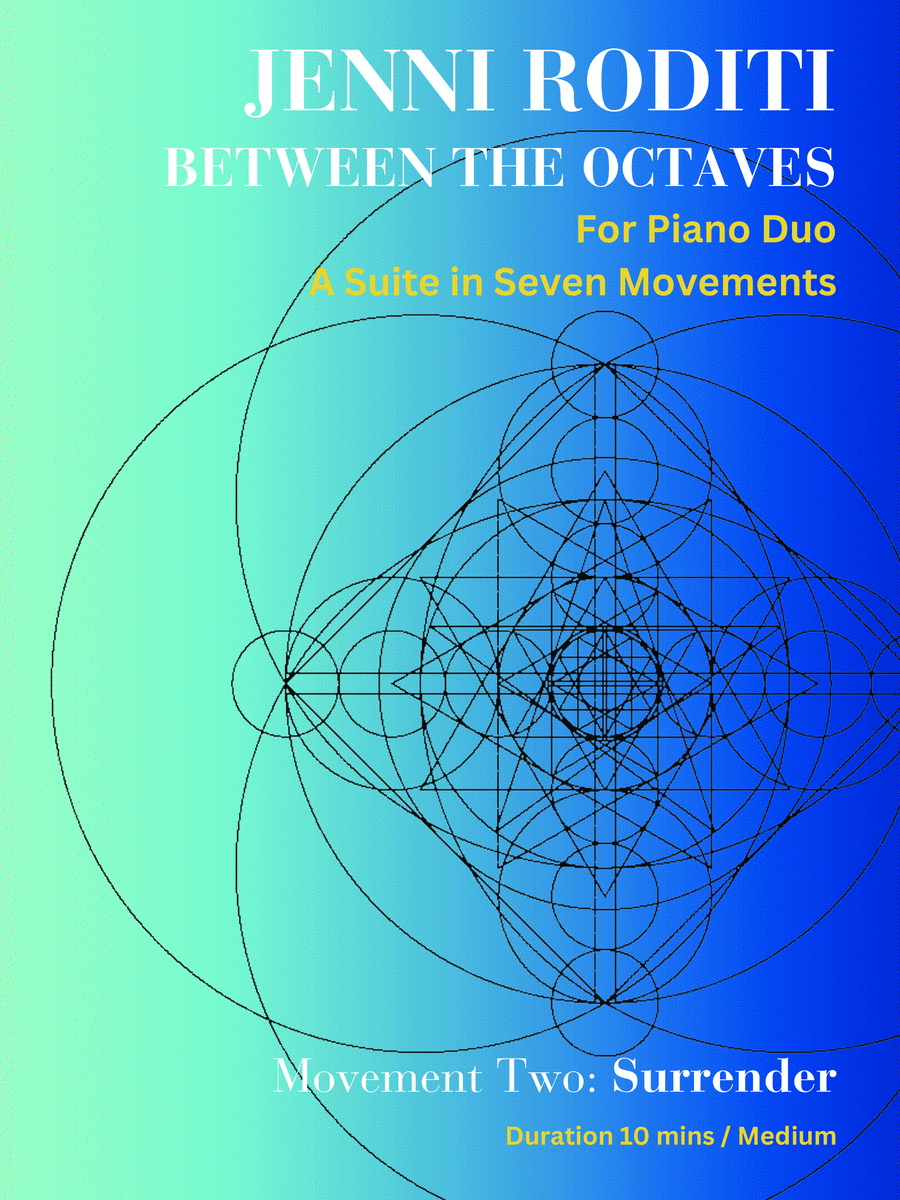
SURRENDER, Between the Octaves, A Piano Duo Suite (Movement 2 of 7)
2 Pianos, 4 mains
dislocation I mean a degree of tension between the natural acoustics of the two instruments in the room and the players idiosyncrasies as musicians  The whole point of this work was to examine the nature of my syntax, grammar, and compositional thinking
$20.00 17.32 € 2 Pianos, 4 mains PDF SheetMusicPlus

2 Pianos,4 Hands,Piano Duet - Level 4 - Digital Download SKU: A0.757132 Composed by Johann Sebastian Bach. Arranged by Simon Peberdy. Baroque,Instructional,Standards. Score. 6 pages. Simon Peberdy #6210435. Published by Simon Peberdy (A0.757132). One of Bach's popular 2 part inventions with a new additional piano part written by Simon Peberdy to double the fun! For more music for 2 pianos and piano duets, please visit http://www.simonpeberdymusic.comFor a video of the first 5 of Bach's 2 Part Inventions in new arrangements with an additional piano part by Simon Peberdy, click [https://www.youtube.com/watch?v=rx3IphRUhBo]For a video of the second 5, click [https://www.youtube.com/watch?v=rx3IphRUhBo]
Bach 2 Part Invention No. 12 in A major for 2 pianos (additional piano part by Simon Peberdy)
2 Pianos, 4 mains

$2.99 2.59 € 2 Pianos, 4 mains PDF SheetMusicPlus


Partitions Gratuites
Acheter des Partitions Musicales
Acheter des Partitions Digitales à Imprimer
Acheter des Instruments de Musique

© 2000 - 2026

Accueil - Version intégrale





