EUROPE
61 articles
USA
0 articles
DIGITAL
25 articles (à imprimer)
Partitions Digitales
Partitions à imprimer
25 partitions trouvées


B-Flat Trumpet,Piano - Level 2 - Digital Download SKU: A0.549220 Composed by Johann Sebastian Bach. Arranged by James M. Guthrie, ASCAP. Baroque,Holiday,Standards,Wedding. Score and part. 9 pages. Jmsgu3 #3468158. Published by jmsgu3 (A0.549220). J. S. Bach BWV 508. Bist du bei mir Bach adapted this aria from a lost Stölzel opera called Diomedes. He changed the original orchestral instrumentation to soprano, strings, and continuo.  He also modified the voice-leading making it sound more like a Bach composition. The work appears as BWV 508 No. 25 in the Anna Magdalena Notebook No. 2.   Source Only a few remnants of the original opera have survived. Historians speculate that Anna Magdalena got the song from the Leipzig Opera after the bankruptcy of 1720. Chances are good, though, that the tune was a favorite of everyone in Leipzig at the time.   Lyrics When thou art near, I go with joyTo death and to my rest.O how joyous would my end be,If your fair hands            Would close my faithful eyes. - Unknown Bach Overview First of all, Johann Sebastian Bach is maybe the greatest composer in music history. Certainly, he was prolific. As a result, everyone has heard of his works. Furthermore, these works number well over a thousand. It seems like people are probably most familiar with instrumental works such as the Brandenburg Concertos, and the Goldberg Variations. But, similarly famous are such noteworthy works as the Well-Tempered Clavier, the Musical Offering, and indeed the Art of Fugue. Seems like his most famous vocal works include the most noteworthy Mass in B Minor. Also, most noteworthy are the St. John Passion, and indeed the Christmas Oratorio.  History Bach came from a long line of musicians and above all, composers. Consequently, he, first of all, pursued a career as a church organist. So as a result, he gained employment in various Protestant churches in Germany. For a while, he worked as a court musician in Weimar and Köthen. Here he probably developed his organ style and likewise his chamber music style. Eventually, he, therefore, gained an appointment as Cantor of St. Thomas in Leipzig. Here he worked until difficulties with his employer ultimately drove him away. The King of Poland finally appointed him as court composer.  Style It seems like Bach created a fascinating new international style. He synthesized elements of the most noteworthy European music ideas into his new style. Even more, this new style was probably his synthesis of European musical rhythm and form. Furthermore, he demonstrated a complete mastery of counterpoint and motivic development. His sense of harmonic organization probably propelled him to the top. Revival                Mendelssohn conducted a Bach revival in the nineteenth century. His effort probably helped to re-familiarize the public with the magnitude of Bach’s works. During this period, scholars published many noteworthy Bach biographies. Moreover, Wolfgang Schmieder published the BWV (Bach Werke Verzeichnis). As a result, this is now the official catalog of his entire artistic output. The BWV number allows us to locate a work in the catalog. Sometimes scholars will simply use an S (Schmieder) as an abbreviation for BWV.  Voyager NASA launched two Voyager spacecraft in 1977. Onboard are phonograph records with sounds, music, and images of life on Earth. The purpose of the launch was to inform intelligent extraterrestrial life forms about conditions on Earth. The music on the disc is varied. There is Bach, Mozart, Beethoven, and Stravinsky among others. However, because Bach is so important in our music history, it contains three times more Bach than all the others combined.
Bach: Bist du bei mir BWV 508 for Trumpet & Piano
Trompette

$32.95 28.59 € Trompette PDF SheetMusicPlus

B-Flat Trumpet,Piano - Level 1 - Digital Download SKU: A0.548515 Composed by Wade. Arranged by James M. Guthrie, ASCAP. Christian,Christmas. Score and part. 4 pages. Jmsgu3 #3388127. Published by jmsgu3 (A0.548515). O Come All Ye Faithful arranged with new harmony for the final verse. Score: 3 pages, part: 1 page. Trumpet in Bb O Come, All Ye Faithful O Come, All Ye Faithful is an English translation of the Latin Christmas carol Adeste Fideles. No one knows exactly who wrote it. One theory holds that King John IV of Portugal (1604–1656) wrote it. Another theory says John F. Wade or John Reading wrote it. Nowadays, we usually attribute it to John Wade. Seems like Stonyhurst College in Lancashire owns the oldest manuscript. It is from the year 1751. Lyrics Frederick Oakeley, a Catholic priest in 1841 wrote the English translation. This translation is probably the most common in the English-speaking states. To begin with, the hymn had only four verses. Later, the verses grew to eight. Music directors often cut various verses because otherwise, the song goes too long. Some believe that St. Bonaventure wrote the first Latin lyrics. Others hold that King John IV of Portugal is responsible. Yet even others think the Cistercian monks wrote them. King John IV His subjects called King John IV of Portugal The Musician King. He became king in 1640. In addition to performing the duties of a king, he composed and wrote as a music journalist. King John built a very large music library. Unfortunately, the massive earthquake of Lisbon ruined the library in 1755. In addition to building his library, the king started a Music School that produced many accomplished musicians. The king also worked diligently to get instrumental music approved by the Vatican for use in his churches. Aside from his authorship of Adeste Fideles, he is famous for another popular choral setting of the Crux Fidelis, a prevalent Lenten hymn. Performance in Context Verses are sometimes left out because all eight verses would take too long to perform. More to the point though, some of the verses may be unsuitable for whatever of the church calendar they are intended. The eighth verse deals with the Epiphany, so it makes sense to sing this on Epiphany Sunday, but not other Sundays. Similarly, other verses are used according to whether the event is Midnight Mass or regular daytime Mass.  Register for free lifetime updates and revisions at www.jamesguthrie.com
O Come All Ye Faithful for Trumpet & Piano
Trompette

$24.95 21.65 € Trompette PDF SheetMusicPlus

B-Flat Trumpet,Piano - Level 2 - Digital Download SKU: A0.549835 Composed by Johann Sebastian Bach. Arranged by James M. Guthrie, ASCAP. Baroque,Concert,Easter,Sacred,Standards. Score and part. 12 pages. Jmsgu3 #3554463. Published by jmsgu3 (A0.549835). Wachet auf, ruft uns die Stimme (Awake, the voice is calling us) from Cantata BWV 140. Duration: ca. 4:00, Score: 6 pages, solo part 1 page, piano part: 4 pages. Program this for church services during the Easter season, weddings, or as a recital encore.Wachet auf, ruft uns die Stimme (Awake, the Voice is calling us) also known as: Sleepers Awake Bach composed his church cantata Wachet auf (BWV 140) as part of his second annual cantata cycle covering the entire annual church calendar. It is based on the hymn of the same name by Philipp Nicolai (1599). The hymn text covers the readings for the 27th Sunday after Trinity. Bach designed the cantata in seven movements, setting the stanzas in various forms. Among these forms are the chorale fantasia, the chorale prelude, and a four-part chorale. He casts the new lyrics as recitatives – in a manner similar to the opera. Fourth Movement Bach writes the fourth movement, Zion hört die Wächter singen (Zion hears the watchmen singing), in the style of a chorale prelude with the chorale phrases performed as a strict cantus firmus. The phrases seem to enter at times erratically against the famous lyrical melody. The violins play this melody in unison as a foil against the cantus phrases. The violin melody is so independent and complete that when the cantus melody appears it catches the listener at times totally off-guard. Bach later transcribed this movement for organ (BWV 645). This transcription became No. 1 of the Six Schübler Chorales. Bach Overview First of all, Johann Sebastian Bach is maybe the greatest composer in music history. Certainly, he was prolific. As a result, everyone has heard of his works. Furthermore, these works number well over a thousand. It seems like people are probably most familiar with the instrumental works such as the Brandenburg Concertos, and the Goldberg Variations. But, similarly famous are such noteworthy works as the Well-Tempered Clavier, the Musical Offering, and certainly the Art of Fugue. Seems like his most famous vocal works include the most noteworthy Mass in B Minor. Also, most noteworthy, though, are the St. John Passion, and certainly the Christmas Oratorio.  History Bach came from a long line of musicians and above all, composers. Consequently, he, first of all, pursued a career as a church organist. So as a result, he gained employment in various Protestant churches in Germany. For a while, he worked as a court musician in Weimar and Köthen. Here he probably developed his organ style and likewise his chamber music style. Eventually, he, therefore, gained an appointment as Cantor of St. Thomas in Leipzig. Here he worked until difficulties with his employer ultimately drove him away. The King of Poland finally appointed him as court composer.  Style It seems like Bach created a fascinating new international style. He synthesized elements of the most noteworthy European music ideas into his new style. Even more, this new style was probably his synthesis of European musical rhythm and form. Furthermore, he demonstrated a complete mastery of counterpoint and motivic development. His sense of harmonic organization probably propelled him to the top. Revival               Mendelssohn conducted a Bach revival in the nineteenth century. His effort probably helped to re-familiarize the public with the magnitude of Bach’s works. During this period, scholars published many noteworthy Bach biographies. Moreover, Wolfgang Schmieder published the BWV (Bach Werke Verzeichnis). As a result, this is now the official catalog of his entire artistic output. The BWV number allows us to locate a work in the catalog. Sometimes scholars will simply use an S (Schmieder) as an abbreviation for BWV.
Bach: Wachet auf for Trumpet & Piano
Trompette

$24.95 21.65 € Trompette PDF SheetMusicPlus

B-Flat Trumpet,Piano - Level 3 - Digital Download SKU: A0.549500 Composed by Felix Mendelssohn (1809 –1847). Arranged by James M. Guthrie, ASCAP. Instructional,Romantic Period,Sacred,Standards. Score and part. 20 pages. Jmsgu3 #3501845. Published by jmsgu3 (A0.549500). TRUMPET in Bb and PIANO - Score: 11 pages, solo part: 3 pages, piano part: 5 pages. Duration: 4:20. This is a popular recital piece that would work well also in church or school programs.  Mendelssohn Background Felix Mendelssohn (1809 –1847) was, by all means, a German mastermind composer, musician, and orchestra conductor of the Romantic period. Consequently, Mendelssohn composed in the usual forms of the time - symphonies, concertos, oratorios, piano music, and chamber music. To summarize, his most famous works include his music for A Midsummer Night's Dream, the Italian Symphony, the Scottish Symphony, The Hebrides Overture, his later Concerto for Violin & Orchestra, and his Octet for Strings. His most well-known piano pieces, by and large, are the Songs Without Words.  Artistic Standing  Musical tastes change from time to time. Moreover, just such a change occurred in the late 19th and early 20th centuries. This plus rampant antisemitism brought a corresponding amount of undue criticism. Fortunately, however, his artistic inventiveness has indeed been critically re-evaluated. As a result, Mendelssohn is once again among the most prevalent composers of the Romantic era. Early Family Life Mendelssohn was, in fact, born into a prominent Jewish family. His grandfather was, notably, the philosopher Moses Mendelssohn. Felix was, in fact, raised without religion. At the age of seven, he was suddenly baptized as a Reformed Christian. He was, moreover, a child musical prodigy. Nevertheless, his parents did not attempt to exploit his talent. Early Adulthood Mendelssohn was, in general, successful in Germany. He conducted, in particular, a revival of the music of Johann Sebastian Bach, specifically with his presentation of the St Matthew Passion in 1829. Felix was truly in demand throughout Europe as a composer, conductor, and soloist. For example, he visited Britain ten times. There, he premiered, namely, many of his significant works. His taste in music was. To be sure, inventive and well-crafted yet markedly conservative. This conservatism separated him by all means from more audacious musical colleagues like Liszt, Wagner, and Berlioz. Mendelssohn founded the Leipzig Conservatoire which, to clarify, became a defender of this conservative viewpoint. Mature Adulthood Schumann notably wrote that Mendelssohn was the Mozart of the nineteenth century, the most brilliant musician, the one who most clearly sees through the contradictions of the age and for the first time reconciles them. This observation points to a couple of features in particular that illustrate Mendelssohn's works and his artistic procedure. Musical Features In the first place, his musical style was fixed in his systematic mastery of the style of preceding masters. This being said, he certainly recognized and even developed early romanticism from the music of Beethoven and Weber. Secondly, it indicates that Mendelssohn sought to strengthen his inherited musical legacy rather than to exchange it with new forms and styles or replace it with exotic orchestration. Consequently, he diverged his contemporaries in the romantic period, such as Wagner, Berlioz, and Liszt. Mendelssohn revered Liszt's virtuosity at the keyboard but found his music rather insubstantial.
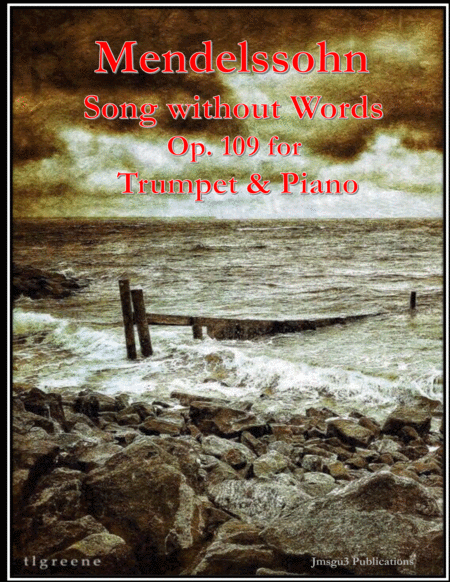
Mendelssohn: Song Without Words Op. 109 for Trumpet & Piano
Trompette

$32.95 28.59 € Trompette PDF SheetMusicPlus

B-Flat Trumpet Solo - Level 3 - Digital Download SKU: A0.894419 Composed by Daniel Butterfield. Arranged by Zack Richards. Contemporary,Folk,Holiday,Patriotic. Individual part. 4 pages. Zack Richards #6426687. Published by Zack Richards (A0.894419). Taps has always been near and dear to me for almost as long as I've played the Trumpet. I have played it more times than I can count. I was the Bugler for our local Boy Scout troop, playing Taps at many campouts and events to signal the end of the day. I also played it with our High School Marching Band for Memorial Day services, including an incredibly special one at my grandfather's gravesite shortly after his passing. He had served in the Army during World War II. I also played it for several funerals, including my Uncle's, who had served in the Marines. For some time, I had volunteered for our local VFW to play for Veteran's funerals. My High School Trumpet teacher and numerous other people in my life are Veterans and have made a huge impact on me. I decided to write this arrangement to give tribute to all Veterans and Service Members and to help the Echo Taps Worldwide cause. Echo Taps Worldwide was first done on May 19, 2007, in recognition of Armed Forces Day at National Cemeteries, State Veterans Cemeteries and American Battle Monuments Cemeteries overseas. The idea is that at gatherings across the world on Armed Forces Day, Buglers play Taps in succession, with one beginning as the previous ends, to honor those who have sacrificed so much. The intention is also to bring attention to the dire need for buglers to play for Veteran's funerals across the world. If you can, please look into volunteering for your local organizations to play Taps. From Thomas Day, a Marine veteran who founded Bugles Across America in 2000, A live bugler performing Taps is an expression of the Nation’s appreciation for the service of each veteran...With more than 600,000 veterans dying each year, we are always looking for new volunteers to perform this valuable service. Performance and Rehearsal mp3 Tracks available!S0.1059653 Echo Taps Rehearsal TrackS0.1059683 Echo Taps Performance Track All of these works are available individually or all together in my United We Stand Collection. S0.1059689 United We Stand Collection Zack Richards Music Minus One Series Each of these works for Solo Trumpet with mp3 accompaniment track also have a corresponding arrangement for Trumpet Ensemble.S0.792173 Echo Taps for Trumpet EnsembleS0.1059707 United We Stand Collection for Trumpet Ensemble Solo B-flat Trumpet Intermediate- Advanced Intermediate Approx. 2:30   Visit zackrichards.com for more from this composer!
Echo Taps for Solo Trumpet
Trompette

$5.99 5.2 € Trompette PDF SheetMusicPlus

B-Flat Trumpet,Piano - Level 1 - Digital Download SKU: A0.548502 Composed by Traditional. Arranged by James M. Guthrie, ASCAP. Christian,Christmas. Score and part. 4 pages. Jmsgu3 #3387385. Published by jmsgu3 (A0.548502). The First Noel arranged for Trumpet in Bb & Piano with new harmony for the final verse.Origins The First Noel is an English Christmas carol. Even more, it was probably written in the late Cornish Renaissance period. While other versions spell the title as Nowell, this is just a colloquial variation. Furthermore, Noel is an older word meaning Christmas. Therefore the First Noel translates as the First Christmas. First of all, Gilbert and Sandy published the earliest version. As a result, this version appears in the Carols Ancient and Modern songbook of 1823. William Sandy edited and arranged the book. Similarly, his partner Davies Gilbert edited and added the familiar extra verses. The First Noel: Trumpet Version comes with new harmony in final verse for more energy and drive. Stainer Organist and composer Sir John Stainer published the most noteworthy customary arrangement in the 1870’s.  Stainer is above all famous for his songbook entitled: Christmas Carols New and Old (1871). This volume served as an important catalyst for reviving the English Christmas carol.  Other famous Stainer arrangements from this book are such titles as What Child Is This, God Rest Ye Merry Gentlemen, Good King Wenceslas, and I Saw Three Ships. Diatonic Function The melodic structure in the First Noel is uncommon among English folk tunes. It simply repeats one phrase twice then follows a variation refrain. All three phrases of the song end on the mediant scale degree. This is unusual because the diatonic function of the mediant is non-final compared to the more usual tonic or even dominant degrees. Consequently, this gives the song as kind of open-ended feeling – like maybe it never really ends. Political Context The Catholic clergy sang carols outside of the church in Latin. After the Protestant Reformation, the reformers thought it would be better for everyone to sing carols. They decided to bring music back to the common folk. So, they translated the lyrics from Latin into common language. Moreover, the Protestants wanted more control over the music in church than what the Vatican allowed. Protestant composers such as William Byrd composed complex polyphonic Christmas music that they called carols. Nonetheless, some famous folk carols were composed in this era. Eminent composers in the nineteenth century began to revise and adapt them. Consequently, they revived the English carol.  Register for free lifetime updates and revisions at www.jamesguthrie.com  
The First Noel for Trumpet & Piano
Trompette

$24.95 21.65 € Trompette PDF SheetMusicPlus

B-Flat Trumpet,Piano - Level 1 - Digital Download SKU: A0.548721 Composed by Martin Luther. Arranged by James M. Guthrie, ASCAP. Easter,Instructional,Standards. Score and part. 4 pages. Jmsgu3 #3411757. Published by jmsgu3 (A0.548721). Out of the Depths I Cry to You by Martin Luther. The first verses feature modified counterpoint and harmony proceeding at quarter = 82. The final verse is reharmonized for maximum dramatic effect at a more contemplative tempo such as quarter = 64. Features the entire range of the instrument. Very powerful selection for Lent or Easter. Duration (3 verses) 3:05, 36 ms. Score: 3 pg. Solo part: 1 pg. The piano reads from the score. Out of the Depths Aus tiefer Not schrei ich zu dir (From deep affliction I cry out to you), is, of course, a hymn composed by Martin Luther. Moreover, Luther also wrote the lyrics, essentially a paraphrase of Psalm 130. First published in 1524, it is also one of eight songs in the original Lutheran hymnal. It appears likewise in many hymnals and in different translations. The lyrics furthermore stimulated compositions from the Renaissance to the contemporary. Consequently, composers such as Johann Sebastian Bach built an entire chorale cantata on it. Other composers similarly contributed pieces, such as Felix Mendelssohn and Max Reger. Luther Background Martin Luther, (1483 –1546) was a German professor of theology, composer, priest, and moreover, an influential character in the Protestant Reformation. Luther had a momentous impact on church and society due to his contributions to the musical arts. He wanted to disseminate the gospel among mankind and with this intention thought that the best way to do that was through music. Influence It is important to realize that other musicians, and their descendants, were encouraged by Luther’s songs and wrote their own hymns. Luther, to be sure, had a thorough musical education. For example, he knew secular and sacred songs from an early age. He, in particular, played the lute well and sang in the monastery when he was a monk. That is to say, music was an essential part of his life. He in fact first began writing songs in 1523, sometimes writing the melody as well as the lyrics. Luther was certainly able to evaluate the composers of his time. He thought especially highly of Josquin des and Ludwig Senfl. He was also acquainted, with this in mind, with other composers and their works. Legacy The Lutheran musical ethos soon covered all of Germany and later significantly fashioned Protestant musical culture. Heinrich Schütz and Johann Sebastian Bach are the most compelling evidence of this Protestant musical culture. Additionally, as a point often overlooked, the pedal organ, first refined in northern Germany, became universally prevalent. As a matter of fact, Dieterich Buxtehude established a regular evening organ concert series in Lübeck. Another key point is that this concert series, in turn, spread North German Musical ideas worldwide. Luther was especially convinced that music is a beautiful and exclusive offering of the divine.
Luther: Out of the Depths for Trumpet & Piano
Trompette

$24.95 21.65 € Trompette PDF SheetMusicPlus

B-Flat Trumpet Solo - Level 2 - Digital Download SKU: A0.1350715 Composed by Wolfgang Amadeus Mozart. Arranged by Glauco Fernandes. Chamber,Classical,Instructional,Wedding. Individual part. 1 pages. Glauco Fernandes #935538. Published by Glauco Fernandes (A0.1350715). Explore Mozart's lively composition Turkish March with our exclusive easy arrangement, designed for beginners. Created for musicians taking their first steps in learning, this arrangement offers a simple and accessible interpretation, making the piece enjoyable and suitable for those just starting to play.Ideal for those looking to begin their musical journey with an iconic classical piece, this arrangement of the Turkish March is perfect for beginner students, teachers introducing the fundamentals of music, and anyone seeking a smooth introduction to Mozart's work. Even younger musicians will be able to enjoy this engaging arrangement.The sheet music includes straightforward markings and instructions, ensuring an uncomplicated and fun approach to Mozart's classic composition. Acquire your score today and take the first steps in your musical journey with the timeless charm of the Turkish March.This arrangement is also suitable for more experienced musicians seeking practicality. It can be played at various events such as weddings, birthdays, corporate events, and more.For more high-quality sheet music, consider searching for Glauco Fernandes on the website. Contact: glaucofernandes.arrangements@gmail.com. Explore additional arrangements and broaden your musical repertoire.And don't forget to check out my YouTube channel to explore more enchanting arrangements: [EnchantedSheetMusic](http://www.youtube.com/@EnchantedSheetMusic).
Turkish March by Mozart - Trumpet Solo with Chord Notations
Trompette

$2.99 2.59 € Trompette PDF SheetMusicPlus

B-Flat Trumpet Solo - Level 2 - Digital Download SKU: A0.1350718 Composed by Wolfgang Amadeus Mozart. Arranged by Glauco Fernandes. Chamber,Classical,Instructional,Wedding. Individual part. 1 pages. Glauco Fernandes #935542. Published by Glauco Fernandes (A0.1350718). Explore Mozart's lively composition Turkish March with our exclusive easy arrangement, designed for beginners. Created for musicians taking their first steps in learning, this arrangement offers a simple and accessible interpretation, making the piece enjoyable and suitable for those just starting to play.Ideal for those looking to begin their musical journey with an iconic classical piece, this arrangement of the Turkish March is perfect for beginner students, teachers introducing the fundamentals of music, and anyone seeking a smooth introduction to Mozart's work. Even younger musicians will be able to enjoy this engaging arrangement.The sheet music includes straightforward markings and instructions, ensuring an uncomplicated and fun approach to Mozart's classic composition. Acquire your score today and take the first steps in your musical journey with the timeless charm of the Turkish March.This arrangement is also suitable for more experienced musicians seeking practicality. It can be played at various events such as weddings, birthdays, corporate events, and more.For more high-quality sheet music, consider searching for Glauco Fernandes on the website. Contact: glaucofernandes.arrangements@gmail.com. Explore additional arrangements and broaden your musical repertoire.And don't forget to check out my YouTube channel to explore more enchanting arrangements: [EnchantedSheetMusic](http://www.youtube.com/@EnchantedSheetMusic).
Turkish March by Mozart - Trumpet Solo
Trompette

$2.99 2.59 € Trompette PDF SheetMusicPlus

Piano,Trumpet - Level 4 - Digital Download SKU: A0.587789 Composed by Scott Joplin. Arranged by David McKeown. 20th Century,Folk,Jazz,Ragtime. Score and part. 8 pages. David McKeown #4967675. Published by David McKeown (A0.587789). The most popular of Scott Joplin’s piano rags during his lifetime, The Maple Leaf Rag was published in 1899. Joplin lived for a while in Sedalia, Missouri and the Maple Leaf Club in that town is thought to have provided the name for this composition. It provided Joplin with a steady income for the rest of his life, and while he requested that it be played at his funeral, his wife refused as she felt it inappropriate. It was the first track on Joshua Rifkin’s famous 1970 revival recording of Joplin’s music and, never waning in popularity, it has featured in hundreds of films.This version for Trumpet and Piano includes all four sections of the original composition. The tempo in recorded versions varies widely between 72 and 126, so the marking of 92 is a suggestion only.Musicians at an advanced intermediate level and above will find this ideal for formal and informal performances. The overall performance time is around four minutes.Teachers will enjoy using this arrangement as a fun way to help with phrasing, syncopated rhythms and light articulation. Click the YouTube link to hear a full performance of the clarinet version of this arrangement. There are many more top quality arrangements and compositions by David McKeown for you to browse at http://www.sheetmusicplus.com/publishers/david-mckeown/6203?aff_id=673683 
Maple Leaf Rag, by Scott Joplin, for Trumpet and Piano
Trompette

$4.60 3.99 € Trompette PDF SheetMusicPlus

Trumpet Solo - Level 5 - Digital Download SKU: A0.829071 Composed by Eric Bolvin. Instructional,Jazz. Individual part. 64 pages. ERIC V BOLVIN #3579875. Published by ERIC V BOLVIN (A0.829071). The Be-Bop Range Book is a creative approach to developing range, technique and improvisational be-bop skills for trumpet.IntroductionTrumpet range and developing it is one of the most common and controversial subjects among trumpet players, teachers and authors. Without delving too far into the physical and scientific aspects of trumpet playing, allow me to paraphrase the great Yogi Berra;The upper register of the trumpet is the same as the middle and lower registers, just different.All trumpet playing is a coordination or balance of three things: air, tongue level and embouchure. It is through sensible, intelligent and consistent practice that we develop the skills necessary to play throughout the entire range of our instrument.Purpose Of This BookAlthough hitting the high note may be the quest for many trumpet players, a more useful and musical goal is developing a large playable range. This means being able to articulate and play musically and dynamically throughout the entire range of the instrument. This is accomplished through the use of Range Arcs, which are musical phrases that cover a large range. In addition to building our playable range, we are working on technique and adding to our jazz vocabulary.I originally developed the concept of Range Arcs in The Modern Jazz Trumpet Method. Many players have commented on how useful these studies are, so I decided to expand on it here. For more rudimentary range, flexibility and endurance study, seeTongue Level & Air.The Approach NoteI have found that how we approach the highest note of a musical phrase is critical to range development. This aspect of range development is presented here in a progressive, creative format.Exercises 1-5 use the Chromatic Approach. This means that the highest note of the arc is approached from a 1â„2 step below. The exercises continue, adding a 1â„2 step to the approach note every five exercises.Articulation & PhrasingAll exercises in this book are to be played in a swing style. However, if you are having trouble with an exercise, sometimes playing it straight may help. Jazz articulation should also be employed throughout. What does that mean exactly? Jazz trumpet articulation is as spontaneous and individual as an improvised solo. Honestly, if I have to think about it, I can’t do it. The best advice is to listen to the trumpet players quoted in this book and to as much jazz trumpet as you can. Transcribe and play solos while emulating their style and articulation.Immersing yourself in this will result in your own personal style of articulation. Jazz articulation on trumpet is also born out of necessity. Some slurs in a line may just not be possible so you must tongue. This will be revealed when you start some of the exercises that contain wider intervals.How To Use This BookEach exercise group consists of a Range Arc, Range Builder and Range Builder Extended. Each group should be practiced for at least one week before moving ahead to the next one.Range ArcsThe Range Arc is the original lick. Many of these have been borrowed from some of the great jazz trumpeters of all time; Freddie Hubbard, Clifford Brown, Lee Morgan, Chet Baker, Tom Harrell, Randy Brecker, Fats Navarro and Blue Mitchell.You should begin with the key that is marked with an asterisk * ; it is an easy key and range and will help you familiarize yourself with the lick. Practice slowly at first and then work for speed. Once you are familiar with the * lick, start at the beginning of the Range Arc. Work on each key until you get it smoothly. Repeat as needed and rest between each key. Take the D.C. and play 8va through the indicated key (see the box at the end of the Range Arc) that takes you to High C. Rest for 15 minutes.Range BuildersAfter resting, you are ready for the Range Builder. These are short.
The Be-Bop Range Book
Trompette

$16.95 14.71 € Trompette PDF SheetMusicPlus

Piano,Trumpet - Level 4 - Digital Download SKU: A0.587750 Composed by Peter Ilyich Tchaikovsky. Arranged by David McKeown. Children,Concert,Film/TV,Romantic Period,Standards. Score and part. 14 pages. David McKeown #4839889. Published by David McKeown (A0.587750). Sleeping Beauty, is the second ballet of three composed by Pyotr Tchaikovsky. Here, the famous Waltz is arranged for Solo Trumpet and Piano, directly from the orchestral score. The first performance of the ballet was in St Petersburg in 1890. Like his other ballets, Sleeping Beauty was slow to gain popularity with the public and international recognition only came after Tchaikovsky’s death. Included in the single download are nine pages of piano score and an attached four-page part for the solo instrument. Musicians at an upper intermediate level and above will find this ideal for formal and informal performances. The melody is expressive and legato; the accompaniment is challenging in parts with a high tempo throughout. Both parts require dramatic dynamic contrasts and the solo part explores a wide range of the instrument. The overall performance time is around five minutes. The linked youtube performance is the clarinet version of this arrangement.There are many more top quality arrangements and compositions by David McKeown for you to browse at http://www.sheetmusicplus.com/publishers/david-mckeown/6203
The Sleeping Beauty Waltz by Tchaikovsky, for Trumpet and Piano
Trompette

$4.60 3.99 € Trompette PDF SheetMusicPlus

Trumpet Solo - Level 2 - Digital Download SKU: A0.589049 By The Beatles. By John Lennon and Paul McCartney. Arranged by David McKeown. Rock. Individual part. 3 pages. David McKeown #5325417. Published by David McKeown (A0.589049). In My Life by the Beatles, was released on the 1965 album, Rubber Soul. It was chiefly written and sung by John Lennon, who claimed it was his first serious attempt at personal song-writing. The song features a baroque style piano solo by George Martin. The tempo was too fast for him to perform it, so he played it at half tempo and layer doubled the tape speed. The resulting tinny sound gave rise to a host of copycat harpsichord solos on contemporary pop songs.This version of In My Life is arranged in a suitable key and range for solo Trumpet. Piano/Guitar chords in concert pitch are included above the stave.Musicians at an early intermediate level will find In My Life ideal for formal and informal concert performance. Most of the solo is straightforward, although the transcribed piano solo is at a higher level of difficulty; these eight bars can be skipped without affecting the overall structure of the song. The overall performance time is around two and a half minutes. Teachers will enjoy using this arrangement as a fun way to help with syncopated rhythms.There are many more top quality arrangements and compositions by David McKeown for you to browse at http://www.sheetmusicplus.com/publishers/david-mckeown/6203
In My Life
Trompette
The Beatles
$4.99 4.33 € Trompette PDF SheetMusicPlus

Trumpet - Level 2 - Digital Download SKU: A0.1099560 Composed by Eddie Lewis. Classical,Instructional,March. 13 pages. Tiger Music #703450. Published by Tiger Music (A0.1099560). Upgrade your library of easy trumpet literature with At Last Victorious! easy trumpet quartet. This is a 6/8 march in three sharps. As a trumpet teacher with over forty years of experience teaching beginners, I believe that solid range should be developed over a long period of time. But this doesn’t mean that the beginner students need to wait for their range to improve before they dive deeper into the musical side of the instrument. At Last, Victorious! easy trumpet quartet includes the most difficult combination of skills without moving into our first intermediate level. We will talk more about skill levels below, but let me say that many people would label At Last, Victorious as an intermediate piece. In our skill level system, three sharps and six-eight time signature are both in our second beginner skill level. And yet, the highest note in the first part is fourth space E. At Last, Victorious! easy trumpet quartet is the kind of piece I would assign to my students right before they “graduate†from the second beginner skill level into the first intermediate skill level. At Last, Victorious! is a march in six-eight time signature in three sharps. It is not as long as a traditional march and the “trio†is not technically a real trio (and therefore not marked as such). But I do believe that the piece serves as a nice introduction to marches for beginner trumpet students.
At Last, Victorious! Easy Trumpet Quartet
Trompette

$11.28 9.79 € Trompette PDF SheetMusicPlus

Trumpet Solo - Digital Download SKU: A0.829065 Composed by Eric Bolvin. Arranged by Eric Bolvin. Instructional. Individual part. 64 pages. ERIC V BOLVIN #3578777. Published by ERIC V BOLVIN (A0.829065). Tongue Level & Air is a 26 lesson course that starts easy and helps you improve your sound, range, control and endurance. All players at all levels can benefit from this book, including beginners. Check out our FREE lessons and videos below.Efficient trumpet playing is a balance between three elements; air, tongue level, and embouchure. This balance cannot be explained in scientific terms, therefore it must be accomplished by feel through proper practice.The purpose of Tongue Level & Air is to provide trumpet players with a course of study which will enable them to find their balance and become more efficient in their playing.Trying to describe the balance with statements such as The balance is 1/3 air, 1/3 tongue level, and 1/3 embouchure is pointless. The balance is in a constant state of flux, changing from day to day, gig to gig, and note to note. Your balance can change when you change instruments, when the playing environment is unfamiliar, when you are sick or tired, or for many other reasons. It is best not to over analyze your balance, but to develop it naturally over time and by feel.You will discover early in your study of these materials and after viewing the videos below  that we have plenty of air to play the trumpet. The secret to efficiency lies in the control of that great reserve of air power. When doing the breathing exercises in Lessons 1-3 Part 3, don’t hold back the first time through. On the repeat control the air and go for the musical result.
Tongue Level & Air
Trompette

$16.95 14.71 € Trompette PDF SheetMusicPlus


Partitions Gratuites
Acheter des Partitions Musicales
Acheter des Partitions Digitales à Imprimer
Acheter des Instruments de Musique

© 2000 - 2026

Accueil - Version intégrale





