EUROPE
8896 articles
USA
0 articles
DIGITAL
20 articles (à imprimer)
Partitions Digitales
Partitions à imprimer
20 partitions trouvées


Brass Ensemble - Level 4 - Digital Download SKU: A0.767194 Composed by Claudio Monteverdi. Arranged by Mike Lyons. Baroque,Renaissance. Score and parts. 26 pages. Lyons Music Services #3074153. Published by Lyons Music Services (A0.767194). Monteverdi's third book of madrigals of 1592 is one of the earliest steps towards the writing of opera as we know it. In this collection of songs, Monteverdi, for the first time, starts to bring small groups of songs (2 or 3) to form a 'Scena - a collection with similar words or on a similar theme or by the same poet and keeping them as a little group within the book of madrigals. The 7th song, Se Per Estremo Ardore expresses the extreme desire of the singer for his lover.As with all of Monteverdi's vocal music, it translates really well onto instruments. The individual madrigals are available separately. This flexible arrangement is equally playable on woodwind ensembles as on brass.Flexible quintet parts are supplied as follows:Part 1 in Bb,Part 2 in Bb, Part 3 in Bb/Eb/F, Part 4 in Bb/Eb/C(Bass clef) and Part 5 in Bb/Eb/C(Bass clef)Other parts may be requested free of charge.
Monteverdi - The Third Book of Madrigals - No 7 Se Per Estremo Ardore
Ensemble de cuivres

$5.99 5.17 € Ensemble de cuivres PDF SheetMusicPlus

Brass Ensemble - Level 4 - Digital Download SKU: A0.870401 Composed by Giovanni Gabrieli. Arranged by Randy A. Steinberg. Baroque. Score and parts. 39 pages. Randy A. Steinberg #1988931. Published by Randy A. Steinberg (A0.870401). Giovanni Gabrieli was no mere composer. He was an event. The figure at the nexus of many things all coming together in one grand tide. The greatest church in the greatest city of Europe. Freedom of intellectual thought. A Venetian School of composers at the forefront of musical innovation. The printing press and musical publishing. A Doge (Chief Magistrate or Duke) willing to spend, and spend big, on musical pomp and ceremony. A dearth of wealth and money to fund the grandest celebrations. He was the leading Italian composer and organist in Venice at its greatest heights at the chasm between the end of the Renaissance and the beginning of the Baroque period in music. Presented here is a Canzona published around 1615 for 7 brass. A variety of substitute parts are also included to handle the trombone parts with French horn and tuba. A Gabrieli instrumental ensemble work for 7 players that provides listeners with a rich mid-sized ensemble piece for brass with many of the common Gabrieli touches and rhythms.
Canzon V a 7 - No. 199
Ensemble de cuivres

$5.99 5.17 € Ensemble de cuivres PDF SheetMusicPlus

Brass Ensemble - Level 4 - Digital Download SKU: A0.870400 Composed by Giovanni Gabrieli. Arranged by Randy A. Steinberg. Baroque. Score and parts. 43 pages. Randy A. Steinberg #1989055. Published by Randy A. Steinberg (A0.870400). Giovanni Gabrieli was no mere composer. He was an event. The figure at the nexus of many things all coming together in one grand tide. The greatest church in the greatest city of Europe. Freedom of intellectual thought. A Venetian School of composers at the forefront of musical innovation. The printing press and musical publishing. A Doge (Chief Magistrate or Duke) willing to spend, and spend big, on musical pomp and ceremony. A dearth of wealth and money to fund the grandest celebrations. He was the leading Italian composer and organist in Venice at its greatest heights at the chasm between the end of the Renaissance and the beginning of the Baroque period in music. Presented here is a Canzona published around 1615 for 7 brass. A variety of substitute parts are also included to handle the trombone parts with French horn and tuba. This work has many of the nice Gabrieli touches such as themes played in echoes and a grand fanfare theme used in many other of his works. A nice work from Gabrieli that pleases many audiences.
Canzon VI a 7 - No. 200
Ensemble de cuivres

$5.99 5.17 € Ensemble de cuivres PDF SheetMusicPlus

Brass Ensemble - Level 3 - Digital Download SKU: A0.552157 Composed by Franz Joseph Haydn. Arranged by James M. Guthrie. Classical,Instructional,Standards,Wedding. Score and parts. 20 pages. Jmsgu3 #6237803. Published by jmsgu3 (A0.552157). Divertimento No. 30 Hob. XI No. 30 in three movements for 2 French Horns in F and Bass Trombone. Originally scored for Baryton, Viola & CelloI. Adagio cantabileII. Minuett - AllegrettoIII. Fine - Allegro assaiScore: 11 pages. Duration: 7:40Franz Josef Haydn was an Austrian composer who is best known for his work in the field of chamber music. He composed in a variety of musical forms, including divertimenti, trios and string quartets. He was a prolific composer who wrote over 100 pieces of chamber music and is believed to have been a major influence on the music of his students and contemporaries, including Mozart and Beethoven. Haydn's music is known for its balance and clarity in structure. His chamber works were known for their accessibility and elegance, with melodies that were often lighthearted and charming. His symphonies were well-crafted and often featured balanced melodic elements. Haydn composed many well-known divertimenti and trios, but his string quartets are what he is most celebrated for. He wrote some sixty to eighty string quartets, and these works were historically significant for expanding the limits of the genre and for their influence on the composers and musicians who followed him.
Haydn: Divertimento No. 30 for French Horn Duo & Bass Trombone
Ensemble de cuivres

$32.95 28.41 € Ensemble de cuivres PDF SheetMusicPlus

Brass Ensemble - Level 3 - Digital Download SKU: A0.739464 Composed by Various. Arranged by David Catherwood. Contemporary. Score and parts. 96 pages. Opus 3 Music #4292265. Published by Opus 3 Music (A0.739464). Brass Quartet Collection - Seven Really Useful Pieces A great collection of pieces suitable for many occasions -  weddings, formal dinners, concerts, graduations, etc.  Indeed any occasion where a Brass quartet/band might be required to provide music. For Concert use the pieces could be combined into short Suites eg 'Two pieces by Handel', 'Classics from Europe' etcContents1. March from Scipio (Handel) 2.Air from Rinaldo (Handel) 3.Theme from Sleeping Beauty Waltz (Tchaikovsky) 4.St. Anthony Chorale (Brahms) 5.Theme from Pomp & Circumstance March No.4 (Elgar)6.Ode to Joy (Beethoven)7.Pavane (Arbeau) These arrangements are suitable for virtually any Brass Quartet combination (or small Brass Band) As with all music available from Opus 3 Music these arrangements have been well tried and tested in performanceThe download contains a generous set of parts for the following instruments covering standard brass quartets and small brass bands (Unity series) ALSO INCLUDED IS A SCORE in C (Making it easy to use a keyboard to teach/help individual parts without having to transpose various parts in Bb, Eb or F)Part 1 in Bb (Trumpet or Cornet 1)Part 2 in Bb (Trumpet or Cornet 2)Part 2 in Eb (Horn 1)Part 3 in Bb (Trombone/Baritone)Part 3 in Eb (Horn 2)Part 3 in F (Horn in F)Part 3 in C (Trombone)Part 4 in C (Bass Trombone/Tuba)Part 4 in Bb (Euphonium/Bb Bass)Part 4 in Eb ( Eb Bass)Optional Percussion Parts for all pieces
Brass Collection - 7 Really Useful Pieces Arr. for Brass Quartet/small Brass band by D Catherwood
Ensemble de cuivres

$14.99 12.93 € Ensemble de cuivres PDF SheetMusicPlus

Brass Ensemble - Level 4 - Digital Download SKU: A0.817989 Composed by Johannes Brahms. Arranged by Matt Lax. Romantic Period. Score and parts. 28 pages. Matthew Lax #2858915. Published by Matthew Lax (A0.817989). One of Brahms' most popular Hungarian Dances, this arrangement is perfect for your recital or background music performance. Scored for 7-piece brass this is perfect for occasions when you want more weight than a quintet but can't stretch to a full 10-piece ensemble.3 Trumpets in BbHorn in FTromboneBass TromboneTubaCheck out my other publications here:http://www.sheetmusicplus.com/publishers/matthew-lax/5267If you like my arrangement please let me know by submitting a review.Thank you
Hungarian Dance No.1 (Brass Septet)
Ensemble de cuivres

$15.00 12.94 € Ensemble de cuivres PDF SheetMusicPlus

Brass Ensemble - Level 3 - Digital Download SKU: A0.1027894 Composed by William Elsom. Contemporary. Score and parts. 46 pages. Will Elsom #3053855. Published by Will Elsom (A0.1027894). Programme Notes Boudicca became the Queen of the Iceni upon the death of her husband, Prasutagus. The Iceni had lived in relative peace with the Romans, with Prasutagus living as a client king, paying tribute to Rome. The Romans refused to accept a woman as the ruler, and sought to assume total control. To demonstrate its superiority, a Roman Legion attacked the Iceni, captured Boudicca and made her watch as her daughters were raped. She sought revenge, allying the Iceni with the Trinovantes under her command, and wreaked havoc, destroying many Roman settlements. Boudicca was only stopped when Rome sent one of the best generals of the time, Seutonius Paulinus. Seutonius has been depicted offering Boudicca surrender with honour and her life, but when she rejected this, his tactical acumen proved superior, and all the Iceni and Trinovantes were wiped out. 1 – Boudicca Unites the Tribes The piece opens with the initial statement of Boudicca’s theme. Figure 3 depicts Boudicca’s reign as the leader of the Iceni, interspersed with a sadder theme depicting her lonely widowhood. Figure 4 sees the tribes called together with a drinking song and Figure 5 is the war cry, as Boudicca gives a rousing speech, first to her own warriors then to the Trinovantes. The second time bar before Figure 7 sees the tribes fall into a restless sleep. Amid early morning mists, Figure 7 sees restless horses, with distant fanfares heard, signalling the coming of the Romans. The Romans main theme is at Figure 8, with a constant fanfare over the top, signalling the confidence of the leaders. Figure 10 sees the Iceni and Trinovantes coming slowly out of hiding, and Boudicca’s theme growing in volume until the death chords signify the tribes have prevailed. 2. The Bards Sing The tribes sing a hymn to an unnamed Pagan God. At Figure 13, the Euphonium develops Boudicca’s theme depicting Taranis, the Bard of the Iceni, singing wistfully of happier times. He then makes an impassioned speech for peace, before cutting off in mid sentence. He then sits quietly (Figure 16) fearing the future. Figure 17 gives a euphoric and hopeful rendition of the hymn, as if Taranis has not been heard. 3 – Epping NB: It is my piece, and I say Epping is as credible as anywhere as the site of the final battle, and will not enter into any correspondence on the matter! A fanfare awakens the two tribes. Figure 18 sees the tribes prepare for a final battle, and the repeated section depicts two victories at Verulanium (St Albans) and Londinium (London – then a small barracks). At Figure 20 Taranis has a vision, and tries to change Boudicca’s mind about another attack. Boudicca listens to him, but tells him the die is cast, and there is no going back. Death or Glory… The war cry ensues at Figure 21, but at Figure 22 it is the Romans’ theme heard, and the death chords (Figure 24) signify that it is the two tribes that are being slaughtered this time. Brave souls (Repiano and Flugel at 24) fight on in vain to allow Boudicca to escape. At Figure 25 Boudicca prays, but realising all is lost, at Figure 26 drinks poison. As she dies, the last thing this brave British heroine hears is the sound of the Roman’s theme, signifying Seutonius’ total victory.   William Elsom, December 2004
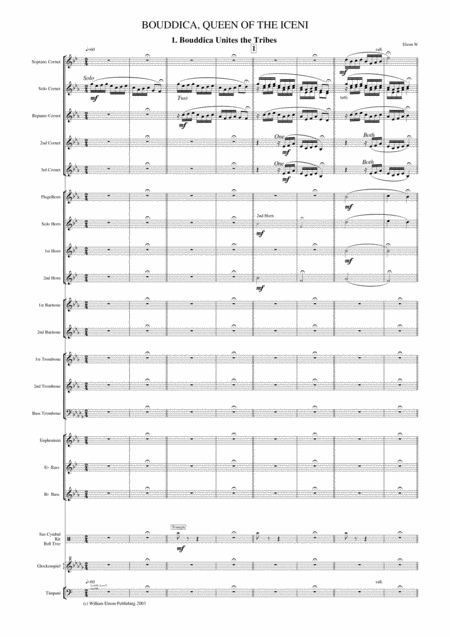
Boudicca, Queen of the Iceni
Ensemble de cuivres

$60.00 51.74 € Ensemble de cuivres PDF SheetMusicPlus

Brass Ensemble - Level 3 - Digital Download SKU: A0.767268 Composed by Claudio Monteverdi. Arranged by Mike Lyons. Baroque,Renaissance. Score and parts. 324 pages. Lyons Music Services #3218659. Published by Lyons Music Services (A0.767268). As part of my continuing project to transcribe Monteverdi's madrigals onto winds, here is the 6th book. In this book we see a much greater development towards dramatic representation. In a way, this book is divisible into two Scenes with a number of single items in between. The vocal lines are all much more complex and we can also see the beginnings of monodic writing appear in the semi-recit sections of some of the songs. Also clearly developing are delineations of the voices into soloists and chorus. Several songs in this book are almost akin to arias, with clear soloistic writing for the higher voices (Cantus/Tenor). The first four songs form a kind of introductory 'scena', which Monteverdi calls Lamento d'Arianna. A little later, there is a set of 6 songs which he grouped together under the title Sestina. A Sestina is a complex poem made up of 6 stanzas each of 6 verses with rules regarding hoe the last line of the first verse is repeated. Obviously, we are not using the lyrics, but we need to be aware of the structure so that when the music reappears we can treat it appropriately. As with all things madrigalian, the lyrics are rife with double entendres, despite the fact that all of the lyrics deal with loss of one kind or another. Monteverdi uses some very close dissonances to describe death and release. Often with wrenching results for the harmony.Please note, there are two extra parts for No.13, which is for 7 voices. Part 6 is an Alto voice (Horn/Alto Sax/Clarinet) and part 7 is a tenor voice (Trombone/Baritone/Tenor Sax/Euphonium).
Monteverdi - The Sixth Book of Madrigals (Complete)
Ensemble de cuivres

$115.00 99.17 € Ensemble de cuivres PDF SheetMusicPlus


Partitions Gratuites
Acheter des Partitions Musicales
Acheter des Partitions Digitales à Imprimer
Acheter des Instruments de Musique

© 2000 - 2026

Accueil - Version intégrale





