EUROPE
1208 articles
USA
0 articles
DIGITAL
51 articles (à imprimer)
Partitions Digitales
Partitions à imprimer
51 partitions trouvées


Brass Ensemble - Level 3 - Digital Download SKU: A0.774879 Composed by Sir Arthur Seymour Sullivan. Arranged by Bill Wilson. 20th Century. Score and parts. 22 pages. Alexander Wilson #553031. Published by Alexander Wilson (A0.774879). Arthur Sullivan wrote the music to The Lost Chord at his brother's deathbed. It is wistful, introspective, emotional, and rises to a powerful climax. There are arrangements of this fabulous song for brass quintet, but they omit what I feel are important harmonic elements that are included in this brass sextet version. This powerful piece is suitable in a serious concert setting or in a church setting where the message is about loss. A Toot Suite Brass Arrangement for two Bb trumpets, French horn, trombone, baritone, and tuba.  Performance time is approximately 3:30.  Visit our website, www.tootsuitebrasspublishing.com, for a catalog of our arrangements available through sheetmusicplus.com.
The Lost Chord
Ensemble de cuivres

$4.00 3.47 € Ensemble de cuivres PDF SheetMusicPlus

Brass Ensemble - Level 3 - Digital Download SKU: A0.1027894 Composed by William Elsom. Contemporary. Score and parts. 46 pages. Will Elsom #3053855. Published by Will Elsom (A0.1027894). Programme Notes Boudicca became the Queen of the Iceni upon the death of her husband, Prasutagus. The Iceni had lived in relative peace with the Romans, with Prasutagus living as a client king, paying tribute to Rome. The Romans refused to accept a woman as the ruler, and sought to assume total control. To demonstrate its superiority, a Roman Legion attacked the Iceni, captured Boudicca and made her watch as her daughters were raped. She sought revenge, allying the Iceni with the Trinovantes under her command, and wreaked havoc, destroying many Roman settlements. Boudicca was only stopped when Rome sent one of the best generals of the time, Seutonius Paulinus. Seutonius has been depicted offering Boudicca surrender with honour and her life, but when she rejected this, his tactical acumen proved superior, and all the Iceni and Trinovantes were wiped out. 1 – Boudicca Unites the Tribes The piece opens with the initial statement of Boudicca’s theme. Figure 3 depicts Boudicca’s reign as the leader of the Iceni, interspersed with a sadder theme depicting her lonely widowhood. Figure 4 sees the tribes called together with a drinking song and Figure 5 is the war cry, as Boudicca gives a rousing speech, first to her own warriors then to the Trinovantes. The second time bar before Figure 7 sees the tribes fall into a restless sleep. Amid early morning mists, Figure 7 sees restless horses, with distant fanfares heard, signalling the coming of the Romans. The Romans main theme is at Figure 8, with a constant fanfare over the top, signalling the confidence of the leaders. Figure 10 sees the Iceni and Trinovantes coming slowly out of hiding, and Boudicca’s theme growing in volume until the death chords signify the tribes have prevailed. 2. The Bards Sing The tribes sing a hymn to an unnamed Pagan God. At Figure 13, the Euphonium develops Boudicca’s theme depicting Taranis, the Bard of the Iceni, singing wistfully of happier times. He then makes an impassioned speech for peace, before cutting off in mid sentence. He then sits quietly (Figure 16) fearing the future. Figure 17 gives a euphoric and hopeful rendition of the hymn, as if Taranis has not been heard. 3 – Epping NB: It is my piece, and I say Epping is as credible as anywhere as the site of the final battle, and will not enter into any correspondence on the matter! A fanfare awakens the two tribes. Figure 18 sees the tribes prepare for a final battle, and the repeated section depicts two victories at Verulanium (St Albans) and Londinium (London – then a small barracks). At Figure 20 Taranis has a vision, and tries to change Boudicca’s mind about another attack. Boudicca listens to him, but tells him the die is cast, and there is no going back. Death or Glory… The war cry ensues at Figure 21, but at Figure 22 it is the Romans’ theme heard, and the death chords (Figure 24) signify that it is the two tribes that are being slaughtered this time. Brave souls (Repiano and Flugel at 24) fight on in vain to allow Boudicca to escape. At Figure 25 Boudicca prays, but realising all is lost, at Figure 26 drinks poison. As she dies, the last thing this brave British heroine hears is the sound of the Roman’s theme, signifying Seutonius’ total victory.   William Elsom, December 2004
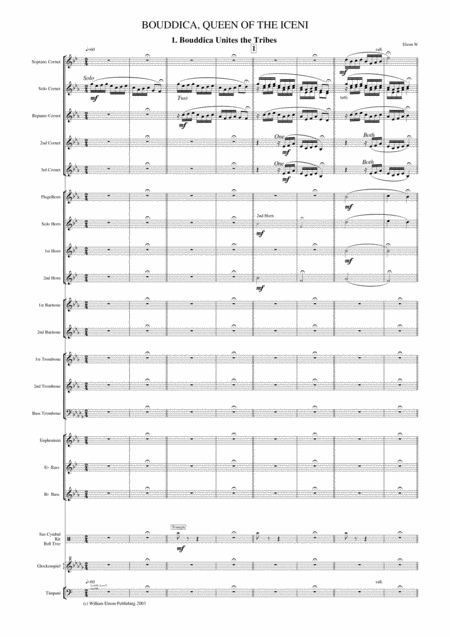
Boudicca, Queen of the Iceni
Ensemble de cuivres

$60.00 52.03 € Ensemble de cuivres PDF SheetMusicPlus

Brass Ensemble - Digital Download SKU: A0.790955 Composed by Camille Saint-Saens. Arranged by Kevin P Holdgate. Contemporary. Score and parts. 74 pages. Kevin P Holdgate #4338385. Published by Kevin P Holdgate (A0.790955). The Versatile Brass Classical CollectionThis is the Full Brass Band ArrangementI did this arrangement originally for Versatile Brass, which we played on a number of concerts. This is not an arrangement for the 'faint of heart'. It is difficult, because the piece is difficult... but what a magnificent piece of music it is. According to legend, Death appears at midnight every year on Halloween. Death calls forth the dead from their graves to dance for him while he plays his fiddle (here represented by the trumpets). His skeletons dance for him until the rooster crows at dawn, when they must return to their graves until the next year.The original piece opens with a playing a single note, D, played twelve times on the Harp, in my arrangement this is played by Tuba and Tubular Bell (the twelve strokes of midnight). The trumpet enters playing the tritone, which was known as the diabolus in musica (the Devil in music). Out of interest in the original, the solo violin plays this, during the Medieval and Baroque eras, consisting of an A and an Eâ™­-in an example of scordatura tuning, the violinist's E string was actually been tuned down to an Eâ™­ to create the dissonant tritone., no need for such alterations here.
Danse Macabre (Brass Band Version)
Ensemble de cuivres

$39.99 34.68 € Ensemble de cuivres PDF SheetMusicPlus

Brass Ensemble - Level 3 - Digital Download SKU: A0.767273 Composed by Claudio Monteverdi. Arranged by Mike Lyons. Baroque,Renaissance. Score and parts. 16 pages. Lyons Music Services #3218683. Published by Lyons Music Services (A0.767273). As part of my continuing project to transcribe Monteverdi's madrigals onto winds, here is the 6th book. In this book we see a much greater development towards dramatic representation. In a way, this book is divisible into two Scenes with a number of single items in between. The vocal lines are all much more complex and we can also see the beginnings of monodic writing appear in the semi-recit sections of some of the songs. Also clearly developing are delineations of the voices into soloists and chorus. Several songs in this book are almost akin to arias, with clear soloistic writing for the higher voices (Cantus/Tenor). The first four songs form a kind of introductory 'scena', which Monteverdi calls Lamento d'Arianna. A little later, there is a set of 6 songs which he grouped together under the title Sestina. The final song from Lamento d'Arianna tanslates as Ah! Who does not even answer! Ah! Who is deaf to my laments (pleas) Another song of a young man being turned down by his lover. As with all things madrigalian, the lyrics are rife with double entendres. Monteverdi uses some very close dissonances to describe death and release.
Monteverdi - The Sixth Book of Madrigals - 04. Ahi ch' ei non pur risponde
Ensemble de cuivres

$5.99 5.19 € Ensemble de cuivres PDF SheetMusicPlus

Brass Ensemble - Level 3 - Digital Download SKU: A0.808687 Composed by Johannes Brahms (1833-1897). Arranged by F. Leslie Smith. Holiday,Romantic Period,Wedding. Score and parts. 28 pages. Sweetwater Brass Press #3872461. Published by Sweetwater Brass Press (A0.808687).     Brahms completed Six Pieces for Piano in 1893, just four years before his death. It was the second from last work he would write for solo piano, an introspective composition that he dedicated to Clara Schumann. To four of the six pieces he attached the label Intermezzo. Although the term originally defined a composition that was inserted between two other pieces-say, the movements of a suite or the acts of an opera-Brahms wrote them as independent works. And of these, the most popular is this, the Intermezzo in A major, andante teneramente. As described on the website Favorite Classic Composers, It's a sweetly melancholy piece, with a strong tinge of melancholy.    Except for a few items, this arrangement is not technically difficult. For the most part, Trumpet 1 plays the melody. Some of the notes are relatively high, the highest being C6 (high D for B-flat trumpet); there are several of those. Trumpet 2 has one brief A5 (high B). Trombone carries the heavy load; it has lots of oodle-oodles in the form of up-and-down eighth notes and triplet figures plus one F2. In the tuba part the range of notes is E1 to F3 and it contains a number of octave jumps. This is a beautiful piece, but it does require that each musician listen to the other four while playing.    This arrangement was completed in 2018, and performance time runs about 4 minutes, 55 seconds. The arranger, Les Smith, would be very interested in your comments; contact him at lessmith@ufl.edu or leave a review on the SheetMusicPlus website. For more arrangements by Les, enter Sweetwater Brass Press (without the quotation marks) in the search box. (Also, purchase of this piece entitles you to your choice of another of his arrangements at no charge; send a copy of your purchase receipt directly to him at lessmith61@bellsouth.net.)
Intermezzo (from Six Pieces for Piano, Op. 118)
Ensemble de cuivres

$4.95 4.29 € Ensemble de cuivres PDF SheetMusicPlus

Brass Ensemble - Level 3 - Digital Download SKU: A0.767274 Composed by Claudio Monteverdi. Arranged by Mike Lyons. Baroque,Renaissance. Score and parts. 37 pages. Lyons Music Services #3218685. Published by Lyons Music Services (A0.767274). As part of my continuing project to transcribe Monteverdi's madrigals onto winds, here is the 6th book. In this book we see a much greater development towards dramatic representation. In a way, this book is divisible into two Scenes with a number of single items in between. The vocal lines are all much more complex and we can also see the beginnings of monodic writing appear in the semi-recit sections of some of the songs. Also clearly developing are delineations of the voices into soloists and chorus. Several songs in this book are almost akin to arias, with clear soloistic writing for the higher voices (Cantus/Tenor). The first four songs form a kind of introductory 'scena', which Monteverdi calls Lamento d'Arianna. A little later, there is a set of 6 songs which he grouped together under the title Sestina. Song number 5 sits between Lamento della Ninfa and Sestina as a stand-alone song. Zephyrs turn and bring good weather A zephyr is a kind of fickle wind that can bring clouds or sunshine. As with all things madrigalian, the lyrics are rife with double entendres. Monteverdi uses some very close dissonances to describe death and release.
Monteverdi - The Sixth Book of Madrigals - 05. Zefiro torna e bel tempo rimena
Ensemble de cuivres

$5.99 5.19 € Ensemble de cuivres PDF SheetMusicPlus

Brass Ensemble - Level 3 - Digital Download SKU: A0.786386 Composed by Horatio Spafford, Philip Bliss, and Pyotr Tchaikovsky. Arranged by Beka Wilson. Christian,Contemporary,Gospel,Romantic Period,Sacred. Score and parts. 8 pages. Beka Wilson #4632417. Published by Beka Wilson (A0.786386). Horatio Spafford’s hymn, written after the death of his four daughters in a shipwreck, has brought comfort to many in their dark times. This arrangement (in the setting of Tchaikovsky’s Swan Lake) would be great for a calm instrumental special before the sermon, or a comforting song at a funeral.7 pages (includes piano score and parts), approximately 3:14 (suggested 100bpm), intermediate levelThis arrangement is for any combination of treble clef B flat instruments, but the following instrumentation is also available on Sheet Music Plus:Flute/oboe/violin: S0.587367Viola: S0.587377Alto Sax: S0. 587393Horn: S0. 587405Cello/bassoon/trombone: S0. 587409For custom instrumentation (for example, flute/cello or alto sax/clarinet), contact me at bekmars10@gmail.com, and I can get something posted here on Sheet Music Plus.
It Is Well (in the setting of Swan Lake)
Ensemble de cuivres

$9.99 8.66 € Ensemble de cuivres PDF SheetMusicPlus

Brass Ensemble - Level 3 - Digital Download SKU: A0.740228 Composed by Gustav Mahler. Arranged by Craig Garner. Romantic Period. Score and parts. 14 pages. Dorm 40 Music #2922907. Published by Dorm 40 Music (A0.740228). This miniature may be Mahler's most famous symphonic excerpt due to its use in the Visconti film Death in Venice. The melody (possibly a love song to his wife, Alma) is characterized by sighing motive and long suspensions which are stretched to their breaking point before they resolve. This unique and beautiful arrangement includes an optional Harp part. The combination of brass and harp is amazing! The audio sample includes both versions for you to hear: first without Harp, and then with the Harp. There is nothing like the sound of Mahler performed on brass. This arrangement makes a wonderful addition to your library. Performance time, depends how slow you want to play it, but usually 3:30-4:00. Published by Dorm 40 Music, www.dorm40music.com
Adagietto, from Symphony No. 5
Ensemble de cuivres

$12.00 10.41 € Ensemble de cuivres PDF SheetMusicPlus


Partitions Gratuites
Acheter des Partitions Musicales
Acheter des Partitions Digitales à Imprimer
Acheter des Instruments de Musique

© 2000 - 2026

Accueil - Version intégrale





