EUROPE
25822 articles
USA
0 articles
DIGITAL
25 articles (à imprimer)
Partitions Digitales
Partitions à imprimer
25 partitions trouvées


Recorder - Level 3 - Digital Download SKU: A0.1128492 Composed by Ludwig van Beethoven. Arranged by Ander. Classical,Film/TV,Instructional,March,Romantic Period. Recorder Ensemble. 16 pages. Woods Only, Arrangements #729115. Published by Woods Only, Arrangements (A0.1128492). This arrangement adapted for recorder quintet was written keeping the characteristics of the original work, in order to be performed by young music students who want to enter the symphonic music. Besides, it can also be used by professional musicians, for recitals, repertoire, academic presentations and didactic material. As much as it is a funeral march, it is well suited for any musical performance occasion. The transcription is faithful to the structure, with only one change of key, so that it is comfortable for all the instruments in the formation, as well as for use in ensemble practice between musicians of different traditions. Ludwig van Beethoven began concentrated work on his Symphony No. 7 in A major Op. 92 in 1811, it was completed in 1812, and was dedicated to Count Moritz von Fries, and premiered in Vienna on December 8, 1813. It is considered a remarkable example of the more ebullient side of Beethoven's compositional personality and evidence that even after the onset of deafness, he still found cause for musical optimism. The second movement Allegretto is a funeral march in everything but name. Often several contrasting melodic ideas are made to coexist, as if Beethoven were imagining several processions converging on the cemetery at the same time. As he was working on this symphony during the years of the Napoleonic Wars, this experience was probably within his experience. It was also used as the soundtrack to the film Knowing, by director Alex Proyas and starring Nicolas Cage, where it is used in the final scene of the film. Beethoven called Symphony No. 7 his most excellent symphony, and a music critic of the time reported, this symphony is the most melodically rich and the most pleasing and comprehensible of all Beethoven's symphonies..
Symphony No. 7 by Beethoven for Recorder Quintet
5 Flûtes à bec

$9.99 8.7 € 5 Flûtes à bec PDF SheetMusicPlus

Recorder - Level 2 - Digital Download SKU: A0.1128137 Composed by Ludwig van Beethoven. Arranged by Ander. Classical,Folk,March,Opera,Romantic Period. Recorder Ensemble. 16 pages. Woods Only, Arrangements #728752. Published by Woods Only, Arrangements (A0.1128137). This arrangement adapted for recorder quintet was written keeping the characteristics of the original work, in order to be performed by young music students who want to enter the symphonic music. Besides, it can also be used by professional musicians for recitals, repertoire, academic presentations and didactic material. The transcription remains faithful to the structure, with only one change in tone, so that it is comfortable for all the instruments in the formation, as well as being used as an activity in ensemble practice among musicians of different traditions. Beethoven's Turkish March (Op. 113) is the 4th movement of the operatic work: The Ruins of Athens, a set of incidental pieces written in 1812 by Ludwig van Beethoven, where the melody was originally written in 1809 as Theme with Six Variations for Piano, Op. 76. The work was written to accompany the play of the same name by August von Kotzebue, for the dedication of a new theater in Pest. Perhaps the best known part of the composition is the Marcia alla turca, In Latin America, this movement became known in Jean-Jacques Perrey's version (who titled it The Elephant never Forgets) since it was used as the opening theme of the successful Mexican TV comedy El Chavo del Ocho. The opening and the turkish march are often performed separately, and the other pieces in this set are not often heard.
Turkish March by Beethoven for Recorder Quintet
5 Flûtes à bec

$9.99 8.7 € 5 Flûtes à bec PDF SheetMusicPlus

Recorder - Level 1 - Digital Download SKU: A0.1129692 Composed by Ludwig van Beethoven. Arranged by Ander. Classical,Instructional,March,Opera,Romantic Period. Recorder Ensemble. 15 pages. Woods Only, Arrangements #730103. Published by Woods Only, Arrangements (A0.1129692). This arrangement adapted for recorder quintet was written keeping the characteristics of the original work, that is, inspiring and significant to the already known choral symphony by Beethoven, indicated to be performed by young music students, who want to enter the symphonic music, moreover, it can also be used by professional musicians, for recitals, repertoire, academic presentations and didactic material. As much as it is a funeral march, it is well suited for any musical performance occasion. The transcription is faithful to the structure, with only one change in key, so that it is comfortable for all instruments in the formation, thus maintaining the essence of the striking melody, as well as using it for ensemble practice among musicians of different traditions. Beethoven's Ninth Symphony Op. 125 incorporates part of the poem An die Freude (To Joy), a hymn written by Friedrich Schiller, with the text sung by soloists and a choir in its last movement. It was the first example of a major composer using the human voice as prominently as the instruments in a symphony, thus creating a far-reaching work that set the tone for the symphonic form that was to be adopted by Romantic composers. This is the last complete symphony composed by Ludwig van Beethoven. The choral symphony, better known as the Ninth Symphony or The Ninth, is one of the best known works in the Western repertoire, considered both an icon and predecessor of Romantic music, and one of Beethoven's great masterpieces, where it was first performed on May 7, 1824, the same year it was completed, at the Kärntnertortheater in Vienna, Austria. The conductor was Michael Umlauf, the theater's music director, and Beethoven - dissuaded from conducting by the advanced stage of his deafness - was given a special place on the stage next to the conductor. It was later rearranged by Herbert von Karajan to become the anthem of the European Union in 1972, the national anthem of Rhodesia from 1974 until 1979, Rise, O Voices of Rhodesia, used the tune Ode to Joy..
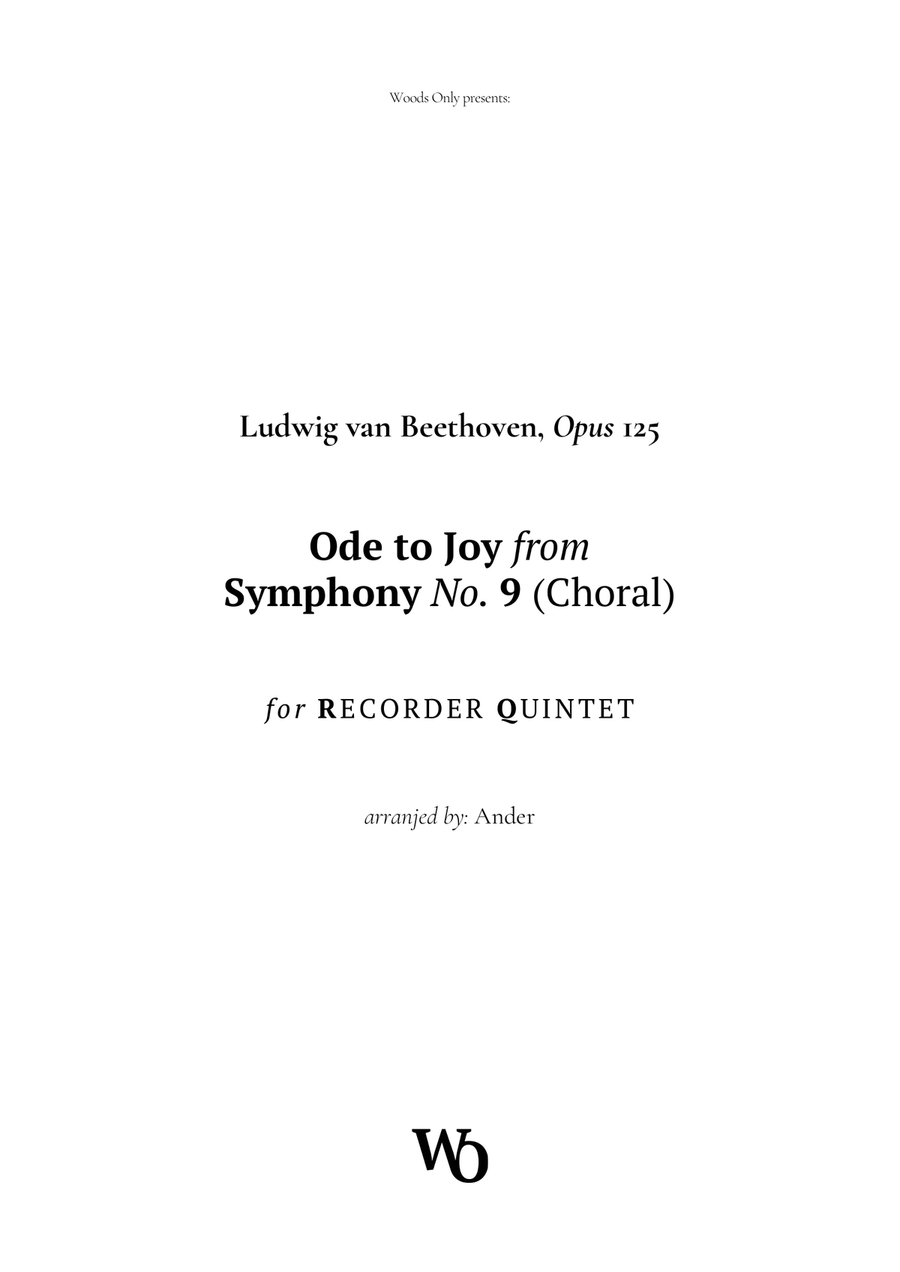
Ode to Joy by Beethoven for Recorder Quintet
5 Flûtes à bec

$9.99 8.7 € 5 Flûtes à bec PDF SheetMusicPlus

Recorder - Level 1 - Digital Download SKU: A0.1183501 Composed by Felix Bartholdy Mendelssohn. Arranged by Langanho. Classical,March,Opera,Romantic Period,Wedding. Recorder Ensemble. 7 pages. Avery Lynn Jordan #783173. Published by Avery Lynn Jordan (A0.1183501). This is a reduction for recorder quintet and piano with chords, with the intention of giving better practicity to groups that intend to play at weddings, and not only that, it can be used in several occasions, both by professionals and beginners, because it was adapted to be easy to perform. The Wedding March by Felix Mendelssohn was composed in 1842 to set the music for the play A Midsummer Night's Dream (Musik zu Ein Sommernachtstraum). It is a piece of music played during wedding ceremonies, at the moment of the bride's entrance, usually preceded by notes of Triumphal Clarins that emphasize the importance of this moment. Originally the piece is instrumental, having been performed at weddings in the version.
Wedding March by Mendelssohn for Recorder Quintet and Piano with Chords
5 Flûtes à bec

$19.99 17.41 € 5 Flûtes à bec PDF SheetMusicPlus

Recorder - Level 2 - Digital Download SKU: A0.1129491 Composed by Ludwig van Beethoven. Arranged by Ander. Christmas,Classical,Instructional,March,Romantic Period. Recorder Ensemble. 16 pages. Woods Only, Arrangements #729939. Published by Woods Only, Arrangements (A0.1129491). This arrangement adapted for recorder quintet was designed to make its listeners weep with emotion, because the adaptation preserves the original essence of the work, keeping its integrity faithful to what Beethoven wanted to transmit, with only a slight change in tone and addition of harmonic resources in the structure of the arrangement. Even though it is a funeral march, it is well suited for any musical performance occasion, being intended for beginner students who want to immerse themselves in the universe of romantic music, and nothing better than starting with the transitional composer of this period, which also does not prevent professional teachers from using it for recitals, academic presentations or didactic material in their classes as an ensemble practice. Ludwig van Beethoven's Piano Sonata No. 14 in C minor sharp, Op. 27, No. 2, is one of his most popular compositions and was an audience favorite even in his day. Written when Beethoven was 31, the Moonlight Sonata (Mondscheinsonate in German) was composed after he finished some commissioned works, but there is no evidence that he was hired to write this work. It did not receive its nickname until 1832, five years after Beethoven's death. It was the critic Ludwig Rellstab who compared the music to a moonlighting on Lake Lucerne. This comparison was adopted as a nickname for the work. Called Quasi una fantasia by the author - like its companion Op. 27, No. 1 - the piece was completed in 1801 and dedicated the following year to one of the composer's pupils. Beethoven chose to open the sonata with a slow, hypnotic arpeggio movement, the best known of the entire work. The dotted rhythm of its minimal melody evokes the tradition of 'Trauermusik' (funeral music).
Moonlight Sonata by Beethoven for Recorder Quintet
5 Flûtes à bec

$9.99 8.7 € 5 Flûtes à bec PDF SheetMusicPlus

Recorder - Level 2 - Digital Download SKU: A0.1292310 Composed by Pietro Mascagni. Arranged by Ander. 19th Century,Opera,Romantic Period,Wedding. Recorder Ensemble. 7 pages. Woods Only, Arrangements #882922. Published by Woods Only, Arrangements (A0.1292310). In this arrangement, you will play the Intermezzo from the Opera Cavalleria Rusticana by Pietro Mascagni for Recorder Quintet, one of the most beautiful and exciting works of classical music. You will preserve all the fidelity and expressiveness of the original score, adapting it to a smaller ensemble. You will be enchanted by the beauty and delicacy of this piece, which represents a moment of calm and reflection in the opera. This arrangement is ideal for performance events or didactic material, as well as for weddings, concerts or public presentations. It is an accessible and rewarding piece, that will make you feel like a true artist. Do not miss this opportunity to acquire this exclusive and wonderful arrangement of the Intermezzo from the opera Cavalleria Rusticana by Pietro Mascagni for Quintet!
Intermezzo from Cavalleria Rusticana by Mascagni for Recorder Quintet
5 Flûtes à bec

$9.99 8.7 € 5 Flûtes à bec PDF SheetMusicPlus

Recorder - Level 2 - Digital Download SKU: A0.1274803 Composed by Wolfgang Amadeus Mozart. Arranged by Ander. Classical,Opera. Recorder Ensemble. 8 pages. Woods Only, Arrangements #866956. Published by Woods Only, Arrangements (A0.1274803). Introducing the sheet music for the Queen of the Night Aria (Der Hölle Rache kocht in meinem Herzen) from the opera The Magic Flute (Die Zauberflöte), K. 620, by Wolfgang Amadeus Mozart, for Recorder Quintet. This arrangement maintains the entire original structure of the work, without reductions in duration and the like, with only the ensemble being reduced. Intended for performance groups that already have experience in musical performance, this arrangement can also be used as teaching material for music students and can be used in academic recitals, concerts and ceremonies, catering to various groups of varied tastes.
Queen of the Night Aria by Mozart for Recorder Quintet
5 Flûtes à bec

$9.99 8.7 € 5 Flûtes à bec PDF SheetMusicPlus

Recorder - Level 1 - Digital Download SKU: A0.1184041 Composed by Richard Wagner. Arranged by Langanho. Classical,Opera,Romantic Period,Wedding. Recorder Ensemble. 7 pages. Avery Lynn Jordan #783744. Published by Avery Lynn Jordan (A0.1184041). This reduction was made for recorder quintet and piano with chords, with the intention of being totally practical for musicians of small groups who wish to use it especially at weddings, and not only, can be used for academic or performance purposes, because in it were extracted all the essence of the original work, however, being adapted to be easy to play, serving professional musicians or beginners. The Bridal Chorus by Richard Wagner was composed in 1850 as a prelude to the third act of the opera Lohengrin. It is played when Elsa and Lohengrin enter the bridal chamber to consummate their marriage. The wedding night turns tragic, and Wagner is said to have found it amusing that the piece was used at weddings.
Bridal Chorus by Wagner for Recorder Quintet and Piano with Chords
5 Flûtes à bec

$19.99 17.41 € 5 Flûtes à bec PDF SheetMusicPlus


Partitions Gratuites
Acheter des Partitions Musicales
Acheter des Partitions Digitales à Imprimer
Acheter des Instruments de Musique

© 2000 - 2026

Accueil - Version intégrale





