EUROPE
14421 articles
USA
0 articles
DIGITAL
22 articles (à imprimer)
Partitions Digitales
Partitions à imprimer
22 partitions trouvées


Acoustic Guitar,Bass Clef Instrument,Bass Guitar,Drums,Electric Guitar,Keyboard,Treble Clef Instrument - Level 3 - Digital Download SKU: A0.1393972 Composed by Georges Bizet. Arranged by David Woodcock. Classical,Instructional,Opera. 39 pages. David Woodcock #977425. Published by David Woodcock (A0.1393972). This is an arrangement of the famous melody from Bizet's opera Carmen, scored for flexible ensemble in G. It is also available in C. This series has been specifically designed to meet the requirements of the ever-changing ensemble combinations that primary and secondary schools and other instrumental ensembles face.  Because certain instruments are more comfortable in playing in certain keys, each work will be offered in two keys. This should allow for the music director to choose the key most suitable for the instrumental combination. Each piece consists of five core instrumental parts: 2 treble, 1 alto, tenor and bass. All parts will have a number of transpositions suitable for the instruments that are capable of playing those parts, eg, Part 2 will have parts for violin, B flat clarinet and trumpet, and E flat alto sax.  This will save music directors' time in having to write out additional parts. Optional parts are included for tuned and untuned percussion, guitar (chords) and bass guitar (notation and TAB), a keyboard part appropriate to the difficulty level, and a rehearsal piano part which is a fuller realisation of the piece and could be played by a more advanced student or the music director. If the numbers of players on each part allows, the music director can feel free to 'solo' instruments and vary the orchestration, especially on repeats, to create variety in instrumental colour.
Habenera - in G for flexible ensemble
4 Tubas

$20.00 17.25 € 4 Tubas PDF SheetMusicPlus

Tuba - Level 2 - Digital Download SKU: A0.1124473 Composed by Johann Sebastian Bach. Arranged by Ander. Baroque,Christmas,Easter,Sacred,Wedding. 7 pages. Woods Only, Arrangements #725220. Published by Woods Only, Arrangements (A0.1124473). This easy arrangement for tuba quartet has been adapted to be simple to perform and understand the period minuet form of the original work for various levels of musical knowledge. It can be freely played by beginning students due to the ease built into the piece in relation to the author's suggested interpretation. Recommended for performance in academic recitals, and public festivals, it also serves as a study of Baroque repertoire. This famous piece has traditionally been attributed to Johann Sebastian Bach, as it appears in the Notebook for Anna Magdalena , a notebook that Bach gave to his wife Anna Magdalena in 1725 and which was to be filled with the favorite selections of Bach family members. However, recent research has concluded that this minuet, sometimes referred to as BWV Anhang 114. was probably composed by Christian Petzold, a German composer and organist contemporary with Bach.
Minuet in G major by Bach for Tuba Quartet
4 Tubas

$7.99 6.89 € 4 Tubas PDF SheetMusicPlus

Tuba Quartet - Level 2 - Digital Download SKU: A0.1406819 Composed by George Frideric Handel. Arranged by Ander. Baroque,Chamber,Christian,Easter. 15 pages. Woods Only, Arrangements #989572. Published by Woods Only, Arrangements (A0.1406819). We present our arrangement of the acclaimed song Hallelujah from Handel’s oratorio “The Messiahâ€, adapted for Tuba Quartet. This sheet music is a faithful reproduction of the original composition, bringing the grandeur of Handel’s work to the chamber music. George Frideric Handel, one of the greatest composers of the Baroque period, composed The Messiah in 1741. The piece, cataloged as HWV 56 in Handel’s works catalog, is known for its emotional depth and musical complexity. The song “Hallelujah†is one of the most recognized in the oratorio, celebrating the resurrection and the final victory over sin and death. This arrangement is perfect for teachers looking to expand their student's didactic repertoire, offering a unique opportunity to explore Baroque music in a chamber context. In addition, it is an excellent choice for groups wishing to present an impactful piece in recitals or concerts. With the arrival of the month of March, Easter is approaching. What better way to celebrate than with the music that encapsulates the joy and hope of this season? This arrangement of Hallelujah is the perfect choice to add a special touch to your Easter celebrations. Purchase our arrangement of Hallelujah and experience the timeless beauty of Handel’s music in a new way. Take the opportunity to own a piece that will surely delight musicians and listeners. Don’t miss the chance to make your performances even more memorable.
Hallelujah from Messiah by Handel for Tuba Quartet
4 Tubas

$7.99 6.89 € 4 Tubas PDF SheetMusicPlus

Tuba Quartet - Level 3 - Digital Download SKU: A0.1261848 Composed by Ludwig van Beethoven. Arranged by Ander. 19th Century,Classical,Film/TV,March,Romantic Period. 13 pages. Woods Only, Arrangements #854931. Published by Woods Only, Arrangements (A0.1261848). This arrangement adapted for tuba quartet was written keeping the characteristics of the original work, in order to be performed by young music students who want to enter the symphonic music. Besides, it can also be used by professional musicians, for recitals, repertoire, academic presentations and didactic material. As much as it is a funeral march, it is well suited for any musical performance occasion. The transcription is faithful to the structure, with only one change of key, so that it is comfortable for all the instruments in the formation, as well as for use in ensemble practice between musicians of different traditions. Ludwig van Beethoven began concentrated work on his Symphony No. 7 in A major Op. 92 in 1811, it was completed in 1812, and was dedicated to Count Moritz von Fries, and premiered in Vienna on December 8, 1813. It is considered a remarkable example of the more ebullient side of Beethoven's compositional personality and evidence that even after the onset of deafness, he still found cause for musical optimism. The second movement Allegretto is a funeral march in everything but name. Often several contrasting melodic ideas are made to coexist, as if Beethoven were imagining several processions converging on the cemetery at the same time. As he was working on this symphony during the years of the Napoleonic Wars, this experience was probably within his experience. It was also used as the soundtrack to the film Knowing, by director Alex Proyas and starring Nicolas Cage, where it is used in the final scene of the film. Beethoven called Symphony No. 7 his most excellent symphony, and a music critic of the time reported, this symphony is the most melodically rich and the most pleasing and comprehensible of all Beethoven's symphonies..
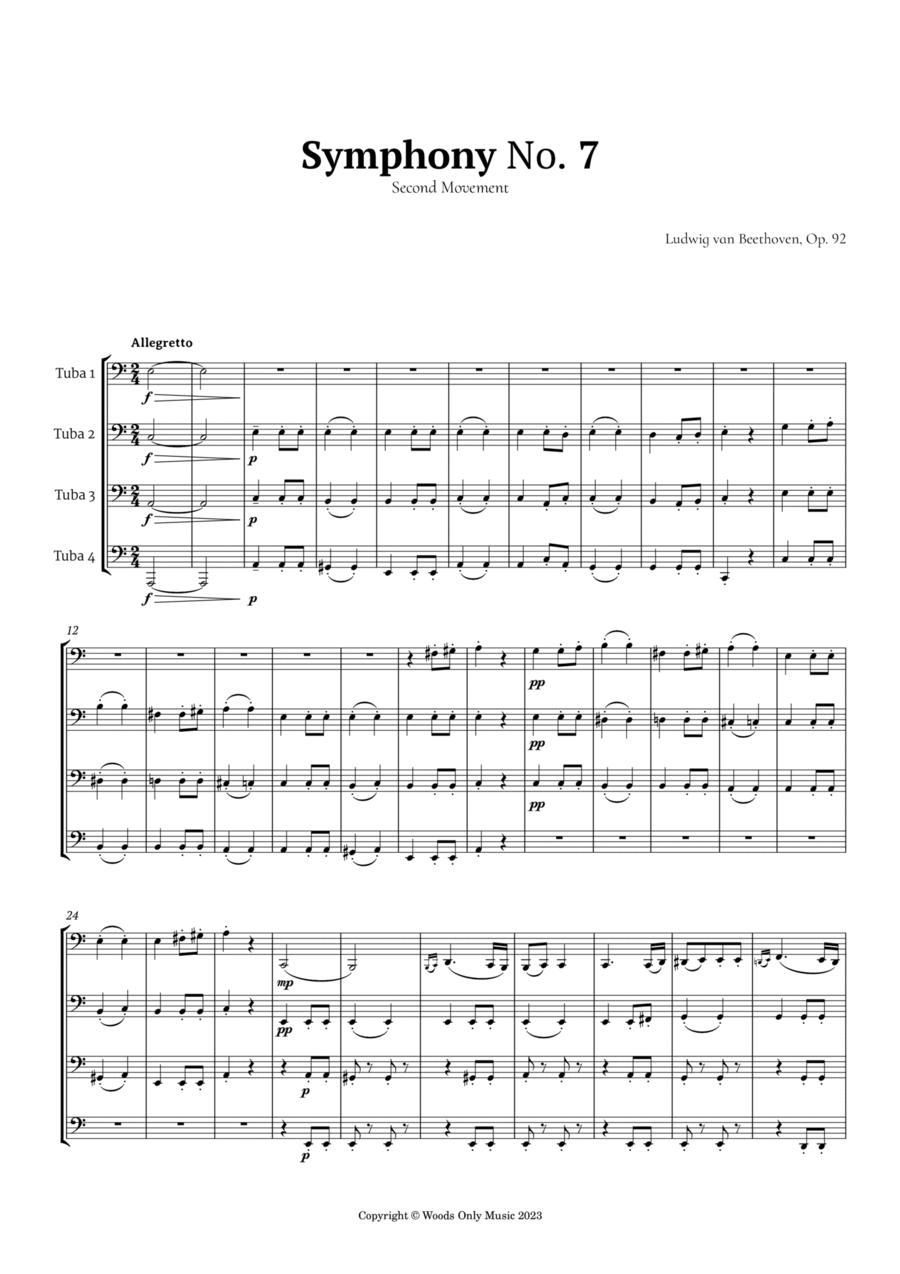
Symphony No. 7 by Beethoven for Tuba Quartet
4 Tubas

$7.99 6.89 € 4 Tubas PDF SheetMusicPlus

Tuba Quartet - Level 3 - Digital Download SKU: A0.1261601 Composed by Ludwig van Beethoven. Arranged by Langanho. 19th Century,Classical,Romantic Period. 13 pages. Woods Only, Arrangements #854680. Published by Woods Only, Arrangements (A0.1261601). This adaptation was intended for a small group of tuba quartet, where the original essence of the piece was kept, however, with a reduction in the duration, where only the main themes of the opening were extracted. As it is simplified, it is intended for beginner students of instrumental music who want to enter orchestral music, even in a simplified and reduced form, and can be used by music teachers with their students in ensemble practice in situations such as academic recitals, didactic concerts, or assessment tests. The Symphony No. 5 in C minor, Op. 67, known as the Symphony of Destiny, by Ludwig van Beethoven, written between 1804 and 1808, is one of the most popular and best known compositions in the entire repertoire of European music. The four movements are characterized by orchestral homogeneity, being, at the same time, an example of alternation: the first movement, revealing great tension, denounced by the strings and raised to an extreme drama; the second movement reveals solemnity, in a funeral march that rises by its emotion and beauty; the third movement, a crispness; the fourth movement expresses triumph and magnificence.
Symphony No. 5 by Beethoven for Tuba Quartet
4 Tubas

$7.99 6.89 € 4 Tubas PDF SheetMusicPlus

Tuba Quartet - Level 2 - Digital Download SKU: A0.1261708 Composed by Ludwig van Beethoven. Arranged by Ander. 19th Century,Classical,Folk,March,Romantic Period. 9 pages. Woods Only, Arrangements #854788. Published by Woods Only, Arrangements (A0.1261708). This arrangement adapted for tuba quartet was written keeping the characteristics of the original work, in order to be performed by young music students who want to enter the symphonic music. Besides, it can also be used by professional musicians for recitals, repertoire, academic presentations and didactic material. The transcription remains faithful to the structure, with only one change in tone, so that it is comfortable for all the instruments in the formation, as well as being used as an activity in ensemble practice among musicians of different traditions. Beethoven's Turkish March (Op. 113) is the 4th movement of the operatic work: The Ruins of Athens, a set of incidental pieces written in 1812 by Ludwig van Beethoven, where the melody was originally written in 1809 as Theme with Six Variations for Piano, Op. 76. The work was written to accompany the play of the same name by August von Kotzebue, for the dedication of a new theater in Pest. Perhaps the best known part of the composition is the Marcia alla turca, In Latin America, this movement became known in Jean-Jacques Perrey's version (who titled it The Elephant never Forgets) since it was used as the opening theme of the successful Mexican TV comedy El Chavo del Ocho. The opening and the turkish march are often performed separately, and the other pieces in this set are not often heard.
Turkish March by Beethoven for Tuba Quartet
4 Tubas

$7.99 6.89 € 4 Tubas PDF SheetMusicPlus

Tuba Quartet - Level 2 - Digital Download SKU: A0.1409506 Composed by Wolfgang Amadeus Mozart. Arranged by Ander. Chamber,Christian,Classical,Easter,Religious. 7 pages. Woods Only, Arrangements #992136. Published by Woods Only, Arrangements (A0.1409506). Introducing the sheet music for Lacrymosa from the Requiem Mass (Missa pro defunctis), K. 626, by Wolfgang Amadeus Mozart, for Tuba Quartet. This sheet music maintains the entire original structure of the work, without reductions in duration and the like, with only the reduction of the ensemble being made. This arrangement is intended for performance groups that already have experience in musical performance, but can also be used as teaching material for music students, and can be used in academic recitals, concerts and ceremonies, catering to various groups of varied tastes. The Requiem in D minor (K. 626) is a requiem mass by Austrian composer Wolfgang Amadeus Mozart from 17911. Mozart composed part of the Requiem in Vienna in late 1791 but it was unfinished at his death on December 5th of the same year. This sheet music is a unique opportunity to experience Mozartâ??s genius in an arrangement for quartet.
Lacrymosa by Mozart for Tuba Quartet
4 Tubas

$7.99 6.89 € 4 Tubas PDF SheetMusicPlus

Tuba Quartet - Level 3 - Digital Download SKU: A0.1262048 Composed by Ludwig van Beethoven. Arranged by Ander. 19th Century,Christmas,Classical,March,Romantic Period. 13 pages. Woods Only, Arrangements #855104. Published by Woods Only, Arrangements (A0.1262048). This arrangement adapted for tuba quartet was designed to make its listeners weep with emotion, because the adaptation preserves the original essence of the work, keeping its integrity faithful to what Beethoven wanted to transmit, with only a slight change in tone and addition of harmonic resources in the structure of the arrangement. Even though it is a funeral march, it is well suited for any musical performance occasion, being intended for beginner students who want to immerse themselves in the universe of romantic music, and nothing better than starting with the transitional composer of this period, which also does not prevent professional teachers from using it for recitals, academic presentations or didactic material in their classes as an ensemble practice. Ludwig van Beethoven's Piano Sonata No. 14 in C minor sharp, Op. 27, No. 2, is one of his most popular compositions and was an audience favorite even in his day. Written when Beethoven was 31, the Moonlight Sonata (Mondscheinsonate in German) was composed after he finished some commissioned works, but there is no evidence that he was hired to write this work. It did not receive its nickname until 1832, five years after Beethoven's death. It was the critic Ludwig Rellstab who compared the music to a moonlighting on Lake Lucerne. This comparison was adopted as a nickname for the work. Called Quasi una fantasia by the author - like its companion Op. 27, No. 1 - the piece was completed in 1801 and dedicated the following year to one of the composer's pupils. Beethoven chose to open the sonata with a slow, hypnotic arpeggio movement, the best known of the entire work. The dotted rhythm of its minimal melody evokes the tradition of 'Trauermusik' (funeral music).
Moonlight Sonata by Beethoven for Tuba Quartet
4 Tubas

$7.99 6.89 € 4 Tubas PDF SheetMusicPlus

Tuba - Level 2 - Digital Download SKU: A0.1124123 Composed by Johann Sebastian Bach. Arranged by Ander. Baroque,Christmas,Easter,Sacred,Wedding. 10 pages. Woods Only, Arrangements #724880. Published by Woods Only, Arrangements (A0.1124123). This easy arrangement for tuba quartet has been adapted to be simple to perform and understand the structure of the original work for various levels of musical knowledge. It can be played freely by beginning students because of the ease imposed on the piece. It is often performed at wedding ceremonies slowly and reverently, challenging the effect suggested by Bach in his original score for voices with trumpet, oboes, strings, and continuous bass. This is one of Bach's most beautiful cantatas, made famous by the Jesus the Joy of Men chorus. It was originally composed for Advent 1716 in Weimar. Years later, already in Leipzig, Advent was tempus clausum, there was no music in the churches. Bach then reworked it for the Feast of Mary's Visitation. It is the final chorale of the cantata Herz und Mund und Tat und Leben. Although it is the 32nd cantata composed by Bach, of those that have survived, it was given BWV 147 in the complete catalog of his works.
Jesu, joy of man's desiring by Bach for Tuba Quartet
4 Tubas

$7.99 6.89 € 4 Tubas PDF SheetMusicPlus


Partitions Gratuites
Acheter des Partitions Musicales
Acheter des Partitions Digitales à Imprimer
Acheter des Instruments de Musique

© 2000 - 2026

Accueil - Version intégrale





