EUROPE
11557 articles
USA
528 articles
DIGITAL
77 articles (à imprimer)
Partitions Digitales
Partitions à imprimer
77 partitions trouvées

1 16 31 ....76

Organ - advanced - Digital Download SKU: S9.Q11730 In Memoriam. Composed by Enjott Schneider. This edition: Sheet music. Downloadable. Duration 32 minutes. Schott Music - Digital #Q11730. Published by Schott Music - Digital (S9.Q11730). In his Organ Symphony No. 8 'In Memoriam', following an idea of the cathedral organist Silvius von Kessel from Erfurt (and dedicatee of the work), Enjott Schneider carries on where Anton Bruckner left off, processes themes from the latter's Symphony No. 8 variatively and contrasts it to 'Haus-Choral des Erfurter Doms', 'Wachet auf, ruft uns die Stimme'. Bruckner's material is used as a starting point and further developed by Schneider in four movements: typically enough, the initial movement is called 'Metamorphosen' before an almost eerie atmosphere is created in a 'Scherzo sinistro'. The twelve-note series (in the third movement), embedded in a transcendental mood, eventually develops into the chorale which, now as main theme of the finale, amalgamates with Bruckner's stylistic moments and leads to a magnificent end - an exciting and rousing piece of music.Enjott Schneider knüpft in seiner Orgelsinfonie Nr. 8 In Memoriam an Anton Bruckner an, verarbeitet variativ Themen aus dessen Sinfonie Nr. 8 und stellt diese aber dem Choral Wachet auf, ruft uns die Stimme gegenüber. Eine spannende und aufwühlende Musik.
Orgelsinfonie No. 8
Orgue

$21.99 18.89 € Orgue PDF SheetMusicPlus

Instrumental Solo,Pipe Organ - Level 2 - Digital Download SKU: A0.1251285 By Indrė Gerikaitė. By Juozas Naujalis. Arranged by Balys Vaitkus. Classical,Religious,Romantic Period. Individual part. 2 pages. Nacionaline vargonininku asociacija #845562. Published by Nacionaline vargonininku asociacija (A0.1251285). 12 Organ Trios, Op. 4. Taking into account the date of publication (1897) these seem to be the first printed organ compositions of Naujalis. They were published in Warsaw, in the collection Preludia na organy, part 2, series III. The publication soon received positive comments in the Polish newspaper of the St. Cecilia Society, Musica sacra (1898 No. 5). There are many signs that Naujalis used this edition as his favourite teaching manual since the fingerings and pedaling given are from the author himself.Juozas Naujalis (1869–1934) – Lithuanian composer and organist. In 1892, he was appointed organist and choir leader at the Kaunas Cathedral, a position he held until his death. Naujalis became actively involved in organizing local musical societies and institutions. As an outcome of his groundbreaking work, a number of important private entities, such as the first boys’ choir in Lithuania based at the Archcathedral Basilica in Kaunas, courses and the school for organists (1911), the first legal Lithuanian bookshop and music publishing house in Kaunas (1905–1912), the first music magazine Vargonininkas (The Organist) and calendars for organists published in Lithuanian (1909–1910), and the music school in Kaunas (1919), have been launched. In 1908, he founded the Children Society and St. Gregory Society for Organists, which was later reorganised into St. Cecilia Society for church musicians (1924). Naujalis was also the first Lithuanian composer to achieve recognition abroad. His church music was published in Regensburg, Warsaw, St. Petersburg, Leipzig and Paris. In recognition of his merits in the field of church music he was made Commander of the Order of the Crown of Italy in Rome, in 1929.A total of 29 organ pieces by Naujalis were recorded at the Archcathedral Basilica in Kaunas in 2019.
Trio No. 8 in G major, Op. 4 by Juozas Naujalis (1869–1934)
Orgue
IndrÄ— GerikaitÄ—
$4.99 4.29 € Orgue PDF SheetMusicPlus

Electronic Keyboard,Organ,Piano and Keyboard - Digital Download SKU: HX.603404 Composed by Ludwig van Beethoven. This edition: scorch. E-Z Play Today. Classical. Score. 2 pages. Hal Leonard - Digital #762100. Published by Hal Leonard - Digital (HX.603404). About Hal Leonard E-Z Play TodayFor organs, pianos, and electronic keyboards. E-Z Play Today is the shortest distance between beginning music and playing fun. Now there are more than 300 reasons why you should play E-Z Play Today. * World's largest series of music folios * Full-size books - large 9 x 12 format features easy-to-read, easy-to-play music * Accurate arrangements... simple enough for the beginner, but accurate chords and melody lines are maintained * Eye-catching, full-color covers * Lyrics... most arrangements include words and music * Most up-to-date registrations - books in the series contain a general registration guide, as well as individual song rhythm suggestions * Guitar Chord Chart - all songs in the series can also be played on guitar.
Piano Sonata No. 8 "Pathetique" Second Movement
Orgue

$2.99 2.57 € Orgue PDF SheetMusicPlus

Instrumental Solo,Pipe Organ - Level 2 - Digital Download SKU: A0.1251258 By Audra Telksnytė. By Juozas Naujalis. Arranged by Balys Vaitkus. Classical,Religious,Romantic Period. Individual part. 2 pages. Nacionaline vargonininku asociacija #845535. Published by Nacionaline vargonininku asociacija (A0.1251258). 14 Preludes, Op. 20. Fourteen pieces for organ, dedicated to a “beloved friend, Fr. Teodoras Brazys,†presents the largest collection of works for this instrument in Naujalis’ oeuvre. Like Naujalis, Brazys was the graduate of the Church Music School in Regensburg. These fourteen preludes for organ appear to be written in expression of deep affinity and gratitude to a like-minded friend who shared similar values. Some of Naujalis’ organ preludes have been included in music collections abroad – by Mieczysław Surzyński in Warsaw and Joseph Joubert in Paris. Juozas Naujalis (1869–1934) – Lithuanian composer and organist. In 1892, he was appointed organist and choir leader at the Kaunas Cathedral, a position he held until his death. Naujalis became actively involved in organizing local musical societies and institutions. As an outcome of his groundbreaking work, a number of important private entities, such as the first boys’ choir in Lithuania based at the Archcathedral Basilica in Kaunas, courses and the school for organists (1911), the first legal Lithuanian bookshop and music publishing house in Kaunas (1905–1912), the first music magazine Vargonininkas (The Organist) and calendars for organists published in Lithuanian (1909–1910), and the music school in Kaunas (1919), have been launched. In 1908, he founded the Children Society and St. Gregory Society for Organists, which was later reorganised into St. Cecilia Society for church musicians (1924). Naujalis was also the first Lithuanian composer to achieve recognition abroad. His church music was published in Regensburg, Warsaw, St. Petersburg, Leipzig and Paris. In recognition of his merits in the field of church music he was made Commander of the Order of the Crown of Italy in Rome, in 1929.A total of 29 organ pieces by Naujalis were recorded at the Archcathedral Basilica in Kaunas in 2019.
Prelude No. 8 in F major “O God my Father”, Op. 20 by Juozas Naujalis (1869–1934)
Orgue
Audra TelksnytÄ—
$4.99 4.29 € Orgue PDF SheetMusicPlus

Instrumental Solo,Pipe Organ - Level 2 - Digital Download SKU: A0.1250967 By Indrė Gerikaitė. By Juozas Naujalis. Arranged by Balys Vaitkus. Classical,Religious,Romantic Period. Individual part. 2 pages. Nacionaline vargonininku asociacija #845258. Published by Nacionaline vargonininku asociacija (A0.1250967). Manuscript of Trio No. 5 has been stored in the archives of Lithuanian Theater, Music and Film Museum together with the unfinished Prelude No. 6. It seems, that these were some pages from a larger lost collection of pieces. The manuscript of Trio No. 5 was discovered in 2019 by Lithuanian organist Paulius Grigonis. At present this is its first known publication. The name Trio is slightly inaccurate for this piece, because its right hand has two voices almost throughout (33 bars out of 44 bars), which is led by the left hand and pedals. As given in the original source, the present publication maintains the free migration between the written out two-voice-texture and intervals written as one voice (bars 7, 8, 23).Juozas Naujalis (1869–1934) – Lithuanian composer and organist. In 1892, he was appointed organist and choir leader at the Kaunas Cathedral, a position he held until his death. Naujalis became actively involved in organizing local musical societies and institutions. As an outcome of his groundbreaking work, a number of important private entities, such as the first boys’ choir in Lithuania based at the Archcathedral Basilica in Kaunas, courses and the school for organists (1911), the first legal Lithuanian bookshop and music publishing house in Kaunas (1905–1912), the first music magazine Vargonininkas (The Organist) and calendars for organists published in Lithuanian (1909–1910), and the music school in Kaunas (1919), have been launched. In 1908, he founded the Children Society and St. Gregory Society for Organists, which was later reorganised into St. Cecilia Society for church musicians (1924). Naujalis was also the first Lithuanian composer to achieve recognition abroad. His church music was published in Regensburg, Warsaw, St. Petersburg, Leipzig and Paris. In recognition of his merits in the field of church music he was made Commander of the Order of the Crown of Italy in Rome, in 1929.A total of 29 organ pieces by Naujalis were recorded at the Archcathedral Basilica in Kaunas in 2019.
Trio No. 5 by Juozas Naujalis (1869–1934)
Orgue
IndrÄ— GerikaitÄ—
$4.99 4.29 € Orgue PDF SheetMusicPlus

Organ - advanced - Digital Download SKU: S9.Q45183 Martin Luther. Composed by Enjott Schneider. This edition: Sheet music. Downloadable. Duration 24 minutes. Schott Music - Digital #Q45183. Published by Schott Music - Digital (S9.Q45183). On the occasion of the quincentenary of Reformation Day in 2017, the composer Enjott Schneider thoroughly studied Martin Luther the individual and all his contradictions. The result is a brilliant, demanding organ symphony which is perfect for concerts on the subject of Reformation and Martin Luther. The composer describes the five movements of the symphony as follows: '1st movement: Wir glauben all an einen Gott with its quintuplet-like beginning is very Gregorian in style, outlining the range of Lutheran emotionalism between the Middle Ages and the modern era. The irrationality of faith ultimately has priority over any thought and evidence. At the beginning of the movement, sounds of knocking on wood remind of the nailing of the Ninety-Five Theses to the doors of churches in Wittenberg. The chorale melody sometimes hides with an almost rough medieval saltarello, referring to Luther's robustness and vitality with which he knew to carry away even common people. 2nd movement: In 1530, the electoral prince of Saxony presented to Luther at Coburg Castle the golden signet ring with the Luther rose which became the symbol of his theology of grace. A white heart with black cross is fixed on a five-petalled rose. To him, white is the colour of angels and ghosts, black stands for the pain of crucification: The just shall live by faith, but by faith in the Crucified. But the fact that the rose and the heart are the dominating symbols shows how Catholic Marian piety remained an ingredient of Luther's spirituality throughout his life. In line with the dominant five-petal structure of the rose, this movement was composed, to a large extent, in accordance with the floating, lyrical rhythm in 5/8 time. 3rd movement: The omnipresence of death and dying – from the plague and war to the never-ending dangers of daily life – was an essential part of the world view of that time. Fears ensued that might heighten into the grotesque, e.g. in the pictures of Hieronymus Bosch. The Danse macabre was a popular motif in those years. Luther's chorale Mitten wir im Leben sind / mit dem Tod umfangen from 1524 (Enchiridion from Erfurt) is based on the Gregorian chant Media vita in morte sumus created in France around 750 and, with its idea of transience, inspired a simplistic air. 4th movement: The famous confession delivered at the Diet of Worms in 1521, I stand here and can say no more. God help me. Amen, are not Luther's words but the version later used as text for a pamphlet. However, it represents quite plainly the straightforwardness and inevitability of his mission. Musically, it was made into a perpetuum mobile, i.e. a dogged, ostinato and never-ending musical air. 5th movement: The Mighty Fortress, on the other hand, is one of the great symbols of Martin Luther which, with its shining C major key, embodies the Protestant ideology and willful nature of the Reformation unlike any other song. Heinrich Heine called it the Marseille anthem of the Reformation, Friedrich Engels the Marseillaise of the Peasants' Wars. This disputability is not thought through to the end but rather interrupted: With a jubilant birdcall version of the melody, the finale shows a rather chamber-music-like side of the ideals of freedom of Christians.'.
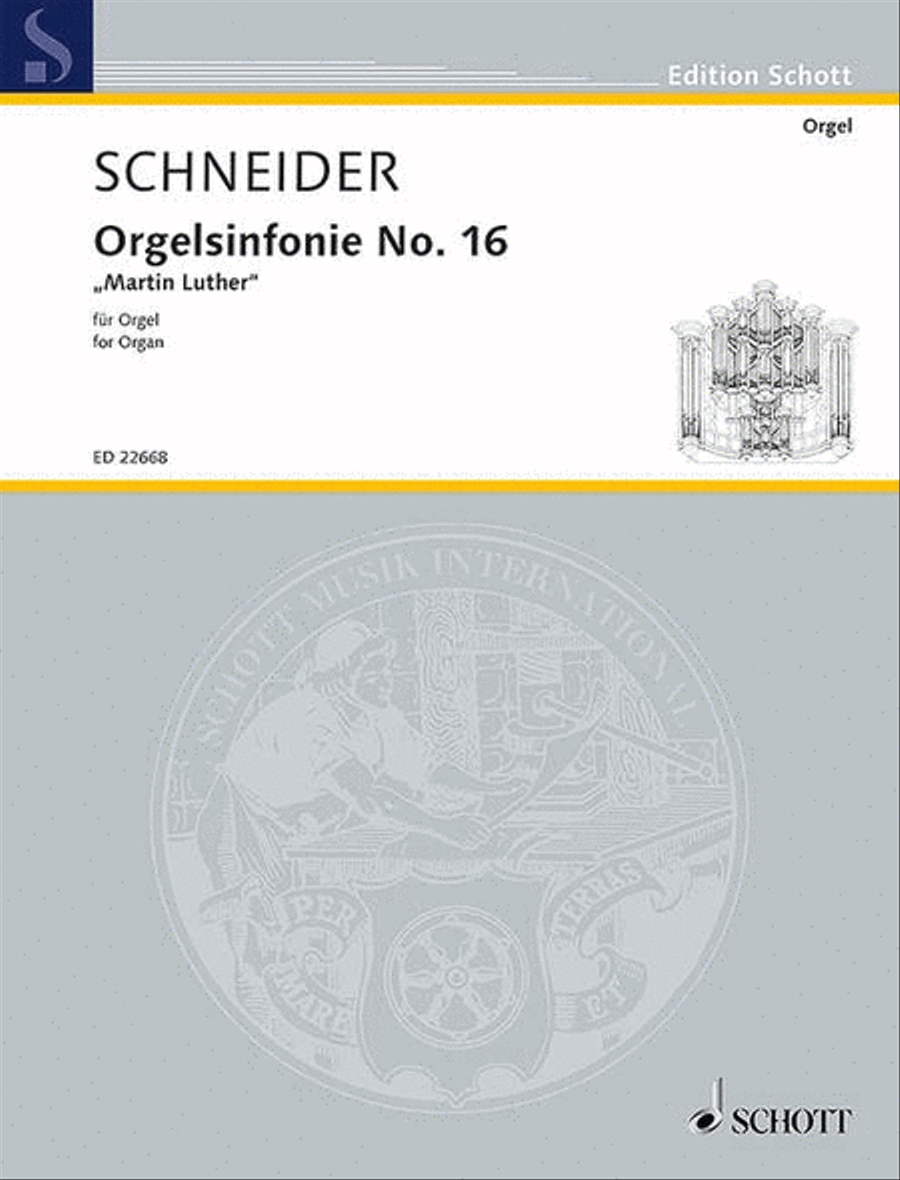
Orgelsinfonie No. 16
Orgue

$21.99 18.89 € Orgue PDF SheetMusicPlus


1 16 31 ....76


Partitions Gratuites
Acheter des Partitions Musicales
Acheter des Partitions Digitales à Imprimer
Acheter des Instruments de Musique

© 2000 - 2026

Accueil - Version intégrale





