EUROPE
971 articles
USA
26 articles
DIGITAL
30 articles (à imprimer)
Partitions Digitales
Partitions à imprimer
30 partitions trouvées


Organ - Level 3 - Digital Download SKU: A0.1487533 By Jacob Hershberger. By Jacob Hershberger. Arranged by Jacob Hershberger. Children,Christian,Easter,Religious,Spiritual. Score. 6 pages. Jasberger Music #1063748. Published by Jasberger Music (A0.1487533). Celebrate Easter with the uplifting and joyous Fanfare on the Hymn Christ the Lord is Risen Today. This organ fanfare is perfect for opening your Easter worship service, whether you're leading a choir or inviting the congregation to sing along.A Joyous Celebration of the Resurrection:The Fanfare on the Hymn Christ the Lord is Risen Today beautifully captures the spirit of Easter, celebrating Jesus Christ's resurrection on the third day after His atoning sacrifice. This piece is designed to elevate your worship experience, helping everyone feel the joy and triumph of Christ's victory over death.Perfect for Worship Services: Ideal Opener: Start your Easter service with this powerful fanfare. Imagine the majestic sounds filling the church as the procession begins or just before the opening prayer, welcoming everyone to celebrate the risen Lord. Versatile and Flexible: This fanfare can be easily adapted to fit your service. Whether performed with a choir or sung by the congregation, the arrangement is flexible, allowing you to extend it based on the number of verses you wish to sing. Easy for Congregations: The melody is simple and accessible, making it easy for everyone to join in and sing along, enhancing the communal worship experience. Why Choose This Fanfare: Rich and Full Harmonies: Experience the depth and beauty of rich harmonies that bring the hymn to life, adding a special resonance to your worship. Emotional and Moving: The stirring melodies and powerful chords evoke a sense of awe and reverence, perfectly capturing the essence of Easter. Bring the joy of Easter to your worship service with the Fanfare on the Hymn Christ the Lord is Risen Today. This organ fanfare is not just a musical masterpiece but a heartfelt expression of faith and celebration. Its flexibility, ease of use, and emotional impact make it a wonderful addition to your Easter service. Order your copy today and let the spirit of Easter fill your church.
Fanfare on the Hymn Christ, the Lord is Risen Today. For Organ, Choir or Congregation
Orgue
Jacob Hershberger
$7.95 6.7 € Orgue PDF SheetMusicPlus

Organ - advanced to difficult - Digital Download SKU: S9.Q6221 D'après The Turn of the Screw d'Henry James. Composed by Jean Guillou. This edition: Sheet music. Downloadable. Op. 28. Duration 16 minutes. Schott Music - Digital #Q6221. Published by Schott Music - Digital (S9.Q6221). Though the work bearing this title is a portrait of childhood, it is a childhood quite different from the purely gameplaying and dreamlike childhood that is customarily represented. The childhood described here is carrying the seed, in all its purity, of all positive and negative qualities to be found the fully-grown men: a childhood both angelic and diabolical, and indeed very close to Henry James' The Turn of the Screw which was the direct inspiration for this monodrama. Its growth follows the innumerable sudden changes, turns and contrasts of the unsophisticated spirit. There is hardly any development at all, as each idea gives birth to the next or rejects the previons one, being object to every impulse, every tempest, every flux, every fear and delight. After a dreamlike introduction, in which two simple melodies stand out, comes a sudden awakening, Allegro, stamped all over with lavish and forever regenerating dynamism. A sudden halt leads a kind of outburst from the most simple folklore is singing, in regular, repeated notes. Again the question mark leads us to another melody, Tranquillo, of a sweet tempo, but brilliantly decorated with counter-point, its cursive traits leading this time to a kind of roguish march (Vigoroso). Yet soon there emerges a melancholic chant, Largo, in the Cromorne's timbre, and then, in the highest register of the Trumpet there reappears like a metamorphosed memory, the theme of the second movement. Passing other episodes, we come to Tempo giusto, insistent and glorious, interrupted by other passionate figures, cut off by unsettling silent moments and taken up again in always accelerating volleys.
Scènes d'Enfant
Orgue

$22.99 19.38 € Orgue PDF SheetMusicPlus

Organ - Level 4 - Digital Download SKU: A0.549915 Composed by James M. Guthrie. Contemporary,Instructional. Score. 3 pages. Jmsgu3 #3911787. Published by jmsgu3 (A0.549915). In Nomine: A prelude to the St Luke Organ Book (by Daniel Pinkham) for one single organ manual. Subtitled The Little Time Machine, the composition features one iteration of the In Nomine cantus firmus. As the piece progresses, the cantus is treated in medieval, Renaissance, Baroque, classical, romantic, and modern styles. I performed this piece just before the world premiere of Daniel Pinkham's St. Luke Organ Book in 2006.The history of In Nomine is rooted in its origin as a type of contrapuntal instrumental composition by 16th-century English composers, usually for a consort of viols, lute, or keyboard, based on a version of a piece of plainchant. The name In Nomine was adopted for this type of piece after the English composer John Taverner composed an instrumental piece based on the plainchant Gloria Tibi Trinitas to which he set the words In nomine Domini in his Gloria Tibi Trinitas six-voice Mass. Over the next 150 years, English composers worked this melody into In Nomine pieces of ever more fantastic stylistic range. This set a fashion, and several 20th-century composers, such as Peter Maxwell Davies and Roger Smalley, have quoted In Nomines in their works. The In Nomine played a significant role in developing English polyphony. It is a title given to many pieces of English polyphonic, predominantly instrumental music, first composed during the 16th century. The In Nomine was the chief means by which the grand tradition of vocal polyphony was brought to bear on the evolution of instrumental music in England. The In Nomine is considered the most conspicuous single form in the early development of English consort music and is significant in the genesis of chamber music in England. It marked the first time a specific instrumental style was formed, and it influenced the development of English polyphony by bringing the tradition of vocal polyphony into the realm of instrumental music.Despite various attempts by scholars to elucidate its almost legendary origin, the mystery of the origin of the In Nomine remains unsolved.
Guthrie: Organ Prelude on In Nomine
Orgue

$34.95 29.46 € Orgue PDF SheetMusicPlus

Organ - intermediate to advanced - Digital Download SKU: S9.Q52078 Complete theoretical and practical method for organ-playing in three parts. This edition: Sheet music. Downloadable. Op. 3. Schott Music - Digital #Q52078. Published by Schott Music - Digital (S9.Q52078). French • English • Dutch • German.Flor Peeters, born in Belgium in 1903, is one of the most important organists and organ composers of the 20th century. After completing his studies at the famous Lemmens Institute in Mechelen, he worked there as a teacher of organ and improvisation before becoming professor at and director of the Royal Flemish Conservatoire of Antwerp. Until his death in 1986, Peeters gave concerts all around the world, held numerous master classes and received several awards and prizes for his achievements as a composer, organist and teacher. In his successful three-volume educational work 'Ars Organi', Peeters combines theoretical knowledge and practical exercises on all aspects of organ playing, starting with basic information on the instrument, manual and pedal exercises and two-part manual and pedal playing. While Vol. 2 contains exercises on three-part playing, Vol. 3 contains exercises on four and five-part playing as well as studies on demanding trio playing. Each learning stage is accompanied by pedal exercises and tips on articulation, touch, interpretation, registration and organ specifications - a valuable compendium for every organist.
Ars Organi
Orgue

$35.99 30.34 € Orgue PDF SheetMusicPlus

Organ - very easy to easy - Digital Download SKU: S9.Q46423 Complete theoretical and practical method for organ-playing in three parts. This edition: Sheet music. Das Standardwerk für den Orgelunterricht – jetzt in der Edition Schott lieferbar. Downloadable. Op. 1. Schott Music - Digital #Q46423. Published by Schott Music - Digital (S9.Q46423). German • English • French • Dutch • Spanish • Portuguese • Italian.Flor Peeters, born in Belgium in 1903, is one of the most important organists and organ composers of the 20th century. After completing his studies at the famous Lemmens Institute in Mechelen, he worked there as a teacher of organ and improvisation before becoming professor at and director of the Royal Flemish Conservatoire of Antwerp. Until his death in 1986, Peeters gave concerts all around the world, held numerous master classes and received several awards and prizes for his achievements as a composer, organist and teacher. In his successful three-volume educational work 'Ars Organi', Peeters combines theoretical knowledge and practical exercises on all aspects of organ playing, starting with basic information on the instrument, manual and pedal exercises, and two-part manual and pedal playing. While Vol. 2 contains exercises on three-part playing, Vol. 3 contains exercises on four and five-part playing as well as studies on demanding trio playing. Each learning stage is accompanied by pedal exercises and tips on articulation, touch, interpretation, registration and organ specifications - a valuable compendium for every organist.
Ars Organi
Orgue

$34.99 29.5 € Orgue PDF SheetMusicPlus

Organ - advanced to difficult - Digital Download SKU: S9.Q6218 Composed by Jean Guillou. This edition: Sheet music. Downloadable. Op. 20. Duration 36 minutes. Schott Music - Digital #Q6218. Published by Schott Music - Digital (S9.Q6218). This is the name given to the ancient tales and legends of Scandinavia, mostly drawn up in Iceland. The term itself is of Germanic origin, form the verb 'sagen' which means to say, to recount. The title also has to do with what is said, what is recounted, in a musical epic of today. Three of these pieces, Sagas 2, 4 and 6, have the particularity of being improvisations. In Saga 1, the instrument seems to awaken out of a dream of which the two opposing elements gradually become ordered. Pedal staccati soon take control and come to predominate as they build up while, in a spirit of contradiction, various solo steps, Cornet, Cromore, unfold their melismas. The dream then reestablishes itself, this time for good. The second Saga is a sombre, frenetic dance based on groups of five semiquaves. It dies away, then, after a long silence, a note emerges, and this lone note, on three different solo stops, beaten, hunted by its two neighbouring notes in increasingly animated accents, anacruses and appoggiaturas, disappears, giving way to the sombre dance which then broadens out. It is interrupted all of a sudden by the irritated, exasperated, fuming tone of that harshness that overdoes itself and vanishes. The sombre dance appears one last time, letting itself go into paroxym. The third Saga unfolds as a very ancient chant, the memory of an Ossianic chant of the earliest times. The fourth Saga develops the lyricism of a tale to be told. But in midway comes a sort of destructive outburst of which the ever tighter links give way for a moment to pure narrativity, which, after a few upsets, ends the piece with the memory of great danger overcome by candour. The fifth Saga is a kind of quiet walk, interspersed with a few controversies, interceptions and demonstrations that are rather more lively. The sixth Saga develops a kind of theme in runs, whose constantly rhythmic rebounding might bring out the idea of apologetic or exalted acclamation.Jean Guillou (*1930) gilt als einer der bedeutenden Organisten und Orgelkomponisten der Gegenwart. Sein kompositorisches Schaffen umfasst über 40 Orgelwerke, außerdem Symphonien, Klavier- und Orgelkonzerte und Kammermusik. Auch bereichert der Dupré-Schüler, der seit 1963 Titularorganist an St. Eustache in Paris ist, das gängige Orgelrepertoire durch eine Reihe außergewöhnlicher Transkriptionen von Orchesterwerken.
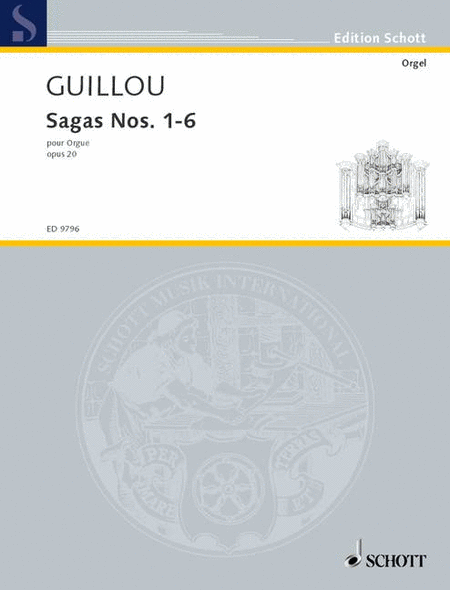
Sagas Nos. 1-6
Orgue

$22.99 19.38 € Orgue PDF SheetMusicPlus

Organ - Level 4 - Digital Download SKU: A0.576012 Composed by David Warin Solomons. Contemporary. Score. 9 pages. David Warin Solomons #46379. Published by David Warin Solomons (A0.576012). This is one of a suite of organ pieces composed by David W Solomons performed by David Carlston Williams Registrations are as suggested by the performer. (the sound sample is from the CD, available from this site)  The suggested order for this suite is: 1. Passacaglia: based on an ostinato passage in 3 time. The idea behind the passacaglia relates to the origin of the word, it is basically a gentle stroll down the street (pasar la calle in Spanish, which was converted into Passacaglia in Italian) 2. Dorina: a descriptive piece in Dorian mode based on a song about a cat, from the aptly named village of Chattevoix, who stalks, but never catches, a little bird.  3. Playtime: also about a cat, the composer's own cat who is playful and rushes around the house but occasionally stopping to pummel the soft furnishings. 4. Early Evening in Camden Town: a more serious and sad piece - in 3-3-2 time. It is an evocation of the poor folk in Camden and their dreams of what could be, if only….. It was originally a song, which the composer wrote when he was living in London, based on a poem by fellow Londoner Sandra Erös The streets are part of a toy town, waiting to be played with…. 5. The Bishop's Dance: a curious and comical piece in 11 time (3, 3, 3, 2). It comes from the legend of Robin Hood, in which Robin meets the bishop of Hereford, who had hoped to get the better of him, but Robin prevails and forces him to dance. The clumsy attempts of the ungainly Bishop to obey Robin's commands cause great merriment among the merry men  To quote our vicar, Rev Barbara, after the recital For me music paints a picture, and, for that, I have got this picture of someone going for a stroll in their village and then they came across a very old cat wandering down the street imaging it could catch birds but never catching them. And then it would lie down for a sleep and dream of the days when it was a kitten.... It was a very reflective programme and turns our mind about What for the Autumn, what do we need to do next.. it really did fit in with the mood of the year, as we turn towards building up the programme for next year... So thank you, it gave us time to reflect in a very beautiful manner.... The rest of the suite is also available on this site: separately (with performances by David Carlston Williams) and as a set Video of Dorina:https://www.youtube.com/watch?v=tunykPeiU4M
Dorina for organ
Orgue

$13.00 10.96 € Orgue PDF SheetMusicPlus

Organ - Level 4 - Digital Download SKU: A0.576014 Composed by David Warin Solomons. Contemporary. Score. 7 pages. David Warin Solomons #44017. Published by David Warin Solomons (A0.576014). This is one of a suite of organ pieces composed by David W Solomons performed by David Carlston Williams for a CD in June 2015 The suggested order for this suite is: 1. Passacaglia: based on an ostinato passage in 3 time. The idea behind the passacaglia relates to the origin of the word, it is basically a gentle stroll down the street (pasar la calle in Spanish, which was converted into Passacaglia in Italian) 2. Dorina: a descriptive piece in Dorian mode based on a song about a cat, from the aptly named village of Chattevoix, who stalks, but never catches, a little bird. 3. Playtime: also about a cat, the composer's own cat who is playful and rushes around the house but occasionally stopping to pummel the soft furnishings. 4. Early Evening in Camden Town: a more serious and sad piece - in 3-3-2 time. It is an evocation of the poor folk in Camden and their dreams of what could be, if only….. It was originally a song, which the composer wrote when he was living in London, based on a poem by fellow Londoner Sandra Erös The streets are part of a toy town, waiting to be played with…. 5. The Bishop's Dance: a curious and comical piece in 11 time (3, 3, 3, 2). It comes from the legend of Robin Hood, in which Robin meets the bishop of Hereford, who had hoped to get the better of him, but Robin prevails and forces him to dance. The clumsy attempts of the ungainly Bishop to obey Robin's commands cause great merriment among the merry men To quote our vicar, Rev Barbara, after the recital For me music paints a picture, and, for that, I have got this picture of someone going for a stroll in their village and then they came across a very old cat wandering down the street imaging it could catch birds but never catching them. And then it would lie down for a sleep and dream of the days when it was a kitten.... It was a very reflective programme and turns our mind about What for the Autumn, what do we need to do next.. it really did fit in with the mood of the year, as we turn towards building up the programme for next year... So thank you, it gave us time to reflect in a very beautiful manner.... The rest of the suite is also available on this site: separately (with performances by David Carlston Williams) and as a set (with David's performance of Passacaglia).
Camden Town for organ solo
Orgue

$13.00 10.96 € Orgue PDF SheetMusicPlus

Organ - Level 4 - Digital Download SKU: A0.576016 Composed by David Warin Solomons. Contemporary. Score. 33 pages. David Warin Solomons #44013. Published by David Warin Solomons (A0.576016). This is a suite of 5 organ pieces composed by David W Solomons originally performed by David Carlston Williams on 17 August 2014 on the organ of St Paul's Springfield Road, Sale (Cheshire, UK) Registrations are as suggested by the performer. (the sound sample is a recording of Passacaglia from the subsequent CD recording performed by David Carlston WIlliams in June 2015) The suggested order for this suite is: 1. Passacaglia: based on an ostinato passage in 3 time. The idea behind the passacaglia relates to the origin of the word, it is basically a gentle stroll down the street (pasar la calle in Spanish, which was converted into Passacaglia in Italian) 2. Dorina: a descriptive piece in Dorian mode based on a song about a cat, from the aptly named village of Chattevoix, who stalks, but never catches, a little bird. 3. Playtime: also about a cat, the composer's own cat who is playful and rushes around the house but occasionally stopping to pummel the soft furnishings. 4. Early Evening in Camden Town: a more serious and sad piece - in 3-3-2 time. It is an evocation of the poor folk in Camden and their dreams of what could be, if only….. It was originally a song, which the composer wrote when he was living in London, based on a poem by fellow Londoner Sandra Erös The streets are part of a toy town, waiting to be played with…. 5. The Bishop's Dance: a curious and comical piece in 11 time (3, 3, 3, 2). It comes from the legend of Robin Hood, in which Robin meets the bishop of Hereford, who had hoped to get the better of him, but Robin prevails and forces him to dance. The clumsy attempts of the ungainly Bishop to obey Robin's commands cause great merriment among the merry men To quote our vicar, Rev Barbara, after the recital For me music paints a picture, and, for that, I have got this picture of someone going for a stroll in their village and then they came across a very old cat wandering down the street imaging it could catch birds but never catching them. And then it would lie down for a sleep and dream of the days when it was a kitten.... It was a very reflective programme and turns our mind about What for the Autumn, what do we need to do next.. it really did fit in with the mood of the year, as we turn towards building up the programme for next year... So thank you, it gave us time to reflect in a very beautiful manner.... The suite is also available as separate pieces (with performances by David Carlston Williams).
5 pieces for organ
Orgue

$31.00 26.13 € Orgue PDF SheetMusicPlus

Organ - Level 4 - Digital Download SKU: A0.575684 Composed by David Warin Solomons. Contemporary. Score. 4 pages. David Warin Solomons #44021. Published by David Warin Solomons (A0.575684). This is one of a suite of organ pieces composed by David W Solomons performed by David Carlston Williams for a CD in June 2015 The suggested order for this suite is: 1. Passacaglia: based on an ostinato passage in 3 time. The idea behind the passacaglia relates to the origin of the word, it is basically a gentle stroll down the street (pasar la calle in Spanish, which was converted into Passacaglia in Italian) 2. Dorina: a descriptive piece in Dorian mode based on a song about a cat, from the aptly named village of Chattevoix, who stalks, but never catches, a little bird. 3. Playtime: also about a cat, the composer's own cat who is playful and rushes around the house but occasionally stopping to pummel the soft furnishings. 4. Early Evening in Camden Town: a more serious and sad piece - in 3-3-2 time. It is an evocation of the poor folk in Camden and their dreams of what could be, if only….. It was originally a song, which the composer wrote when he was living in London, based on a poem by fellow Londoner Sandra Erös The streets are part of a toy town, waiting to be played with…. 5. The Bishop's Dance: a curious and comical piece in 11 time (3, 3, 3, 2). It comes from the legend of Robin Hood, in which Robin meets the bishop of Hereford, who had hoped to get the better of him, but Robin prevails and forces him to dance. The clumsy attempts of the ungainly Bishop to obey Robin's commands cause great merriment among the merry men To quote our vicar, Rev Barbara, after the recital For me music paints a picture, and, for that, I have got this picture of someone going for a stroll in their village and then they came across a very old cat wandering down the street imaging it could catch birds but never catching them. And then it would lie down for a sleep and dream of the days when it was a kitten.... It was a very reflective programme and turns our mind about What for the Autumn, what do we need to do next.. it really did fit in with the mood of the year, as we turn towards building up the programme for next year... So thank you, it gave us time to reflect in a very beautiful manner.... The rest of the suite is also available on this site: separately (with performances by David Carlston Williams) and as a set (with David's performance of Passacaglia).
Passacaglia for organ solo
Orgue

$13.00 10.96 € Orgue PDF SheetMusicPlus

Organ - Level 4 - Digital Download SKU: A0.576013 Composed by David Warin Solomons. Contemporary. Score. 7 pages. David Warin Solomons #44019. Published by David Warin Solomons (A0.576013). This is one of a suite of organ pieces composed by David W Solomons performed by David Carlston Williams for a CD in June 2015 The suggested order for this suite is: 1. Passacaglia: based on an ostinato passage in 3 time. The idea behind the passacaglia relates to the origin of the word, it is basically a gentle stroll down the street (pasar la calle in Spanish, which was converted into Passacaglia in Italian) 2. Dorina: a descriptive piece in Dorian mode based on a song about a cat, from the aptly named village of Chattevoix, who stalks, but never catches, a little bird. 3. Playtime: also about a cat, the composer's own cat who is playful and rushes around the house but occasionally stopping to pummel the soft furnishings. 4. Early Evening in Camden Town: a more serious and sad piece - in 3-3-2 time. It is an evocation of the poor folk in Camden and their dreams of what could be, if only….. It was originally a song, which the composer wrote when he was living in London, based on a poem by fellow Londoner Sandra Erös The streets are part of a toy town, waiting to be played with…. 5. The Bishop's Dance: a curious and comical piece in 11 time (3, 3, 3, 2). It comes from the legend of Robin Hood, in which Robin meets the bishop of Hereford, who had hoped to get the better of him, but Robin prevails and forces him to dance. The clumsy attempts of the ungainly Bishop to obey Robin's commands cause great merriment among the merry men To quote our vicar, Rev Barbara, after the recital For me music paints a picture, and, for that, I have got this picture of someone going for a stroll in their village and then they came across a very old cat wandering down the street imaging it could catch birds but never catching them. And then it would lie down for a sleep and dream of the days when it was a kitten.... It was a very reflective programme and turns our mind about What for the Autumn, what do we need to do next.. it really did fit in with the mood of the year, as we turn towards building up the programme for next year... So thank you, it gave us time to reflect in a very beautiful manner.... The rest of the suite is also available on this site: separately (with performances by David Carlston Williams) and as a set (with David's performance of Passacaglia).
Playtime for organ
Orgue

$13.00 10.96 € Orgue PDF SheetMusicPlus


Partitions Gratuites
Acheter des Partitions Musicales
Acheter des Partitions Digitales à Imprimer
Acheter des Instruments de Musique

© 2000 - 2026

Accueil - Version intégrale





