EUROPE
4227 articles
USA
18 articles
DIGITAL
18 articles (à imprimer)
Partitions Digitales
Partitions à imprimer
18 partitions trouvées


Elgar : Variations Enigma, Op. 36 - IX. Adagio 'Nimrod' (niveau intermédiaire)
Cor
Téléchargez la partition Cor Variations Enigma, Op. 36 - IX. Adagio 'Nimrod' (niveau inter…
5.99 € Cor PDF Tomplay

Elgar : Variations Enigma, Op. 36 - IX. Adagio 'Nimrod' (niveau facile/intermédiaire)
Cor
Téléchargez la partition Cor Variations Enigma, Op. 36 - IX. Adagio 'Nimrod' (niveau facil…
5.99 € Cor PDF Tomplay

French Horn Solo - Level 4 - Digital Download SKU: A0.1021225 Composed by Pavel Trojan. 20th Century,Contemporary,Standards. Individual part. 31 pages. Pavel Trojan #5821007. Published by Pavel Trojan (A0.1021225). Jingles and Fanfare (2020) is a set of four movements (album) for four french horns, appropriate both for music school students and professional concert artists.PAVEL TROJAN was born on 14th August 1956 in Domažlice. Between 1977 and 1982, he studied composition with Ilja Hurník at the Prague Conservatory; after that, from 1982 until 1989, he went to attend the Music and Dance Faculty of the Academy of Performing Arts in Prague, where he studied in the class of Jiří Pauer.The composer has extensive chamber, orchestral and musical dramatic work, which includes both opera and musical. In his work he puts emphasis on melody, brevity and clarity.He has been working at the Prague Conservatory since 1986, at first as a music theory tutor, and from 1991 as a music composition teacher. From 1992 until 2004, he was the vice director of the conservatory until being appointed the director in December 2004 (until July 2018). He is currently teaching a composition. Main works:Piano Concerto (1989), Missa solemnis (1998), Variations on a Theme by and Written in Honor of Václav Trojan (2006), Sinfonia giocosa (2008), Piano Trio No. 2 (2009), Pastoral Fairytale (Opera, 2012), Concerto for Violin and Orchestra N. 2 (2015), The Cross of Zavis (Musical, 2016).
Pavel Trojan - Jingles and Fanfare for Four French Horns
Cor

$7.99 6.7 € Cor PDF SheetMusicPlus

French Horn Solo - Level 5 - Digital Download SKU: A0.767350 Composed by Mike Lyons. Concert,Contemporary. Individual part. 7 pages. Lyons Music Services #3520235. Published by Lyons Music Services (A0.767350). This is my third new sonata for unaccompanied French horn. it has three movements as follows:   Movement 1: Dance It begins with a crotchet theme which forms the basis of the rest of the movement. The opening should be stately and measured, but not slow. The echoes should be as quiet as possible for each statement of the opening motif. I have made a lot of use of rhythmic features in this movement. After the Maestoso, the 12/8 section is in the nature of a jig, with lots of repeated pitches and very rhythmical There's much use of syncopation. After I have played around with these ideas (intervals based on the opening) there is a more legato tune, also based on the opening music, but in a grander style and marked nobilmente. This is almost a processional, and leads to a reprise of the jig motifs in a new mode and with modifications to the rhythm. The second movement of this sonata is a set of 3 variations on an original tune. The melody is quite hymn-like and needs to be played as such. Very legato, with very slight tongue. Variation 1 is an 8th note variation, with a slight increase in tempo to help it to flow. The player will need to pay close attention to the written phrasing so as not to lose the theme. This variation is p throughout. Variation 2 is a triplet/sextuplet variation, again with a slight increase in tempo. This variation has turns, which I have written out in ossias above to be clear how I would like it to be played. Variation 3 is a semiquaver and glissando variation, requiring good tongue technique and clear phrasing. Breathing should be easy as I have made provision for breaths to mark the ends of phrases. Please don't change these! Finally, there is a restatement of the original theme with slight adaptations to bring the movement to a quiet finish. The third and final movement of the sonata is a rondo. The opening music keeps returning throughout the length of the movement. It comprises a stuttering rhythmic phrase with alternating upwards and downwards scales which gradually build up throughout the opening of the movement. Each time the ritornello idea returns it has been altered in some way. Between the ritornelli are slightly less frenetic sections of cantabile melodic ideas which hark back to both the first and second movements as well as referencing the scalic ideas from the third movement. Although the music is fast, it should be playable without resorting to triple tonguing.
Horn Sonata No. 3 (Complete)
Cor

$18.00 15.1 € Cor PDF SheetMusicPlus

French Horn Solo - Level 3 - Digital Download SKU: A0.784335 Composed by Joshua Hauser. Instructional. Individual part. 38 pages. Slide Ride #5288663. Published by Slide Ride (A0.784335). 1 Octave Scale Studies in 15+ keys for 4-part ensembles of like or mixed instruments If this is your first exposure to these scale studies, you are in for a treat! Donuts, if you make a mistake!The initial incarnation of these studies were written for trombone quartet and we would play them in the Tennessee Tech Trombone Choir with the challenge that whomever made the first mistake had to buy donuts for the rest of the ensemble. Since then I have brought that version to several clinics and warm up sessions. One time before I got to explain the title, a fellow trombone professor said, Oh, I get it! Don’t step in the holes!I only wish I had thought of that myself... Since we have one of the best donut shops in TN here in Cookeville, treating the studio to sugar coated goodies was always my intent.As with those initial exercises, you can vary these as much as you’d like.·     Choose a tempo.·     Choose a dynamic.·     Choose an articulation/style.One way I like to play these is to have one person be the model, playing the entire scale over and over while everyone else plays the fragmented versions. That helps everyone to keep on track and stay in time. Double or triple up the parts for ensemble cohesion with a larger group.Practice one key, gradually speeding it up to improve fluidity, or choose a variation and take it through all keys, playing version A, B, C, or D then skipping to play the same set in a new key.If you want an additional challenge, play them in different octaves or change the key. Play the F Major set in f minor (all forms), different modes, etc. Players really have to be on their toes to remember if they are playing melodic minor in the ascending or descending form! For jazz players, try swinging them in dorian or mixolydian modes.The variations are endless!If you are using these with transposing instruments, 1) is F Major in Concert Pitch, 2) is Bb Major in Concert pitch, and so on. When you reach a scale that is enharmonic for another key (Db/C#, Gb/F#, or Cb/B), they are presented in both keys for each instrument so Trumpets can play in Eb while the Flutes are playing in C# with similar examples for all keys.All Donut Etudes with the same volume number are compatible so you can play them in mixed quartets or large ensembles with one or more instruments/people on part 1 and a different instrument on part 2, etc. Since the quartets are all identical, conductors/coaches can use any of the scores to tell which part should be playing at what time. Once you have played a scale with one set of parts, everyone can rotate to a different part and play the same scales again!Enjoy!
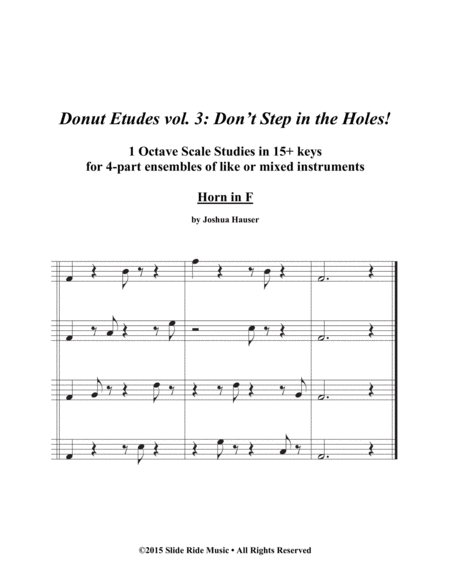
Donut Etudes vol. 3: Don’t Step in the Holes! – Horn Quartet
Cor

$5.00 4.19 € Cor PDF SheetMusicPlus


Partitions Gratuites
Acheter des Partitions Musicales
Acheter des Partitions Digitales à Imprimer
Acheter des Instruments de Musique

© 2000 - 2026

Accueil - Version intégrale





